


TL;DR:
- Rare coffee regions are isolated areas with unique genetic traits and unmatched flavor profiles. The best examples include Sarawak’s Libex, Panama’s Gesha, and Gran Canaria’s Agaete, each offering distinctive, high-quality coffee. Transparency in sourcing and careful brewing enhance the experience of these rare, terroir-driven coffees.
Rare coffee growing regions are specific, often remote locations that produce coffees with unique genetic varieties, exceptional terroir, and flavor profiles absent from mainstream coffee markets. The specialty coffee industry recognizes these origins not just by geography but by the convergence of altitude, soil chemistry, indigenous cultivation traditions, and genetic rarity. Regions like Sarawak in Malaysian Borneo, Panama’s Boquete highlands, and Gran Canaria’s Agaete Valley each represent a distinct category of coffee terroir that produces cups no commodity farm can replicate. For adventurous coffee enthusiasts, these origins are the frontier.
1. What makes rare coffee growing regions worth seeking out?
The defining trait of a rare coffee origin is not just low production volume. True rarity comes from the intersection of genetic uniqueness, geographic isolation, and flavor complexity that cannot be reproduced elsewhere. A coffee grown on volcanic terraces at 1,800 meters with a specific microclimate will taste fundamentally different from one grown at sea level on flat farmland.
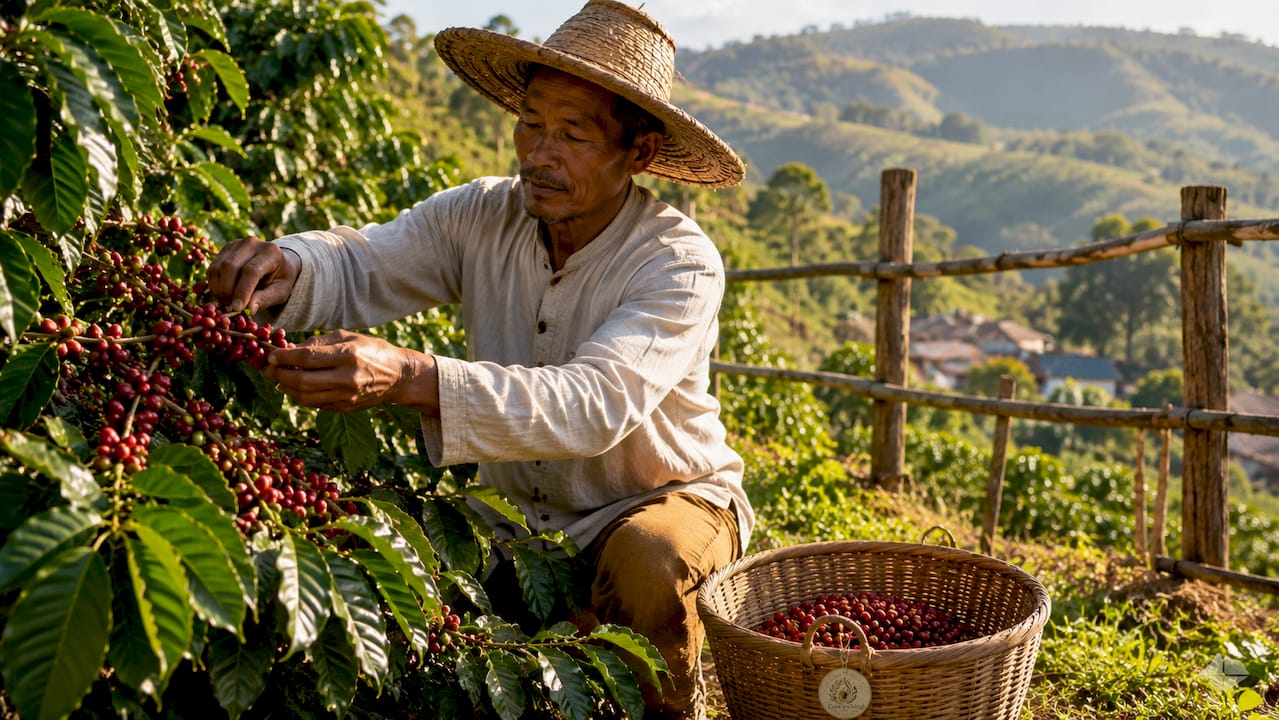
Terroir, the French wine term now standard in specialty coffee, describes how soil minerals, rainfall patterns, altitude, and shade trees collectively shape a bean’s chemistry. Altitude’s effect on flavor is especially pronounced in rare regions. Higher elevations slow cherry maturation, concentrating sugars and acids into a denser, more complex cup.
Cultural traditions add another layer. Indigenous and smallholder farmers in rare regions often use processing methods passed down across generations. Those methods are inseparable from the flavor. Losing the farmer means losing the coffee.
2. Sarawak, Malaysia: the global home of Libex coffee
Sarawak is the world’s only significant source of Libex coffee, a natural hybrid of Liberica and Excelsa species found nowhere else at commercial scale. A DNA study of 113 accessions using 7,000 genetic markers confirmed that 40 of 45 Sarawak samples carry significant Excelsa genetics. That finding places Sarawak in a category of its own within global coffee genetics.
Libex thrives in Sarawak’s lowland tropical climate, where Arabica cannot survive. Its climate resilience makes it a serious candidate for expanding specialty coffee production as temperatures rise globally. The flavor profile is bold and woody with fruity undertones, quite different from the bright acidity of Ethiopian Arabica.
Indigenous communities including the Bidayuh and Iban peoples have cultivated Libex for generations, supported now by government research programs. Their land stewardship is the reason this genetic treasure still exists.
- Libex is a Liberica-Excelsa hybrid unique to Sarawak’s lowland forests
- DNA verification confirms genetic distinction from standard Liberica
- Climate resilience makes Libex viable where Arabica fails
- Bidayuh and Iban communities are the primary cultivators
- Specialty roasters in Asia, Europe, and North America are beginning to stock Libex lots
Pro Tip: Brew Libex as a pour-over at a slightly lower temperature, around 90°C, to pull out its fruity notes without amplifying the woody bitterness that can emerge at full boil.
3. Panama’s Boquete region: the benchmark for Gesha coffee
Panama’s Boquete highlands produce Gesha coffee, the variety that reset the global specialty market’s price ceiling. Luxury lots from farms like Hacienda La Esmeralda have exceeded $13,000 per pound at auction. That price is not marketing. It reflects a flavor profile so distinct that experienced tasters describe it as closer to jasmine tea than coffee.
Boquete sits above 1,500 meters on the slopes of Volcán Barú. The combination of volcanic soil, consistent cloud cover, and cool nights slows cherry development to an extreme degree. That slow maturation concentrates aromatic compounds responsible for Gesha’s signature jasmine, bergamot, and stone fruit notes.
Gesha originated in Ethiopia’s Gori Gesha forest, but Panama’s specific terroir transformed it into something the origin country itself cannot replicate. Other regions now grow Gesha, including Colombia and Ethiopia, but Boquete remains the reference point for the variety’s highest expression.
- Altitude above 1,500m is non-negotiable for authentic Boquete Gesha
- Volcanic soil provides mineral complexity absent in lowland farms
- Flavor notes: jasmine, bergamot, peach, and delicate tea-like acidity
- Auction prices reflect genuine scarcity, not just branding
- Slow cherry maturation is the key mechanism behind flavor density
Pro Tip: Brew Boquete Gesha with filtered water at 93°C using a Chemex or Kalita Wave. Hard water kills the delicate floral acidity. Keep your grind medium-fine and your ratio at 1:15.
4. Gran Canaria’s Agaete Valley: Europe’s rarest coffee crop
The Agaete Valley in Gran Canaria holds a distinction no other European location can claim: it is one of the only places on the continent producing coffee commercially. Agaete’s Typica-derived plants grow on preserved volcanic terraces using farming techniques that date to the 19th century. The Azores islands host experimental plantations, but Agaete is the established commercial producer.
The valley’s microclimate is the reason coffee grows this far north. Warm Atlantic air, volcanic soil, and a frost-free environment create conditions that mimic tropical highlands. Production volumes are tiny. Most Agaete coffee never leaves the island, which makes it genuinely difficult to source outside of Gran Canaria.
The flavor profile is mild and sweet, with low bitterness and a clean finish. Typica, the variety grown here, is one of the oldest cultivated coffee species. Its Ethiopian genetic roots give Agaete coffee a historical depth that matches its geographic rarity.
- Agaete is one of only two European locations with active coffee cultivation
- Typica variety traces its lineage to Ethiopian wild coffee ancestors
- 19th-century terrace farming methods are still in use today
- Volcanic soil and Atlantic microclimate replace tropical altitude
- Most production is consumed locally, making export lots extremely limited
5. Bolivia’s Yungas Valley: extreme altitude, extreme flavor
Bolivia’s Yungas Valley produces some of the most complex specialty coffee in the world, and almost no one outside the specialty trade knows it exists. The Caranavi and Coroico zones sit between 1,400 and 2,300 meters, making them among the highest commercial coffee growing areas on earth. That altitude forces cherries to mature slowly, building sugar and acid density that translates directly into cup complexity.
The challenge is getting the coffee out. Transport costs in Yungas can consume half of total production costs. Steep mountain roads, limited infrastructure, and small farm sizes make consistent quality difficult without cooperative support. The coffees that do reach specialty roasters are exceptional, but supply is unpredictable.
Flavor profiles from Yungas lean toward dark chocolate, dried fruit, and a heavy body with bright acidity. The combination is unusual. Most high-body coffees lack brightness, but Yungas altitude produces both simultaneously.
- Caranavi and Coroico are the primary production zones within Yungas
- Altitude range of 1,400–2,300m produces extreme flavor density
- Transport costs make up a significant share of total production expenses
- Smallholder farms dominate, with cooperative support critical to quality
- Flavor profile: dark chocolate, dried fruit, heavy body, and bright acidity
6. Other uncommon coffee regions worth your attention
Several other exotic coffee origins deserve a place on any serious enthusiast’s radar. Each offers a distinct terroir story and a flavor profile that mainstream origins cannot match.
Hawaii’s Ka’u region sits on the southern slope of Mauna Loa and produces coffee with a flavor profile that reflects volcanic soil and consistent Pacific trade winds. Ka’u is often overshadowed by Kona, but specialty buyers consistently rank its lots among Hawaii’s finest. The rebirth of Ka’u’s coffee industry is tied directly to smallholder farmers reclaiming land, adding a cultural narrative to every bag.
The Azores Islands in Portugal host experimental coffee plantations on Faial and São Miguel. Production is minimal and largely consumed locally, but the volcanic terroir and Atlantic climate produce a coffee with unusual mineral clarity. These lots rarely reach international markets, which makes them a genuine collector’s find.
Inca Gesha from Peru carries a name that suggests a connection to Panama’s famous variety, but genetic research shows it is a distinct variety. Relying on varietal names alone misleads buyers. DNA-verified sourcing from transparent roasters is the only reliable way to know what you are actually purchasing.
- Hawaii Ka’u: volcanic terroir, cultural revival, and underrated specialty lots
- Azores Islands: experimental Atlantic coffee with mineral clarity
- Inca Gesha (Peru): genetically distinct from Panama Gesha despite the name
- Chachapoyas, Peru: cloud forest altitude and indigenous cultivation traditions
- Harrar, Ethiopia: dry-processed wild coffee with blueberry and wine notes
Pro Tip: When sourcing from rare or uncommon regions, ask your roaster for the farm name, processing method, and harvest date. Roasters who cannot answer those questions are likely selling blended or mislabeled lots.
Key takeaways
The most exceptional cups in specialty coffee come from rare growing regions where altitude, volcanic soil, genetic uniqueness, and smallholder traditions converge in ways no commodity farm can replicate.
| Point | Details |
|---|---|
| Genetic rarity defines true origin value | Libex and Gesha coffees carry DNA profiles that no other region can reproduce at scale. |
| Altitude drives flavor density | Regions above 1,400m produce slower cherry maturation, concentrating sugars and acids into complex cups. |
| Transport costs limit rare coffee supply | In Bolivia’s Yungas, infrastructure challenges make consistent quality dependent on cooperative support. |
| DNA verification protects buyers | Varieties like Inca Gesha are genetically distinct from their namesakes, requiring transparent sourcing. |
| Cultural stewardship preserves rare origins | Indigenous farmers in Sarawak and Ka’u are the reason these genetic varieties still exist commercially. |
Why rare origins changed how I think about coffee
The first time I tasted a Boquete Gesha, I genuinely thought the barista had added something to the cup. That jasmine and bergamot intensity does not read as coffee to a palate trained on commodity blends. It reads as something else entirely, something that makes you question what coffee actually is.
What I have learned from years of tasting rare origins is that flavor complexity is almost always a function of stress. The Yungas farmer dealing with impossible roads, the Agaete grower working 19th-century terraces, the Bidayuh community maintaining Libex trees in Borneo’s lowlands. Difficulty in production translates directly into density in the cup. That is not romantic storytelling. It is chemistry.
The part that concerns me most is the genetic ambiguity problem. Too many roasters sell “Gesha” or “Liberica” without any verification. Buyers pay rare-coffee prices for mislabeled lots. The solution is simple: demand transparency. Ask for the farm, the variety verification, and the processing method before you pay a premium.
Supporting ethical sourcing practices in rare regions is not just a values statement. It is the only way these origins survive long enough for the next generation of enthusiasts to taste them. Climate change is already shrinking viable growing zones. The regions that will persist are the ones with strong community structures and documented genetic resources.
My honest recommendation: buy one truly rare lot per month. Brew it carefully. Read about where it came from. That practice builds a tasting vocabulary that no course or book can replicate.
— Anthony-Yasin
Qahwatalard’s collection of rare single-origin coffees
Qahwatalard sources premium single-origin coffees with full traceability, connecting you directly to the farms and regions covered in this guide. Every lot is selected for origin integrity, flavor complexity, and sustainable sourcing practices that support the smallholder communities behind these rare cups.
The Qahwatalard catalog includes specialty lots that reflect the terroir-driven flavor profiles described here, from bold and fruity African origins to delicate floral varieties. The brand’s commitment to transparency means you know exactly where your coffee was grown, who grew it, and how it was processed. For enthusiasts ready to move beyond mainstream origins, Qahwatalard’s African Espresso offers a direct entry point into high-complexity, origin-specific flavor.
FAQ
What are rare coffee growing regions?
Rare coffee growing regions are geographically isolated or genetically unique areas that produce coffees with flavor profiles and variety characteristics not found in mainstream coffee markets. They are defined by exceptional terroir, low production volume, and often indigenous cultivation traditions.
Where is Libex coffee grown?
Libex coffee grows almost exclusively in Sarawak, Malaysia, where a DNA study of 113 accessions confirmed that 40 of 45 Sarawak samples carry significant Excelsa genetics. No other region produces Libex at commercial scale.
Why is Panama Gesha so expensive?
Panama Gesha from Boquete commands prices exceeding $13,000 per pound at auction because its combination of altitude above 1,500 meters, volcanic soil, and slow cherry maturation produces a flavor profile, jasmine, bergamot, and stone fruit, that no other origin replicates.
How do I find authentic rare coffee varieties?
Ask your roaster for the farm name, harvest date, and variety verification before purchasing. Genetic ambiguity in varieties like Inca Gesha means varietal names alone are unreliable. Transparent roasters with DNA-verified sourcing are the only trustworthy option.
What brewing method works best for rare coffees?
Pour-over methods like Chemex or Kalita Wave work best for rare coffees because they preserve delicate acidity and floral aromatics. Industry experts recommend filtered water, precise grind calibration, and water temperature around 90–93°C to avoid over-extraction and bitterness.


