


TL;DR:
- Coffee bloom is the pre-infusion stage where hot water releases trapped carbon dioxide from fresh coffee grounds. Proper blooming ensures even water contact, resulting in a cleaner, more balanced flavor in the final cup. The duration and method of bloom depend on bean freshness and roast age for optimal extraction.
Coffee bloom is defined as the pre-infusion stage of brewing where a small amount of hot water saturates freshly ground coffee, triggering a rapid release of trapped carbon dioxide gas. This degassing phase, known formally as the bloom or pre-infusion, lasts 30–45 seconds using a standard 2:1 water-to-coffee ratio. Skipping it means CO2 stays in the grounds during your main pour, repelling water and producing an uneven, often sour cup. For home brewers working with fresh beans, the coffee blooming process is the single most controllable variable between a flat brew and a genuinely expressive one.

What is coffee bloom and why does it happen?
Coffee bloom happens because roasting traps CO2 inside the bean’s cellular structure. When heat breaks down the bean’s organic compounds during roasting, carbon dioxide forms and gets locked into the porous matrix of the roasted cell walls. Grinding the bean cracks open that structure and exposes the trapped gas to air, which is why freshly ground coffee releases CO2 faster than pre-ground coffee sitting in a bag.
When hot water first hits the grounds, that CO2 escapes rapidly. The visible result is a dome-shaped foam rising from the bed of grounds. That foam is not flavor. It is not crema. The foam is hydrophobic CO2 escaping the grounds, and it actively pushes water away from the coffee particles until it dissipates.
Here is what the coffee blooming process looks like in practice:
- Vigorous bubbling appears within the first 5–10 seconds of water contact.
- A dome or crust forms above the coffee bed as CO2 lifts the grounds.
- The dome deflates as gas escapes, signaling the bloom is nearly complete.
- Minimal or no rise in older coffee indicates most CO2 has already off-gassed during storage.
The roast date directly affects how vigorous the bloom appears. Beans roasted within the past two weeks produce the most dramatic bloom. Beans roasted more than a month ago bloom weakly or not at all.
How does coffee bloom affect flavor extraction?
CO2 is hydrophobic, meaning it repels water at the molecular level. When CO2 remains in the grounds during your main brew, water cannot make consistent contact with the coffee particles. The result is uneven extraction and sour tastes in the final cup, because under-extracted sections of the bed produce acidic, hollow notes while over-extracted sections turn bitter.
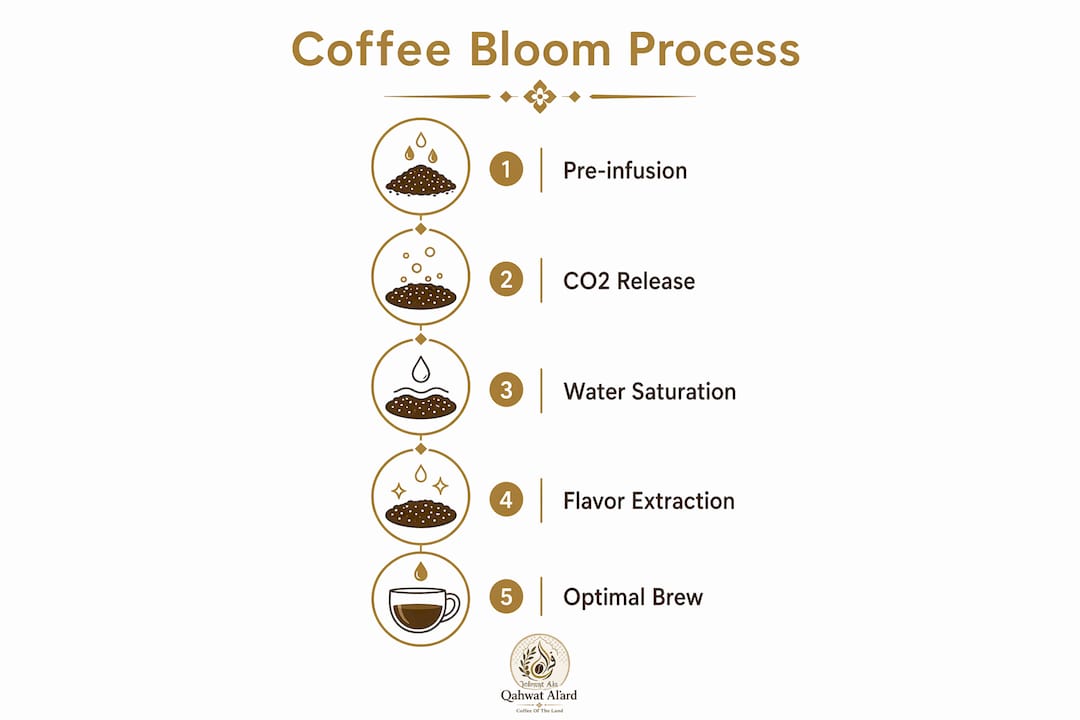
Blooming removes that barrier before the main water volume hits the grounds. Once CO2 escapes, water saturates the bed evenly. Even saturation means every particle contributes to extraction at roughly the same rate. The outcome is a cleaner, more balanced cup with better flavor clarity, richer body, and a rounder finish.
The significance of coffee bloom shows up most clearly when you compare bloomed versus non-bloomed brews side by side using the same beans. Non-bloomed coffee often tastes thin or sharp. Bloomed coffee from the same batch tastes fuller and more coherent. The difference is not subtle with fresh beans.
Pro Tip: If your pour-over tastes sour despite good beans and correct water temperature, skip the bloom on your next brew and compare. The contrast will show you exactly how much CO2 interference was costing you.
The impact of coffee bloom also extends to understanding extraction more broadly. Bloom is the foundation of extraction control. Get it right, and every other brewing variable becomes easier to dial in.
Common myths about coffee bloom
Several persistent misconceptions cause home brewers to misread what the bloom is actually doing.
-
A bigger bloom means better coffee. A large, vigorous bloom signals freshness, not quality. Bloom size mainly indicates how much CO2 remains in the bean, which reflects roast recency. A bean with a dramatic bloom could still taste mediocre if it was poorly grown or processed. Freshness is necessary but not sufficient for a great cup.
-
The foam contains flavor compounds. The foam you see during bloom is pure CO2 gas lifting the grounds. It carries no soluble flavor. Protecting the foam or trying to preserve it adds nothing to the cup. The goal is to let it dissipate fully so water can do its job.
-
Bloom is only for pour-over brewing. The coffee bloom explanation applies to any brew method using whole or ground beans, including French press, AeroPress, and Chemex. Even drip machines with a pre-infusion setting replicate the bloom stage automatically.
-
More agitation during bloom always helps. Swirling or stirring aids even wetting of the grounds, but opinions among baristas vary on how much is appropriate. Over-agitation during bloom can cause fines migration, where the smallest coffee particles move to the bottom of the bed and clog the filter, creating channeling in the main brew.
-
Bloom duration does not matter. Duration matters significantly. Too short a bloom leaves CO2 in the grounds. Too long a bloom with older beans wastes time without benefit. Bloom duration is a real variable, not a formality.
How to achieve coffee bloom: best practices
The standard bloom technique uses a 2:1 to 4:1 water-to-coffee ratio and a 30–45 second wait before the main pour. For a 20-gram dose, that means 40–80 grams of water for the bloom phase. Use water at your normal brew temperature, typically 195–205°F.
Adjusting bloom time by freshness
Fresh beans benefit from a longer bloom to release CO2 fully before the main pour. Beans roasted within the past week may need a full 45 seconds or slightly more. Beans roasted three to four weeks ago can bloom for 30 seconds. Beans older than six weeks may need only 20 seconds, since most CO2 has already escaped. Adjusting bloom duration based on roast age is one of the most practical coffee brewing tips you can apply immediately.
Agitation: swirl, stir, or leave it alone
| Technique | Effect on wetting | Risk |
|---|---|---|
| No agitation | Grounds wet unevenly | Dry pockets in the bed |
| Gentle swirl | Even saturation of the bed | Minimal if done once |
| Light stir with a spoon | Thorough wetting, especially for large doses | Fines migration if overdone |
| Vigorous stirring | Maximum wetting speed | Bed clogging, channeling |
A single gentle swirl immediately after adding bloom water is the most reliable approach for most home setups. It wets the grounds evenly without disturbing the bed structure. Excessive agitation risks fines migration and bed clogging, which undermines extraction despite the initial benefit of faster wetting.
Pro Tip: Use a gooseneck kettle for bloom water. The controlled pour lets you saturate all the grounds evenly from the start, reducing the need for agitation entirely.
Bloom across different brew methods
Pour-over methods like the V60 and Chemex show the bloom most visibly and benefit most from manual control. AeroPress brewers can bloom by adding water, capping the device, and waiting before pressing. French press brewers can add bloom water, wait, then add the remaining water before the full steep. Grind size also affects how quickly CO2 escapes during bloom. Finer grinds release CO2 faster. Coarser grinds may need a slightly longer bloom to fully degas.
Key takeaways
Coffee bloom is the most direct way to control extraction quality at home: release the CO2 first, and every subsequent variable becomes easier to manage.
| Point | Details |
|---|---|
| Bloom definition | Pre-infusion stage releasing CO2 before the main brew to enable even extraction. |
| Standard ratio and timing | Use a 2:1 to 4:1 water-to-coffee ratio and bloom for 30–45 seconds. |
| Bloom size signals freshness | A vigorous bloom means fresh beans, not better flavor; quality depends on origin and process. |
| Adjust duration by roast age | Fresh beans need longer bloom; older beans need less time since CO2 has already escaped. |
| Agitation has limits | One gentle swirl aids wetting; over-agitation causes fines migration and channeling. |
Why bloom taught me to stop rushing my morning cup
I spent years treating bloom as a formality. I would pour a splash of water, count to fifteen, and move on. The cups were fine. They were not great. The shift came when I started using single-origin beans with a clear roast date and actually waited the full 45 seconds. The difference in the cup was immediate and repeatable.
What I have learned is that bloom is not really about the foam or the ritual. It is about giving the coffee time to prepare for extraction. Rushing it is like preheating an oven halfway and then wondering why the bake is uneven. The physics do not care about your schedule.
The part most articles skip is how much bloom behavior varies by bean origin and density. High-altitude beans tend to be denser and hold more CO2, producing a more dramatic bloom that genuinely needs the full 45 seconds. Lower-density beans from certain processing methods bloom more quietly and forgive a shorter wait. Treating every bean identically is the most common bloom mistake I see from experienced home brewers.
My honest recommendation: treat bloom duration as a variable you adjust per bag, not a fixed rule. Start at 30 seconds, taste the cup, extend to 45 seconds on your next brew, and taste again. The feedback loop is fast and the cost is zero. That kind of experimentation, grounded in understanding what the bloom actually does, is how you build real brewing intuition.
— Anthony-Yasin
Fresh beans make the bloom worth doing
The bloom technique only delivers its full benefit when the beans are genuinely fresh. Qahwatalard sources and roasts single-origin coffees from renowned growing regions worldwide, giving home brewers the CO2-rich, freshly roasted beans that make every bloom count.

Each bag carries traceability back to its origin, so you know exactly what you are working with before your first pour. Whether you brew pour-over, AeroPress, or French press, starting with beans that still have something to release is the foundation of a great cup. Qahwatalard’s African Espresso and single-origin selections are roasted to preserve the freshness that makes the bloom stage genuinely expressive. Explore the full range and give your next brew the start it deserves.
FAQ
What is coffee bloom in simple terms?
Coffee bloom is the brief pre-infusion step where a small amount of hot water saturates the grounds and releases trapped CO2 before the main brew begins. It takes 30–45 seconds and uses roughly twice the weight of water as coffee.
Does every brew method need a bloom?
Any brew method using freshly ground coffee benefits from a bloom, including pour-over, AeroPress, and French press. Drip machines with a pre-infusion setting replicate the bloom automatically.
Why does my coffee not bloom much?
Low bloom activity means the beans have already off-gassed most of their CO2 during storage. This happens with pre-ground coffee or beans roasted more than four to six weeks ago.
Can you bloom for too long?
Yes. Extending bloom beyond what the beans need does not improve extraction and can cool the brew water unnecessarily. Fresh beans need up to 45 seconds; older beans need less.
Does agitation during bloom help or hurt?
One gentle swirl helps wet the grounds evenly and improves extraction. Vigorous stirring risks fines migration and bed clogging, which creates channeling and uneven extraction in the main brew.


