
Decaf coffee contains real caffeine, typically 2 to 15 milligrams per cup, so it is not truly caffeine-free. Compare that to roughly 95 mg in a regular brewed cup and you can see why decaf works for most people trying to cut back, but it will not zero out your intake.
Decaffeination removes at least 97% of the caffeine from green beans, and the National Coffee Association puts a typical cup at around 2 mg. That number climbs depending on cup size, brew method, and how the beans were processed.
- A standard 8-oz decaf can run up to 7 mg, according to Healthline.
- Larger 16-oz brewed decafs from coffee chains may contain a higher but still small amount of caffeine.
- If you have been told to avoid caffeine entirely, for pregnancy, a heart condition, or extreme sensitivity, talk to your doctor before assuming decaf is a safe substitute.
Key Takeaways
Decaf coffee contains 2 to 15 mg of caffeine per cup depending on serving size, decaffeination method, and brewing choices, making it low-caffeine rather than caffeine-free.
| Point | Details |
|---|---|
| Decaf is not zero caffeine | At least 97% of caffeine is removed, but a typical cup still has 2 to 7 mg. |
| Cup size drives the biggest swings | 16-oz brewed decafs have measured 8.6 to 13.9 mg versus roughly 2 mg in a small cup. |
| Process and brew method both matter | Water-based methods like Swiss Water start lower, but grind, ratio, and steep time change the final number. |
| Check with a doctor if caffeine is off-limits | Pregnancy guidance and certain medical conditions call for professional advice, not assumptions about “decaf equals zero.” |
| Traceable sourcing helps you choose wisely | Qahwat Al’ard’s Peru Decaf and related products offer transparency about origin and processing for readers managing intake. |
This article is general information, not a substitute for advice from a qualified doctor. Consult a qualified healthcare professional about your own circumstances before acting on anything here.
Table of Contents
- How Much Caffeine Is in Decaf Coffee, Really?
- What Changes the Caffeine Left in Your Cup
- Who Should Be Careful With Decaf Coffee
- How to Lower the Caffeine in Your Decaf
- About the Research Behind This Guide
- How Decaffeination Went From Chemical Experiment to Industry Standard
- How Countries Regulate Decaf Caffeine Labeling
- Does the Leftover Caffeine in Decaf Actually Do Anything?
- The Real Question Isn’t “How Much” but “Which Cup”
- Where to Find Traceable, Well-Processed Decaf
- Sources
- FAQ
How Much Caffeine Is in Decaf Coffee, Really?
The honest answer depends on what you are drinking and how it was made.
Here is roughly what you are looking at across common serving sizes:
- 8-oz cup: Typically 2 to 7 mg, with Healthline citing up to 7 mg as a realistic upper average.
- 12-oz cup: Usually falls somewhere in the 4 to 10 mg range, scaling roughly with volume.
- 16-oz cup: This is where things get interesting. Some chain-brewed decaf samples measured between 8.6 and 13.9 mg, according to Healthline’s review of café measurements.
Swiss Water, one of the more transparent names in water-process decaffeination, puts the practical range even wider: 3 to 15 mg per brewed cup depending on preparation and serving size. That is a five-fold spread from the low end to the high end, and it comes down almost entirely to how much coffee is used per cup and how long it brews.
Why do bigger cups sometimes carry disproportionately more caffeine? It is not that the coffee gets “more decaffeinated” per ounce. Double the coffee, and you are working with double the trace amount left in those beans. That is simple math, not a flaw in the decaffeination process.
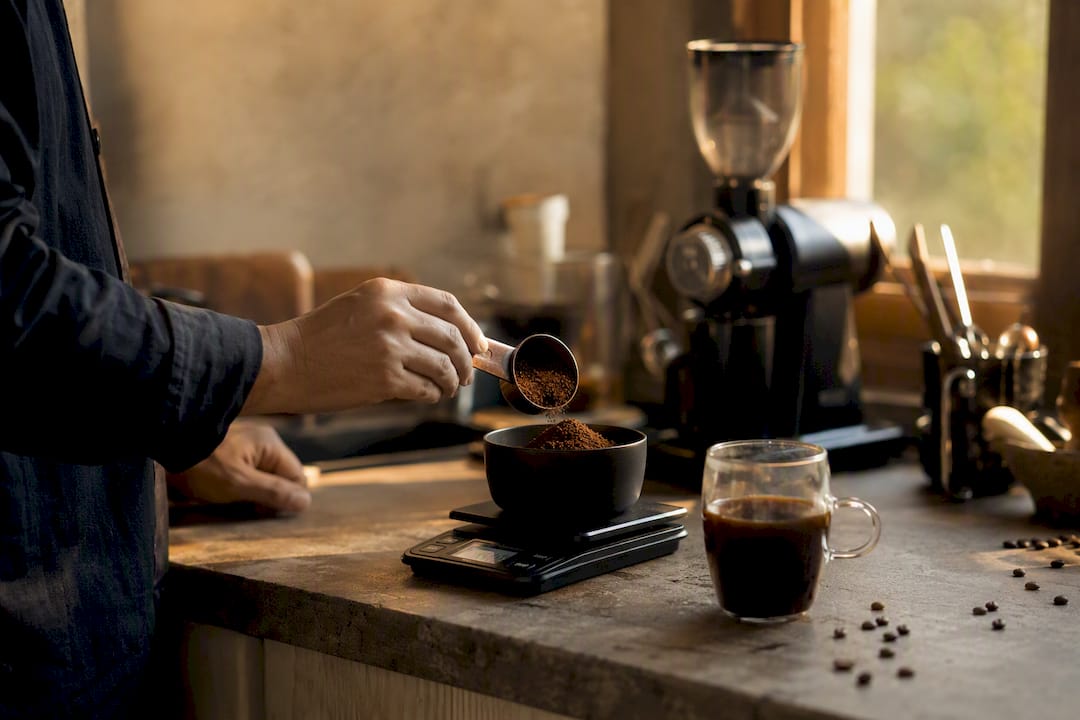
If you drink multiple 16-oz decafs a day, you could be taking in a moderate small total amount of caffeine without realizing it. That is not dangerous for most people, but it is worth knowing if you are trying to eliminate caffeine rather than just reduce it.
What Changes the Caffeine Left in Your Cup
Three factors decide how much caffeine survives into your mug: the decaffeination method, the roast, and how you brew it.
- Decaffeination method. Water-based processes like the Swiss Water Process use only water, temperature, and time to pull caffeine out of green beans, without solvents. It can leave green beans up to 99.9% caffeine free before roasting even starts. CO2 processing uses pressurized carbon dioxide to target caffeine molecules selectively, and traditional solvent methods use compounds like ethyl acetate. All three methods can hit the FDA-recognized threshold of removing at least 97% of caffeine, but none of them guarantee an identical number cup to cup.
- Roast level. Roasting does not meaningfully strip caffeine, caffeine is a heat-stable compound, but roast level affects bean density and how easily caffeine extracts during brewing. Darker roasts lose more mass through the roasting process, which can concentrate remaining compounds slightly differently than a lighter roast of the same origin.
- Brewing variables. Coffee-to-water ratio, grind size, and contact time all influence extraction. A finer grind size or longer steep pulls more caffeine out of the grounds, regardless of how thoroughly the beans were decaffeinated. Espresso, drip, French press, and instant decaf can all produce different final numbers from the same starting beans.
Pro Tip: If you want the lowest possible caffeine count, ask your roaster which decaffeination method they use. Water-processed decafs tend to have the most consistent, well-documented residual caffeine numbers because the process itself is chemical-free and easier to verify.
Who Should Be Careful With Decaf Coffee
Most people can drink decaf without giving caffeine a second thought. The exceptions matter, though, and they come down to dosage sensitivity and medical circumstance rather than decaf being inherently risky.
WebMD notes that pregnancy guidance commonly recommends staying under 200 mg of caffeine per day. Decaf usually fits comfortably within that limit even at several cups, but some clinicians still recommend avoiding it entirely during pregnancy out of caution, since even small amounts of caffeine cross the placenta.
A few groups should check with a doctor before treating decaf as a safe default:
- People with anxiety disorders or panic conditions who are highly sensitive to even trace caffeine.
- Anyone with a heart arrhythmia or a cardiologist’s instruction to eliminate caffeine.
- People taking medications that interact with caffeine metabolism, including certain antidepressants and antibiotics.
- Pregnant or breastfeeding individuals following stricter guidance from their own physician.
Here is a useful mental benchmark: if a regular cup of coffee has about 95 mg of caffeine, you would need somewhere between 13 and 45 cups of decaf, depending on where in the 2 to 7 mg range that particular decaf falls, to match that single regular cup. For nearly everyone, one decaf in the afternoon is not going to cause a caffeine problem. For someone told to avoid caffeine entirely, though, “nearly zero” is not the same as zero, and that distinction is worth a conversation with your doctor rather than a guess.
How to Lower the Caffeine in Your Decaf
If your goal is minimizing residual caffeine rather than eliminating decaf altogether, a few practical choices make a real difference.
- Choose water-processed decaf. Beans processed with the Swiss Water method or similar chemical-free techniques tend to start with the lowest possible caffeine baseline before they ever reach your cup. Qahwat Al’ard’s own Peru Decaf is sourced with this kind of traceable processing in mind.
- Go darker or go instant. Instant decaf and darker roasts have generally tested lower in residual caffeine in industry reviews, though results vary by brand.
- Control your serving size. An 8-oz cup will almost always carry less caffeine than a 16-oz cup of the same brew, simply because there is less coffee involved.
- Loosen your brew ratio. Using slightly less ground coffee per cup, or shortening steep time, reduces how much of anything, caffeine included, gets extracted.
- Ask for the numbers. Reputable roasters can tell you which decaffeination process they use and, ideally, point to lab-tested figures rather than a vague “trace amounts” label.
Pro Tip: If you are experimenting with cutting caffeine gradually rather than all at once, keep your cup size consistent for a week or two. Comparing a 16-oz decaf to an 8-oz decaf will make the caffeine feel wildly inconsistent when the real variable is just volume.
About the Research Behind This Guide
This guide was researched and written by Yasin Sofyian Ayesh, drawing on published data from the National Coffee Association, Healthline, WebMD, and Swiss Water, along with Qahwat Al’ard’s own explainer on how coffee gets decaffeinated.
Qahwat Al’ard sources single-origin coffee with full traceability, including its decaf offerings, and publishes educational content on roasting and processing rather than just selling beans. For readers exploring lower-caffeine or flavor-focused options, a few product lines are worth a look:
- Max Caf Blend, a full-flavor option for readers who want richness without maximizing caffeine load.
- Flavored Coffees Sample Pack, useful for tasting several profiles before committing to a bag.
- Cold Brew Coffee, a format where concentration and steep time change the caffeine math compared to hot brewing.
How Decaffeination Went From Chemical Experiment to Industry Standard
Decaffeination is more than a century old, and it started with a German coffee merchant named Ludwig Roselius, who developed the first commercial process around 1903 after a shipment of coffee beans was accidentally soaked in seawater and lost most of its caffeine in transit. Roselius refined the accident into a method using benzene as a solvent, marketed under the brand name Sanka. Benzene is now recognized as a carcinogen and was phased out decades ago, but the core idea, using a solvent to pull caffeine from green beans before roasting, stuck around.
Through the mid-20th century, manufacturers shifted to other solvents like trichloroethylene and later methylene chloride and ethyl acetate, both still used today in regulated amounts. The bigger shift came in the 1970s and 1980s with the development of water-based processing in Switzerland, which eliminated solvents entirely by using hot water and activated carbon filtration to strip caffeine while preserving flavor compounds. This approach was later trademarked as the Swiss Water Process and remains one of the most widely trusted chemical-free methods.
CO2 processing arrived around the same era, using pressurized carbon dioxide to act as a selective solvent that targets caffeine molecules specifically. Each method reflects a different tradeoff between cost, flavor preservation, and chemical use, and all three are still in commercial use today, which is part of why caffeine content in decaf varies from brand to brand.
How Countries Regulate Decaf Caffeine Labeling
Labeling standards for decaf are looser than most coffee drinkers assume. There is no federal requirement to print exact milligram counts on decaf packaging, which is why so few bags list a number.
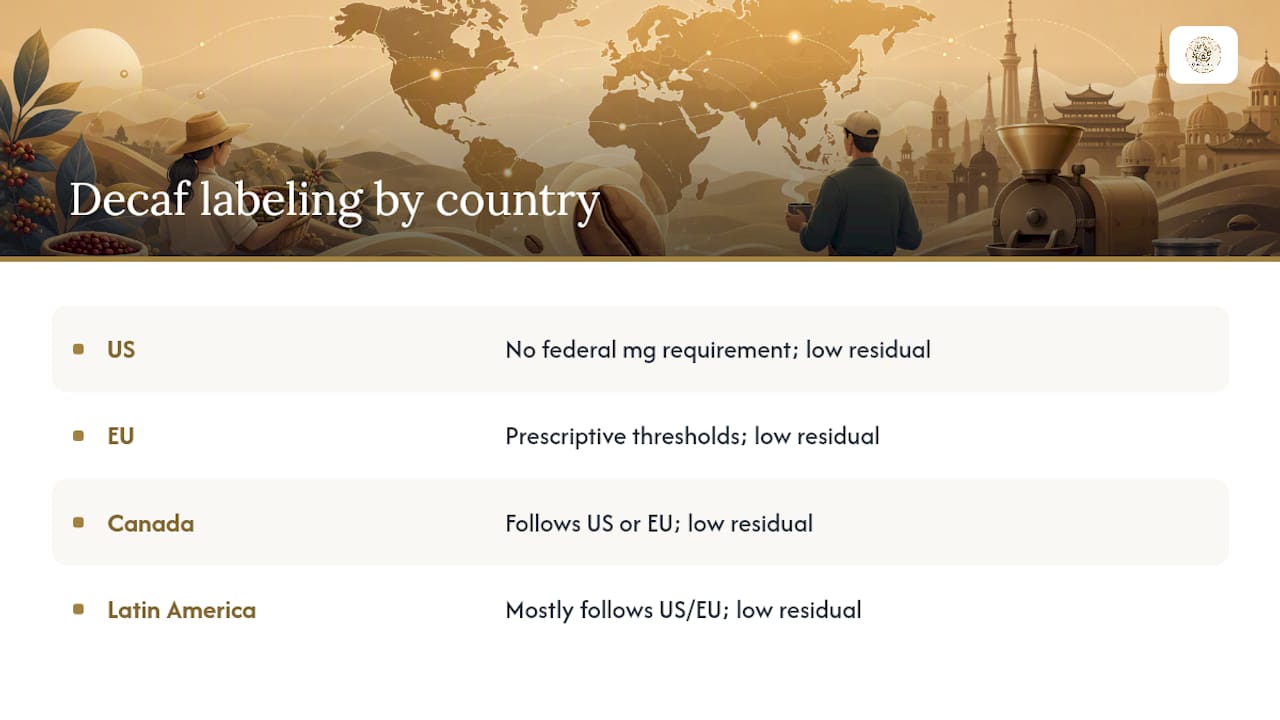
The European Union takes a more prescriptive approach. Those thresholds are stricter and more clearly codified than the American standard, though in practice, both regions end up with similarly low residual caffeine in finished decaf products.
Other markets, including Canada and much of Latin America, largely follow either the US convention or import EU-aligned standards depending on trade relationships. The practical upshot for you as a shopper: a bag labeled “decaf” in the US has met a baseline removal threshold, but exact milligram content is rarely disclosed unless a roaster chooses to test and publish it voluntarily, which is one reason working with a transparent, traceable roaster matters more than the label alone.
Does the Leftover Caffeine in Decaf Actually Do Anything?
The trace caffeine in decaf is small enough that most people will not notice any stimulant effect from a single cup.
That said, “most people” is not “everyone.” Caffeine sensitivity varies by genetics, particularly how quickly your liver metabolizes it, and some individuals report noticing even small doses, especially in the evening or on an empty stomach. There is also a psychological angle worth acknowledging: the ritual of drinking a warm cup of decaf, the aroma, the routine, can trigger some of the same alertness cues as regular coffee independent of the caffeine itself.
On the potential upside, trace caffeine is unlikely to meaningfully add to any of the benefits associated with regular coffee consumption, mood, focus, or metabolic effects tend to require doses well above what decaf provides. What decaf does offer is the flavor and ritual of coffee without the sleep disruption or jitteriness that comes with a full-caffeine cup late in the day. For most healthy adults, that tradeoff is exactly what makes decaf worth keeping in rotation rather than treating it as a lesser substitute.
The Real Question Isn’t “How Much” but “Which Cup”
The most useful thing the numbers on decaf teach you is not a single milligram figure, it is that “decaf” is a category, not a fixed quantity. A 2 mg cup and a 14 mg cup are both technically decaf, and treating them as interchangeable is where most confusion starts. Anyone giving advice about decaf without acknowledging that five-fold swing between the National Coffee Association’s 2 mg average and Healthline’s measured 13.9 mg chain samples is oversimplifying.
Conventional advice tends to stop at “decaf has a little caffeine, don’t worry about it.” That is fine for the vast majority of readers. But it skips the more useful guidance: your serving size and brewing method probably matter more than which brand you buy, once you have picked a reputable, water-processed option. A 16-oz gas station decaf and an 8-oz cup of a carefully sourced, traceable decaf are not the same beverage, even if both say “decaffeinated” on the label.
If you take one thing from this, prioritize knowing your process and your cup size before you worry about brand loyalty. That is the lever that actually moves the number.
— Yasin Sofyian Ayesh
Where to Find Traceable, Well-Processed Decaf
If you have read this far, you already know that not all decaf is created equal, and picking a roaster who is transparent about sourcing and processing matters more than chasing a specific milligram count. Qahwat Al’ard sources single-origin beans with full traceability back to growing regions like Peru, Colombia, and Uganda, and roasts to order rather than sitting on stock, which keeps flavor and freshness consistent batch to batch.
For readers specifically managing caffeine intake, the Peru Decaf offers a traceable, water-processed option without guesswork about origin. If you want a fuller-bodied option that still fits into a lower-caffeine routine, the Max Caf Blend is worth trying, and the Flavored Coffees Sample Pack lets you compare several profiles before settling on a favorite. If cold brew is more your speed, Qahwat Al’ard’s Cold Brew Coffee is another format worth exploring, since steep time and concentration change the caffeine math compared to hot brewing.
Browse the full lineup and pick a bag that matches how you actually drink your coffee, not just what the label promises.
Sources
- All About Decaffeinated Coffee | National Coffee Association
- How Much Caffeine Is in Decaf Coffee? | Healthline
- Decaf Coffee: Benefits, Caffeine Content, Risks and Process | WebMD
- How Much Caffeine Is in Decaf? | Swiss Water
FAQ
Does Decaf Coffee Have Any Caffeine at All?
Yes. Decaf typically contains 2 to 15 mg of caffeine per cup, compared to about 95 mg in a regular cup, so it is reduced rather than eliminated.
How Many Cups of Decaf Equal One Regular Cup?
Depending on where a decaf falls in its typical range, it takes roughly 13 to 45 cups of decaf to match the caffeine in one regular 8-oz cup of coffee.
Is Decaf Safe During Pregnancy?
Decaf usually fits within the commonly recommended 200 mg daily caffeine limit for pregnancy, but some clinicians still advise caution, so check with your doctor for personalized guidance.
Why Does a Large Decaf Sometimes Have More Caffeine Than a Small One?
Larger servings use more ground coffee, and more grounds mean more residual caffeine gets extracted, even though the percentage removed during decaffeination stays the same.


