
Shade-grown coffee is coffee grown beneath a canopy of trees rather than in open rows of exposed shrubs. When the shade is genuine and well managed, it supports local birds and insects, protects soil and water, and tends to produce denser, more complex-tasting beans than full-sun coffee. Not every bag labeled “shade-grown” delivers on that promise, which is why certifications and sourcing transparency matter more than the phrase itself.
TL;DR:
- Only about 25% of global coffee land actually meets the rigorous standards for genuine shade-grown systems like rustic or traditional polyculture.
- Shade-grown coffee supports diverse tree species that provide critical habitat for migratory birds and insects, while also stabilizing soil and improving water retention.
- Beneficial environmental effects of shade include increased carbon storage, microclimate regulation, and reduced soil erosion, especially on steep slopes.
- Denser, slow-ripening beans from shade-grown farms develop richer flavors, with more complexity and better balance in the cup, but quality depends on proper farm management.
- To ensure authenticity, look for certifications like Bird Friendly® and ask for detailed farm and origin information from roasters rather than relying on vague labeling.
Table of Contents
- What Is Shade-Grown Coffee, and What Are the Main System Types?
- How Does Shade-Grown Coffee Help the Environment?
- Does Shade-Grown Coffee Taste Different?
- Why Do Some Farmers Choose Sun-Grown Over Shade-Grown Coffee?
- How Can You Tell if Coffee Is Genuinely Shade-Grown?
- How Qahwat Al’Ard Sources and Traces Its Coffee
- Why Shade-Grown Coffee Deserves More Attention Than It Gets
- Shop Qahwat Al’Ard’s Traceable, Sustainably Sourced Coffee
- Sources
- FAQ
What Is Shade-Grown Coffee, and What Are the Main System Types?
Coffee is naturally an understory plant. Left alone in its native highlands of Ethiopia, it grows in the dappled light beneath larger trees, not under direct sun. Shade-grown cultivation mimics that original habitat by keeping a canopy of taller trees above the coffee shrubs, creating what agronomists call an agroforestry system: a deliberate mix of crop and tree species managed together instead of a single-crop field.
Not all shade is created equal. Researchers and coffee agronomists generally sort shaded and unshaded farms into four broad categories:
- Rustic systems: coffee planted directly into existing native forest with minimal clearing, keeping the highest tree diversity and canopy complexity of any system.
- Traditional polyculture: farmers thin the forest and add useful species like fruit trees, timber, or nitrogen-fixing legumes alongside the coffee, still under a diverse, multi-layered canopy.
- Commercial polyculture: shade trees are reduced to a small number of species, often chosen for a specific secondary crop or fast growth rather than ecological function.
- Shaded monoculture: a single fast-growing shade species, like a legume tree, is planted in rows purely to filter light. This is the thinnest form of shade and the easiest to fake on a label.
Beyond these, plenty of coffee is grown with no shade at all. Full-sun monoculture became common starting in the 1970s and 1980s, when new coffee varieties bred for direct sunlight let farmers pack in more plants per acre and push yields higher. Governments and development agencies in Latin America actively promoted the switch, framing it as modernization. The trade-off didn’t show up immediately. It showed up over decades, as soils eroded, pesticide use climbed, and bird populations in coffee-growing regions declined.
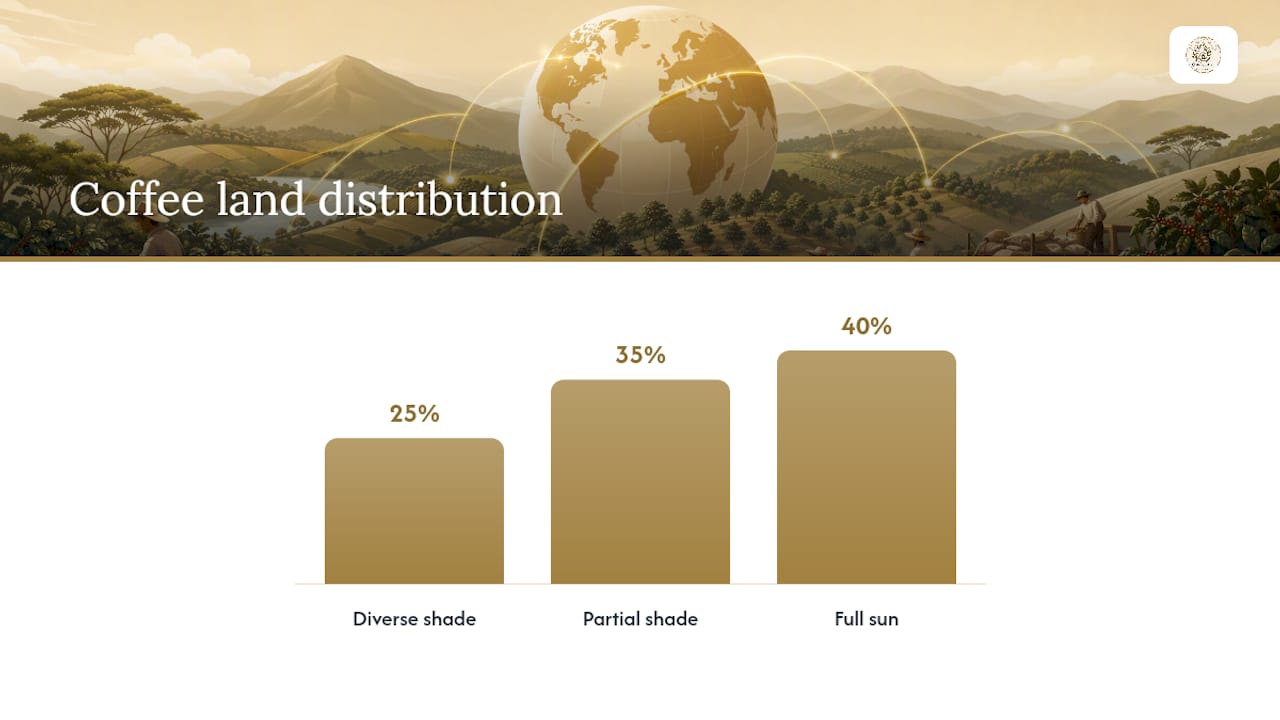
Globally, the reversal never fully happened. Root Capital estimates that about 25% of coffee-growing land worldwide sits under diverse shade, another 35% carries partial shade, and the remaining 40% is grown in full sun. That 25% figure is worth remembering, because it means genuinely shade-grown coffee, of the rustic or traditional polyculture variety, is closer to a specialty niche than an industry norm. This is also why a “shade-grown” claim on a bag deserves a second look rather than automatic trust. A farm with a scattering of legume trees technically qualifies as shaded, but it isn’t providing anywhere near the ecological value of a rustic or traditional polyculture system.
How Does Shade-Grown Coffee Help the Environment?
The environmental case for shade-grown coffee isn’t a single benefit. It’s a cluster of connected effects that start with the trees themselves and ripple outward into soil, water, and climate.
Bird and insect habitat. A canopy of native trees functions as a stopover and wintering ground for migratory birds that would otherwise lose habitat to cleared farmland. The Smithsonian Migratory Bird Center’s Bird Friendly® program has documented this connection directly, which is why the certification requires specific canopy cover and tree-species diversity rather than just “some shade.” More tree species usually means more insect diversity too, and that insect activity supports natural pest control that reduces a farm’s reliance on chemical inputs.
Soil stabilization and erosion control. Tree roots anchor slopes that would otherwise wash out during heavy rain, a real concern on the steep hillsides where much of the world’s specialty coffee grows. Fallen leaves build up a litter layer on the ground that slows runoff, adds organic matter, and keeps topsoil from eroding into streams below. Farms that clear their canopy for sun-grown rows tend to see faster soil degradation over time, especially on slopes above 20 degrees.
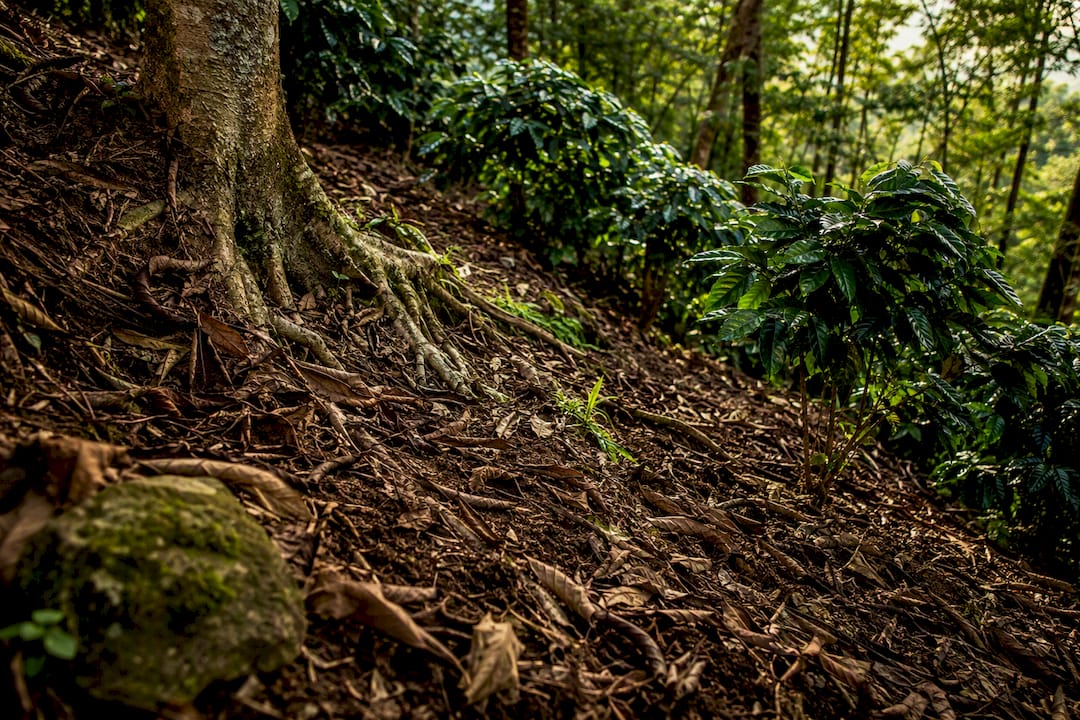
Water retention and watershed benefits. That same leaf litter and root structure helps soil absorb and hold rainfall instead of shedding it immediately. Shaded farms generally maintain more consistent soil moisture through dry spells, which matters increasingly as rainfall patterns shift.
Carbon storage. Trees are carbon reservoirs, both in their trunks and branches above ground and in the root systems and organic matter they build into soil below it. A rustic or traditional polyculture farm stores meaningfully more carbon per acre than a cleared sun-grown field, simply because it’s carrying far more woody biomass.
Climate resilience. This might be the least appreciated benefit. A 2022 review published in Frontiers in Sustainable Food Systems found that shade canopies buffer microclimate extremes, lowering peak daytime temperatures and raising nighttime minimums compared to exposed fields. That buffering reduces evaporation from soil and gives coffee plants a more stable environment to withstand heat spikes and erratic rainfall, both of which are becoming more common in major growing regions.
Statistic Callout: Coffee plants under Bird Friendly® shade standards can live more than 30 years, roughly double the productive lifespan of sun-grown plants, which typically decline after about 15 years.
None of this is uniform across every farm or every country. A Frontiers-published analysis of agroforestry and canopy structure points out that the strength of these benefits depends heavily on tree species diversity and canopy structure, not shade percentage alone. Elevation, rainfall, and local ecology all shape what “good” shade management actually looks like in a given region, which is one reason blanket claims about shade-grown coffee tend to oversimplify a genuinely site-specific practice.
Does Shade-Grown Coffee Taste Different?
Shaded coffee cherries ripen slower than sun-grown ones, and that slower timeline changes what ends up in your cup. Direct sun accelerates photosynthesis and fruit development, pushing cherries to mature faster but with less time to build sugar and complex compounds inside the bean. Under a canopy, cherries take longer to reach full ripeness, giving them more time to accumulate sugars and develop the biochemical complexity that shows up later as flavor.
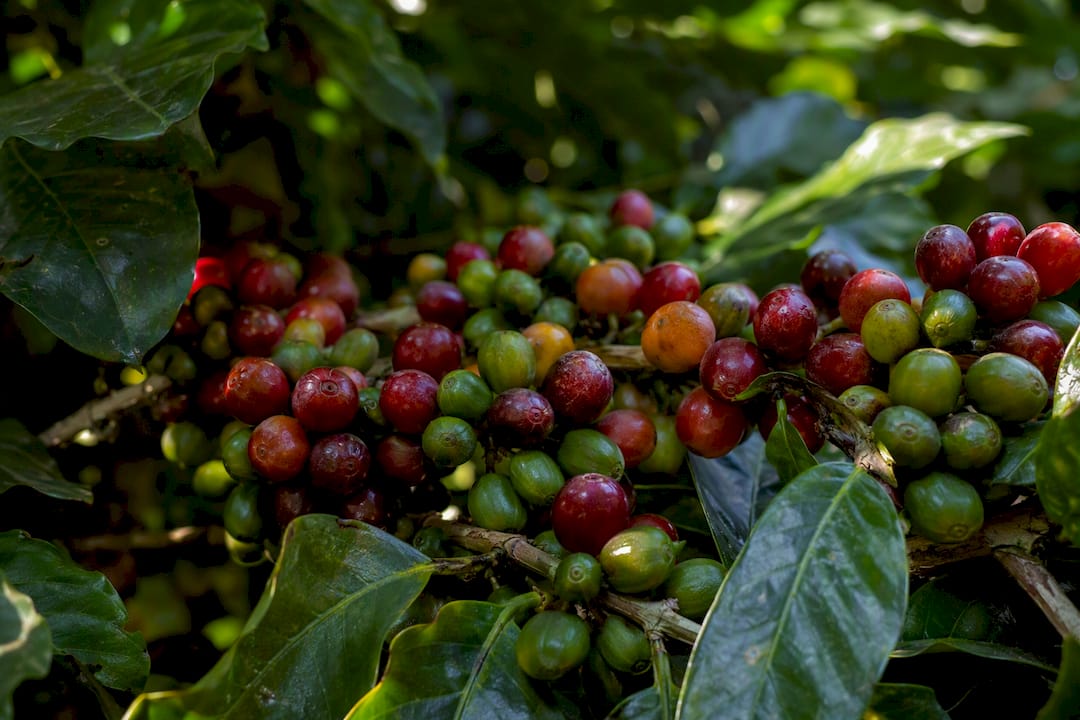
That slower ripening tends to produce denser beans. Density matters to roasters because denser beans generally hold more soluble compounds, the sugars, acids, and aromatic precursors that develop into flavor during roasting. According to background research summarized on the topic, the link between slower maturation and bean biochemistry is one reason specialty roasters actively seek out shade-grown lots when sourcing.
What this means in practice for a cup of coffee:
- More flavor complexity. Shade-grown beans more often show layered notes, fruit, floral, or wine-like acidity, rather than a flat, one-dimensional profile.
- Better balance at the specialty grade. Buyers grading coffee for competitions and specialty certification frequently note that dense, slow-matured beans hold up better through roasting without tasting scorched or hollow.
- Roast-level sensitivity. Denser beans respond differently to heat, so how a roaster shapes flavor through timing and temperature can make or break what a shade-grown lot is capable of showing in the cup.
- Regional variation still applies. A shaded lot from a high-elevation farm in Colombia will taste nothing like a shaded lot from lowland Uganda, because altitude and varietal matter as much as shade itself.
None of this means every shade-grown coffee automatically tastes better than every sun-grown coffee. A poorly managed shaded farm with disease pressure or uneven ripening can still produce a mediocre cup. But when shade is paired with good farm management, the biological mechanics genuinely favor a richer result, which is why shade-grown lots show up disproportionately often at the top of specialty grading sheets.
Why Do Some Farmers Choose Sun-Grown Over Shade-Grown Coffee?
Shade-grown coffee asks more of a farmer, and it’s worth being straightforward about that instead of pretending the choice is obvious.
Yields are typically lower. Sun-grown monocultures, planted densely with high-yield varieties, can produce significantly more coffee per acre than a shaded rustic or traditional polyculture farm. This is the core trade-off: shade systems generally sacrifice raw volume in exchange for quality and ecological benefit.
Management is more labor-intensive. A shaded farm asks a grower to manage two ecosystems at once, coffee and the tree canopy above it. Pruning shade trees to control light levels, harvesting secondary crops like fruit or timber, and maintaining a more complex planting all require more hands-on labor than a sun-grown row crop.
Pest and disease effects cut both ways. Shade can reduce certain pest pressures by supporting natural predator insects and birds that eat coffee pests. But dense canopy can also raise humidity around the coffee plants, which in some regions increases fungal disease risk, including coffee leaf rust. The right balance depends on local climate and canopy design, not a blanket rule.
Income diversification is the real economic lever. Root Capital’s analysis notes that shade trees can double as a second income stream, producing fruit, timber, or firewood that farmers sell alongside their coffee harvest. Combined with premium prices paid by specialty buyers for high-quality shaded lots, that diversification can offset the lower coffee yield itself.
Pro Tip: If you want to support farmers making this trade, look past the price tag on the bag. A higher price for a certified, traceable shade-grown coffee is often the mechanism that makes the lower-yield farming model financially viable for the grower in the first place.
Ecological benefits also compound into economic ones. Reference the earlier point about plant longevity: a coffee tree that survives 30 years instead of 15 spreads its establishment costs, land clearing, planting, years of no harvest before maturity, over double the productive lifespan. That’s a real balance-sheet benefit that rarely makes it into marketing copy about sustainability.
How Can You Tell if Coffee Is Genuinely Shade-Grown?
“Shade-grown” isn’t a regulated term the way “organic” is in most countries, so there’s nothing stopping a bag from using the phrase loosely. Certifications exist precisely to close that gap, but they aren’t interchangeable.
- Look for Bird Friendly® certification first. This is widely regarded as the most stringent seal available for shade-grown coffee because it requires full organic certification plus specific standards for canopy height, tree species diversity, and percentage of cover. A bag carrying this seal has been independently verified against real ecological criteria, not just a farmer’s word.
- Understand what organic certification does and doesn’t cover. Organic certification restricts synthetic pesticides and fertilizers, which is valuable, but it says nothing about canopy or shade structure on its own. A sun-grown farm can be fully organic.
- Know that Rainforest Alliance sets a lower shade bar. The certification requires some tree cover, but the threshold and enforcement are less rigorous than Bird Friendly® standards, so the seal alone doesn’t guarantee rustic or traditional polyculture-level biodiversity.
- Check for farm and region transparency. A retailer willing to name the specific farm, cooperative, or region a coffee comes from is signaling real supply-chain visibility. Vague country-of-origin labeling with no further detail is a yellow flag.
- Ask direct questions if you’re buying from a roaster. A grower or importer working directly with farms should be able to tell you, at minimum, whether the coffee was grown under diverse native shade or a single shade species, and roughly what percentage of canopy cover the farm maintains.
Certification labels and sourcing claims work best together, not as substitutes for each other. Reading sustainability certifications on a coffee bag takes a few extra minutes, but it’s the difference between supporting a rustic agroforestry farm and rewarding a marketing term with no real system behind it.
How Qahwat Al’Ard Sources and Traces Its Coffee
Qahwat Al’Ard builds its sourcing around full traceability, meaning every bean can be traced back to its specific growing region, from Colombia’s highland farms to Peru’s cooperatives, Bali’s volcanic soils, and Uganda’s shaded plots. That’s the same transparency standard the checklist above asks readers to look for in any roaster.
Assessing a supplier for genuine sustainability means going past a certification logo and asking about the farm itself: canopy structure, tree diversity, and how the grower manages the land year over year. Qahwat Al’Ard treats that origin story, not just the roast date, as part of what a customer is actually buying.
Some practical touchpoints readers can expect:
- Origin and region information disclosed on product pages, not buried in fine print.
- Beans roasted fresh to order rather than sitting in warehouse inventory for months.
- Sourcing relationships built around ethical and transparent supply chains rather than anonymous commodity purchasing.
Why Shade-Grown Coffee Deserves More Attention Than It Gets
Most conversations about sustainable coffee jump straight to certifications and stop there, as if a logo settles the question. It doesn’t. The more interesting story is what’s actually happening on the land: a farmer choosing to keep a diverse canopy instead of clearing it for a few more rows of higher-yield plants, trading some short-term income for soil that doesn’t wash away and trees that keep producing coffee for decades longer.
That choice connects directly to what ends up in your cup. Slower-ripened, denser beans aren’t a marketing invention. They’re a biological consequence of the same shade that’s protecting the birds and stabilizing the soil. Flavor and ecology aren’t separate stories here; they’re the same story told from two angles.
If you’re buying coffee with any intention of supporting that model, buy from roasters willing to name the farm and describe the canopy, not just the tasting notes. Certified or fully traceable beans aren’t a small upgrade. They’re the only real way to know your money reached the kind of farm worth keeping in business.
— Yasin Sofyian Ayesh
Shop Qahwat Al’Ard’s Traceable, Sustainably Sourced Coffee
Putting the checklist above into practice is easier when a roaster does the transparency work for you. Qahwat Al’Ard’s Latin American Blend draws on origin-disclosed farms with full traceability back to the growing region, giving you a direct line to the source instead of a generic country-of-origin label.
For something more distinctive, the Coffee with Mushrooms Dark Roast and Coffee with Mushrooms Medium Roast pair functional ingredients with the same sourcing standards, roasted fresh to order rather than pulled from aging warehouse stock. Each product page lists origin and roast details upfront, so you can check them against the verification steps covered earlier rather than taking a label at its word. Browse the current lineup and pick a bag that matches the farm-level transparency you’re after.
Sources
For readers who want to go deeper than this guide, a few sources stand out. Root Capital’s shade-grown explainer covers global land-use figures and farmer economics in plain language. The Smithsonian’s Bird Friendly® program page details certification criteria directly from the organization that created the standard. The Frontiers in Sustainable Food Systems review offers the most rigorous look at climate adaptation benefits, and the Brookes University academic review adds recent, region-specific biodiversity data.
- Shade-Grown Coffee: What’s the Big Deal? - Root Capital
- Smithsonian Migratory Bird Center’s Bird Friendly® Coffee Program Protects Migratory Birds and Supports Shade-Grown Coffee Farms | Smithsonian Global
- Shaded‑coffee: A nature‑based strategy for coffee production under climate change? A review — Frontiers (2022)
FAQ
What coffee is considered shade-grown?
Coffee grown beneath a canopy of trees, ranging from rustic farms planted directly into native forest to traditional polyculture systems that mix coffee with fruit and timber trees. Roughly 25% of global coffee land is grown under this kind of diverse shade.
Is shade-grown coffee actually better?
It tends to be better for biodiversity, soil health, and carbon storage, and it often produces denser, more complex-tasting beans due to slower cherry ripening. It isn’t automatically better in every case. Quality still depends on canopy diversity, farm management, and how the coffee is processed and roasted.
What does “shade-grown” actually mean on a coffee label?
It means the coffee plants were grown under some level of tree cover instead of in open, direct sunlight, but the term itself isn’t regulated. That’s why certifications like Bird Friendly® matter: they set actual criteria for canopy cover and tree diversity instead of leaving the definition up to the label.
How can I find genuinely shade-grown, traceable coffee?
Look for third-party certification like Bird Friendly®, and prioritize roasters that disclose specific farm or region information rather than vague country labeling. Qahwat Al’Ard, for example, publishes origin details across its single-origin lineup so buyers can verify sourcing before ordering.


