


Most coffee drinkers assume the roast is what makes a cup taste the way it does. It’s an understandable assumption, but it misses something far more fundamental. The land where a coffee plant grows, the minerals in the soil beneath its roots, the altitude of the hillside, the mist that rolls through each morning—all of these forces shape the chemical blueprint of every bean before a roaster ever touches it. Terroir is not a marketing term borrowed from wine labels. It is a measurable, scientifically documented set of forces that determine the ceiling of what any coffee can become.
Table of Contents
- What is terroir in coffee?
- How terroir shapes coffee flavor: The science and sensory impact
- Terroir versus processing: Which matters more?
- Terroir and coffee culture: Origin, ethics, and evolving consumer tastes
- Our perspective: Why terroir still matters—even as coffee culture evolves
- Explore the world of terroir with our curated selections
- Frequently asked questions
Key Takeaways
| Point | Details |
|---|---|
| Terroir shapes flavor | Altitude, soil, and microclimate combine to define coffee’s taste and quality. |
| Processing also matters | How coffee is processed can enhance or mask terroir-driven flavors. |
| Consumer priorities evolving | Many now weigh both origin and processing, making exploration more rewarding. |
| Ethics and story count | Single-origin coffees often promote transparency, traceability, and ethical sourcing. |
What is terroir in coffee?
The word “terroir” comes from French wine culture, where it describes the unique combination of soil, climate, and geography that gives a wine its sense of place. In coffee, the concept is just as powerful and arguably even more complex. A single coffee plant is sensitive to dozens of environmental variables, each one nudging the bean’s chemistry in a slightly different direction.
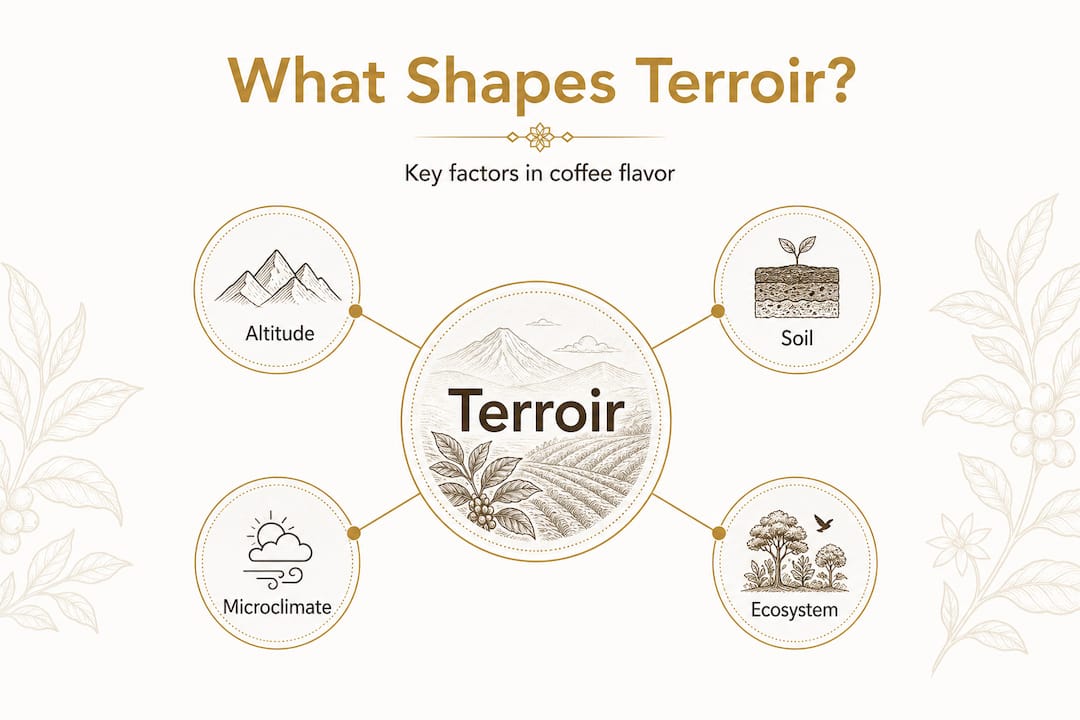
The core components of coffee terroir include:
- Altitude: Higher elevations mean cooler temperatures, slower cherry development, and denser beans with more complex compounds.
- Soil composition: Volcanic soils rich in minerals like chromium, copper, calcium, and magnesium leave a chemical fingerprint on the bean. Soil minerals such as Cr, Cu, Ca, and Mg trace origins and directly influence bean composition.
- Microclimate: The pattern of rain, fog, sun, and wind specific to a small geographic area shapes how the plant develops.
- Local ecosystem: Shade trees, nearby flora, and biodiversity affect the plant’s stress levels and nutrient uptake, both of which influence flavor precursors.
- Water availability and drainage: How much water the plant receives and how well the soil drains affects cherry development and sugar concentration.
Think of terroir as the coffee plant’s autobiography, written by the land before the farmer or roaster adds their chapter. Two farms separated by just a few kilometers in elevation can produce beans with noticeably different flavor profiles, even when they grow the same variety and use identical processing methods. That’s not an accident. That’s terroir at work.
How terroir shapes coffee flavor: The science and sensory impact
With a definition in hand, let’s dive into exactly how these physical factors express themselves in your cup.
Altitude is perhaps the most well-documented terroir variable in specialty coffee. At higher elevations, cooler temperatures slow the maturation of coffee cherries. This extended development period allows the plant to accumulate more sugars, phenolic compounds, and chlorogenic acids in the bean. The result is a denser, more complex bean that scores higher on cupping evaluations. Higher altitude correlates with decreased caffeine, increased phenolics and chlorogenic acids, brighter acidity, and better overall cup scores. Coffees grown at 1800 to 2100 meters regularly achieve Specialty Grade scores above 80 on the SCAA scale, a threshold that marks genuine quality.
| Altitude range | Caffeine level | Phenolic content | Typical flavor notes | SCAA score range |
|---|---|---|---|---|
| Below 1000m | High | Low | Earthy, woody, flat | 70-75 |
| 1000-1500m | Moderate | Moderate | Nutty, mild sweetness | 75-80 |
| 1500-1800m | Lower | Higher | Fruity, balanced acidity | 80-84 |
| 1800-2100m | Lowest | Highest | Bright, complex, floral | 84-90+ |
Volcanic soil adds another dimension entirely. Regions like Ethiopia’s Yirgacheffe or Peru’s Cusco highlands sit on mineral-rich substrates that feed the coffee plant a distinct cocktail of trace elements. These minerals don’t just nourish the plant; they influence which flavor precursors develop inside the cherry. Cusco’s high-altitude Typica coffees, for example, are known for exceptional acidity and a clarity in the cup that’s almost crystalline. That’s not a coincidence. It’s the land speaking.
Statistic callout: Scientific studies confirm that altitude plays a dominant role in specialty coffee quality, but interactions between processing methods and micro-level terroir factors create significant nuances that support premium pricing for high-terroir lots.
Microclimate matters in ways that are harder to quantify but easy to taste. The famous “mist belt” coffees of Kenya, grown in areas where morning fog rolls in consistently, develop a particular brightness and berry-forward character that’s almost impossible to replicate elsewhere. The fog slows drying of the cherry skin, extends the fermentation window slightly, and creates conditions for specific enzymatic activity inside the fruit.
Pro Tip: When exploring new single-origin coffees, look for bags that list specific elevation or sub-region. A label that says “grown at 1900 meters in the Sidama zone” tells you far more about what’s in the cup than a generic country label. If you want to experience how dramatically origin can shift flavor, a flavored coffees sample pack is a great starting point for side-by-side comparison.
Terroir versus processing: Which matters more?
But flavor isn’t just about the land, is it? Let’s dig into how preparation methods can amplify or overshadow a coffee’s terroir.
Here is where the specialty coffee world gets genuinely interesting, and a little contentious. Terroir establishes the raw potential of a coffee. It sets the ceiling. But processing, the method used to remove the coffee cherry’s fruit from the seed after harvest, can dramatically reshape what ends up in your cup.
The three primary processing methods each interact with terroir differently:
- Washed (wet) processing: Removes the fruit before drying, allowing the bean’s intrinsic terroir character to shine through most clearly. Washed Ethiopian coffees from Yirgacheffe are a textbook example of terroir-forward expression.
- Natural (dry) processing: Dries the whole cherry, allowing fruit sugars to ferment into the bean. This can produce extraordinary complexity but can also mask terroir nuances under heavy fruit-forward flavors.
- Honey processing: A middle path that retains some fruit mucilage, creating sweetness while still allowing some origin character to come through.
| Flavor attribute | Terroir-driven | Processing-driven |
|---|---|---|
| Acidity brightness | Strongly terroir | Moderately affected by washing |
| Fruit-forward sweetness | Mildly terroir | Strongly natural/honey process |
| Floral aromatics | Strongly terroir | Mildly affected |
| Body/mouthfeel | Moderately terroir | Strongly processing |
| Fermentation notes | Minimally terroir | Strongly natural process |
| Bitterness | Altitude/terroir | Roast profile dominant |
Processing and roasting can sometimes override origin traits entirely, particularly with experimental lots that use extended fermentation or anaerobic methods. Some critics argue this homogenizes flavors, making a Kenyan natural taste more like a Colombian natural than like a traditional Kenyan washed coffee.
This is not necessarily a bad thing. But it does mean that buying a coffee from a “famous” origin doesn’t guarantee you’ll experience that region’s classic terroir character. A heavily processed lot from Ethiopia might taste more like a tropical fruit cocktail than the jasmine-and-bergamot profile that made Ethiopian coffee famous.
Roast level adds another layer. A dark roast will suppress the delicate high-altitude acidity and floral notes that terroir builds into the bean. If you want to taste terroir clearly, lighter roasts are your best tool. Our mushroom medium roast and mushroom dark roast show how roast profile can shift the experience dramatically, even within the same base. For something that leans into roast character over origin, a french roast will tell you more about the roaster’s craft than the farm’s geography.
Terroir and coffee culture: Origin, ethics, and evolving consumer tastes
To further understand why origin matters, let’s explore how terroir ties into the stories, ethics, and choices behind specialty coffees today.
There’s a reason single-origin coffees command premium prices and loyal followings. When a bag tells you the coffee comes from a specific cooperative in Oaxaca, Mexico, grown at 1600 meters by a family that has farmed the same hillside for three generations, you’re not just buying flavor. You’re buying transparency, accountability, and a direct connection between your cup and the land it came from.
“The most honest coffees are the ones that can’t hide behind blending or heavy processing. They stand on the merit of their land and the care of their farmers.”
This connection between terroir and ethics is not accidental. Coffees that are marketed with specific origin details tend to come from supply chains where farmers receive fairer prices, because traceability requires relationships. When a roaster can tell you the name of the farm and the elevation it sits at, that roaster almost certainly knows the farmer personally or works through a trusted direct-trade importer.
Consumer priorities are shifting in 2026. Consumers are shifting focus from origin cues to processing cues, with many specialty buyers now asking “is this washed or natural?” before they ask “where is it from?” This reflects growing sophistication, not a rejection of terroir. It reflects an understanding that both origin and process are part of the full picture.
Here’s how to read a coffee bag for terroir clues:
- Look for specific region or sub-region names. “Ethiopia” tells you little. “Yirgacheffe, Gedeo Zone” tells you a great deal.
- Check the listed altitude. Anything above 1500 meters is a strong signal of terroir-driven complexity.
- Note the variety. Heirloom Ethiopian varieties, Bourbon, Typica, and Gesha all carry distinct terroir sensitivity.
- Identify the processing method. Washed lots will express terroir most directly.
- Read the tasting notes critically. Floral, citrus, and stone fruit notes usually signal high-altitude, terroir-forward character.
Our Mexico coffee pods offer a great entry point into terroir exploration, showcasing the distinct character of high-altitude Mexican growing regions in a convenient format. For a quick daily ritual that still honors origin, our instant coffee options are sourced with the same attention to provenance.
Our perspective: Why terroir still matters—even as coffee culture evolves
With all these complexities, here’s our unfiltered take for today’s coffee explorer.
There’s a temptation in specialty coffee circles to treat terroir as the only variable worth discussing, as if the land is everything and everything else is noise. We’ve seen the opposite trend too, where processing innovation becomes so celebrated that origin becomes almost irrelevant. Both extremes miss the point.
Terroir is not a destination. It’s a starting point. Understanding where a coffee comes from and what the land contributes gives you a framework for everything else. When you know that a high-altitude Kenyan coffee carries inherent brightness and berry complexity, you can make an informed choice about whether you want a washed lot to amplify that character or a natural lot to add a layer of jammy depth on top of it. Without terroir knowledge, you’re just guessing.
The uncomfortable truth is that many consumers, even experienced ones, confuse processing-driven flavors with terroir-driven flavors. A heavily fermented natural Ethiopian coffee tastes extraordinary, but the blueberry and wine notes you’re experiencing are largely the product of fermentation, not the altitude or soil of the Gedeo highlands. That’s not a lesser experience. But it is a different one, and knowing the difference makes you a more intentional coffee drinker.
We believe the most rewarding path is to treat terroir, processing, and roast as three instruments in the same ensemble. Learning to hear each one separately, and then together, is what separates a coffee enthusiast from a coffee connoisseur. Our African espresso is a perfect example of how terroir-rich African origins can be expressed through an espresso roast profile without losing their essential character. At Qahwat Al’Ard, we source with terroir in mind and roast to let the land speak as clearly as possible.
Pro Tip: Try the same origin prepared as both a washed and a natural lot, side by side. This single exercise will teach you more about terroir versus processing than any amount of reading. Your palate is the best instrument you have.
Explore the world of terroir with our curated selections
Understanding terroir is one thing. Tasting it is another experience entirely, and that’s where the real education begins.
At Qahwat Al’Ard, we’ve built our entire sourcing philosophy around giving you direct access to coffees where the land’s character is front and center. Our single origin favorites sample pack lets you taste coffees from multiple distinct terroirs side by side, turning every brew session into a guided journey across continents. If you want to experience how altitude, soil, and climate express themselves differently across regions, this is the most direct path. For something with a distinctive character of its own, our Max Caf Blend brings together complementary origins with intention. Every bag we offer at Qahwat Al’Ard coffees carries the story of its land, its farmer, and the craft that brought it to your cup.
Frequently asked questions
What are the main components of coffee terroir?
Terroir includes altitude, soil composition, climate, and the local ecosystem, all of which shape coffee flavor. Soil minerals like chromium, copper, calcium, and magnesium trace a bean’s geographic origins and directly influence its composition.
Does higher altitude always mean better coffee?
Higher altitude tends to produce brighter, more complex flavors and higher cup scores, but processing quality and farming care also play critical roles in the final result.
Can processing override terroir flavors in coffee?
Yes, processing methods like natural or anaerobic fermentation can dominate or significantly modify origin-driven flavors, especially in experimental lots designed to maximize fruit-forward character.
How does terroir relate to ethical sourcing?
Coffees marketed with specific terroir details typically come from traceable, direct-trade supply chains where farmers receive fairer compensation because transparency requires genuine relationships with producers.
Should I focus on origin or processing when buying specialty coffee?
Both matter and reward different kinds of curiosity. Choosing by origin offers geographic exploration, while different processing styles reveal entirely new flavor dimensions within the same terroir.


