


TL;DR:
- Fair price coffee guarantees producers a minimum price that covers sustainable costs and living wages. Certification systems like Fairtrade also include community premiums and require annual audits, benefiting organized cooperatives. While certifications offer trusted standards, transparency in sourcing and relationships often provide deeper insights into ethical practices.
Fair price coffee is defined as a guaranteed minimum payment to coffee producers that covers sustainable production costs and provides living wages, regardless of what global commodity markets do on any given day. The term is commonly used to describe the principles behind Fairtrade International’s certification system, though it also applies to direct trade and other ethical sourcing models. Understanding fair coffee pricing explained clearly matters because the global coffee supply chain is notoriously unequal. Millions of smallholder farmers in Ethiopia, Colombia, and Honduras grow the world’s most consumed beverage while earning less than the cost of production. Fairtrade International and similar systems exist to close that gap.
What is fair price coffee explained: the core definition
Fair price coffee, in industry terms, refers to any pricing model that guarantees producers a floor price above the volatile commodity market rate. The most widely recognized standard is the Fairtrade minimum price floor, which sits at $1.80 per pound for washed Arabica green coffee as of 2026. That figure acts as a safety net. When the New York “C” market drops below $1.80, certified farmers still receive $1.80. When the market rises above it, farmers receive the higher market price.
The Fairtrade system has transferred over $1 billion in additional revenue to farming communities since its founding. That number represents real infrastructure, healthcare access, and school buildings in coffee-growing regions across Africa, Latin America, and Southeast Asia. Fair price coffee is not charity. It is a structured pricing mechanism designed to make farming economically viable long term.
Beyond the floor price, Fairtrade certification adds a social premium of $0.20 per pound on top of every sale. Cooperative members vote democratically on how those funds are spent, directing money toward roads, clinics, and agricultural training. This community investment component is what separates fair price coffee from simply paying a higher commodity rate.
How does Fairtrade certification set and enforce fair prices?
Fairtrade International operates through a third-party audit system that verifies labor, environmental, and social governance standards at the farm and cooperative level. Certification is not a one-time approval. Auditors return annually to confirm compliance, and certified Fairtrade coffee volumes grew 12% year over year in 2025, reflecting rising consumer demand for verified ethical sourcing. That growth signals that the certification model is gaining traction, not losing relevance.
Here is how the Fairtrade pricing structure works in practice:
- Minimum price floor: $1.80/lb for washed Arabica, protecting farmers when markets crash
- Social premium: $0.20/lb invested in community projects chosen by cooperative members
- Cooperative requirement: Farmers must organize into certified cooperatives to access the system
- Annual audits: Third-party inspectors verify labor conditions, environmental practices, and financial transparency
- Democratic governance: Cooperatives must demonstrate member participation in decision-making
One limitation worth knowing: certification costs and cooperative requirements exclude many small independent producers who practice ethical farming but cannot afford the annual audit fees or lack the organizational infrastructure to form a recognized cooperative. Fairtrade certification benefits organized groups more than individual growers.
Pro Tip: When you see the Fairtrade logo on a bag, check the roaster’s website for the specific origin country and cooperative name. That extra step tells you far more about the coffee’s actual sourcing story than the logo alone.
Reading coffee sustainability certifications in detail helps you understand exactly what each label does and does not guarantee before you buy.
What market forces shape fair coffee pricing beyond certification?
The global coffee commodity market is controlled largely by the New York “C” market, which sets the benchmark price for Arabica coffee traded worldwide. That market is highly volatile and often falls below the actual cost of production for smallholder farmers. Price swings of 30–50% within a single year are not unusual, driven by weather events in Brazil, currency fluctuations, and speculative trading.
This volatility is the core problem that fair price systems solve. Think of the Fairtrade floor price as crop insurance. A farmer in Guatemala does not know what the “C” market will do next harvest season. The floor price removes that uncertainty for certified producers.
The table below shows how different pricing models compare in practice:
| Pricing model | Who sets the price | Typical price range (per lb) | Quality focus |
|---|---|---|---|
| New York “C” market | Commodity traders | $0.80–$2.50+ (volatile) | None |
| Fairtrade minimum | Fairtrade International | $1.80 floor | None |
| Direct trade | Individual roasters | $2.50–$6.00+ | High |
| Specialty auction | Buyers at origin | $5.00–$100.00+ | Very high |
“Price volatility is a key driver for fair price mechanisms in coffee to protect producers from income shocks.” — Understanding Fair Trade Prices
Direct trade relationships, practiced by specialty roasters like those sourcing for high-end cafés in New York and Portland, often pay premiums well above Fairtrade minimums. Direct trade premiums reflect quality and traceability rather than minimum wage protection alone. A roaster paying $4.50 per pound for a washed Ethiopian Yirgacheffe is rewarding exceptional cup quality and a trusted farmer relationship, not just meeting an ethical baseline. Understanding why single-origin costs more gives you a clearer picture of how quality and ethics intersect in specialty pricing.
Fairtrade vs. direct trade: how do the models compare?
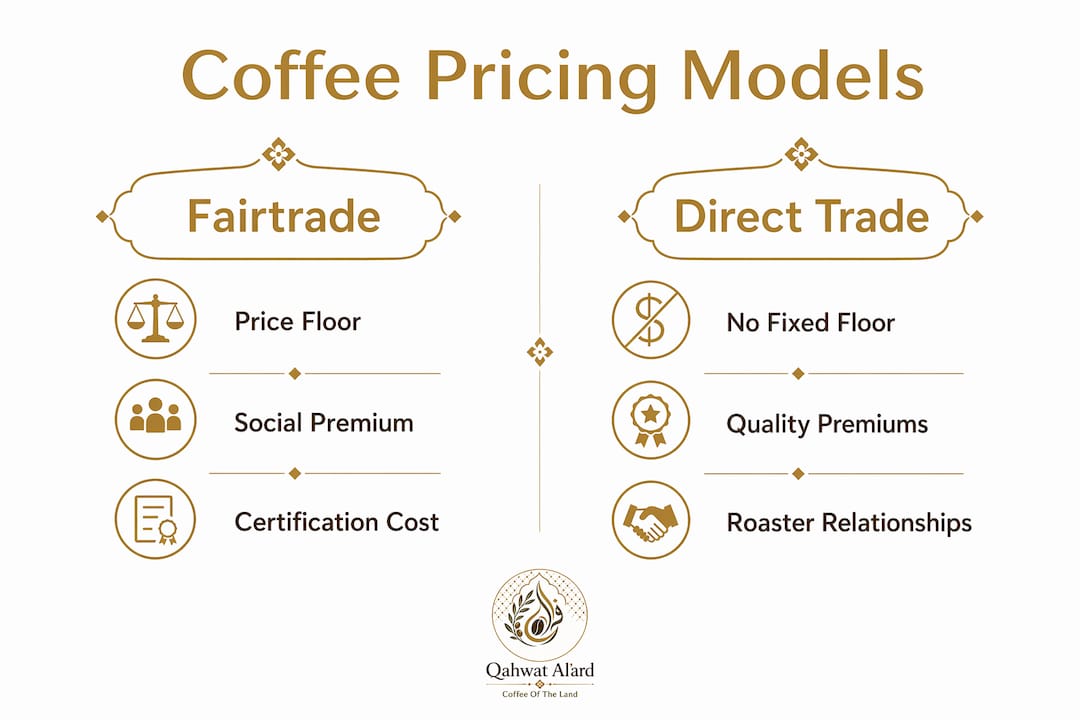
Fairtrade and direct trade both aim to pay producers fairly, but they operate through fundamentally different structures. Fairtrade is a third-party certified system with published price floors, standardized audits, and legal accountability. Direct trade is a relationship-based model where individual roasters negotiate prices directly with farmers or cooperatives, often paying above Fairtrade rates but without standardized verification.
Here is a direct comparison:
| Feature | Fairtrade | Direct trade |
|---|---|---|
| Price floor | Yes, $1.80/lb (washed Arabica) | No fixed floor |
| Third-party audit | Yes, annual | No, self-reported |
| Quality focus | Not required | Central to the model |
| Community premium | Yes, $0.20/lb | Varies by roaster |
| Accessible to independents | Limited | Yes |
Some roasters combine Fairtrade certification with direct trade premiums to capture both verified ethics and quality-driven pricing. This hybrid approach is increasingly common among specialty roasters who want the accountability of certification and the flexibility to reward exceptional producers beyond the minimum.
The tradeoff is real. Fairtrade guarantees a verified ethical floor. Direct trade can pay far more, but the consumer has to trust the roaster’s word. Neither model is universally superior. They serve different parts of the market and different producer needs.
Pro Tip: Look for roasters who publish their farm-gate prices or sourcing reports publicly. Transparency at that level signals a genuine commitment to fair compensation, whether or not a Fairtrade logo appears on the bag.
Ethical coffee sourcing guides explain how to evaluate a roaster’s sourcing philosophy beyond what any single certification tells you.
Why does fair pricing matter for producers and communities?
Stable income is the most direct benefit of fair price coffee for farming families. When a cooperative in Peru knows it will receive at least $1.80 per pound regardless of market conditions, it can plan for the next planting season, service equipment loans, and pay workers reliably. That predictability is what separates subsistence farming from a sustainable agricultural business.
The social premium of $0.20 per pound funds community projects voted on by cooperative members. Real examples of what those funds have built include:
- Clean water systems in rural Honduran coffee communities where municipal infrastructure does not reach
- Primary school construction in Ethiopian cooperatives where children previously traveled hours to attend class
- Healthcare clinics in Colombian growing regions serving farmers and their families
- Agricultural training programs that teach soil health, shade-grown techniques, and climate adaptation
- Road improvements connecting remote farms to processing facilities and export markets
Fair price systems also encourage cooperative governance. When farmers participate in democratic decision-making about how premiums are spent, they build organizational capacity that extends beyond coffee. Cooperatives that manage Fairtrade premiums well often develop credit unions, shared equipment programs, and collective bargaining power with exporters.
The sustainability benefits extend to the environment as well. Farmers who earn stable incomes are less likely to clear forest for short-term cash crops. Fair price systems create economic conditions where long-term environmental stewardship becomes financially rational.
Key takeaways
Fair price coffee works because it replaces volatile commodity pricing with a guaranteed floor, a community premium, and verified ethical standards that protect producers from income shocks.
| Point | Details |
|---|---|
| Fairtrade price floor | $1.80/lb for washed Arabica acts as a safety net when commodity markets fall. |
| Social premium impact | $0.20/lb per pound funds community projects chosen democratically by cooperative members. |
| Direct trade distinction | Direct trade pays quality-driven premiums above Fairtrade minimums but lacks standardized third-party verification. |
| Certification limits | Many ethical independent producers cannot access Fairtrade due to cooperative requirements and audit costs. |
| Consumer role | Researching roaster sourcing philosophies beyond labels leads to more informed purchasing decisions. |
Why fair price coffee is more complex than the label suggests
I have spent years reading sourcing reports, visiting roaster websites, and talking to people who work directly with coffee cooperatives. The honest truth is that the Fairtrade logo tells you something important, but it does not tell you everything. The Fairtrade logo guarantees a minimum price and community investment. It does not tell you whether the coffee tastes exceptional or whether the farmer received $2.50 or $1.80.
What I find more telling is when a roaster publishes the name of the cooperative, the farm-gate price paid, and the harvest year on the bag. That level of transparency is harder to fake than a certification logo. Certifications are a floor, not a ceiling. The best sourcing happens when roasters treat them as a starting point and build genuine relationships above that baseline.
I also think consumers underestimate how much their purchasing choices shape the market. Ethical labels act as indicators, not definitive solutions. When you consistently buy from roasters who pay above the minimum and publish their sourcing data, you create demand signals that push the entire industry toward better practices. That is not idealism. That is how markets respond to consistent buyer behavior.
The future of fair price coffee will likely involve more granular traceability, possibly blockchain-based verification, and pricing models that reward climate resilience alongside quality. Certifications will need to evolve as climate change disrupts traditional growing regions and forces farmers to adapt. The roasters and brands that build real relationships now will be better positioned to support producers through those transitions.
— Anthony-Yasin
Explore ethically sourced coffee from Qahwatalard
Qahwatalard sources premium coffee with traceability and ethical compensation at the center of every product decision. The platform works with growers from renowned coffee regions and offers full transparency on origins, so you know exactly where your coffee comes from and how it was produced.
Whether you prefer a bold African Espresso with deep fruit notes or the functional depth of a mushroom dark roast, Qahwatalard’s range reflects a genuine commitment to fair compensation and quality-driven sourcing. The single-origin collection is the best place to start if you want to taste the difference that ethical sourcing makes in the cup. Every purchase supports the kind of supply chain this article has been explaining.
FAQ
What is the Fairtrade minimum price for coffee in 2026?
The Fairtrade minimum price floor for washed Arabica green coffee is $1.80 per pound. This floor protects certified farmers when global commodity prices fall below the cost of production.
Does fair trade coffee taste better than regular coffee?
The Fairtrade logo does not indicate coffee quality or flavor. Certified coffees range from commodity blends to award-winning microlots, so taste depends on the specific origin and roaster, not the certification itself.
How is direct trade different from Fairtrade?
Direct trade is a roaster-to-farmer relationship model that often pays premiums above Fairtrade minimums based on quality and trust, but it lacks standardized third-party audits. Fairtrade is a certified system with verified price floors and annual compliance checks.
Who benefits most from fair price coffee systems?
Organized farmer cooperatives benefit most from Fairtrade certification because the system requires cooperative infrastructure. Many excellent independent producers are excluded due to certification costs despite practicing ethical farming.
Is fair trade coffee worth paying more for?
Fairtrade certification guarantees a minimum price floor and community investment premium, which directly supports producer livelihoods and infrastructure. For consumers who prioritize verified ethical sourcing, the price difference is backed by a structured accountability system.


