


TL;DR:
- Seasonal coffee menu planning focuses on timing, recipes, and marketing to maximize profit and efficiency. Limiting seasonal items to two or three and standardizing recipes ensures consistency and manageable operations. Successful seasonal menus evolve by testing, refining, and gradually integrating profitable drinks into the core offerings.
Seasonal coffee menu planning is the process of creating timely, profitable, and operationally sound coffee offerings tailored to customer preferences throughout the year. In the specialty coffee industry, this practice is also called menu engineering, a discipline that focuses on maximizing margin and workflow efficiency rather than simply adding variety. A well-executed seasonal coffee menu planning guide covers four pillars: timing, menu structure, recipe standardization, and marketing. Get all four right, and your café builds customer anticipation, controls costs, and keeps baristas confident behind the bar.
How to plan your seasonal coffee menu changes effectively
The single most important rule in seasonal menu planning is timing. Start planning 3–4 months before each season’s launch date. That means your fall menu work begins in june, your winter menu in august, and your spring menu in december. That lead time is not padding. It covers ingredient sourcing, staff training, and marketing campaign development.
Here is a practical four-step sequence to follow:
- Audit your current menu. Identify which core items sell consistently and which underperform. This tells you what to protect and what space exists for seasonal additions.
- Source ingredients early. Specialty syrups, spices, and single-origin beans from specific harvest windows book out fast. Confirm supplier availability before finalizing any recipe.
- Standardize recipes before training. Write every recipe in full before a single training session begins. Baristas cannot train consistently from a half-finished spec sheet.
- Build your marketing calendar. Map out social media teasers, loyalty program messages, and in-store signage at least six weeks before launch. Marketing begins months before the release date to build demand and manage inventory expectations.
Pro Tip: Create a shared planning document with columns for season, launch date, sourcing deadline, training date, and marketing start date. Reviewing it quarterly keeps every department aligned without last-minute scrambles.
How do you design a balanced café coffee menu?

A balanced coffee menu rests on a stable core with a small, rotating seasonal layer on top. A strong coffee program includes 5–8 core staples with seasonal rotations 3–4 times per year. That frequency keeps customers engaged without forcing your team to relearn the bar every few weeks.
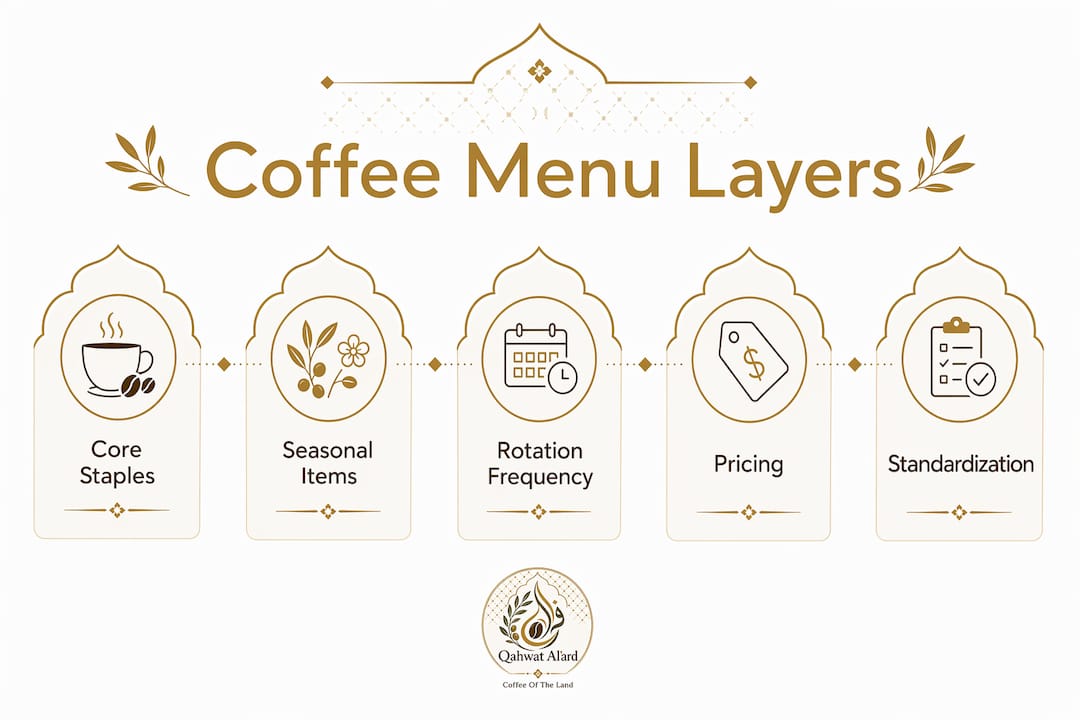
The core menu is your brand. It should include your house espresso, a milk-forward option, a black coffee, and a cold brew or iced offering. These items never leave the menu. They define what your café stands for and give regulars a reason to return daily.
Seasonal items sit on top of that foundation. Limit seasonal offerings to 2–3 items at any one time. More than three seasonal drinks simultaneously creates ingredient chaos, slows service, and confuses customers. Two well-executed seasonal drinks outperform five mediocre ones every time.
Pricing seasonal drinks for real margins
Pricing is where many café owners leave money on the table. Ingredient costs should represent 20–30% of the sale price to maintain healthy margins. A seasonal latte with $1.10 in ingredient costs should be priced between $4.25 and $5.50 depending on your market. That range delivers 70–80% gross margin, which is the standard target in specialty coffee.
Understanding single-origin pricing factors helps you make smarter sourcing decisions when building seasonal recipes around premium beans.
Pro Tip: Build a simple cost card for every seasonal drink before it goes on the menu. List every ingredient, its unit cost, and the portion used. If the total exceeds 30% of your target price, reformulate before launch.
| Menu layer | Item count | Rotation frequency |
|---|---|---|
| Core staples | 5–8 items | Permanent |
| Seasonal specials | 2–3 items | 3–4 times per year |
| Limited-time offers | 1–2 items | Event-driven |
How do you create and standardize seasonal coffee recipes?
Recipe standardization is the difference between a seasonal drink that tastes great on day one and one that tastes great on day one hundred. Standardized recipes include ingredient quantities, milk texture, garnish details, and presentation photos. Without that level of detail, flavor drift sets in within weeks as each barista makes small personal adjustments.
Follow this sequence for every new seasonal recipe:
- Experiment with ratios. Test at least three versions of each drink before committing. Adjust sweetness, spice level, and espresso volume separately so you know what each variable does.
- Write the full spec. Document every detail: grams of syrup, ounces of milk, steam temperature, foam texture, garnish placement, and cup size. Leave nothing to interpretation.
- Photograph the finished drink. A reference photo attached to the recipe card prevents presentation drift. Digital recipe management tools that include photos and precise instructions prevent flavor inconsistency across baristas.
- Run a team tasting session. Have every barista make the drink from the spec sheet before the launch date. Taste together, note discrepancies, and update the recipe if needed.
- Version-control your recipes. Date every revision. If a recipe changes after launch based on customer feedback, the team needs to know which version is current.
Building your baristas’ coffee flavor vocabulary before tasting sessions makes feedback more specific and useful. Vague comments like “it tastes off” become “the acidity is too sharp” when your team has the language to describe what they experience.
A practical approach to ingredient efficiency: design seasonal drinks using 80% or more of your existing core ingredients. A pumpkin spice latte that uses your house espresso, whole milk, and vanilla syrup as a base only requires one new ingredient: the pumpkin spice blend. That limits purchasing complexity and reduces waste when the season ends.
Pro Tip: Store all recipe cards in a shared digital folder accessible on a tablet behind the bar. Printed cards get wet, torn, and lost. A digital system with version history solves all three problems at once.
How to market and launch your seasonal coffee menu
A great seasonal drink that nobody knows about is a missed opportunity. Start marketing months before the launch date using social media teasers and loyalty program messages to build anticipation and manage inventory expectations.
Effective seasonal launch marketing follows these principles:
- Tease before you reveal. Post ingredient close-ups, color palettes, or flavor hints two to three weeks before launch. Curiosity drives more engagement than a straightforward product announcement.
- Use limited-time language deliberately. “Limited time only” messaging drives immediate trial and helps control inventory by creating urgency without discounting.
- Feature seasonal items at the point of sale. A table tent, chalkboard callout, or digital menu highlight at the register converts curious customers who would not have ordered otherwise.
- Coordinate with inventory. Launch marketing only when stock is confirmed. Running out of a seasonal ingredient two weeks into a six-week campaign damages customer trust.
- Track sales by item daily. Monitor which seasonal drink sells faster and adjust your reorder schedule accordingly. This data also informs next year’s planning.
“The cafés that build the most loyal seasonal followings treat each launch like a small event. They create a story around the drink, train their team to tell it, and give customers a reason to come back before the season ends.”
Merchandise and limited-edition branding can extend seasonal excitement beyond the cup. Seasonal café merchandise tied to a drink launch gives customers a tangible way to connect with the season and increases average transaction value.
Common seasonal menu pitfalls and how to avoid them
The most expensive mistake in seasonal menu planning is adding too many items at once. Menu engineering focuses on fewer, profitable, easy-to-make items rather than an extensive variety. Every item you add to the seasonal menu is a new thing your team must memorize, source, and execute under pressure.
Watch for these specific traps:
- Confusing popularity with profitability. A drink that sells well but takes four minutes to prepare destroys your morning rush throughput. Popular items can harm efficiency if preparation time is not factored into the decision to keep them.
- Skipping recipe standardization. One barista’s version of a brown sugar oat latte will differ from another’s without a written spec. Inconsistency is the fastest way to lose a customer who loved the drink the first time.
- Ignoring the test-lab opportunity. Seasonal specials act as test labs for future core menu items. Only items that fit your workflow and deliver strong margins deserve a permanent spot.
- Launching without staff readiness. A seasonal menu that goes live before the team is trained creates errors, slow service, and frustrated customers on the highest-traffic days of the season.
Pro Tip: Before adding any seasonal item, ask two questions: Can my fastest barista make this in under 90 seconds during a rush? Does it use ingredients already in my inventory? If the answer to either is no, rethink the recipe.
Key Takeaways
A successful seasonal coffee menu balances a stable core of 5–8 items with 2–3 rotating seasonal specials, priced at 20–30% ingredient cost, standardized with full recipe documentation, and launched with marketing that begins months before the season opens.
| Point | Details |
|---|---|
| Plan 3–4 months ahead | Start sourcing, training, and marketing well before each seasonal launch date. |
| Limit seasonal items | Offer 2–3 seasonal drinks at a time to keep operations manageable and quality high. |
| Price for 70–80% margin | Keep ingredient costs at 20–30% of the sale price on every seasonal drink. |
| Standardize every recipe | Document quantities, milk texture, garnish, and photos before any training begins. |
| Use seasonals as test labs | Only promote seasonal items to permanent status if they fit workflow and deliver strong margins. |
Why simplicity is the hardest skill in seasonal menu design
Every café owner I have spoken with goes through the same arc. They launch their first seasonal menu with six new drinks, a new syrup supplier, and a training session that runs two hours over schedule. By week two, the team is exhausted, two ingredients are running low, and the drink that was supposed to be the star is taking three minutes to make during the morning rush.
The lesson is not that seasonal menus are too hard. The lesson is that complexity is the enemy of execution. The cafés that do seasonal menus best are the ones that treat restraint as a skill. Two drinks, both excellent, both fast, both using ingredients already on the shelf. That is the standard worth chasing.
What I find most underused is the test-lab function of seasonal items. A well-designed seasonal drink tells you something real about your customers and your team. If it sells consistently, gets made correctly by every barista, and does not slow the line, it belongs on the core menu. That is how the best café menus evolve: not through a big redesign, but through seasonal experiments that earn their permanent place.
The other thing most guides skip: train your team on the story of the drink, not just the recipe. Customers ask baristas what a drink tastes like. A barista who can say “it’s our house espresso with a cardamom-honey syrup, inspired by Middle Eastern coffee traditions” sells more drinks than one who says “it’s good.” Flavor vocabulary and origin knowledge are marketing tools hiding in plain sight.
— Anthony-Yasin
Build your seasonal menu on beans worth talking about
Seasonal coffee recipes start with the right base. Qahwatalard’s single-origin coffee collection gives café owners traceable, high-quality beans that bring genuine character to every seasonal drink. A Peruvian bean with natural stone fruit notes behaves differently in a fall spice latte than a generic commodity blend. That difference shows up in the cup and in the conversation your baristas have with customers.
For cafés testing new seasonal recipes before committing to a full order, the Flavored Coffees Sample Pack lets you evaluate flavor profiles without overcommitting on inventory. Qahwatalard also carries the Max Caf Blend as a high-performance espresso base built for high-volume seasonal drink programs. Every product ships with origin and sourcing details, so your team has the story ready before the season opens.
FAQ
How far in advance should I plan a seasonal coffee menu?
Plan 3–4 months before each season’s launch date to allow time for ingredient sourcing, recipe development, staff training, and marketing preparation.
How many seasonal drinks should a café offer at once?
Limit seasonal offerings to 2–3 items at a time. More than three seasonal drinks simultaneously increases ingredient complexity and slows service during peak hours.
What ingredient cost percentage should seasonal drinks target?
Ingredient costs should represent 20–30% of the sale price. A drink with $1.10 in ingredient costs should be priced between $4.25 and $5.50 to maintain 70–80% gross margins.
How do I keep seasonal drinks consistent across baristas?
Standardize every recipe with documented ingredient quantities, milk texture, garnish details, and a reference photo. Digital recipe management tools prevent flavor drift better than printed cards.
Can a seasonal drink become a permanent menu item?
Yes, and it should if the drink fits your operational workflow, sells consistently, and delivers strong margins. Treat seasonal specials as a test lab for future core menu additions.


