


Every decaf coffee on the shelf owes its lower caffeine content to one of four commercial processes: Swiss Water, supercritical CO2, ethyl acetate (often sold as the “sugarcane” method), and methylene chloride, sometimes labeled the “European” process. All four work on green, unroasted beans, and U.S. standards require at least 97% of the caffeine removed before a coffee can legally be called decaf. If avoiding synthetic solvents matters to you, look for Swiss Water or CO2 on the bag; if price matters more, ethyl acetate and methylene chloride are the budget routes.
TL;DR:
- Swiss Water and supercritical CO2 decaffeination avoid synthetic solvents, making them preferable for health-conscious consumers seeking chemical-free options.
- The Swiss Water process relies on water and filtration, retaining most original flavors but generally costs more than solvent methods.
- Supercritical CO2 decaffeination uses high-pressure carbon dioxide to selectively extract caffeine, preserving flavor while requiring expensive equipment.
- Methylene chloride, the least costly method, is common in mass-market decaf and leaves trace residues below safety thresholds, often without clear labeling.
- Residual caffeine in decaf usually measures a few milligrams per 8-ounce cup, still not entirely caffeine-free, with at least 97% caffeine removed as per U.S. standards.
Table of Contents
- Swiss Water Process: Water-Only Decaffeination
- Supercritical CO2: High-Pressure Carbon Dioxide Extraction
- Ethyl Acetate: The “Sugarcane” Decaf Method
- Methylene Chloride: The Direct Solvent (“European”) Method
- What “Decaf” Actually Means: Residuals, Testing, and Labels
- How Decaf Beans Behave Differently, and How to Brew Them Right
- Why Trust This Guide
- Editor’s Perspective: Picking Decaf by Priority
- Taste the Difference Yourself
- Sources
- FAQ
Swiss Water Process: Water-Only Decaffeination
Swiss Water skips solvents entirely and relies on a clever loop of water and carbon filtration. The process starts by soaking a batch of green beans in hot water until it pulls out caffeine along with flavor compounds, oils, and sugars. That liquid, called Green Coffee Extract, gets run through activated carbon filters that trap caffeine molecules but let the larger flavor compounds pass through.
Here’s the trick: that flavor-saturated, caffeine-free extract becomes the decaffeinating agent for the next batch of beans. Because the extract is already full of coffee solubles, only caffeine has anywhere left to go. It moves out of the new beans by osmosis, chasing equilibrium, while the flavor compounds already in the beans stay put. The process typically runs several hours to a full day per batch, depending on the target caffeine level.
- No chemical solvents touch the beans at any stage.
- Often organic certified, since there’s no synthetic input to disqualify it.
- Look for “Swiss Water Process” printed directly on the bag, along with the trademarked logo.
- Flavor tends to stay closer to the original bean, though very delicate origins can lose a touch of brightness.
- Costs more than solvent-based decaf, which shows up in retail price.
Pro Tip: If a bag doesn’t name its decaffeination method at all, it’s rarely Swiss Water. Producers who pay for the process almost always print the logo, since it’s their strongest selling point.
Supercritical CO2: High-Pressure Carbon Dioxide Extraction
Supercritical CO2 decaffeination pushes carbon dioxide to roughly 73 times atmospheric pressure and heats it until it behaves like both a liquid and a gas at once. In that state, CO2 slips into the beans and grabs caffeine molecules with remarkable precision, largely leaving oils, sugars, and aromatic compounds alone. That selectivity is why coffee people consider it the closest thing to a clean extraction. Once the CO2 has absorbed the caffeine, pressure is released, the CO2 reverts to gas, and the caffeine is filtered out, usually recovered and sold to soft drink or pharmaceutical companies.
- Preserves flavor better than most solvent methods because it targets caffeine almost exclusively.
- Requires expensive high-pressure equipment, which is why it’s used mainly by larger processors rather than small operations.
- Leaves no chemical residue behind since the extracting agent is just pressurized CO2.
- Watch for labels saying “CO2 processed” or “carbon dioxide decaffeinated.”
- Best suited to drinkers who want the closest match to a regular roast’s body and aroma.
The tradeoff is scale. CO2 decaf only makes economic sense when a facility is running large volumes, so you’ll see it more often from established specialty roasters than tiny craft operations.
Ethyl Acetate: The “Sugarcane” Decaf Method
Ethyl acetate decaffeination, often marketed as the “sugarcane method” or “natural process,” uses a solvent derived from fermented sugarcane to strip caffeine from the beans. The beans get steamed to open their pores, then washed in an ethyl acetate solution that binds to caffeine and pulls it out, followed by rinsing and drying.
The word “natural” is where things get slippery. Ethyl acetate can be derived from sugarcane or other plant sources, which is technically true. But once it’s synthesized into an industrial solvent, it functions exactly like any other solvent in the extraction process, natural origin or not.
- Landed roughly in the middle on both flavor impact and price, between Swiss Water and methylene chloride.
- Tends to preserve a rounder, sweeter flavor profile than harsher solvent methods.
- Check labels for “EA processed,” “sugarcane processed,” or “naturally decaffeinated.”
- If a bag just says “natural” with no process named, ask the roaster directly before assuming it’s solvent-free.
Methylene Chloride: The Direct Solvent (“European”) Method
Methylene chloride decaffeination, still called the European method in some markets, is the oldest industrial approach and remains the cheapest. Green beans are steamed to swell their cell structure, then repeatedly rinsed with methylene chloride, which bonds directly to caffeine molecules. After several cycles, the beans get steamed again to drive off residual solvent before drying and shipping to roasters.
Regulators allow trace residues because the amounts left behind are minuscule. Residual solvent levels in finished decaffeinated coffee typically measure below 0.5 milligrams per kilogram, well under thresholds considered a health concern by food safety agencies.
- Cheapest of the four methods, which is why it dominates mass-market decaf.
- Common in coffee that doesn’t name its decaffeination process on the packaging.
- Repeated steaming cycles are designed specifically to drive off solvent before roasting.
- Transparency is the tell: roasters proud of their process name it; those using methylene chloride often just say “decaffeinated” and stop there.
What “Decaf” Actually Means: Residuals, Testing, and Labels
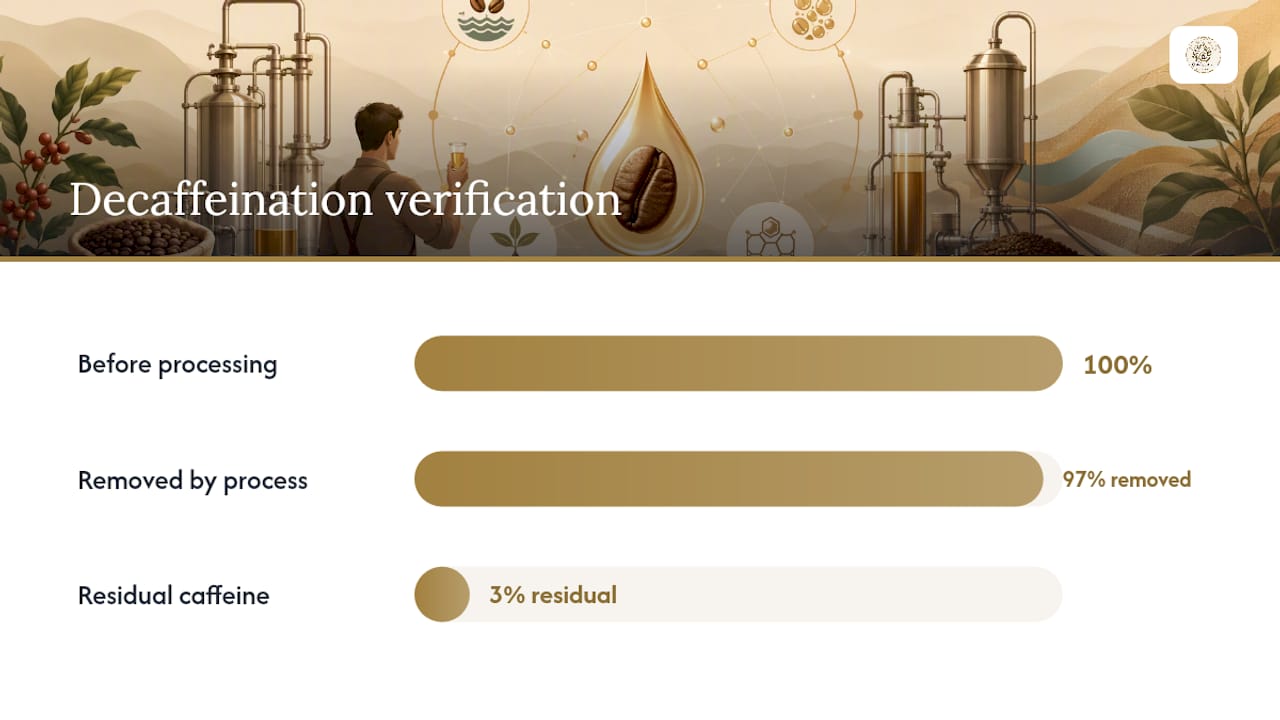
The legal bar in the United States is at least 97% caffeine removal, and every method above is capable of clearing that line when run correctly. That still leaves a small amount of caffeine in the cup, typically a few milligrams per 8 ounce serving, compared to 80 to 100 milligrams in a regular brew.
Roasters and solvent suppliers verify caffeine content with high performance liquid chromatography, the industry standard for precision. Some producers have shifted to near-infrared spectroscopy for faster, cheaper screening on the production line, reserving HPLC for periodic confirmation.
- Swiss Water and CO2 logos signal solvent-free processing outright.
- “EA” or “sugarcane processed” means ethyl acetate, not zero-solvent.
- No method named on the bag usually points to methylene chloride.
- Residual solvent in green coffee runs below 1 mg/kg, and roasted coffee even lower, across all commercial methods.
If you’re avoiding caffeine strictly for a medical reason, talk to your doctor. Decaf still contains a small, measurable amount, and “decaffeinated” isn’t the same as “caffeine-free.”
How Decaf Beans Behave Differently, and How to Brew Them Right
Every one of these methods happens on green beans specifically, because roasting permanently changes the bean’s cellular structure and makes caffeine extraction ineffective afterward. That pre-roast processing leaves its mark: decaffeinated beans come out more porous and more brittle than regular green coffee, since water, CO2, or solvent has already worked its way through the cell walls once.
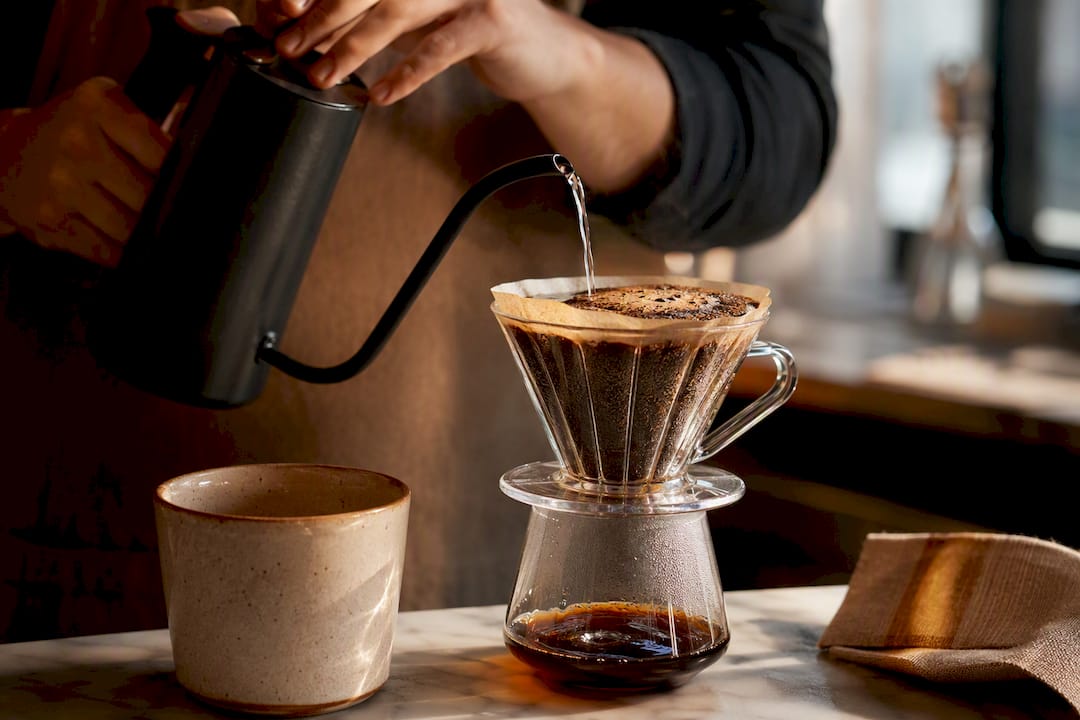
That structural change shows up at the brewing stage. Decaf tends to extract faster, produces noticeably less crema in espresso, and can lose a few of the lighter aromatic compounds depending on which method processed it. Adjusting grind size, dose, and water temperature compensates for most of it.
- Grind slightly coarser than you would for the same origin’s caffeinated version. Faster extraction means over-extraction risk climbs fast.
- Lower your water temperature by 3 to 5 degrees Fahrenheit for pour-over and immersion brewing.
- For espresso, tamp and distribute with extra care. Brittle grounds channel more easily than standard beans.
- Shorten your brew time slightly, or expect a sourer, more bitter cup.
- If crema looks thin, that’s normal for decaf espresso and not a sign of a bad shot.
Pro Tip: Pull your decaf espresso shot a few seconds shorter than usual and taste before adjusting further. Most over-corrections happen because brewers chase the caffeinated bean’s timing on a bean that behaves differently.
Why Trust This Guide
Qahwat Al’ard sources and roasts single-origin coffee with full traceability back to growing regions like Colombia, Peru, Bali, and Uganda, and publishes detailed breakdowns of decaffeination methods and residual caffeine levels as part of its ongoing coffee education work. This article draws on the same reference points the specialty coffee industry relies on for verification, including HPLC testing protocols and the U.S. 97% removal standard, rather than marketing claims from any single processor.
Editor’s Perspective: Picking Decaf by Priority
If chemical-free processing is your top priority, check the bag for the Swiss Water logo or “CO2 processed” language first. Roast date comes second. Decaf beans stale faster than regular beans because of their increased porosity, so a bag roasted three weeks ago outperforms a fresher-tasting claim on an older one. Third, match roast profile to your palate rather than assuming darker roast masks decaf’s flavor gaps; it often just adds bitterness on top of them.
Paying more for Swiss Water or CO2 makes sense when you’re drinking decaf regularly and care about nuance. Ethyl acetate is a fair middle ground for casual drinkers. Methylene chloride works fine if cost is the deciding factor and you’re not sensitive to trace solvents. Specialty decaf is smaller-batch by nature, so availability runs tighter than regular roasts.
— Yasin Sofyian Ayesh
Taste the Difference Yourself
Reading about decaffeination methods only gets you so far. Qahwat Al’ard’s catalog gives you a direct way to compare how different processing approaches actually taste in the cup, without guessing based on a label alone. The Cold Brew Coffee and Cold Brew Coffee selections let you taste how a smoother, low-acid brewing method interacts with bean structure, while Coffee with Mushrooms Medium Roast offers a distinct flavor profile for readers curious about functional blends alongside traditional single-origin roasts.
Each product page lists origin and roast details, and if a specific decaffeination method matters to your purchase, Qahwat Al’ard’s customer service team can confirm processing details before you order. Pick a bag, check the notes, and brew a side-by-side comparison in your own kitchen.
Sources
- How is Decaf Coffee Made? And is it really caffeine-free? — The Conversation
- Decaffeination — ScienceDirect Topics
- Decaffeination — Wikipedia
- Decaffeination — Britannica
FAQ
Which decaffeination method is healthiest?
Swiss Water and supercritical CO2 are generally considered the better choices for health-conscious drinkers since they avoid synthetic solvents entirely, though all four commercial methods meet food safety standards for residual chemicals.
Does Dunkin’ Donuts use chemicals to decaffeinate its coffee?
Major commercial coffee brands typically don’t disclose their specific decaffeination supplier or method on packaging, so it’s best to contact the company directly if a specific process matters to your purchase.
What companies avoid chemical solvents in decaf coffee?
Roasters that use Swiss Water or supercritical CO2 processing avoid chemical solvents, and both methods are usually printed clearly on the bag, since producers see it as a selling point worth highlighting.
What is the European method of decaffeination?
The European method refers to direct solvent decaffeination using methylene chloride, where steamed green beans are rinsed repeatedly with the solvent to bond with and remove caffeine before a final steaming drives off residual traces.
How much caffeine is actually left in decaf coffee?
U.S. standards require at least 97% caffeine removal, leaving a small amount, typically a few milligrams per 8 ounce cup, compared to 80 to 100 milligrams in regular coffee.


