


Decaf coffee is made from green beans that have had most of their caffeine removed using one of four main approaches: solvent-based (direct or indirect), water-based (Swiss Water and similar), supercritical CO2, or triglyceride/oil extraction. According to Britannica, all of these processes happen before roasting, and U.S. labeling rules require at least 97% caffeine removal before a product can be called “decaffeinated.”
Here is the quick landscape, method by method:
- Solvent-based (direct or indirect): Methylene chloride or ethyl acetate washes caffeine from the beans. Cost-effective and widely used, but some buyers prefer to avoid chemical solvents. Best for budget-conscious shoppers and commodity decafs.
- Swiss Water Process: Water and activated charcoal do all the work, no solvents involved. Favored by specialty and organic producers. Best for flavor-first and organic buyers.
- Supercritical CO2: High-pressure carbon dioxide selectively pulls caffeine with minimal flavor disruption. Expensive equipment limits it to large commercial runs. Best for large-batch specialty decaf.
- Triglyceride/oil method: Coffee oils draw out caffeine through heat and soaking. Niche, rarely labeled, and less common in retail.
One-line verdict: Choose Swiss Water for solvent-free flavor preservation. Choose CO2 for the cleanest large-batch specialty result. Choose a solvent-based decaf if budget matters more than processing purity.
Key Takeaways
The decaffeination method used on green beans before roasting determines how much flavor survives, whether solvents are involved, and whether a product qualifies for organic certification.
| Point | Details |
|---|---|
| Pre-roast timing is fixed | All decaffeination happens on green beans; roasting seals pores and makes extraction ineffective afterward. |
| U.S. standard: ≥97% removal | A product must remove at least 97% of caffeine to carry the “decaffeinated” label in the United States. |
| Swiss Water for solvent-free flavor | Swiss Water Process uses water and activated charcoal, no solvents, and is the top choice for organic and specialty decaf. |
| CO2 for large-batch specialty | Supercritical CO2 offers the highest selectivity but requires expensive equipment, making it practical mainly at commercial scale. |
| Qahwat Al’Ard for traceable decaf | Qahwat Al’Ard’s single-origin selections and pod formats offer origin-transparent options; check product pages or contact support for method details. |
Table of Contents
- What is decaffeination and when does it happen?
- How do solvent-based decaf coffee methods work?
- How does the Swiss Water Process preserve flavor?
- What makes supercritical CO2 decaffeination different?
- What is the triglyceride method and other proprietary techniques?
- How do the main decaffeination methods compare?
- How does decaffeination affect flavor and health?
- How to read decaf labels and buy the right method
- What experts and research say about decaf methods
- An honest perspective on choosing decaf
- Qahwat Al’Ard’s decaf and single-origin selections
- Sources
- FAQ
What is decaffeination and when does it happen?
Decaf is not a different coffee species. It is the same green Arabica or Robusta bean you would find in any bag of regular coffee, just processed to strip out most of its caffeine before it ever sees a roaster.
The timing matters. Decaffeination always happens at the green bean stage, before roasting. Green beans are porous and their cell structure is still open, which lets solvents, water, or CO2 move in and carry caffeine out. Once roasting begins, heat seals those pores and locks compounds inside. Trying to decaffeinate a roasted bean would be like trying to squeeze juice from a raisin.
From a chemistry standpoint, caffeine is a water-soluble alkaloid. Green beans, especially after a brief steam or soak, release caffeine readily into whatever extraction medium surrounds them. That is the physical opening every decaffeination method exploits.
The U.S. regulatory standard: The FDA-aligned industry threshold requires that at least 97% of the original caffeine be removed for a product to carry the “decaffeinated” label in the United States. A typical 8-ounce cup of decaf contains somewhere in the range of 2–15 mg of caffeine, compared to roughly 80–100 mg in a standard cup of regular coffee. That residual amount is small but real, which matters for anyone with high caffeine sensitivity.
Regulatory callout: U.S. standard for “decaffeinated” = ≥97% caffeine removed, per Britannica’s decaffeination entry.
How do solvent-based decaf coffee methods work?
Solvent-based processing is the most common decaffeination approach globally, and it splits into two distinct workflows.
Direct solvent method
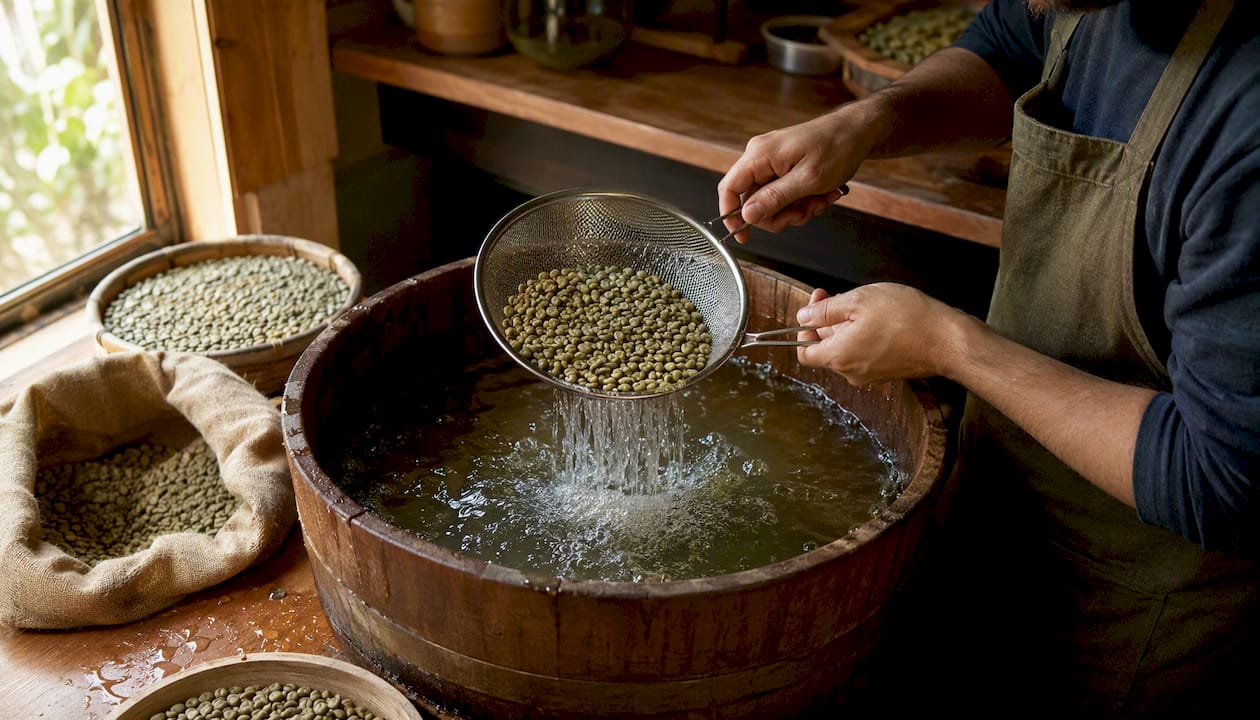
Beans are steamed to open their pores, then repeatedly rinsed with a solvent, either methylene chloride (also called dichloromethane) or ethyl acetate. The solvent bonds with caffeine molecules and carries them away. After several wash cycles, the beans are steamed again to drive off residual solvent, then dried. The whole process is efficient and relatively inexpensive.
Indirect solvent method
Here, beans are soaked in hot water first, which pulls out caffeine along with flavor compounds. The water is then separated from the beans and treated with solvent to remove the caffeine. After the caffeine-laden solvent is removed, the flavor-rich water is reintroduced to the beans so they can reabsorb their aromatic compounds. The beans themselves never directly contact the solvent, which is where the “indirect” label comes from and why some producers consider it a gentler approach for flavor.
Solvents in use today
Per Home Coffee Expert’s decaf guide, the two solvents used in modern commercial decaffeination are:
- Methylene chloride (dichloromethane): Highly effective at binding caffeine, fast, and inexpensive. Residual amounts after steaming and roasting are extremely low, well within FDA limits, but some consumers prefer to avoid it on principle.
- Ethyl acetate: Often marketed as “naturally decaffeinated” because ethyl acetate occurs naturally in fruit. In practice, the commercial-grade version used in decaffeination is almost always synthetically produced. Still, it carries a cleaner perception for many buyers.
Benzene and trichloroethylene, used in earlier decades, were phased out entirely once their health risks became clear. No reputable producer uses them today.
Safety in practice: After solvent washing, beans go through extended steaming and drying. Roasting at high temperatures then burns off any trace that remains. Regulatory agencies including the FDA monitor residue limits, and analytical testing methods such as HPLC verify compliance before products reach shelves.
Pros and cons at a glance:
- Pros: low cost, scalable, widely available, removes caffeine efficiently
- Cons: perceived chemical use, some volatile aroma loss, ethyl acetate’s “natural” claim is often misleading
Label cues for solvent methods: Look for “decaffeinated with methylene chloride,” “decaffeinated with ethyl acetate,” or simply “naturally decaffeinated” (the last phrase usually signals ethyl acetate).
Pro Tip: If a decaf bag says “naturally decaffeinated” without specifying the agent, ask the roaster directly. That phrase almost always means ethyl acetate, not water.
How does the Swiss Water Process preserve flavor?
The Swiss Water Process is the method most specialty roasters reach for when they want solvent-free decaf that still tastes like the origin it came from. The mechanics are clever.
Step by step:
- A batch of green beans is soaked in hot water, which draws out caffeine and flavor compounds together. This first batch is discarded.
- The resulting water, now saturated with flavor compounds but still containing caffeine, is passed through activated charcoal filters. Charcoal traps caffeine molecules (which are larger) while letting the smaller flavor compounds pass through. The result is called Green Coffee Extract (GCE).
- New batches of green beans are then soaked in this GCE. Because the GCE is already saturated with flavor compounds, only caffeine diffuses out of the new beans. Flavor stays put.
- The GCE is continuously recirculated through the charcoal filters to strip caffeine, then reused.
The Swiss Water Process is certified organic-compatible and solvent-free, which is why it dominates the specialty and organic decaf market. Caffeine removal rates typically reach 99.9% by the company’s own reporting, well above the U.S. 97% threshold.
The tradeoff is cost and availability. Swiss Water processing is more expensive than solvent methods, and not every origin or lot is processed this way. You will generally find it on higher-end single-origin decafs and certified organic bags. The label will say “Swiss Water Process” or “Swiss Water Decaf” explicitly.
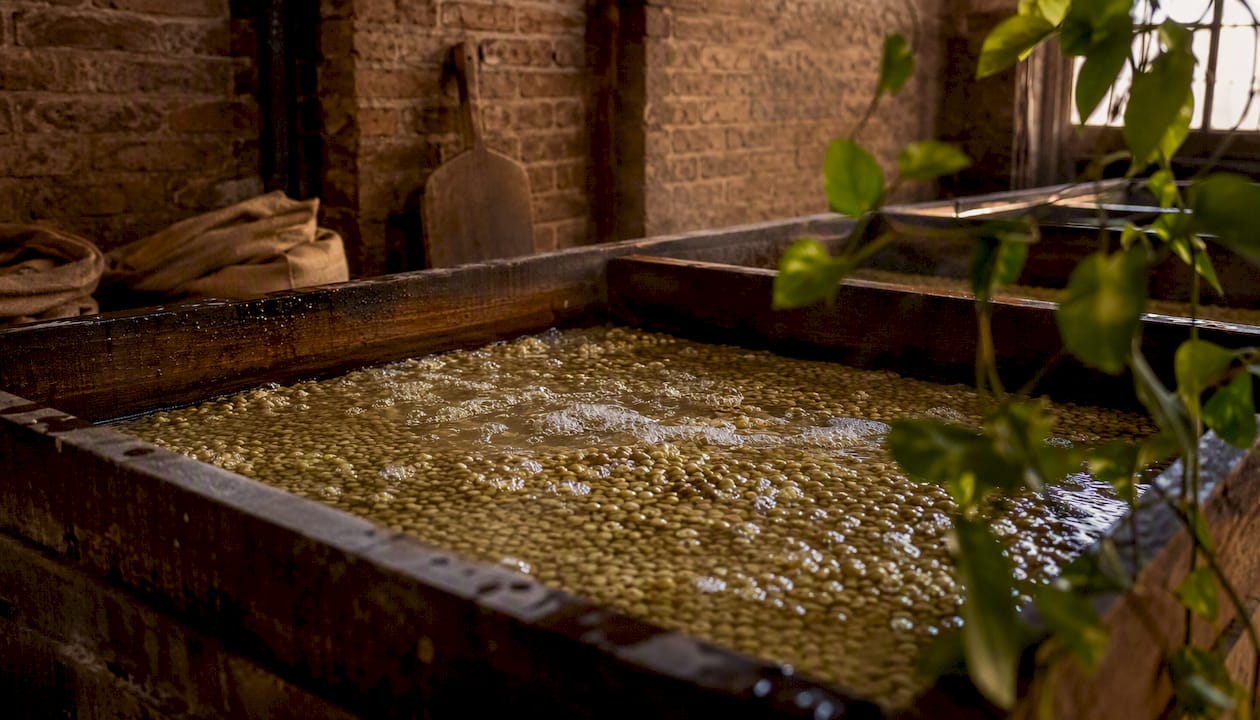
Other water-process variants exist under different proprietary names, but the core mechanics follow the same GCE-and-charcoal logic. If a bag says “water processed” without specifying Swiss Water, the method is similar but may not carry the same third-party certification.
What makes supercritical CO2 decaffeination different?
CO2 decaffeination is the most technically precise method available, and the chemistry behind it explains why it preserves flavor so well.
When CO2 is pressurized above roughly 1,071 psi (74 bar) and heated above 31°C, it enters a “supercritical” state where it behaves simultaneously like a liquid and a gas. In that state, it becomes a highly selective solvent. It dissolves caffeine efficiently while leaving most of the larger aromatic and flavor molecules untouched.
How the process runs:
- Green beans are soaked in water to soften them and open their cell structure.
- Supercritical CO2 is pumped through the beans under high pressure. Caffeine dissolves into the CO2.
- The caffeine-laden CO2 is moved to a separate chamber where pressure drops, caffeine precipitates out, and the CO2 is recycled back into the system.
The selectivity is the real advantage. Many of the volatile compounds responsible for floral, fruity, and complex notes in single-origin coffees survive the process intact. Research on decaffeination’s effects on volatile compounds confirms that method choice meaningfully affects which aromatic compounds survive.
The catch is capital cost. The high-pressure equipment required is expensive to build and operate, so CO2 decaffeination is typically used by large commercial processors handling significant volumes. You will see it on some premium specialty decafs, but it is less common than Swiss Water at the craft roaster level. Caffeine removal is generally very high.
What is the triglyceride method and other proprietary techniques?
The triglyceride method is the least common of the four main approaches, and most consumers will never see it labeled on a bag. Here is how it works: green beans are soaked in a coffee solution (often made from spent coffee grounds) to draw caffeine to the surface of the bean. The beans are then immersed in coffee oils containing triglycerides at high temperatures. Those triglycerides bond with caffeine and pull it out of the beans.
The result is a decaf that retains a strong coffee-oil character, which some producers argue preserves body and mouthfeel better than water-based methods. The process is entirely solvent-free and uses coffee-derived materials throughout.
In practice, the triglyceride method is rare in U.S. retail. It requires specialized equipment and is used by a small number of commercial processors. You are unlikely to see it explicitly labeled unless a producer specifically markets it as a selling point.
Other proprietary and hybrid methods do exist, including variations that combine elements of water processing with modified solvent or CO2 steps. These tend to be trade-secret processes used by specific large processors and are rarely disclosed on consumer packaging. If a label says “proprietary decaffeination process” without further detail, that is usually what it means.
How do the main decaffeination methods compare?
| Method | How it works | Solvent / agent | Flavor preservation | Ideal use | Organic compatible | Cost / availability | Health / residue concerns |
|---|---|---|---|---|---|---|---|
| Direct solvent | Solvent washes beans directly after steaming | Methylene chloride or ethyl acetate | Moderate; some volatiles lost | Commodity, blends | No | Low cost; widely available | Residues removed by steaming and roasting; FDA-monitored |
| Indirect solvent | Water soak extracts flavor + caffeine; solvent treats water only | Methylene chloride or ethyl acetate | Better than direct; flavor reabsorbed | Commodity to mid-tier | No | Low to moderate cost | Beans never contact solvent directly; residues minimal |
| Swiss Water Process | Water and activated charcoal; no solvents | Water + activated charcoal | High; GCE preserves flavor compounds | Specialty, single-origin, organic | Yes | Higher cost; widely labeled | No chemical residues; solvent-free |
| Supercritical CO2 | High-pressure CO2 selectively dissolves caffeine | CO2 | Very high; selective extraction | Large commercial specialty lots | Yes | High equipment cost; less common | No chemical residues; CO2 recycled |
| Triglyceride / oil | Coffee oils draw caffeine from soaked beans | Coffee triglycerides | Good body retention | Niche commercial | Yes | Rare; specialized equipment | No chemical residues; coffee-derived agents |
Best-for recommendations:
- Best for flavor preservation: Swiss Water Process or CO2, both of which protect the volatile compounds that make single-origin coffees worth drinking
- Best for organic shoppers: Swiss Water Process (widely certified organic-compatible and third-party verified)
- Best for budget: Direct or indirect solvent methods, which deliver reliable caffeine removal at lower cost
- Best for large-scale commercial specialty lots: Supercritical CO2, where the equipment investment pays off at volume
One important caveat: flavor outcomes vary by producer, origin, and roast profile even within the same method. A well-executed solvent-based decaf from a skilled roaster can outperform a poorly handled Swiss Water lot. Method is one variable, not the whole story.
How does decaffeination affect flavor and health?
Flavor loss is the honest tradeoff in every decaffeination method. Caffeine itself is nearly tasteless, but the processes used to remove it inevitably affect other compounds. Research on volatile compound changes shows that certain floral, green, and fruity aromatic compounds decrease after decaffeination, with the degree of loss varying by method. Solvent methods tend to strip more volatiles because the solvent is not perfectly selective. CO2 and Swiss Water methods are more targeted, which is why specialty roasters prefer them for origin-forward decafs.
Roasting after decaffeination can compensate for some of that loss. Skilled roasters adjust their profiles to coax more Maillard and caramelization development from decaffeinated beans, partially rebuilding complexity that the extraction process reduced.
Statistic callout: U.S. rules require ≥97% caffeine removal to label coffee “decaffeinated.” A typical decaf cup contains roughly 2–15 mg of caffeine, compared to 80–100 mg in regular coffee, per Britannica.
On the health and safety side, the picture is reassuring. Consolidated reviews of decaffeination chemistry confirm that residual solvent levels after steaming, drying, and roasting fall well below regulatory thresholds. The FDA monitors methylene chloride residues specifically, and the roasting process itself burns off any remaining trace amounts at temperatures that far exceed solvent boiling points.
Which methods best preserve single-origin character:
- CO2 extraction: highest selectivity, most aromatic compounds survive
- Swiss Water Process: excellent for preserving origin notes, especially in lighter roast profiles
- Indirect solvent: better than direct because flavor compounds are reabsorbed
- Direct solvent: most volatile loss, best suited to blends where origin character is less critical
How to read decaf labels and buy the right method
Most decaf bags do not volunteer the processing method upfront. You have to know where to look and what the language actually means.
Label checklist:
- “Swiss Water Process” or “Swiss Water Decaf”: solvent-free, organic-compatible, third-party certified
- “Water processed” or “water decaffeinated”: similar to Swiss Water but may not carry the same certification
- “CO2 decaffeinated” or “supercritical CO2”: high-end, flavor-preserving, usually on specialty or premium bags
- “Naturally decaffeinated”: almost always ethyl acetate; not water-based despite the implication
- “Decaffeinated with methylene chloride” or “decaffeinated with ethyl acetate”: direct disclosure of solvent method
- No method listed: common on commodity supermarket decafs; assume solvent-based unless stated otherwise
Where to find method information:
- Check the front or back panel of the bag for a process callout.
- Look at the roaster’s product page online, where specialty producers usually disclose the method.
- If the bag is silent, email or call the roaster directly. Any producer proud of their decaf process will tell you.
- For single-origin decafs, check whether the origin’s flavor complexity is a selling point on the product page. If it is, the roaster almost certainly used Swiss Water or CO2.
Practical buying tips:
- For single-origin tasting, prioritize Swiss Water or CO2 decafs. The origin character you are paying for survives those methods better.
- For blended supermarket decafs where consistency and price matter more than origin notes, solvent-based is fine and widely available.
- If organic certification matters to you, look for Swiss Water specifically, since it is the most commonly certified option.
- When caffeine sensitivity is a real concern, check the product page or ask the roaster about their typical residual caffeine levels. The 97% removal standard still leaves trace amounts.
On Qahwat Al’Ard’s product pages, look for method disclosures in the product description or the sourcing notes. If the method is not listed, the customer support team can clarify before you order.
What experts and research say about decaf methods
The clearest takeaway from both industry commentary and peer-reviewed literature is that “best” is not a fixed answer. Roastopedia’s decaf overview puts it plainly: the preferred method depends entirely on what the buyer values. Solvent methods win on cost and scale. Swiss Water and CO2 win on flavor fidelity and solvent-free processing. Neither is objectively superior across all priorities.
A few research-backed points to anchor:
- Decaffeination always happens on green beans. The chemistry and porosity of unroasted beans make efficient extraction possible. After roasting, that window closes. This is confirmed across The Conversation’s chemistry explainer and Wikipedia’s decaffeination entry.
- Volatile compound loss is real and method-dependent. PubMed research documents measurable changes in aromatic profiles after decaffeination, with the degree varying by process.
- Residue testing is rigorous. NCBI/PMC review literature covers the analytical methods (HPLC, NIR spectroscopy) used to verify compliance, which gives the regulatory framework real teeth.
- Consumer perception often drives method choice more than chemistry does. Ethyl acetate’s “natural” framing, for example, is largely a marketing position rather than a meaningful safety distinction from methylene chloride at regulated residue levels.
The specialty coffee world has largely settled on Swiss Water and CO2 as the prestige options, not because solvent methods are unsafe, but because the flavor argument for solvent-free processing is genuinely strong for high-quality single-origin lots.
An honest perspective on choosing decaf
The debate over decaf methods often gets framed as “chemical vs. natural,” and that framing does more harm than good. Methylene chloride at FDA-regulated residue levels is not a meaningful health risk. Ethyl acetate is not meaningfully “natural” in its commercial form. The real question is flavor, and on that axis, the evidence is clear: Swiss Water and CO2 preserve more of what makes a good coffee worth drinking.
What I find more interesting is how rarely the conversation reaches the roasting step. Decaffeination strips some precursors that contribute to aroma development during roasting. A roaster who understands that and adjusts their profile accordingly can produce a decaf that competes seriously with their regular offerings. One that does not make that adjustment will deliver a flat cup regardless of which decaffeination method was used upstream. Method matters, but so does what happens after the beans come out of the decaffeination vessel.
For buyers who care about origin character, the practical advice is simple: find a roaster who discloses their decaffeination method and talks about how they roast their decaf differently. That combination of transparency and craft is what separates a genuinely good decaf from one that just happens to have less caffeine.
Qahwat Al’Ard’s decaf and single-origin selections
Knowing how decaffeination works is only useful if you can find coffee that reflects those standards. Qahwat Al’Ard’s catalog is built around traceability and origin transparency, which means the sourcing detail that matters to decaf buyers is part of how the brand operates, not an afterthought.
For convenience-format options, the 12 Pack Single Serve Coffee Capsules and 60 Pack Single Serve Coffee Pods are worth checking for current decaf availability. The Instant Coffee option suits buyers who want a quick cup without a brewer. For origin-forward selections, the Peru Coffee Pods showcase single-origin character in a pod format. If you want to compare caffeinated and decaf options side by side, the Max Caf Blend gives you a reference point for what full-caffeine looks like from the same catalog. Browse the full single-origin collection to see what is currently available. If the decaffeination method is not listed on a product page, contact customer support before ordering.
Sources
- Decaffeination — Britannica
- Retaining flavor while removing caffeine − a chemist explains — The Conversation
- Decaf Coffee: Definition, Decaffeination Process & Comparison Guide — Roastopedia
- PubMed article — study on decaffeination effects
- NCBI PMC review article on related chemistry and processing
- How Decaf Coffee is Made - Easy to Follow Guide with Infographic
FAQ
What is the best method for decaf coffee?
No single method is best for every buyer. Swiss Water Process is the top choice for solvent-free flavor preservation and organic compatibility; supercritical CO2 offers the highest selectivity for large-batch specialty lots; solvent methods (methylene chloride or ethyl acetate) are the most cost-effective for commodity decaf, per Roastopedia.
Which decaf coffee method is the healthiest?
All commercially approved methods produce coffee with residual solvent levels well below FDA thresholds, making them safe by regulatory standards. Swiss Water and CO2 methods involve no chemical solvents at all, which some buyers prefer on principle, though the health distinction from properly processed solvent-based decaf is minimal at regulated levels.
What are the three main methods of decaffeination?
The three most widely used methods are solvent-based (direct and indirect), water-based (Swiss Water Process and similar), and supercritical CO2 extraction. A fourth method, triglyceride/oil processing, exists but is rare in U.S. retail, per Britannica.
What is the European method of decaffeination?
The “European method” typically refers to indirect solvent decaffeination using methylene chloride or ethyl acetate, where beans are soaked in water first and the solvent treats the water rather than the beans directly. It is called “European” because it became widely adopted in European commercial processing, though it is used globally today.
Does decaf coffee still contain caffeine?
Yes. U.S. rules require at least 97% caffeine removal, but a typical decaf cup still contains roughly 2–15 mg of caffeine. Anyone with high caffeine sensitivity should check with the roaster for specific residual levels, since variability exists across methods and producers.


