


TL;DR:
- A burr grinder, a simple brewing device, and a digital scale are essential tools for beginner coffee enthusiasts. These items ensure consistent extraction, ease of use, and accurate measurement to produce café-quality coffee at home. Prioritizing these core accessories over complex equipment helps beginners develop fundamental skills and enjoy better tasting coffee.
The three coffee accessories for beginners that matter most are a burr grinder, a simple brewing device, and a digital scale. These tools are collectively called your “brewing kit” in the specialty coffee world, and together they deliver café-quality results at home without complexity or overspending. Popular entry-level picks like the Baratza Encore grinder, Hario V60 dripper, and Timemore Basic scale give you everything you need to start brewing well under $200. This guide tells you exactly what to buy, what to skip, and how to build your setup smartly.
1. why a burr grinder is your most important tool
A burr grinder is the single biggest upgrade you can make to your home coffee setup. The grinder controls particle size distribution, which directly determines how evenly water extracts flavor from your coffee grounds. Uneven particles produce a mix of over-extracted bitter notes and under-extracted sour ones in the same cup.
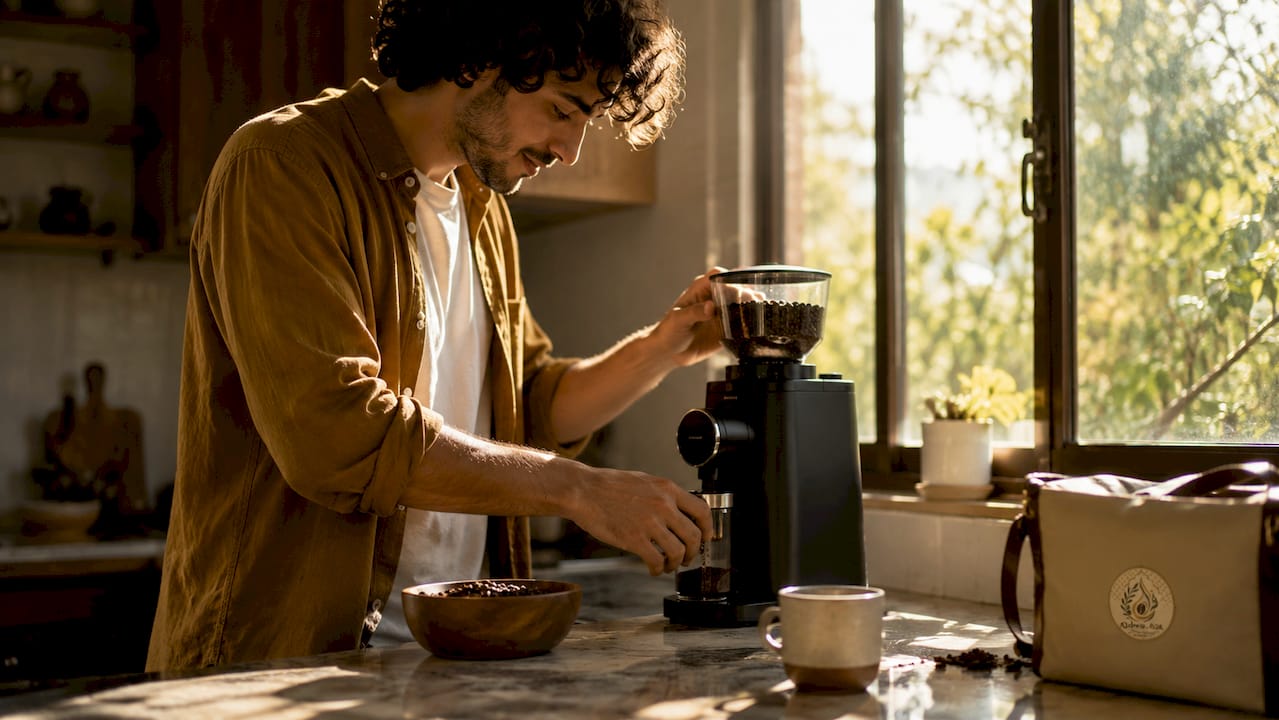
Blade grinders chop beans randomly, creating wildly inconsistent particle sizes. Burr grinders crush beans between two abrasive surfaces, producing uniform grounds you can adjust for any brew method. That consistency is why grinder quality is the primary control variable for extraction quality.
Three strong entry-level burr grinders for beginners:
- Baratza Encore ($175): Electric, 40 grind settings, covers French press to espresso. Widely recommended as the best entry-level grinder for versatility and consistency.
- KINGrinder K6 (~$70): Manual hand grinder, compact, excellent for travel or small kitchens.
- OXO Brew Conical Burr (~$100): Electric, simple dial interface, good for drip and pour-over.
Understanding how grind size affects your cup is a skill that pays off every single brew. Read Qahwatalard’s guide on coffee grind consistency to get a clear picture of how coarse versus fine settings change your flavor.
Pro Tip: Start with a medium grind setting and adjust one step at a time. If your coffee tastes bitter, go coarser. If it tastes sour or weak, go finer.
2. choosing the right brewing device
The brewing device shapes the texture, clarity, and body of your cup. The right choice depends on how much technique you want to learn and what flavor profile you prefer.
French Press is the most forgiving brewer for beginners. It uses full immersion, meaning the grounds steep in water for several minutes before you press a metal filter down. French press suits darker roasts and produces a rich, full-bodied cup with minimal technique required. A quality press costs $25–$50.
Pour-over (Hario V60, Chemex) requires more attention. You pour hot water in slow, controlled circles over a paper filter. The result is a cleaner, brighter cup that highlights the nuanced flavors of lighter roasts. The Hario V60 costs around $15–$25 for the dripper alone, making it one of the most affordable beginner coffee brewing equipment options available.
AeroPress is a hybrid brewer that uses pressure and immersion together. It brews fast (under two minutes), produces low-acidity coffee, and is nearly impossible to break. At around $35, it delivers exceptional value for coffee gadgets for first-timers.
Drip machines certified by the Specialty Coffee Association (SCA) brew at the correct temperature and bloom the grounds properly. They require almost no manual input, making them ideal for weekday mornings.
| Brewer | Technique Level | Best For | Approx. Cost |
|---|---|---|---|
| French Press | Low | Dark roasts, beginners | $25–$50 |
| Hario V60 | Medium | Light roasts, flavor clarity | $15–$25 |
| AeroPress | Low to Medium | Versatile, travel-friendly | $35 |
| SCA Drip Machine | Very Low | Convenience, consistency | $100–$200 |
Pro Tip: If you are completely new to brewing, start with a French press or AeroPress. Both are forgiving and teach you the fundamentals without demanding precision technique on day one.
3. why a digital scale changes everything
A digital scale is the most underrated tool in any beginner coffee making supplies guide. Most new brewers measure coffee by scoops or tablespoons. That method introduces inconsistency because coffee density varies by roast level and bean origin.
Measuring by weight removes that variable entirely. A standard brew ratio is 1:15 (one gram of coffee to 15 grams of water). With a scale, you hit that ratio every time. Without one, your cup changes every morning without you knowing why.
What to look for in a beginner coffee scale:
- 0.1g resolution: Measures small doses accurately, critical for espresso and pour-over
- Built-in timer: Lets you track brew time alongside weight without a separate device
- 500g–2,000g capacity: Covers single cups and full carafes
- Auto-off delay: Prevents the scale from shutting off mid-brew
Affordable options include the Timemore Basic ($30), OXO Brew Scale ($50), and basic kitchen scales in the $15–$20 range that still offer 0.1g accuracy. Using a scale encourages reproducibility and helps you diagnose brewing issues systematically. That means when something tastes off, you can trace it back to a specific variable instead of guessing.
4. gooseneck kettles and pour control
A gooseneck kettle is not required on day one, but it becomes valuable the moment you start brewing pour-over. Standard kettles pour too fast and too wide, disrupting the coffee bed and causing uneven extraction. A gooseneck kettle gives you a slow, precise stream you can direct exactly where you want it.
Pour control directly affects extraction uniformity in pour-over methods like the Hario V60 and Chemex. The Fellow Stagg EKG ($165) is the premium option with a built-in thermometer and hold temperature feature. The Bonavita 1.0L Variable Temperature Kettle (~$50) is the budget pick that still delivers reliable results.
For light roast coffee specifically, water temperature matters as much as grind size. Light roasts need water between 200°F and 205°F to extract properly. A variable temperature kettle removes the guesswork entirely.
5. storage containers and bean freshness
Buying good coffee and storing it poorly is one of the most common beginner mistakes. Coffee beans begin losing their aromatic compounds within days of roasting. Exposure to oxygen, light, and moisture accelerates that process significantly.
Vacuum canisters extend flavor quality by up to 50% by slowing the loss of volatile aromatic compounds. The Airscape Stainless Steel Canister and Fellow Atmos Vacuum Canister are two well-regarded options in the $30–$50 range. At minimum, store beans in an opaque, airtight container away from heat and direct light.
Understanding roast date and freshness is equally important. Coffee tastes best between 7 and 21 days after roasting. Buying fresh-roasted beans from a traceable source makes a noticeable difference in your cup, regardless of what brewing method you use.
Pro Tip: Buy smaller quantities of coffee more frequently rather than one large bag that sits open for weeks. Freshness is a free upgrade.
6. milk frothers for milk-based drinks
If you enjoy lattes, cappuccinos, or flat whites, a handheld milk frother is one of the most affordable coffee gadgets for first-timers. A basic electric frother from Zulay Kitchen or PowerLix costs $10–$15 and produces decent microfoam for milk-based drinks at home.
Automatic steam wands on espresso machines produce better foam, but they require practice. A handheld frother lets you enjoy milk drinks immediately without that learning curve. Heat your milk first (around 150°F), then froth for 20–30 seconds for best results.
7. building your starter kit under $200
A complete beginner setup does not require a large investment. A burr grinder, simple brewer, and scale can deliver café-quality coffee at home for under $200 total. The key is prioritizing the grinder first, then the brewer, then the scale.
Two practical starter kit options:
| Kit | Components | Approx. Total Cost |
|---|---|---|
| Budget Kit | KINGrinder K6 + AeroPress + basic 0.1g scale | ~$120 |
| Mid-Range Kit | Baratza Encore + Hario V60 + Timemore Basic scale | ~$220 |
Avoid buying an advanced espresso machine as your first brewer. Complex espresso machines have steep learning curves that cause frustration before you have built foundational brewing skills. Start with a forgiving brewer, master your grind and ratio, then upgrade when you feel ready.
Shopping used gear on platforms like eBay or Facebook Marketplace can cut costs by 30–50% on quality equipment like the Baratza Encore, which is also repairable and well-supported. Qahwatalard’s overview of home coffee gear covers additional options worth considering as your skills grow.
Key takeaways
The most effective beginner coffee setup combines a quality burr grinder, a forgiving brewing device, and a precise digital scale to deliver consistent, café-quality results at home for under $200.
| Point | Details |
|---|---|
| Grinder comes first | A burr grinder like the Baratza Encore improves cup quality more than any other single purchase. |
| Match brewer to your skill level | French press and AeroPress are the most forgiving options for new brewers. |
| Use a scale every time | A 0.1g digital scale removes guesswork and makes your brew ratio repeatable. |
| Store beans properly | An airtight vacuum canister extends bean freshness by up to 50%. |
| Build gradually | Master your grinder and brewer before adding accessories like gooseneck kettles or espresso machines. |
The grinder-first rule nobody tells you about
I spent my first year as a home brewer chasing the wrong upgrades. I bought a Chemex before I understood grind size. I bought a temperature-controlled kettle before I owned a scale. Every purchase felt logical at the time, but my coffee did not improve much until I replaced a cheap blade grinder with a Baratza Encore.
That single swap changed everything. The same beans, the same water, the same brewer. Better grind, dramatically better cup. Changing one variable at a time is how you actually learn what is affecting your coffee. Most beginners buy five things at once and have no idea which one made the difference.
My honest advice: buy the best burr grinder your budget allows, pick one forgiving brewer, and use a $20 scale. Brew with that setup for 30 days before you buy anything else. You will learn more in those 30 days than most people learn in a year of gear shopping. The coffee does not care how many accessories you own. It cares about grind consistency, water temperature, and ratio. Get those three right first.
— Anthony-Yasin
Start brewing better with Qahwatalard
Your gear is only half the equation. The coffee you put into it matters just as much.
Qahwatalard sources single-origin beans and specialty blends from renowned coffee-growing regions worldwide, with full traceability from farm to bag. For beginners, the single-origin sample pack is the ideal starting point. It lets you taste distinct flavor profiles across multiple origins so you can learn what you actually enjoy before committing to a larger bag. If you prefer something approachable and consistent, the instant coffee option delivers quality without any equipment at all. Fresh, ethically sourced coffee makes every brewing session worth the effort.
FAQ
What are the three must-have coffee accessories for beginners?
The three foundational tools are a burr grinder, a simple brewing device (French press or AeroPress), and a digital scale with 0.1g resolution. Together, these cover grind consistency, brew method, and precise measurement.
Is a burr grinder really necessary for beginners?
A burr grinder is the single most impactful purchase a beginner can make. Blade grinders produce inconsistent particle sizes that cause uneven extraction and poor flavor, regardless of how good your beans are.
How much should a beginner spend on coffee gear?
A functional beginner kit costs $100–$200. The KINGrinder K6, AeroPress, and a basic digital scale deliver excellent results at the lower end of that range.
Do i need a gooseneck kettle to brew pour-over?
A gooseneck kettle improves pour control and extraction uniformity for pour-over methods, but it is not required on day one. Start with your existing kettle and add a gooseneck once you are comfortable with the basics.
How do i store coffee beans to keep them fresh?
Store beans in an opaque, airtight container away from heat and light. A vacuum canister extends freshness by up to 50% by limiting oxygen exposure after the bag is opened.


