
The fastest route to genuinely ethical coffee is a traceable, certified single-origin bag or a curated sample pack that names its farm and region, not just a logo on the bag. Look for lot-level traceability and a real certification (Fair Trade, Rainforest Alliance, or USDA Organic), then confirm the roaster shows a direct relationship with growers. Qahwat Al’Ard’s single-origin collection and sample packs give you both in one order, without guesswork.
TL;DR:
- Verifiable certification, farm-to-roaster traceability, and evidence of fair wages are essential for truly ethical coffee, but certifications alone are limited in oversight.
- Starting with sample packs allows new buyers to taste multiple traceable origins before committing to full bags, ensuring alignment with both taste and ethics.
- Single-origin bags are the clearest proof of traceability, especially when they specify farm or region, offering distinct flavor profiles tied to specific origins.
- Payment above commodity prices through premiums or direct trade supports farmer income stability and funds community improvements in coffee-growing regions.
- Marketers often use vague “sustainable” or “ethical” terminology, so checking for specific farm data, harvest dates, and current certifications is necessary for verification.
Table of Contents
- What Counts as Best Ethically Sourced Coffee?
- Which Qahwat Al’Ard Products Fit an Ethical Buying Strategy?
- How Do You Verify an Ethical Coffee Claim?
- Where Can You Verify Qahwat Al’Ard’s Sourcing Claims?
- Which Brands and Products Should You Actually Buy?
- How Does Ethical Sourcing Actually Help Coffee Farmers?
- What Are the Real Problems With Ethical Coffee Sourcing?
- How Do Fair Trade, Rainforest Alliance, and USDA Organic Compare?
- How Much Power Do Your Coffee Purchases Actually Have?
- Why Does Ethically Sourced Coffee Cost More?
- Why Traceability Beats Buzzwords
- Where to Buy: Shop Qahwat Al’Ard’s Ethically Sourced Collections
- Sources
- FAQ
What Counts as Best Ethically Sourced Coffee?
“Ethically sourced” gets printed on a lot of bags that never earned it. The real version rests on three pillars: verifiable certification, farm-to-roaster traceability, and evidence that growers are paid enough to stay in business.
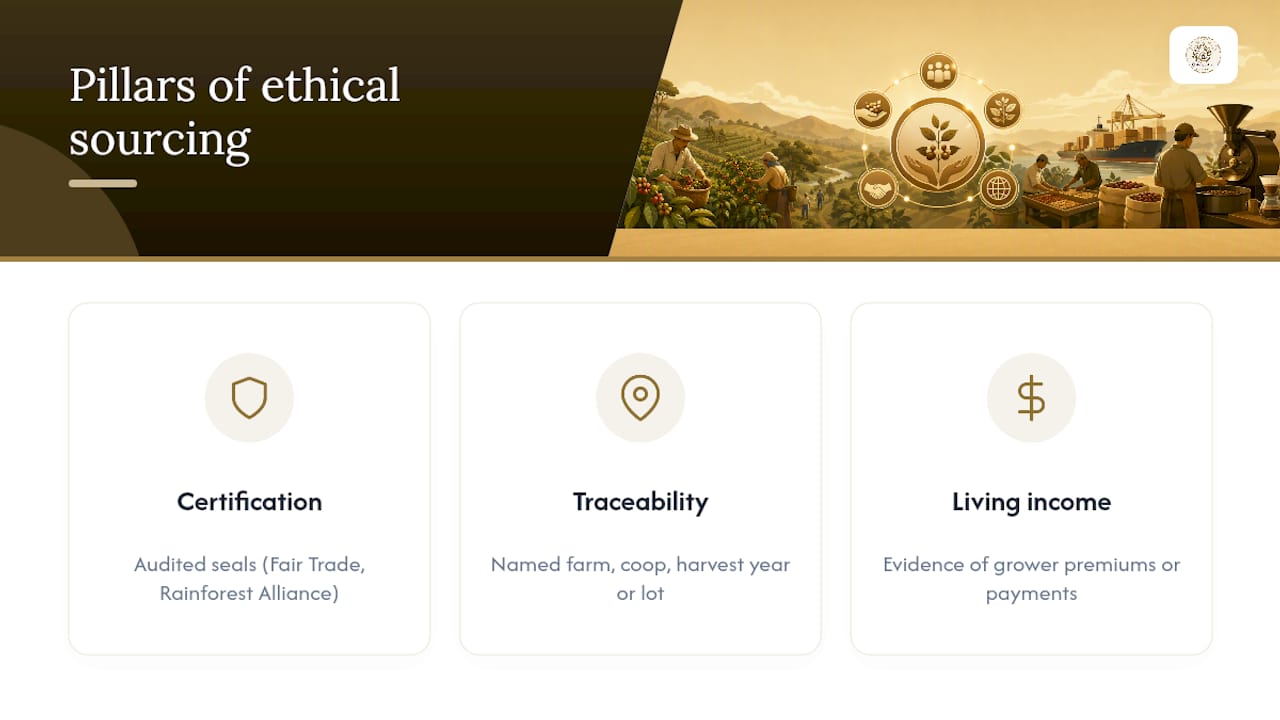
Certification is the easiest pillar to check and the easiest to overstate. A Fair Trade or Rainforest Alliance seal confirms a coffee met a specific set of audited standards, but certifications and supply-chain transparency have real limits as verification tools, since audits happen periodically, not continuously, and standards vary by program. Traceability closes that gap. When a roaster names the farm, cooperative, or region, and can point to a harvest year or lot number, you are looking at a supply chain that can be checked, not just claimed.
The third pillar, living income, is the one most shoppers never think to ask about. A coffee can carry a Fair Trade sticker and still leave farmers below a livable income, because certification alone does not guarantee a living income for growers without an explicit premium structure attached to it. That’s why the strongest ethical claims combine a certification with a named cooperative relationship and a stated premium, rather than relying on the label to do all the work.
The standard industry term for this whole category is sustainable and traceable sourcing, and it’s worth knowing that phrase because you’ll see it on more rigorous product pages than “ethically sourced” alone. Both terms point at the same idea. One just tends to come with more proof attached.
Which Qahwat Al’Ard Products Fit an Ethical Buying Strategy?
Different shopping goals call for different formats. Here’s how a lineup of coffee products can be broken down by what you’re actually trying to accomplish.
Sample packs: the easiest ethical starting point
If you’ve never bought traceable coffee before, a sample pack removes the risk of committing to a full bag of something you might not love. The Single Origin Favorites Sample Pack is built for exactly this: it lets you taste several traceable origins side by side and compare which region’s flavor profile actually suits your palate before you settle on a regular order.
The Best Sellers Sample Pack, which bundles 6 Bean, Cowboy, Breakfast, Peru, Mexico, and Bali, works well as a gift or as a way to sample across both blends and single origins in one box. It’s the broadest introduction Qahwat Al’Ard offers, covering multiple regions and roast styles at once.
If flavored coffee is more your speed, the Flavored Coffees Sample Pack covers that ground, including standouts like Chocolate Hazelnut and French Vanilla, for readers who want the ethical sourcing story without giving up dessert-style flavor notes.
Single-origin: where traceability shows up clearest
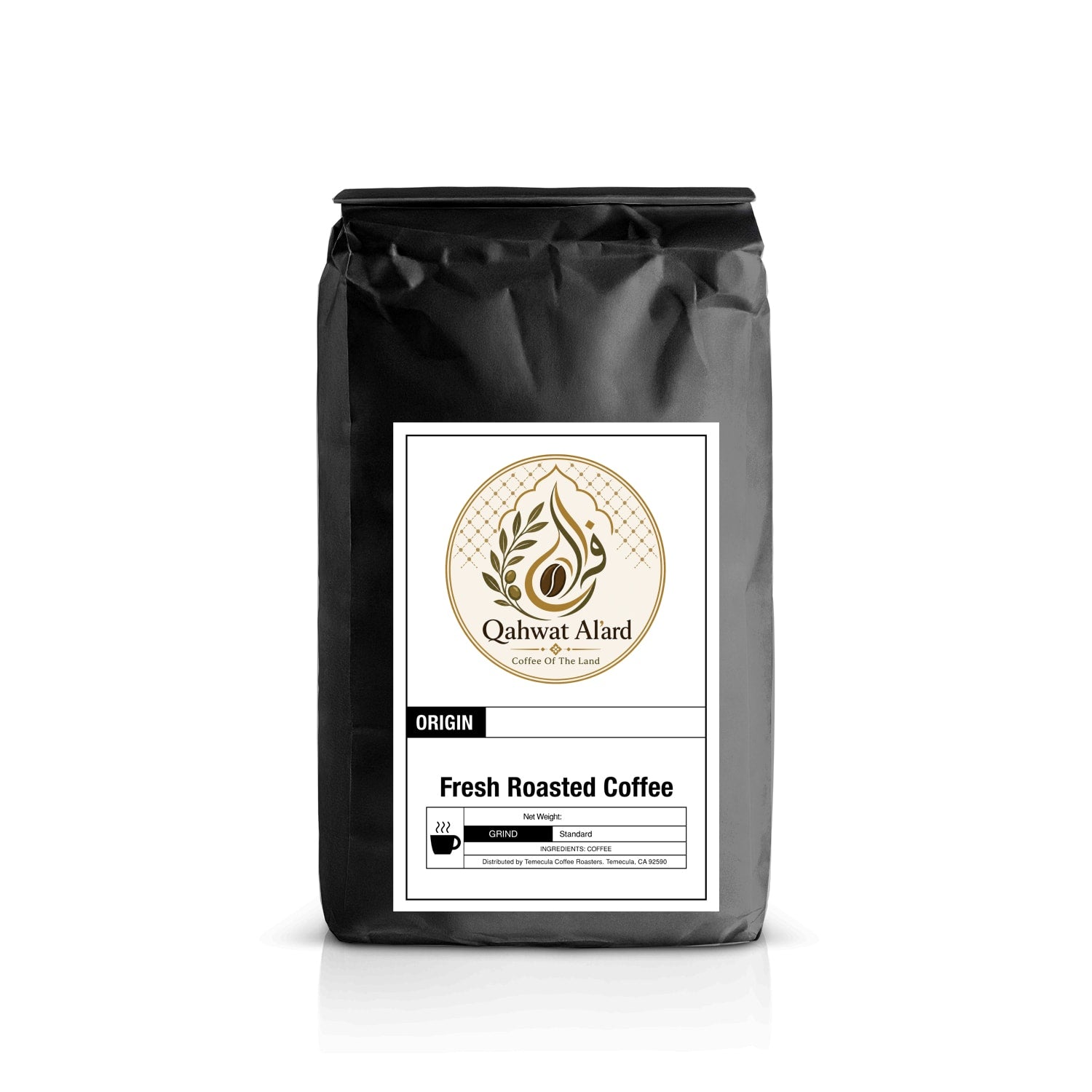
Single-origin coffee is where a traceability claim actually means something, because the bag ties to one farm or region instead of a blend of many. Certain single-origin beans sold individually or in sample packs carry region-specific stories that a blend can’t offer, and origins like Bali offer distinct, earthier profiles worth trying if you’ve only had Latin American coffee before.
Flavored and pods: convenience without giving up transparency
Convenience formats used to mean giving up on sourcing questions entirely. That’s less true now. Mexico Coffee Pods carry the same origin story as the whole-bean version, just in a format built for speed on a weekday morning.
Blends like breakfast round out the lineup for readers who want a familiar, everyday cup rather than a single-origin experience.
- Sample packs: best for first-time ethical buyers who want to compare origins before committing
- Single-origin bags: best for readers who care most about traceability and terroir
- Flavored coffees: best for buyers who want ethical sourcing without sacrificing sweetness or variety
- Pods: best for convenience, provided you check whether the pod shell is compostable
Pro Tip: Start with a sample pack even if you already know you like single-origin coffee. Tasting Peru, Mexico, and Bali side by side teaches your palate to recognize terroir in a way a single bag never will.
How Do You Verify an Ethical Coffee Claim?
Verifying a claim takes about five minutes on a product page, if you know where to look.
- Check for a named farm, coop, or region. Vague phrases like “sourced responsibly” without a location are a red flag. A real traceability claim names the place.
- Look for a harvest year or lot number. Specialty roasters that track lots can tell you when the beans were picked, not just where.
- Confirm the certification is current and specific. Fair Trade USA, Rainforest Alliance, and USDA Organic each test for different things. Fair Trade focuses on minimum pricing and community premiums, Rainforest Alliance leans environmental, and USDA Organic governs farming inputs, not labor conditions.
- Ask whether a premium or direct-trade relationship is mentioned. A stated premium above commodity price is stronger evidence than certification alone.
- Search for environmental language with specifics attached. “Shade-grown” or “regenerative” should come with some description of the practice, not just the word.
On the environmental side, the evidence for why this matters is concrete. Shade-grown systems support far more bird species and healthier soil than sun-grown monoculture plantations, and shade-grown coffee measurably benefits both birds and farmers by preserving forest canopy that would otherwise be cleared. Coffee’s climate footprint is also larger than most drinkers assume: farming practices like shade cover and agroforestry directly change the carbon cost of a single cup, which is why “deforestation-free” claims deserve the same scrutiny as labor claims.
On the social side, labor risk in commodity supply chains, including coffee, remains a documented problem, and cooperative partnerships with visible premium payments are one of the better available signals that a roaster is buying above bare minimum standards. Ethical Consumer’s shopping guide offers a useful gut check here: if a brand’s ethical language could apply to literally any coffee on the shelf, it probably isn’t backed by anything specific.
U.S. coffee consumption recently hit a 20-year high, with daily drinking up nearly 40% compared to prior tracking. That scale means sourcing choices at checkout carry more collective weight on farmer income than most drinkers realize.
Where Can You Verify Qahwat Al’Ard’s Sourcing Claims?
Some coffee catalogs are built around named-origin coffee from regions such as Colombia, Peru, Bali, and Uganda, and roasted to order rather than sitting on a shelf for weeks before shipping. Each product page carries an origin story specific to that region instead of generic sourcing language.
For readers who want to dig past the product page itself, a few resources go deeper into the mechanics:
- The ethical sourcing guide explains how supply-chain transparency and producer relationships actually work behind the scenes.
- The farm-to-cup journey guide walks through what traceability looks like at each step, from harvest to roast.
- The bean-to-cup traceability explainer breaks down what to check for on any product page, not just Qahwat Al’Ard’s own.
These pages exist so you don’t have to take a sourcing claim at face value. Read the origin story on a Peru or Bali bag, then cross-check it against what the traceability guide says a real claim should include.
Which Brands and Products Should You Actually Buy?
Once you know what to check for, the shopping list gets short fast. Prioritize single-origin bags with a named farm or coop over blends when traceability matters most to you, since a blend by definition mixes beans from multiple sources and dilutes any single origin story.
For a first purchase, a sample pack beats committing to one full bag, because it lets you test whether the ethical sourcing story matches a flavor profile you’ll actually keep buying. The Best Sellers Sample Pack works especially well here, spanning six distinct blends and origins in one order.
If tea is part of your routine too, apply the same verification checklist there. English Breakfast and Peach Paradise, both part of Qahwat Al’Ard’s tea line, deserve the same scrutiny on sourcing language as any coffee bag. A brand that’s transparent about coffee origins but vague about tea sourcing is worth a second look before you buy both.
Whole-bean formats generally offer stronger traceability signals than pre-ground or pod coffee, simply because whole beans preserve more information about freshness and origin on the packaging. That doesn’t rule pods out. It just means you should look a little harder at the label before assuming the convenience format carries the same sourcing story as the bag it came from.
How Does Ethical Sourcing Actually Help Coffee Farmers?
Certification premiums and direct-trade relationships exist because commodity coffee pricing alone rarely covers a farmer’s real cost of production. When a roaster pays above commodity price and routes that premium through a named cooperative, the money tends to fund things markets don’t otherwise pay for: school fees, clinic access, or reinvestment in better processing equipment.
The economic case matters because global coffee prices swing hard from season to season based on international supply and demand. Reports tracking global coffee trade show that price volatility directly affects farmer income stability, which is exactly why a fixed premium above commodity price, negotiated through a certification body or a direct relationship, gives growers more predictable income than the open market alone.
There’s a health dimension too, one that gets less attention than pricing. Unsustainable production practices, including heavy pesticide use and poor working conditions, have been linked to negative health outcomes for people in coffee-growing regions. Certifications and agroforestry standards that limit chemical inputs aren’t just an environmental checkbox. They protect the people harvesting the beans you drink.
None of this means every ethically marketed coffee delivers real benefits to farmers. But a premium structure, a named cooperative, and evidence of reinvestment together tell you far more than a logo ever will.
What Are the Real Problems With Ethical Coffee Sourcing?
Ethical sourcing has a credibility problem, and it’s worth naming plainly: certification doesn’t automatically mean a farmer earns enough to live on. That gap between “certified” and “living income” is the single biggest weakness in how the industry markets itself.
Labor risk is another uncomfortable reality. Forced labor and child labor remain documented risks across commodity supply chains, coffee included, according to international labor monitoring that tracks these patterns across agricultural exports. Certification audits catch some of this, but audits are periodic snapshots, not continuous oversight, which means a farm can pass an audit in one season and slip on standards the next.
Greenwashing compounds the problem. Terms like “sustainable,” “ethical,” and “responsibly sourced” carry no legal definition in the U.S. coffee market, so any roaster can print them regardless of actual practice. That’s precisely why traceability, a named farm, a harvest year, a stated premium, matters more than the marketing language wrapped around it. Watchdog groups that track these gaps consistently point back to the same fix: ask for specifics, not adjectives, when a brand makes a sourcing claim.
Price pressure on farmers isn’t going away either. Global coffee demand keeps climbing while a warming climate shrinks the amount of land suitable for growing high-quality Arabica. That combination squeezes smallholder farmers from both directions, rising costs and shrinking margins, even when a buyer pays a fair price at checkout.
How Do Fair Trade, Rainforest Alliance, and USDA Organic Compare?
Each major certification tests for a different thing, and confusing them leads to false confidence.
| Certification | Primary focus | What it does NOT guarantee |
|---|---|---|
| Fair Trade / Fair Trade USA | Minimum price floor, community development premiums | Environmental farming practices |
| Rainforest Alliance | Environmental standards, biodiversity, deforestation limits | A specific minimum price to farmers |
| USDA Organic | Restricted synthetic pesticides and fertilizers | Fair wages or labor conditions |
Fair Trade’s core mechanism is a price floor plus a social premium paid on top, which cooperatives can direct toward community projects. Rainforest Alliance certification, by contrast, centers on farming methods: shade cover, water management, and limits on deforestation, but it doesn’t set a guaranteed minimum farmer price the way Fair Trade does. USDA Organic governs what goes into the soil and onto the plant, pesticide and fertilizer restrictions mostly, without touching wages or working conditions at all.
None of the three certifications covers everything. That’s the practical takeaway: a coffee that’s both Fair Trade and Rainforest Alliance certified is covering more ground than one carrying a single label, because the two standards test for genuinely different things. A coffee with just one certification isn’t necessarily worse. It just means one dimension, price or environment, got verified while the other didn’t.
How Much Power Do Your Coffee Purchases Actually Have?
Individual purchases seem small against a global commodity market, but coffee drinking in the U.S. has scaled to a point where buying patterns genuinely move supply chains. With daily consumption up nearly 40% over the past two decades, roasters and importers respond directly to what buyers ask for at scale.
That demand signal works both ways. When consumers consistently choose certified and traceable coffee over anonymous commodity beans, importers have a financial reason to pay premiums for supply that meets those standards, because they know it will sell. When shoppers skip verification and buy on price alone, that pressure disappears, and commodity buyers have no incentive to pay above the market floor.
Fair Trade advocacy organizations run ongoing consumer education campaigns precisely because informed buying decisions, multiplied across millions of transactions, are one of the few real levers regular shoppers have on how coffee gets grown and priced globally. One bag doesn’t change a supply chain. A sustained shift in what an entire country asks for at checkout does.
Why Does Ethically Sourced Coffee Cost More?
Ethically sourced coffee typically runs higher than commodity-grade beans, and the price gap traces directly back to what certification and traceability actually cost to maintain. Certification audits aren’t free. Cooperatives pay fees to maintain Fair Trade or Rainforest Alliance status, and those costs pass partway down the chain. Direct-trade premiums add another layer, since a roaster paying above commodity price for green beans has to recover that cost somewhere in the retail price.
The value calculation isn’t just about ethics, though. Traceable single-origin coffee tends to taste more distinct than blended commodity coffee, because you’re getting one farm’s terroir instead of an averaged mix. That’s a real quality argument on top of the sourcing one; you’re not only paying for a cleaner supply chain, you’re often paying for a more specific, less homogenized flavor profile.
Sample packs are the smartest way to test that value proposition before committing to a full bag at a higher price point. Buying a sample pack that spans several origins costs less per ounce to try than buying multiple full bags, and it tells you fast whether the premium is worth it for your palate specifically. If you find you can’t tell the difference between a shade-grown single origin and a commodity blend, that’s useful information too. It just means your money is better spent on volume rather than origin specificity, and that’s a legitimate choice.
Why Traceability Beats Buzzwords
Marketing language is cheap to print and expensive to verify, which is exactly why “sustainable” and “ethical” show up on bags that have done little to earn them. A named farm, a harvest year, and a stated premium cost a roaster something real to disclose. That asymmetry is the whole argument for prioritizing traceability over adjectives.
There’s a real tradeoff here worth naming honestly: traceable, certified coffee usually costs more, and taste preference doesn’t always track with sourcing quality. A sample pack is the cheapest way to find out where your palate and your principles actually meet, before you commit a full budget to either one.
— Yasin Sofyian Ayesh
Where to Buy: Shop Qahwat Al’Ard’s Ethically Sourced Collections
Qahwat Al’Ard’s advantage over guessing your way through grocery store shelves is simple: every bag ties back to a named region, Colombia, Peru, Bali, or Uganda, roasted to order instead of sitting in a warehouse for weeks. You’re not choosing between vague sustainability claims. You’re choosing which traceable origin fits your morning.
Start with the Single Origin collection if terroir and traceability matter most to you, or browse Sample Pack options if you’d rather taste several origins before settling on one. Flavored drinkers should head to the Flavored collection, and if you’re shopping for a gift or a pantry staple, the full Coffee catalog covers blends, pods, and everything in between.
If you’re still deciding where to start, the Best Sellers Sample Pack is the single easiest way to taste six distinct origins and blends in one order, roasted fresh, with a real story behind each bag.
Sources
- How to Buy Ethical Coffee | Sustainable Coffee Brand Guide
- Why is shade-grown coffee good for birds and farmers
- Analysis: here’s the carbon cost of your daily coffee and how to make it climate-friendly
- Daily coffee consumption at 20-year high
- Ethical Coffee & Coffee Beans
FAQ
What coffee brand is the most ethical?
There’s no single brand that holds a universal title for “most ethical,” since standards vary by certification and by how transparent a roaster is about traceability. The strongest signal isn’t a brand name at all. It’s whether a specific product names its farm or region, states a harvest year, and shows a real certification, which is why Qahwat Al’Ard’s single-origin coffees lead with that information on every product page.
Is Starbucks coffee actually ethically sourced?
Starbucks runs its own verification program alongside some third-party certification, but large-scale commodity buying at that volume makes farm-level traceability harder to guarantee on every single bag. Smaller roasters that source single-origin lots directly from named cooperatives generally offer clearer, easier-to-verify traceability than large multinational buyers can at scale.
What is the most ethical way to buy coffee?
Buy from roasters that name the farm or cooperative, state a harvest year, and hold a recognized certification like Fair Trade or Rainforest Alliance. Starting with a sample pack lets you compare several traceable origins before you commit to a full bag, which is the most practical way to test ethical claims against your own taste.
Is Cafe Bustelo coffee ethically sourced?
Cafe Bustelo does not market itself around farm-level traceability or third-party ethical certification the way specialty single-origin roasters do. Shoppers looking for verifiable sourcing claims should check the packaging directly for a named region, harvest year, or certification seal rather than assuming a mainstream grocery brand carries the same traceability as a specialty import.


