


TL;DR:
- Developing coffee flavor vocabulary involves using structured tools like the SCA Flavor Wheel and ISO 18794:2025 to improve sensory accuracy and communication. Consistent practice with physical references, detailed tasting journals, and calibrated descriptors enhances understanding of complex coffee profiles. Proper vocabulary allows enthusiasts to describe, troubleshoot, and appreciate coffee with greater clarity and shared language.
Coffee flavor vocabulary is the structured set of sensory terms that transforms vague impressions like “tastes good” into precise, communicable descriptions such as “bright citric acidity with a caramel finish.” Every serious coffee enthusiast hits a wall where their palate outpaces their words. Building coffee flavor vocabulary closes that gap. The Specialty Coffee Association’s Coffee Taster’s Flavor Wheel and ISO 18794:2025 are the two industry-standard frameworks that give your tasting notes structure, accuracy, and meaning. This guide shows you how to use both, train your palate at home, and develop a coffee lexicon that actually reflects what’s in the cup.
What is the Coffee Taster’s Flavor Wheel and how do you use it?
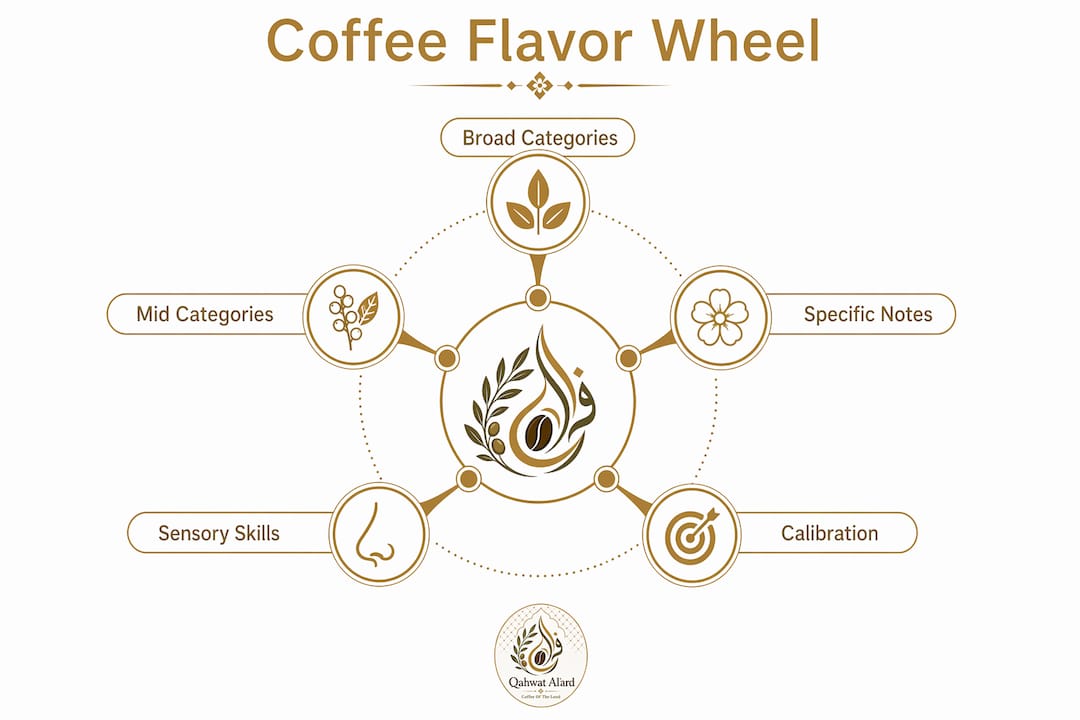
The Coffee Taster’s Flavor Wheel is the foundational tool for developing coffee flavor vocabulary, created by the Specialty Coffee Association in collaboration with World Coffee Research. It organizes coffee descriptors from broad sensory categories at the center outward to highly specific flavor references at the rim. The structure is intentional. You start with what you know and move toward precision.
The SCA defines coffee flavor as a combination of taste and smell, and instructs tasters to evaluate coffee at multiple stages before reaching for the wheel. Those stages include the dry fragrance of ground coffee, the wet aroma after brewing, and the flavors that develop on the palate after sipping. Each stage reveals different compounds, and your vocabulary should reflect all three.
Here is how to use the wheel during a tasting session:
- Smell the dry grounds before brewing. Note broad impressions: fruity, roasted, floral, or nutty.
- Inhale the wet aroma immediately after adding water. Volatile aromatics peak here.
- Sip slowly and let the coffee coat your entire palate before swallowing.
- Start at the center of the wheel with the broadest matching category, then move outward toward specific descriptors.
- Cross-reference two or three outer-ring terms before committing to a note.
The wheel’s hierarchy builds vocabulary and accelerates sensory skill development through consistent use. Think of it less as a lookup table and more as a calibration device. Each session with the wheel trains your brain to file new sensory patterns against known references.
Pro Tip: Smell the wheel’s categories before tasting. Familiarizing yourself with the visual layout and associated words primes your brain to recognize those notes when they appear in the cup.
How does standardized vocabulary like ISO 18794:2025 help coffee enthusiasts?
ISO 18794:2025 is the international standard for coffee sensory analysis vocabulary, updated in 2025 to expand the lexicon available to both professionals and enthusiasts. The standard applies across all coffee forms, from green beans to brewed espresso, and adds precision terms that casual tasting notes often miss. ISO 18794:2025 adds terms like “over-extracted,” “stewed,” “past crop,” and “dense” to the shared vocabulary, covering intensity, extraction quality, and aromatic character in ways that informal slang cannot.
Why does this matter for someone tasting at home? Because standard terminology enables precise communication about flavor intensity and extraction nuances across different contexts and cultures. When you describe a cup as “over-extracted” rather than “too bitter,” you communicate the cause, not just the symptom. That distinction helps you adjust your brew, discuss the coffee with a roaster, or compare notes with another enthusiast anywhere in the world.
The table below shows how informal descriptions map to ISO-aligned terms, and why the shift matters:
| Informal description | ISO-aligned term | Why it’s more precise |
|---|---|---|
| “Too bitter” | Over-extracted | Identifies extraction as the cause, not the bean |
| “Smells old” | Past crop | Points to green bean age as the defect source |
| “Heavy feeling” | Dense | Describes body and mouthfeel with a shared reference |
| “Tastes flat” | Under-extracted | Signals insufficient extraction, not a roast flaw |
| “Weird aftertaste” | Stewed | Indicates heat degradation during brewing or holding |
Aligning your personal tasting notes with these terms does not mean abandoning your own sensory experience. It means giving your impressions a shared language so they travel further than your own notebook.
What practical steps build your coffee flavor vocabulary at home?
Developing coffee vocabulary at home is a matter of structured practice, not talent. The most effective approach combines reference anchors, tasting journals, and deliberate comparison exercises. Here is a step-by-step method that works regardless of your current skill level.
-
Build a reference kit. The Le Nez du Café aroma kit contains 36 vials covering the full aromatic range of coffee and costs over $300. A DIY version costs under $20: gather small jars and fill them with real-world references like a strip of lemon peel, a piece of dark chocolate, a few drops of vanilla extract, and a pinch of ground cinnamon. Smell each before tasting and train your brain to link the descriptor to the physical sensation.
-
Keep a tasting journal. Write notes immediately after tasting, not after the cup cools. Use the broad-to-specific structure: start with a category (fruity), then a subcategory (citrus), then a specific note (lemon zest). Three descriptors per cup is enough in early practice.
-
Practice paired comparisons. Brew two coffees side by side, one Ethiopian natural and one Colombian washed, for example. The contrast sharpens your ability to detect differences rather than just describe a single cup in isolation.
-
Run blind tastings. Ask someone to brew two cups without telling you which is which. Blind conditions remove expectation bias and force honest sensory evaluation.
-
Review and recalibrate weekly. Compare your notes from the same coffee across multiple sessions. Consistency in your descriptions signals that your sensory pattern recognition is developing.
Pro Tip: Limit yourself to three descriptors per cup during the first month of practice. More than three and your sensory memory fragments. Fewer forces you to prioritize what you actually taste over what sounds impressive.
Understanding how origin shapes flavor gives your vocabulary practice a concrete foundation, because the same training method produces very different results depending on whether you are tasting a high-altitude Ethiopian or a low-grown Robusta.
How to interpret common flavor notes and categories in coffee
Flavor notes in coffee like peach, caramel, and jasmine reflect natural characteristics determined by origin and processing, not additives. Beginners should start with broad impression categories and move to specific subcategories as their vocabulary grows. The six primary flavor families on the SCA Flavor Wheel give you a reliable starting framework.
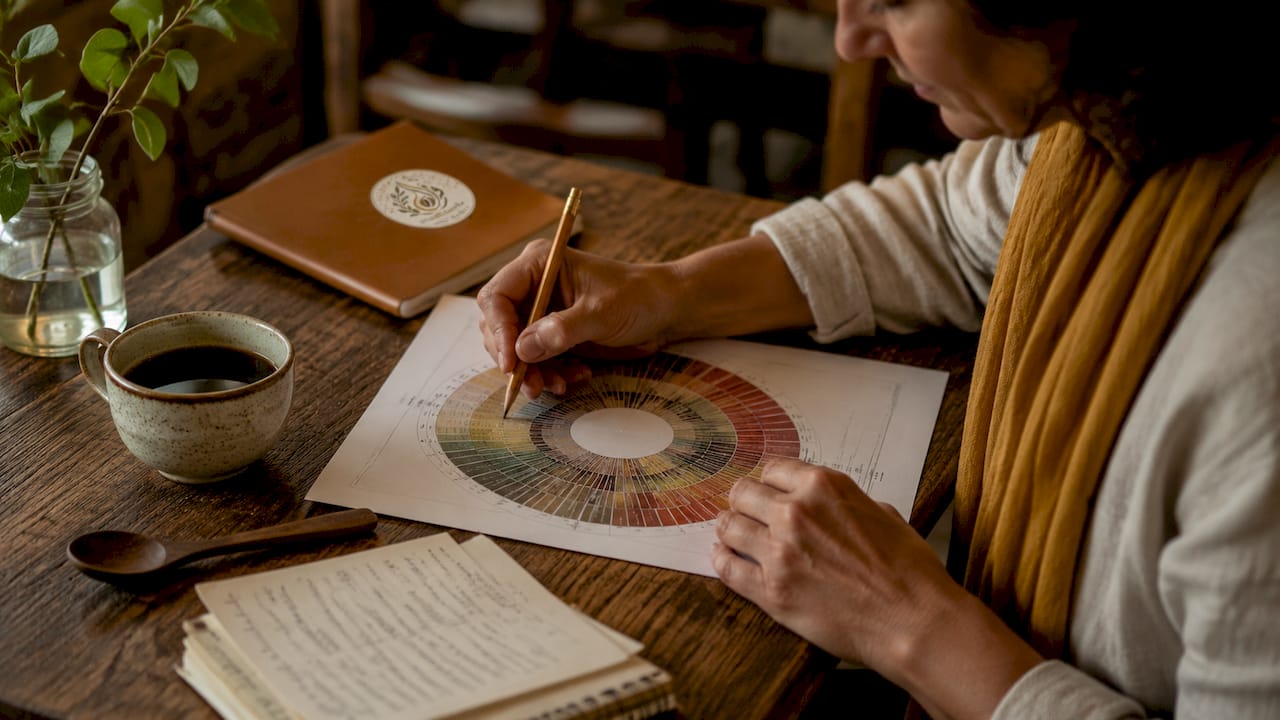
Fruity covers citrus (lemon, orange, grapefruit), berry (blueberry, strawberry, blackcurrant), and stone fruit (peach, apricot, cherry). Ethiopian naturals and Kenyan washed coffees are the most common sources of pronounced fruit notes.
Floral includes jasmine, rose, and chamomile. These notes appear most often in light-roasted Ethiopian Yirgacheffe and Panamanian Geisha coffees, where delicate aromatics survive the roasting process.
Sweet encompasses caramel, brown sugar, honey, and vanilla. These notes develop during roasting through Maillard reactions and are most prominent in medium-roast Central American coffees.
Nutty and chocolatey descriptors include almond, hazelnut, dark chocolate, and cocoa. Brazilian and Colombian coffees frequently express these notes, making them the most familiar to new tasters.
One concept that trips up many beginners is acidity. Acidity in coffee is best understood as brightness, contributed by organic acids including citric, malic, phosphoric, and acetic acid. Citric acid dominates in African coffees, malic acid in Central American coffees, and high levels of acetic acid can indicate a defect. Acidity is not sourness. Sourness signals under-extraction or a processing flaw. Brightness is a positive quality descriptor.
Body and mouthfeel are tactile descriptors, not flavor notes. Body describes the weight of the liquid on your palate: thin, medium, or full. Mouthfeel describes texture: silky, syrupy, or gritty. Both belong in your tasting notes because they complete the sensory picture that flavor alone cannot provide. Exploring flavor complexity across origins gives you direct exposure to how these categories shift depending on where and how a coffee was grown.
What are common mistakes when building coffee flavor vocabulary?
The most common mistake in developing coffee vocabulary is forcing impressive-sounding descriptors onto a cup that does not actually express them. Honest, accurate descriptors build a reliable sensory vocabulary far more effectively than reaching for exotic terms to sound knowledgeable. If you taste “something sweet, maybe caramel-ish,” write that. Do not write “toffee with hints of dried fig” unless you genuinely detect both.
Other pitfalls to watch for:
- Vocabulary overload. Using ten descriptors per cup fragments your sensory memory and makes your notes unreliable over time. Three focused terms beat ten scattered ones.
- Palate fatigue. Tasting more than four or five coffees in a single session degrades your ability to discriminate between notes. Space sessions out or rinse with plain water and unsalted crackers between cups.
- Expectation bias. Reading the roaster’s tasting notes before your own session plants suggestions. Taste first, then compare your notes to the label.
- Ignoring defects. Vocabulary is not just for positive notes. Terms like “fermented,” “rubbery,” or “musty” are part of a complete coffee lexicon and help you identify quality issues.
Professional coffee tasters calibrate their vocabulary by limiting descriptors and focusing on stable sensory pattern recognition, then progressively expanding their lexicon over months of practice. That timeline is realistic for enthusiasts too. Expect meaningful improvement in three to six months of consistent, structured tasting.
Pro Tip: After each tasting session, pick one descriptor you used and find a real-world reference for it. If you wrote “almond,” smell a raw almond before your next session. That physical anchor accelerates recall faster than any amount of reading.
Key takeaways
Building coffee flavor vocabulary requires a structured system: the SCA Flavor Wheel for broad-to-specific calibration, ISO 18794:2025 terms for precision, and consistent sensory practice anchored to real-world references.
| Point | Details |
|---|---|
| Use the SCA Flavor Wheel | Start at the center with broad categories and move outward to specific descriptors during each tasting. |
| Adopt ISO-aligned terms | Replace informal descriptions with standardized terms like “over-extracted” or “past crop” for precise communication. |
| Build sensory anchors | Use Le Nez du Café or a DIY aroma kit to link descriptors to physical smell references for faster recall. |
| Limit early descriptors | Three tasting notes per cup builds more reliable sensory memory than ten scattered impressions. |
| Understand acidity correctly | Treat acidity as brightness, not sourness, and learn which organic acids dominate in different coffee origins. |
Why vocabulary is the part of coffee education most people skip
Most coffee enthusiasts invest in better gear before they invest in better perception. A new grinder is tangible. A richer vocabulary feels abstract. But after years of tasting coffees from dozens of origins, I am convinced the vocabulary comes first. Without words, your palate has nowhere to file what it experiences. You taste the same cup twenty times and never get closer to understanding it.
What changed my own practice was treating the SCA Flavor Wheel not as a reference chart but as a training partner. I would taste a coffee, write three words, then check the wheel to see if I was in the right neighborhood. Over time, the gap between my instinct and the wheel’s language narrowed. That narrowing is the skill.
The ISO 18794:2025 update matters more than most enthusiasts realize. Terms like “stewed” and “dense” fill gaps that the flavor wheel does not cover, particularly around extraction quality and bean age. Knowing those terms changes how you evaluate a cup, not just how you describe it.
My honest advice: resist the urge to sound like a professional taster before you are one. The most credible tasting notes I have read are the honest ones. “Sweet, medium body, something like dried fruit” is more useful than “complex layers of Bing cherry and muscovado sugar” written by someone who tasted it once. Patience and honesty build the vocabulary. The complexity comes later, and it comes naturally.
— Anthony-Yasin
Put your new vocabulary to work with Qahwatalard
The fastest way to build your coffee flavor vocabulary is to taste coffees that actually express distinct, traceable flavor profiles. Qahwatalard’s single-origin collection is sourced from renowned growing regions worldwide, each selection chosen for traceability and flavor clarity. Tasting a washed Ethiopian next to a natural Brazilian is not just enjoyable. It is one of the most effective sensory exercises you can run at home. For a lower-commitment starting point, the single-serve coffee capsules deliver consistent extraction across sessions, which removes brew variables and lets you focus entirely on flavor. Consistent conditions are exactly what structured vocabulary training requires.
FAQ
What is the Coffee Taster’s Flavor Wheel?
The Coffee Taster’s Flavor Wheel is a visual tool developed by the Specialty Coffee Association that organizes coffee flavor descriptors from broad sensory categories at the center to specific flavor references at the outer edge. Tasters use it to move from general impressions toward precise, communicable tasting notes.
How long does it take to build a reliable coffee flavor vocabulary?
Consistent, structured tasting practice over three to six months produces meaningful improvement in descriptor accuracy and sensory recall. Professional tasters calibrate their vocabulary gradually by limiting descriptors per session and anchoring terms to physical smell references.
What is the difference between acidity and sourness in coffee?
Acidity in coffee describes brightness contributed by organic acids like citric and malic acid, and is a positive quality descriptor. Sourness signals under-extraction or a processing defect and is a negative attribute.
Do I need professional tools to train my coffee palate?
No. While Le Nez du Café provides 36 professional aroma references, a DIY kit assembled from household items like lemon peel, dark chocolate, and vanilla extract costs under $20 and delivers comparable sensory anchoring for home practice.
What does ISO 18794:2025 add to coffee tasting vocabulary?
ISO 18794:2025 expands standardized coffee sensory terms to include extraction quality descriptors like “over-extracted” and “under-extracted,” aging indicators like “past crop,” and body terms like “dense,” giving enthusiasts a shared, precise language that goes beyond informal tasting slang.


