


“Regenerative” on a coffee bag is a claim about outcomes on a specific traceable lot, not a farming manual. If you’re shopping, the move is simple: buy single-origin coffee with a named farm or micro-lot, and look for either a third-party regenerative seal or clear evidence from the seller. The Global Coffee Platform and Rainforest Alliance both push toward evidence over marketing language, and some brands build their sourcing around that same traceability standard.
TL;DR:
- Verifiable evidence, such as a third-party regenerative seal or detailed traceability information, is essential to trust a regenerative coffee claim.
- Specific details like farm name, lot code, harvest year, and a traceability link are critical for ensuring transparency and authenticity.
- Regenerative status does not inherently influence flavor but often results in smaller, more variable lots that reflect particular harvests.
- Transition costs, certification requirements, and time delays are significant barriers for farms adopting regenerative practices, limiting widespread availability.
- Multiple certifications and labels serve different functions; stacking them provides a clearer picture of a farm’s environmental and social practices.
Table of Contents
- What “Regenerative” on a Coffee Bag Actually Means
- How Do You Verify a Regenerative Coffee Claim?
- What Traceability Details Should Appear on the Label?
- Does Regenerative Sourcing Change How the Coffee Tastes?
- A Buyer Checklist for Choosing Regenerative Single-Origin Coffee
- Core Regenerative Practices That Show Up in a Coffee’s Story
- What’s the Payoff for Farmers and Ecosystems?
- Why Isn’t Regenerative Adoption Universal Yet?
- How Does Regenerative Compare to Other Sustainable Practices?
- Does Regenerative Farming Change Yield and Quality Over Time?
- What Do Working Regenerative Coffee Farms Look Like?
- Publisher Perspective: How Qahwat Al’ard Approaches Regenerative Sourcing
- Try a Traceable, Single-Origin Lot for Yourself
- Sources
- FAQ
What “Regenerative” on a Coffee Bag Actually Means
When a coffee bag says “regenerative,” it’s making a claim about results, not describing a farming technique you’re supposed to learn. As a shopper, treat it the same way you’d treat “grass-fed” or “single-vineyard”: a product attribute that should be backed by specifics, not a lesson in agronomy.
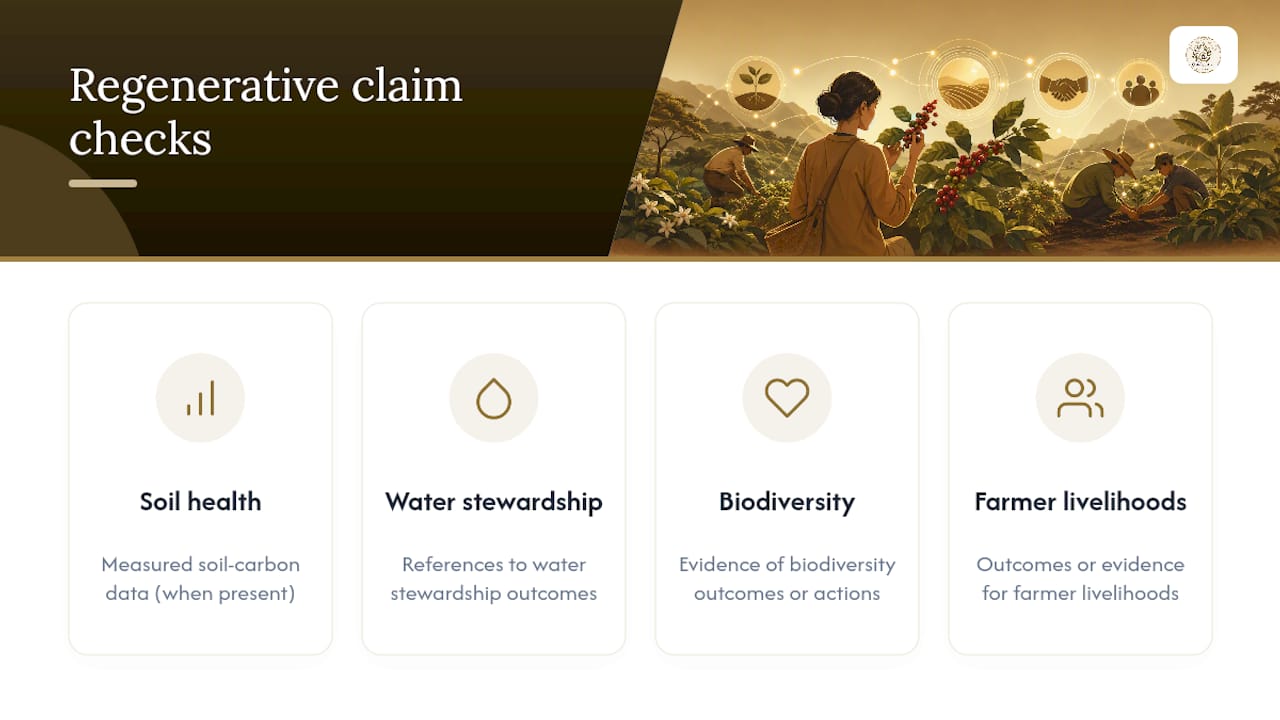
The Global Coffee Platform’s RegenCoffee guidance frames regenerative outcomes around four buckets: soil health, water stewardship, biodiversity, and farmer livelihoods. That’s useful for shoppers mainly because it tells you what a credible claim should reference. A bag that says “regenerative” with nothing else attached to it isn’t lying exactly, but it isn’t giving you much either.
Here’s the part that surprises a lot of shoppers: there’s no single legal definition of regenerative agriculture yet. The GCP’s own RegenCoffee FAQ says as much, and it warns that without outcome-based evidence, the term is wide open to greenwashing. That’s not a knock on the concept. It’s a heads-up that the word alone does no verification work for you.
So expect variability. One roaster’s “regenerative” might mean a certified lot with measured soil carbon data behind it. Another’s might mean a general sustainability statement dressed up in trendier language. Treat vague phrasing (“grown regeneratively,” no further detail) as a starting point for a question, not a finished answer. The specifics on the label and product page are what convert a marketing word into an actual purchase decision.
How Do You Verify a Regenerative Coffee Claim?
Verification happens in about ninety seconds if you know what to check. Most shoppers never look past the front label, which is exactly why vague claims survive.
Start here:
- Look for a third-party seal. Rainforest Alliance’s new Regenerative Agriculture Standard includes an independent seal, with certified coffee expected to reach retail shelves beginning in 2026. A seal means an outside body checked the farm against a defined standard, which is a different level of proof than a brand’s own copywriting.
- Confirm traceability details. A trustworthy bag names the farm or cooperative, gives a micro-lot or lot number, states the harvest year, and often names the exporter or importer. If none of that appears, the “regenerative” claim has nothing to attach to.
- Check for a trace page. Many specialty roasters link a QR code or URL to a page showing the specific lot’s origin story and, ideally, outcome data.
- Ask for evidence when it’s missing. A roaster that sources seriously should be able to point to a supplier transparency page, an audit reference, or a framework like GCP’s RegenCoffee guidance.
Pro Tip: Email or message the roaster and ask one direct question: “Which farm or cooperative did this specific lot come from, and what regenerative outcome is documented for it?” A seller with real sourcing data answers in a sentence. A seller without it goes quiet or gets vague, and that silence tells you plenty.
For a deeper walk through certification logos and what each one actually certifies, this buyer’s guide to sustainability certifications breaks down the differences roaster by roaster.
What Traceability Details Should Appear on the Label?
A coffee bag that backs up a regenerative claim reads almost like a passport. The fewer of these fields present, the more skeptical you should be of any sustainability language on the front.
On the bag itself, look for:
- Single-origin designation (country and region, not a blend)
- Farm or cooperative name
- Micro-lot or lot code
- Harvest year
- Roast date
- Processing method (washed, natural, honey)
On the product page, look for:
- A dedicated trace page or origin story tied to that specific lot
- Downloadable certificates or audit summaries, not just certification logos
- Photos or details of the actual farm or cooperative, not stock imagery
Seals and narrative claims aren’t the same tier of evidence, and it matters which one you weight more heavily. A seal like Rainforest Alliance’s regenerative mark means an independent body checked the farm’s practices against a written standard. A story on a product page (“our farmers care deeply about the land”) is nice context, but it’s not verification. Trust the seal or the documented lot data first, and read the story as supporting color, not proof.
Consumer research backs up why traceability fields matter beyond the sustainability angle too: single-origin labeling is one of the clearest signals specialty shoppers use to judge a coffee’s quality and authenticity, on top of its sourcing story.
Does Regenerative Sourcing Change How the Coffee Tastes?
Not directly, and that’s worth saying plainly. A regenerative claim tells you something about farming outcomes on that plot of land. It doesn’t tell you the coffee will taste like blackberry jam or brown sugar. Flavor comes from varietal, altitude, processing method, and roast, not from a sustainability label.
What regenerative sourcing does correlate with is smaller, more variable lots. Farms transitioning toward regenerative outcomes often work in micro-lots rather than large uniform batches, and that means the coffee you buy this season may taste noticeably different from the same farm’s lot next season. That’s not a flaw. It’s what traceable, single-origin coffee is supposed to do: reflect a specific harvest instead of smoothing everything into a consistent, blended flavor.
When you’re comparing two regeneratively sourced lots, focus on the same variables a specialty buyer would: processing method, roast date, and altitude, all of which should sit right on the label next to the origin details. If a roaster’s tasting notes mention “bright acidity” or “heavy body,” check whether those match the processing method listed. A washed process from a high-altitude lot should read cleaner and more acidic; a natural process usually reads fruitier and heavier. Matching the label to the cup is a habit worth building regardless of any regenerative claim attached to it.
A Buyer Checklist for Choosing Regenerative Single-Origin Coffee
Run through these five checks before you commit to a bag, roughly in this order:
- Confirm it’s single-origin with a named producer. A country name alone (“Colombia”) isn’t enough. Look for the specific farm, cooperative, or region.
- Verify a trace page or lot code exists. If the product page has no way to trace the coffee to a specific harvest, the regenerative claim has nowhere to attach.
- Check for certification or transparent program evidence. A recognized seal (like Rainforest Alliance’s regenerative standard) or a documented outcome report carries more weight than a front-label buzzword.
- Confirm roast date and processing method. Freshness and processing affect both flavor and how meaningful the sourcing claim is in practice.
- Weigh the price against what it funds. Regeneratively sourced, traceable single-origin coffee often carries a premium over commodity blends. That premium typically supports farm transition costs, smaller-batch logistics, and the traceability systems that let you check all four items above in the first place.
None of these steps require special knowledge. They just require reading the label and product page the way you’d read a nutrition panel: looking for specifics, not adjectives.
Core Regenerative Practices That Show Up in a Coffee’s Story
Even though shoppers are buying an outcome, not a technique, it helps to know the practices behind the claim, since product pages and trace stories often reference them directly. Three categories tend to dominate.
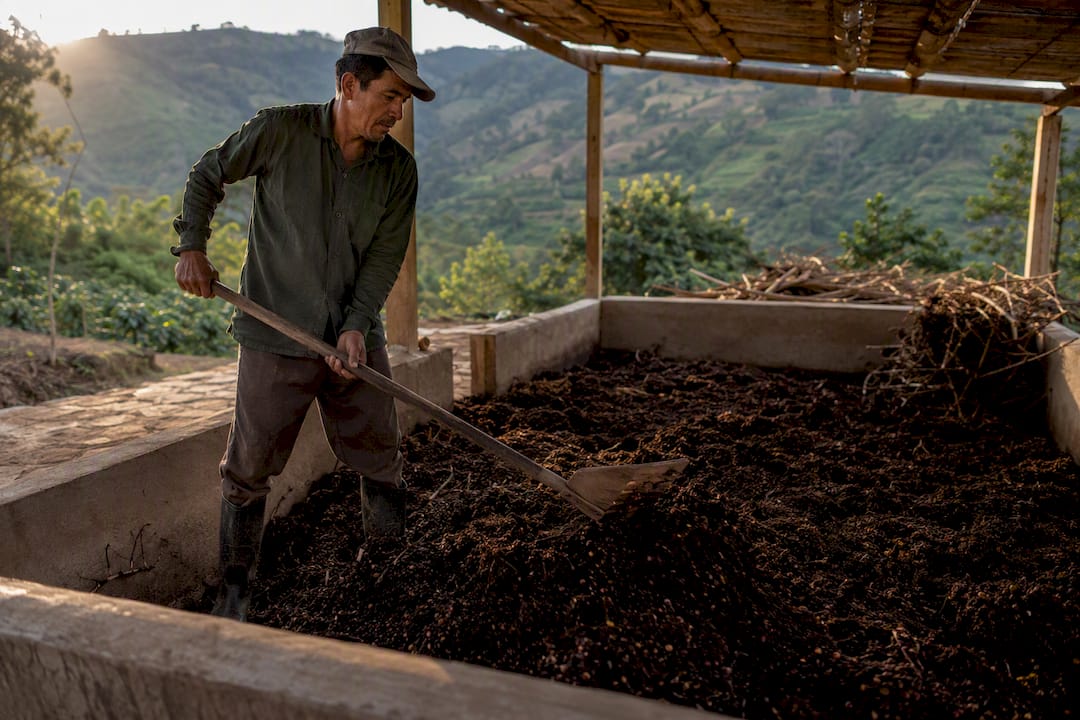
Soil health work usually involves cover cropping between coffee rows, composting cherry pulp and other farm waste back into the soil, and reducing synthetic fertilizer use in favor of organic matter. Farms documenting this often report improved water retention and reduced erosion on slopes, which matters enormously in mountainous coffee-growing regions.
Biodiversity practices center on shade-grown systems, where coffee is planted under a canopy of native trees instead of in cleared, sun-exposed rows. This supports bird populations, pollinators, and natural pest control, and it’s one of the more visually obvious regenerative signals if a farm publishes photos.
Water management covers things like reducing runoff from processing (particularly wastewater from washed coffee), protecting riparian buffers near streams, and using drip or shade systems to cut irrigation needs in drier regions.
When a trace page or producer story mentions any of these specifically, that’s a stronger signal than a bare “regenerative” label. It shows the farm is documenting a real practice tied to a real outcome, which is exactly the evidence-based approach the GCP’s guidance calls for.
What’s the Payoff for Farmers and Ecosystems?
The environmental case for regenerative coffee farming centers on resilience. Soil that holds more organic matter retains water better during dry spells and drains better during heavy rain, which matters as growing regions face more erratic weather. Shade canopies moderate temperature swings around the coffee plants themselves, buffering against heat stress that can otherwise stunt cherry development.
The economic case is less obvious but arguably more important for the farmers doing this work. Diversified, shaded farms often generate secondary income from timber, fruit, or other crops grown alongside coffee, spreading risk instead of betting an entire season on a single commodity. Healthier soil also tends to reduce dependence on purchased fertilizer over time, cutting input costs even if yields stay flat in the short term.
None of this happens overnight, and none of it is guaranteed. But the combination of ecological buffering and diversified income is why more cooperatives are documenting these transitions publicly. It gives them something concrete to point to when buyers, importers, and certification bodies come asking for evidence, which loops right back to why traceability on your bag matters. The story on the label is often the tail end of a multi-year transition a cooperative has been documenting the whole way through.
Why Isn’t Regenerative Adoption Universal Yet?
Cost and time are the two biggest barriers, and neither is small. Transitioning from conventional or even standard sustainable practices toward regenerative outcomes usually means a multi-year window where yields can dip before soil and biodiversity improvements pay off. For a small farm running on thin margins, that gap is a real financial risk, not a theoretical one.
Certification adds a second barrier. Third-party verification, like the process behind Rainforest Alliance’s new regenerative standard, requires documentation, audits, and often infrastructure investment that smaller cooperatives may not have the capital to front on their own. That’s part of why the GCP’s own guidance stresses context-specific pathways rather than a single checklist. What works for a large estate in Brazil doesn’t necessarily map onto a smallholder cooperative in Uganda or Peru.
There’s also a measurement problem. Soil health and biodiversity outcomes take years to show up in data, and farms need consistent monitoring to prove a claim rather than assert it. That monitoring costs money and expertise that not every cooperative has on staff.
For shoppers, this explains why regenerative-labeled coffee is still a minority of what’s on shelves and why premiums exist. You’re not just paying for the coffee. You’re partly funding the transition and documentation costs that make the claim on the bag verifiable in the first place.
How Does Regenerative Compare to Other Sustainable Practices?
Regenerative farming and agroforestry overlap heavily but aren’t identical. Agroforestry specifically describes the physical structure: coffee grown among or under other trees and crops. Regenerative is broader and outcome-focused. It can include agroforestry as one tool among several, alongside soil amendments, water management, and reduced chemical inputs.
Organic certification, by contrast, is mainly an input standard. It restricts synthetic pesticides and fertilizers but doesn’t necessarily require the active soil-building or biodiversity outcomes that regenerative claims center on. A farm can be certified organic while still running monoculture rows with minimal shade cover.
Fair Trade and similar programs focus on a different axis entirely: price floors and labor conditions rather than land management outcomes. A coffee can carry a Fair Trade certification and say nothing about soil health at all.
The practical takeaway for shoppers: these labels answer different questions, and stacking them tells you more than any single one alone. A bag that’s single-origin, shade-grown, organic, and backed by regenerative outcome data is answering questions about origin, farming method, input restrictions, and soil/biodiversity results, respectively. None of those labels substitutes for the others, which is exactly why traceability details matter more than any one seal by itself.
Does Regenerative Farming Change Yield and Quality Over Time?
Short term, yields sometimes dip during transition, particularly in the first two to three years as soil biology rebuilds and shade trees mature. That’s the risk farmers are managing when they commit to this shift, and it’s part of why transition support and price premiums matter economically.
Medium to long term, farms documenting improved soil organic matter and better water retention often report more stable yields across drought years, even if peak yields in ideal years aren’t dramatically higher than a well-managed conventional farm. Consistency, not just volume, is the real gain.
Quality is harder to generalize, because so much of cup quality depends on variety, altitude, and processing regardless of farming method. What regenerative practices more reliably affect is consistency of quality across seasons, since healthier soil and more stable microclimates reduce the swings a stressed plant produces under drought or heat stress. That’s a meaningful benefit for a roaster trying to source the same flavor profile lot after lot, even if it’s not the dramatic taste transformation some marketing implies.
What Do Working Regenerative Coffee Farms Look Like?
The clearest examples tend to come from cooperatives that combine several practices at once rather than adopting a single technique in isolation. A cooperative that shifts from sun-grown monoculture to shade-grown polyculture, adds composting programs for cherry waste, and documents soil and water outcomes over several seasons is the template most certification frameworks point to.
What makes these examples useful to shoppers isn’t the farming detail. It’s that the strongest ones publish their outcome data: soil test results, canopy cover percentages, water usage figures, sometimes tied to a specific certification audit. That documentation is what eventually becomes the trace page or producer story you see linked from a product listing.
Qahwat Al’ard’s own coffee journal walks through several of these farm-level examples in more depth, including how regenerative practices show up on the ground across different growing regions, for shoppers who want the fuller picture behind a specific lot’s story.
Publisher Perspective: How Qahwat Al’ard Approaches Regenerative Sourcing
Qahwat Al’ard publishes educational content and product pages that emphasize traceability and sustainability, treating “regenerative” as a claim that needs sourcing detail attached, not a slogan. Its coffee journal walks through practical, farm-level examples that map to frameworks like GCP’s RegenCoffee guidance, giving shoppers context beyond a single label.
Product pages are built around origin, region, and roast-to-order freshness, which lines up directly with the traceability fields this guide recommends checking before you buy. That’s the standard readers should hold any regenerative claim to: named origin, documented sourcing, and evidence you can actually check, not just adjectives on a bag.
— Yasin Sofyian Ayesh
Try a Traceable, Single-Origin Lot for Yourself
Reading about traceability checklists is one thing. Seeing one applied to an actual bag is more useful. Qahwat Al’ard’s Coffee with Mushrooms Medium Roast is a good example of what a transparent product page should look like: origin details, roast information, and sourcing notes sit right on the page instead of hiding behind a marketing paragraph. That’s the level of detail this whole guide has been telling you to look for, whether or not the bag in front of you comes from Qahwat Al’ard.
If you’ve been using the checklist above while shopping, pull up that product page and run through it. Check whether the origin and roast details are specific enough to satisfy your own standard for traceability. Then decide whether it earns a spot in your next order.
Sources
For primary guidance behind the claims in this article, see the GCP RegenCoffee Guidance, the GCP RegenCoffee FAQ, and the Rainforest Alliance regenerative certification announcement. For consumer context on why origin transparency matters, see The Manual’s single-origin primer.
- REGENCOFFEE GUIDANCE
- Rainforest Alliance Announces Regenerative Agriculture Certification for Coffee
- Like wine or scotch: The rise of single-origin coffee
FAQ
What Does “Regenerative Coffee” Mean on a Product Label?
It’s a claim that a specific traceable lot came from farming practices producing measurable soil, water, biodiversity, or livelihood outcomes, per frameworks like the GCP’s RegenCoffee guidance. It’s not a description of a farming method you’re expected to replicate.
Is There a Certification I Can Look for When Buying Regenerative Coffee?
Yes. Rainforest Alliance’s new Regenerative Agriculture Standard includes an independent seal, with certified coffee expected on shelves starting in 2026.
Does Regenerative Coffee Taste Different From Regular Coffee?
Not inherently. Flavor depends on variety, altitude, and processing, not the regenerative claim itself, though regeneratively sourced lots are often smaller and more seasonal, which increases batch-to-batch variation.
Why Do Regenerative Single-Origin Coffees Often Cost More?
The premium typically funds farm transition costs, smaller-batch logistics, and the traceability systems, like trace pages and lot documentation, that let you verify the claim in the first place.
How Can I Tell If a Regenerative Claim Is Just Marketing?
Check for specifics: a named farm or cooperative, a lot code, and either a third-party seal or a linked outcome report. If the bag only says “regenerative” with no traceable detail behind it, treat the claim skeptically.


