
Community investment by coffee brands raises farmer incomes, builds climate resilience on the farm, and funds public goods like schools, clinics, and water systems that governments in producing regions often can’t provide alone. The money moves through a handful of well-worn channels:
- Premiums paid on top of market price for certified or verified lots
- Direct grants to cooperatives, NGOs, or local governments
- Long-term offtake contracts that guarantee purchase volumes for years, not seasons
- Technical assistance, from agronomists to seedling distribution
Here’s the honest verdict: investment is meaningful when a brand can show you a number, a name, and a timeline. It’s likely marketing when all you get is a warm photo of a farmer and the word “sustainable” on the bag.
Key Takeaways
Meaningful community investment in coffee combines income support, technical training, and long-term contracts, and it is verifiable through published data, not brand language alone.
| Point | Details |
|---|---|
| Follow the money channels | Premiums, grants, long-term contracts, and technical assistance each move value differently; ask which one a brand actually uses. |
| Certifications set a floor | Fairtrade and Rainforest Alliance guarantee minimum prices or audit standards but rarely fund schools, clinics, or living-income gaps. |
| Demand real metrics | Farmer counts, income change, and ROI figures with a named methodology separate credible programs from marketing claims. |
| Watch for equity risks | Certification costs and top-down programs can exclude smallholders and women; participatory governance is a key safeguard. |
| Choose traceable sourcing | Qahwat Al’Ard sources through long-term, named cooperative relationships rather than one-off purchases, making origin claims checkable. |
Table of Contents
- What Is the Role of Community Investment for Coffee Brands, Mechanically?
- Which Community Programs Do Coffee Brands Actually Fund?
- How Do Certifications Compare to Direct Brand Investment?
- How Do Coffee Brands Measure and Report Their Impact?
- What Trade-Offs and Risks Come With Community Investment?
- What Does the Research Say About Community-Led Coffee Initiatives?
- How Did Community Investment in Coffee Evolve to Where It Is Today?
- Why Meaningful Investment Should Be the Baseline, Not the Exception
- Try a Coffee Backed by Traceable Sourcing Relationships
- Sources
- FAQ
What Is the Role of Community Investment for Coffee Brands, Mechanically?
The phrase “community investment” covers a lot of ground, so it helps to know how the money and services actually travel from a bag of coffee to a farming household. Four channels dominate: premiums attached to certified or verified lots, direct-trade price differentials negotiated outside formal certification, multi-year offtake contracts that de-risk a farmer’s planting decisions, and grants or in-kind support (agronomists, seedlings, processing equipment) routed through intermediaries.
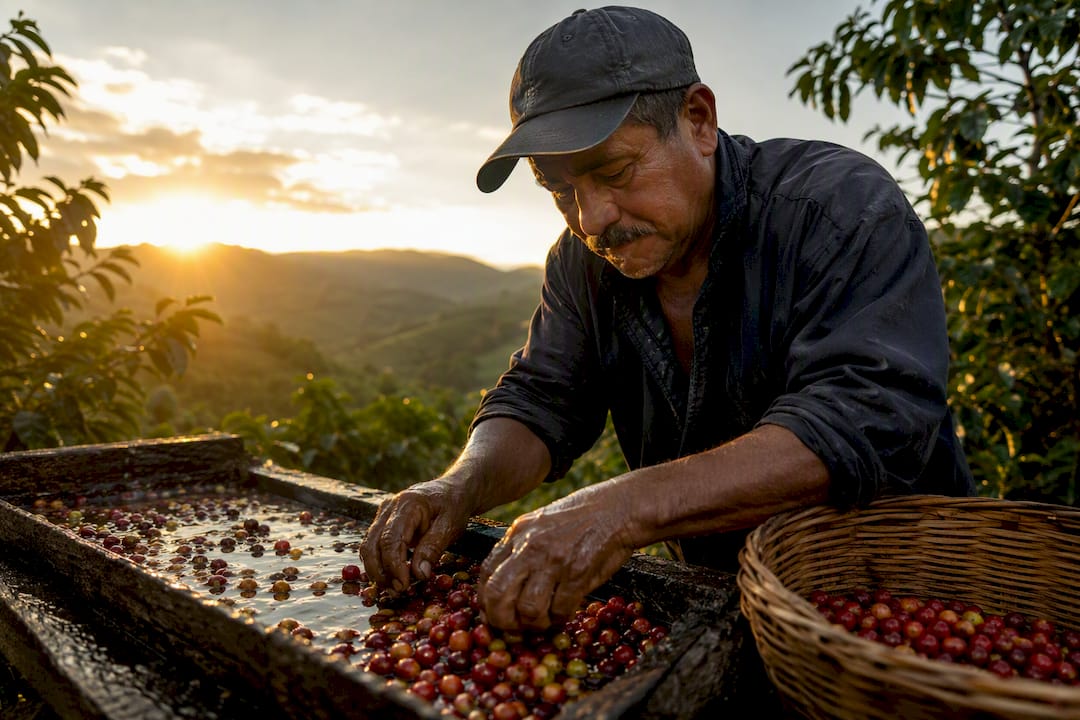
Those intermediaries matter as much as the money. Cooperatives aggregate small lots and negotiate collectively. Wet mills process cherry and often hold the first real leverage point over quality and payment timing. Local NGOs and government extension programs frequently administer training or infrastructure grants because brands rarely have staff on the ground. Exporter-aggregators sit in between, and their cut determines how much of a “premium” actually reaches the farm gate.
Money flows one way, but knowledge and services often flow the other: agronomy training, processing techniques, and market data move from brand or NGO down to the cooperative and household level.
Pro Tip: Ask whether a program’s governance includes farmer representatives with voting power, not just an advisory seat. Contracts that name a specific cooperative and a specific term length are far more verifiable than ones that reference “our partner communities” in the abstract.
Which Community Programs Do Coffee Brands Actually Fund?
Not all investment looks the same, and the timeline for seeing results varies enormously depending on what’s being built.
- Schools and health clinics — village-level infrastructure, benefiting entire communities, with construction visible in one to two years but staffing and use taking longer to stabilize.
- Water and energy systems — clean water access or solar micro-grids, usually village-scale, medium-term payoff (two to four years).
- Farm renewal (replanting) — replacing aging or disease-prone trees, household-level, long-term: full production often takes three to five years after replanting.
- Agroecology and soil health programs — shade management, composting, intercropping, medium-term yield and quality gains, often two to three seasons.
- Farmer training and extension — pruning, fertilization, post-harvest handling, short to medium-term, with some practices showing results within a single harvest.
- Cooperative capacity building — governance, bookkeeping, quality control, medium to long-term, since institutional change is slow.
- Living-income or price-stability programs — direct income support tied to price floors, immediate to short-term effect on household cash flow.
- Community-led agritourism — diversified income beyond coffee, long-term and market-dependent.
A useful contrast: a program pairing agronomy training with wet-mill upgrades and cooperative strengthening reported income increases as high as 250% for some adopting farmers in Kenya, and partial rejuvenation gains up to 60% in Ethiopia, according to a joint impact report from TechnoServe and Nespresso. Compare that to a one-time school donation announced in a press release with no follow-up data. Both count as “community investment.” Only one gives you a way to check its claim.
How Do Certifications Compare to Direct Brand Investment?
Third-party certification and direct brand investment solve different problems, and confusing the two is where a lot of consumer disappointment starts.
Certifications like Fairtrade guarantee a minimum price for raw coffee and layer on a community development premium meant to fund local projects, decided collectively by the cooperative. Rainforest Alliance runs audit frameworks covering environmental and social criteria with farm-level traceability requirements. USDA organic certification governs production standards through a formal certification pathway, but it says nothing about income or community funding at all.
What certifications typically do not guarantee: a living income, school construction, or climate adaptation funding. Those gaps are exactly where direct brand investment tends to step in, whether through grants, technical partnerships, or long-term contracts negotiated cooperative by cooperative.
Direct investment can be more flexible and, when done well, more accountable, because it’s tied to a specific project with a specific budget. But flexibility cuts both ways. It also means there’s no external auditor checking the brand’s homework unless the brand chooses to publish one. Look for independent audits, published impact reports, and traceability down to the specific cooperative or region, not just a country name on the bag.
How Do Coffee Brands Measure and Report Their Impact?
Credible impact claims come with numbers attached to a method, not just a number attached to a press release. The metrics worth watching for: farmers reached, change in farm income, yield shifts, adoption rates of trained practices, return on investment for farm-level interventions, physical community assets built, and gender or inclusion breakdowns.
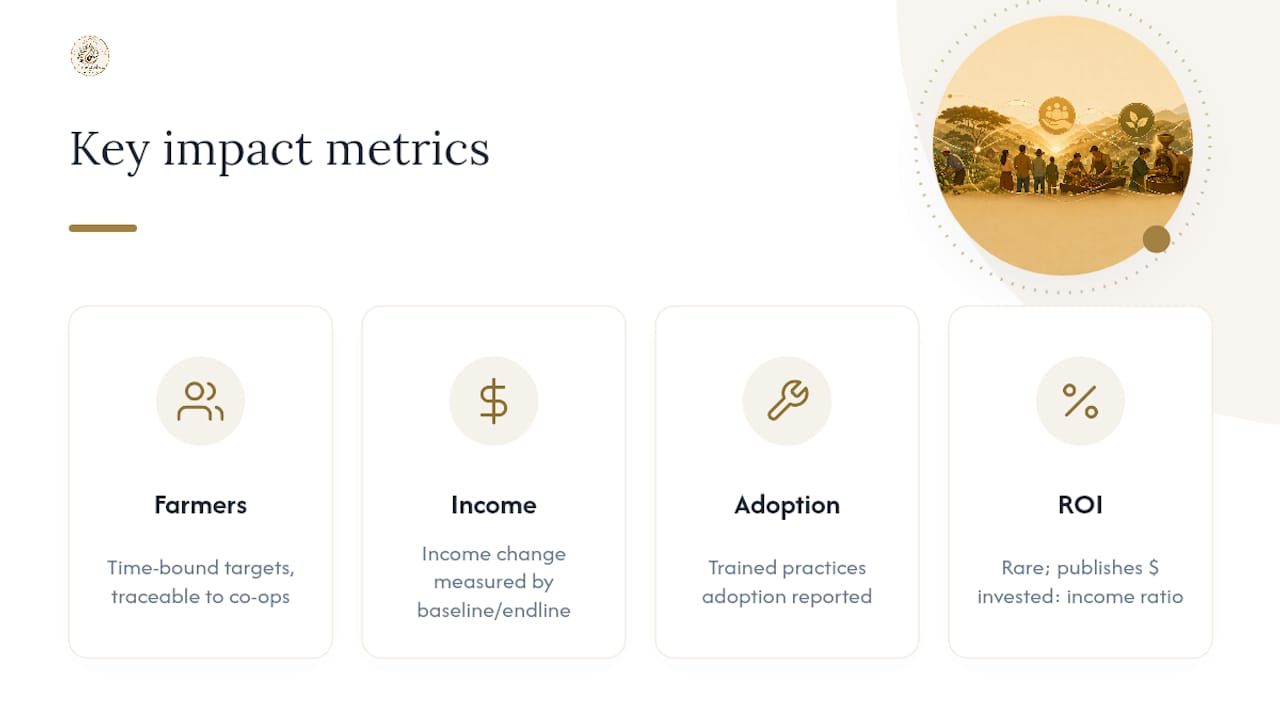
The evidence behind those metrics matters as much as the metrics themselves. Baseline and endline surveys, run before and after an intervention, are the minimum bar. Third-party evaluations add a layer of independence. ROI calculations, where a brand actually publishes the ratio of dollars invested to income generated, are rarer and more valuable.
Statistic callout: One of the more transparent examples in the sector comes from the Nespresso AAA program run with TechnoServe, which reported an estimated return of multiple times on initial farm-level investment, alongside the income gains noted earlier in Kenya and Ethiopia.
A data table only belongs in a brand’s report when every row can be filled with a real, sourced number. Time-bound targets (“500 farmers trained by 2027,” not “many farmers over time”), disaggregated data broken out by gender or farm size, and a traceability map back to named cooperatives are the reporting habits that separate a real program from a marketing footnote.
What Trade-Offs and Risks Come With Community Investment?
Good intentions don’t automatically produce good outcomes, and the coffee sector has plenty of cautionary examples.
- Certification costs can act as a barrier, pricing out the smallest or most resource-poor farms rather than lifting them up.
- Programs sometimes favor already better-off farmers who have the land, labor, or capital to participate.
- Agroecological transitions frequently cause a yield dip in year one or two before soil health improvements pay off.
- Top-down programs can exclude women or non-cooperative-member farmers by design, simply by routing benefits through formal membership structures.
- Short funding cycles (one to two years) rarely match the multi-year timelines farm renewal or soil programs actually need.
Experts caution that ethical certification, left unsupported, can raise the bar higher than resource-poor farmers can clear on their own; responsible brands offset that by funding training, financing, and market access rather than certification alone, according to a review of certification cost burdens.
Pro Tip: If a brand’s program has no phased financing plan and no mention of participatory decision-making, treat the announcement as a pilot, not a proven model, no matter how confidently it’s marketed.
What Does the Research Say About Community-Led Coffee Initiatives?
A systematic review of sustainability initiatives across global coffee supply chains identified 11 distinct initiative types, ranging from certification schemes to producer cooperatives, agroecology programs, and community and cultural initiatives. The finding that matters most for evaluating brand claims: initiatives governed locally, where producers hold real decision-making power, tend to align more closely with the actual social and environmental priorities of the community they’re meant to serve.
Locally governed initiatives, including producer cooperatives and community-led agroecology programs, can improve sustainability outcomes specifically because producers themselves are empowered to make decisions rather than having priorities set externally. But smallholder communities often still face real resource constraints that require partnership with NGOs and government programs to overcome.
That second half of the finding is easy to miss but just as important. Local governance is necessary, not sufficient. Cooperatives still need outside capital, technical expertise, and market access to scale beyond what member dues alone can fund, per the PMC review of coffee supply chain governance.
How Did Community Investment in Coffee Evolve to Where It Is Today?
Community investment in coffee didn’t start as a marketing strategy. It grew out of the collapse of the International Coffee Agreement in 1989, when price controls disappeared and global coffee prices crashed, pushing millions of smallholder farmers into poverty almost overnight. Cooperative movements and fair-trade pioneers in the 1990s built the first formal premium structures as a direct response, trying to insulate farmers from that kind of price volatility.
Certification schemes professionalized through the 2000s, with Fairtrade, Rainforest Alliance, and later organic standards giving buyers a repeatable framework instead of one-off relationships. Specialty coffee’s rise in the 2000s and 2010s added a second pressure: quality-focused roasters wanted direct relationships with specific farms, which is where direct-trade contracts and technical assistance programs took root outside the certification system entirely.
The last decade added two more layers. Climate change turned research investment, like the varietal work coordinated through World Coffee Research, into a competitive necessity rather than a nice-to-have, since arabica-growing regions are losing suitable land as temperatures rise. And the living-income conversation, sharpened by ongoing price volatility, pushed some brands past simple premiums toward direct income-support programs. What started as crisis response is now a structured, if uneven, set of practices, and understanding that history is part of what separates the solidarity economy model from a rebranded donation.
Why Meaningful Investment Should Be the Baseline, Not the Exception
The moral case here is simple: brands that profit from a crop grown by people living on thin margins owe more than a nice label. The practical case is just as strong. Farms that get real technical support and stable contracts produce better coffee for longer, which is good business, not charity.
Prefer brands that publish their methods, name their partners, and stay in a region for years, not one harvest.
Try a Coffee Backed by Traceable Sourcing Relationships
Qahwat Al’Ard builds its sourcing around long-term relationships with named regions and cooperatives, not one-season purchases, so the origin story on the label is something you can actually trace. That’s the practical alternative to buying blind from a brand that only talks about sustainability in the abstract.
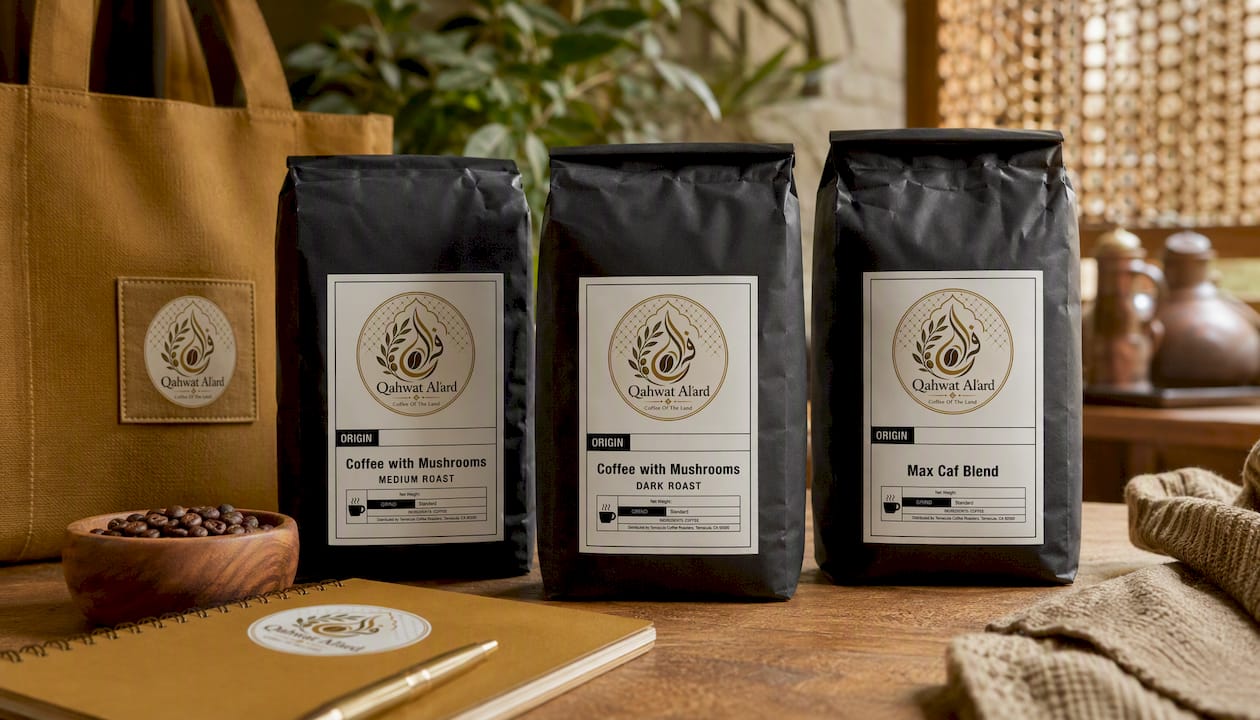
If you want to start with something distinctive, the Coffee with Mushrooms Medium Roast and its bolder counterpart, the Coffee with Mushrooms Dark Roast, pair traceable single-origin beans with a functional twist. For a daily-drinking blend built on the same sourcing principles, the Max Caf Blend is worth a look. Browse the current lineup and pick a bag that matches your roast preference, then check the product page for the origin details behind it.
Sources
- Sustainable coffee: A review of the diverse initiatives and governance dimensions of global coffee supply chains - PMC
- ScienceDirect article S2666188825006690
- TechnoServe - Nespresso AAA Impact Report Ethiopia & Kenya
- Fairtrade Certified: What we certify - Coffee
- World Coffee Research
- Rainforest Alliance
FAQ
Who owns Community Coffee brand?
Community Coffee is a family-owned company headquartered in Louisiana, unrelated to the broader concept of “community investment” discussed in this article.
What coffee company does Tom Hanks own?
There’s no credible, sourced record of Tom Hanks owning a coffee company; this claim appears to be a persistent internet rumor without verified backing.
Is Community Coffee better than Folgers?
That comparison comes down to personal taste and roast preference rather than community investment practices, since neither brand’s community programs were part of the research behind this article.
What does Starbucks do to help farmers’ communities?
Starbucks runs farmer support centers and sourcing verification programs focused on agronomy training and responsible sourcing standards, though independent, farmer-level ROI data comparable to smaller program reports is not widely published.
How can I verify a coffee brand’s community investment claims?
Ask for a published impact report with named metrics, request traceability to a specific cooperative or region, and check whether targets are time-bound rather than open-ended. Brands like Qahwat Al’Ard that name specific sourcing regions and long-term partners make that verification process far easier than brands relying on generic sustainability language.


