


TL;DR:
- A coffee brewing starter set should focus on a high-quality burr grinder, a dripper, and a kettle, as the grinder impacts extraction most. Beginners should prioritize traceable, single-origin beans from the start to enhance flavor understanding and tasting experience. Upgrading over time involves improving control tools like burr grinders and kettles while maintaining a focus on ethical, traceable coffee sources.
A coffee brewing starter set is a curated collection of tools, from a burr grinder to a brewer and scale, designed to move you from pre-ground convenience to fresh-ground, precisely controlled brewing. The single most decisive choice in any home brewing coffee set is the grinder. Everything else is secondary.
Pro Tip: Start with a simple manual brewer and a kitchen scale. You can swap out the kettle or filters later — but a cheap grinder will cap your cup quality no matter what else you buy.
Table of Contents
- What does a coffee brewing starter set actually include?
- Why the grinder deserves the biggest share of your budget
- Manual methods versus automatic brewers — which fits your goals?
- How to choose or assemble a starter set that actually works
- Starter recipes and brew parameters you can use today
- How to upgrade your setup over time
- Where to source ethically traced beans and learn more
- Key Takeaways
- Why traceability changes how you taste coffee
- Qahwat Al’Ard: traceable beans for every stage of your setup
- FAQ
- Further reading and sources
What does a coffee brewing starter set actually include?
A well-built starter set covers six core items. The three most important for hand-drip beginners are a dripper, a kettle, and a grinder. Other commonly included items are a digital scale with timer (ideally 0.1g resolution), filters, an airtight storage container, and fresh, traceable beans. Everything beyond the grinder, dripper, and kettle is optional, depending on your budget and goals.
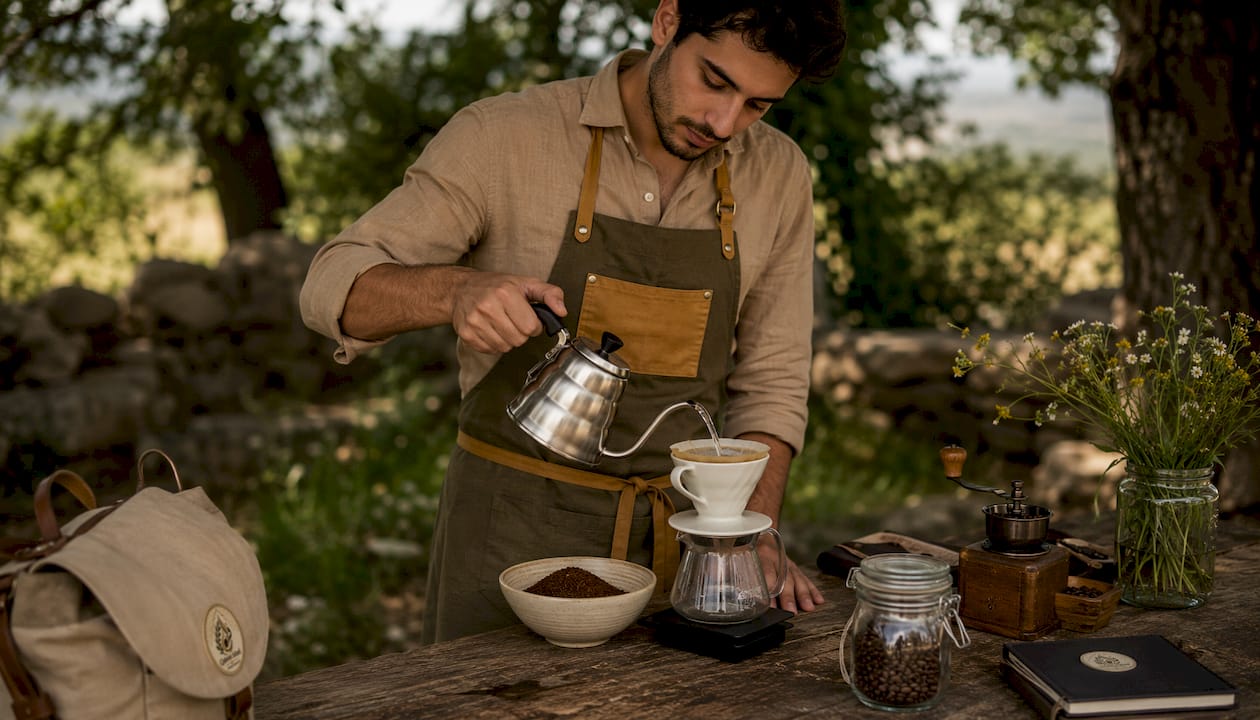
Optional but genuinely useful: a thermometer (until you know your kettle’s pour temperature by feel), a server or carafe for sharing, and a small cleaning brush for the grinder.
Pro Tip: Paper filters are the better starting choice for single-origin beans. They strip out the oils that can muddy delicate floral or fruit notes — exactly what you’re paying for with traceable specialty coffee.
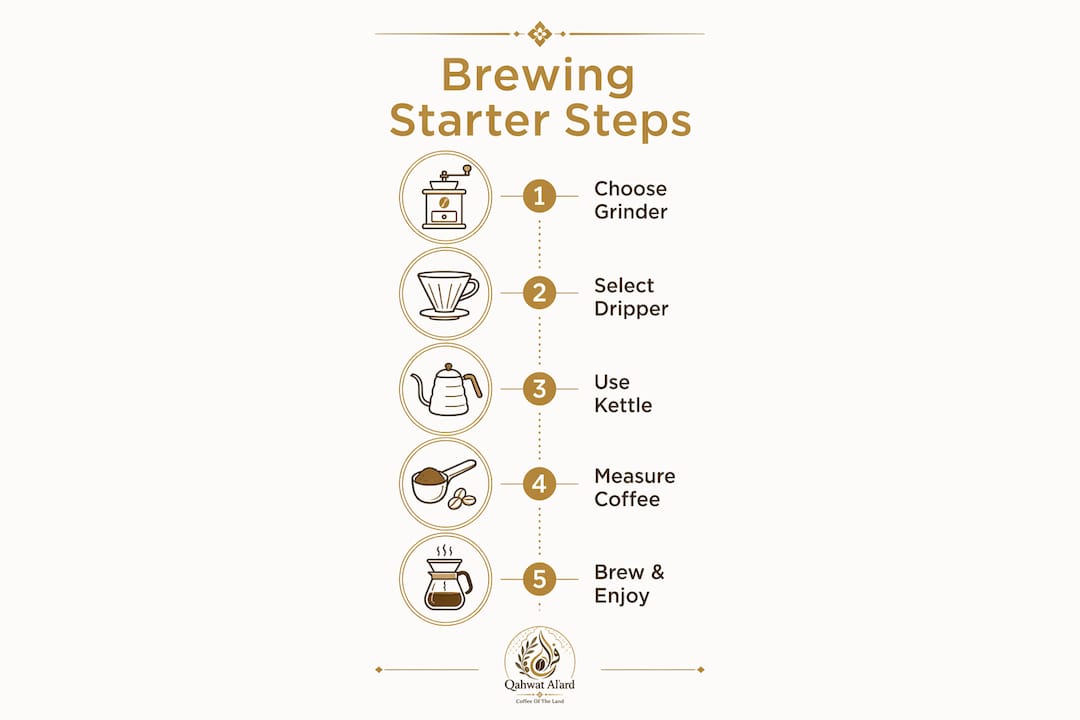
According to beginner kit guides, the three non-negotiables for hand-drip brewing are a dripper, a kettle, and a grinder. Everything else is optional depending on your budget and goals.
Why the grinder deserves the biggest share of your budget
Grind consistency drives extraction more than any other single variable. An uneven grind produces a mix of fine particles and coarse chunks — the fines over-extract (bitter), the chunks under-extract (sour), and the cup tastes like both at once. A quality burr grinder eliminates that problem by producing particles of uniform size.
Budget benchmark: A solid beginner setup — burr grinder, dripper, scale, and gooseneck kettle — typically runs $200–$350. Within that range, allocate the largest single share to the grinder.
Burr grinders come in two types: flat burrs and conical burrs. Both outperform any blade grinder. For a beginner brewing pour-over or French press, a conical burr hand grinder in the $40–$80 range is a practical starting point. An electric flat-burr grinder is the natural upgrade once you’re brewing daily.
Maintenance matters too. Look for grinders with replaceable burrs. Burrs dull over time, and a grinder with sealed, non-replaceable burrs is a dead end. Clean the burr chamber weekly with a brush to prevent rancid oil buildup, which ruins even the best beans.
Pro Tip: If your budget forces a choice between a better grinder and a better brewer, always take the grinder. A $50 V60 with a great grinder will outperform a $200 automatic machine paired with a blade grinder.
Manual methods versus automatic brewers — which fits your goals?
Both approaches can produce an excellent cup. The choice comes down to what tradeoffs you’re willing to accept.
Manual brewers — the V60, French press, and AeroPress — give you direct control over every variable: pour rate, bloom time, water temperature, and immersion duration. That control is exactly what lets you highlight the specific flavor notes of a single-origin bean. A light Ethiopian pour-over and a natural-process Colombian French press taste genuinely different when you’re steering the variables. The SCA’s Golden Cup standard defines the extraction range that produces balanced flavor, and manual methods let you chase that target deliberately.
Automatic drip machines trade that control for consistency and convenience. A high-quality automatic brewer certified to SCA standards — like the Moccamaster KBGV, which brews between 196°F and 205°F and meets the Golden Cup extraction benchmark — can produce café-quality results without any hands-on technique. Some precision coffee makers, like the Fellow Aiden paired with a matching grinder, automate pour-over variables entirely while maintaining the underlying principle: grind, temperature, and ratio still govern the cup.
Use-case guide:
- Daily convenience, consistent results: SCA-certified automatic drip
- Exploring single-origin flavor notes: V60 or AeroPress
- Rich body, low equipment cost: French press
- Entertaining or batch brewing: Automatic with a thermal carafe
For specialty coffee beginners focused on single-origin tasting, start manual. The feedback loop is faster and the flavor payoff is more obvious.
How to choose or assemble a starter set that actually works
Ask these questions before buying any kit or individual piece:
- Does the grinder support the right grind range? Pour-over needs medium-fine; French press needs coarse. A grinder locked into espresso-fine settings won’t work for either.
- Are the burrs replaceable? Non-replaceable burrs mean you’ll buy a new grinder in two years instead of a $15 replacement set.
- Does the scale read to 0.1g? Anything coarser makes ratio control unreliable.
- Is the kettle compatible with your heat source? Induction, electric, or stovetop — confirm before buying.
- Does the kit include recipe guidance? A starter set with no parameters is just a box of gear.
- Can you verify bean traceability? A roast date and origin region on the bag are the minimum. Farm-level traceability is better.
- Is the brewer easy to clean? A dripper you hate washing will sit in a drawer by week three.
Red flags: blade grinders bundled as a selling point, “compatible with all grind sizes” claims (a sign of mediocre burrs), and roasters who can’t tell you where their beans came from.
Starter recipes and brew parameters you can use today
| Brewer | Coffee:Water Ratio | Grind Setting | Water Temp | Brew Time |
|---|---|---|---|---|
| V60 / Pour-over | 1:15 (example ratio for coffee to water) | Medium-fine | 200°F | 2:30–3:00 min |
| French press | 1:15 (example ratio for coffee to water) | Coarse | 200°F | 4 min |
| AeroPress | 1:12–1:15 (e.g., 15g coffee : 200g water) | Medium | 195–205°F | 1:30–2:00 min |
| Auto drip | 1:15–1:17 | Medium | 195–205°F | Per machine cycle |
Brew temperature between 195°F and 205°F is the standard range for reliable extraction. Water with some mineral content produces more balanced flavor than fully demineralized water.
Taste-adjustment rules: if the cup is sour or thin, grind finer or brew longer. If it’s bitter or harsh, grind coarser or shorten brew time. Change one variable per brew so you know what moved the needle.
Pro Tip: Start with a neutral single-origin — a washed Ethiopian or Colombian works well — and write down one change per brew session. After five brews, you’ll understand your grinder and brewer better than any guide can teach you.
How to upgrade your setup over time
Treat the starter set as a learning system, not a one-time purchase. Upgrades should fill a measurable gap in control or consistency, not just add gear.
Months 3–6: If you’re grinding by hand daily, move to an electric burr grinder with flat burrs. This is the single upgrade with the most impact on cup clarity and speed.
Months 6–12: Add a gooseneck kettle with variable temperature control. Once you’re dialing in pour-over recipes, flow rate and temperature precision start to matter. Pair it with a premium coffee gear resource to evaluate what’s worth the spend.
Beyond 12 months: A precision scale with a built-in timer, a vacuum storage canister, and a dedicated server or carafe round out a complete setup. If espresso interests you, the NNEDSZ 20 Bar Espresso Maker is a natural next step into pressure-based brewing.
Prefer modular, repairable gear throughout. Ecosystems that let you swap burrs, upgrade kettles, and add accessories protect your earlier purchases and reduce waste.
Where to source ethically traced beans and learn more
The gear is the frame. The beans are the picture. For single-origin, traceable coffee, look for roasters who publish the farm name, region, processing method, and roast date on every bag. Vague “blend” labels with no origin information are a signal to keep looking.
Qahwat Al’Ard sources premium, traceable single-origin beans from renowned growing regions and publishes the provenance details that specialty coffee enthusiasts actually want to see. Their 12-pack single-serve capsules are a practical first purchase for beginners: you get multiple origins in one order, no commitment to a full bag, and a clear taste comparison across regions. For higher-volume brewing, the 60-pack coffee pods offer the same traceability at scale.
For deeper learning, Qahwat Al’Ard’s coffee accessories starter guide and grind primer cover equipment choices and grind settings in detail. Their specialty brewing methods guide pairs each method with the origin profiles that suit it best.
Key Takeaways
A coffee brewing starter set works when you prioritize grind consistency, measure by weight, and start with traceable single-origin beans.
| Point | Details |
|---|---|
| Grinder first | Allocate the largest share of your starter budget to a burr grinder — it drives extraction more than any other item. |
| Measure by weight | Use a 0.1g-resolution scale and a 1:15 coffee-to-water ratio as your default starting point. |
| Three variables to learn | Grind size, water temperature (195–205°F), and brew ratio control every cup — change one at a time. |
| Start simple | A manual brewer, a scale, and fresh beans are enough to produce café-quality results from day one. |
| Qahwat Al’Ard sample packs | The 12-pack single-serve capsules let beginners taste multiple traceable origins before committing to a full bag. |
Why traceability changes how you taste coffee
Most beginner guides treat the starter set as a gear problem. It isn’t. The gear is just the instrument. What you’re actually building is the ability to taste the difference between a washed Yirgacheffe and a natural-process Sidama — and to understand why those differences exist in the cup.
That’s why Qahwat Al’Ard ties equipment guidance to provenance. A burr grinder and a V60 are tools for listening to a bean. If the bean has no traceable story — no farm, no region, no processing method — the tools have nothing to say. Single-origin, ethically sourced coffee gives the equipment a purpose beyond convenience.
The conventional wisdom in starter-set guides is to buy the cheapest functional gear and upgrade later. That’s reasonable advice for the tools. It’s the wrong frame for the beans. Buy the best traceable single-origin coffee you can find from day one. The flavor difference between a commodity blend and a well-sourced Ethiopian natural is more dramatic than the difference between a $40 hand grinder and a $200 electric one. Start with the beans. The gear will follow.
Qahwat Al’Ard: traceable beans for every stage of your setup
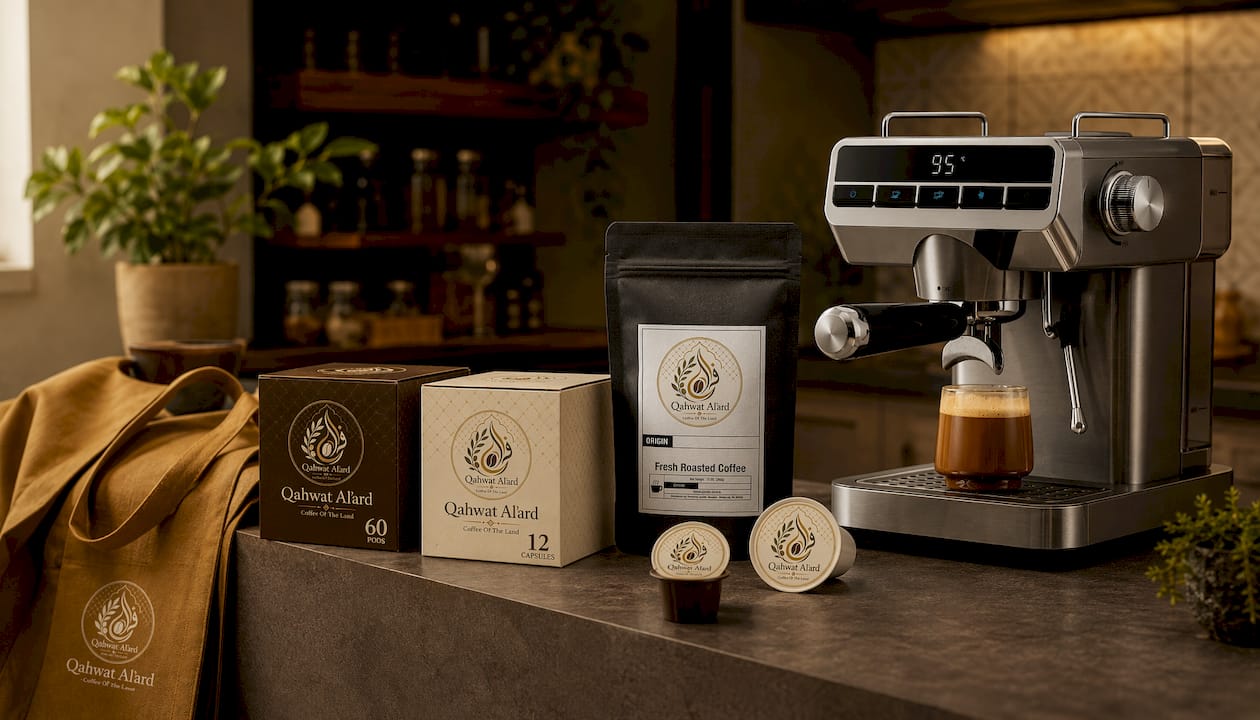
Qahwat Al’Ard gives you something most starter-set guides skip entirely: coffee you can actually trace. Every single-origin offering comes with the provenance details — region, processing method, roast date — that make the brewing practice meaningful. Whether you’re pulling your first V60 or dialing in a precision espresso machine, the beans matter as much as the gear.
Start with the 12-pack single-serve capsules to taste multiple origins side by side, or go straight to the 60-pack pods if you already know what you love. Ready to move into espresso? The NNEDSZ 20 Bar Espresso Maker pairs naturally with Qahwat Al’Ard’s single-origin offerings. Browse the full selection at Qahwat Al’Ard and order the sample pack that fits where you are right now.
FAQ
What does a coffee brewing starter set include?
For hand-drip beginners, a coffee brewing starter set must include three essentials: a dripper, a kettle, and a grinder. Other items like a digital scale, filters, and fresh, traceable beans are excellent additions if budget and goals permit.
How much should a beginner spend on a coffee starter kit?
A solid beginner setup with a burr grinder, dripper, scale, and kettle typically costs a few hundred dollars. Allocate the largest share to the grinder.
What water temperature is best for brewing coffee?
Brew between 195°F and 205°F for reliable extraction, per SCA standards. Water with some mineral content produces more balanced flavor than fully demineralized water.
Is a manual or automatic brewer better for single-origin coffee?
Manual brewers like the V60 or AeroPress give you more control over variables, which helps highlight single-origin flavor notes. High-quality automatic brewers certified to SCA standards can also produce excellent results with less hands-on effort.
Where can I buy traceable single-origin coffee for a starter set?
Qahwat Al’Ard offers traceable single-origin beans and pods with published provenance details. Their 12-pack single-serve capsules are a practical starting point for tasting multiple origins.
Further reading and sources
- The Beginner Home Coffee Kit — Brooklyn Coffee Guide: supports grinder-first budget guidance and component priorities.
- Coffee Equipment Starter Kit for $300 — Home Brew Expert: source for the $200–$350 starter kit benchmark.
- Specialty Coffee Association: primary source for Golden Cup extraction standards, brew temperature ranges (195–205°F), and TDS yield benchmarks.
- Coffee Starter Kit Under 10000 Yen — Coffee Guide JP: supports the three-item minimal kit approach (dripper, kettle, grinder).
- Coffee Accessories for Beginners — Qahwat Al’Ard: equipment primer for readers who want a deeper gear breakdown.
- Understanding Different Coffee Grinds — Qahwat Al’Ard: grind size reference for recipe tuning and brewer pairing.
- Specialty Coffee Brewing Methods Explained — Qahwat Al’Ard: pairs brewing methods with single-origin flavor profiles.
- What Is Single Origin Coffee? — Qahwat Al’Ard: flavor guide for matching origins to brewing methods.


