


Start at 1:16, meaning 1 gram of coffee for every 16 grams of water, then adjust to taste within a 1:15 to 1:18 range. Espresso and cold brew break this rule entirely: espresso runs closer to 1:2 from dose to yield, and cold brew concentrate lands between 1:5 and 1:8 before dilution. Weigh both coffee and water on a kitchen scale, brew one cup, and taste before you touch anything else.
TL;DR:
- Most brewing methods benefit from a coffee to water ratio between 1:15 and 1:18, with 1:16 as the standard starting point.
- Adjusting the ratio by one step (from 1:15 to 1:16 or 1:16 to 1:17) subtly changes strength and clarity, requiring precise measurement with a scale.
- Espresso brewing typically uses a 1:2 yield ratio, with about 18 grams of coffee producing roughly 36 grams of espresso, which is a different scale altogether.
- Water quality and temperature significantly affect the effective ratio, as hard water and temperature variations can alter extraction and flavor perception.
- Taste diagnostics should guide whether to tweak ratio, grind size, temperature, or brew time, always changing one variable at a time for best results.
Table of Contents
- What Is the Coffee to Water Ratio, and Why Does It Matter?
- What’s the Ideal Coffee Ratio, and How Do You Convert It to Cups?
- What Coffee Ratio Should You Use for Each Brewing Method?
- How Do You Measure and Calculate the Right Coffee Dose?
- Should You Adjust Ratio or Change Grind, Temperature, and Time Instead?
- Practical Rules and a Quick Troubleshooting Checklist
- Where Qahwat Al’ard Fits Into This Guide
- How Water Quality and Temperature Change Your Effective Ratio
- How Does Brew Time Interact With Your Coffee Ratio?
- Why I Tell Every New Brewer to Start With Ratio First
- Coffee and Tools That Make Dialing In Easier
- Sources
- FAQ
What Is the Coffee to Water Ratio, and Why Does It Matter?
The coffee to water ratio is a weight relationship, not a volume one. It compares grams of ground coffee to grams of water, and it’s the single biggest lever you have over how strong a cup tastes.
Strength and extraction are two different things, even though people mix them up constantly. Strength is how much dissolved coffee ends up in your cup, measured as total dissolved solids (TDS). Extraction is what percentage of the coffee’s soluble material actually made it into the water, and it’s driven by grind size, water temperature, and contact time. Peer-reviewed research on coffee chemistry and extraction backs up this distinction: you can pull a coffee that’s both weak and over-extracted, or strong and under-extracted. Ratio alone doesn’t guarantee balance.
That’s why ratio comes first. It’s the fastest, most reliable way to change strength without touching anything else.
- Ratio controls strength (how much coffee relative to water).
- Extraction controls balance (sour, sweet, or bitter).
- A scale measuring grams beats spoons or scoops every time.
What’s the Ideal Coffee Ratio, and How Do You Convert It to Cups?
For most brewed methods, the reference range runs from 1:15 to 1:18 by weight, with 1:16 serving as the practical default that works across most beans and brewing styles. Mainstream culinary sources back this up too. Food Network’s guidance points to roughly 60 grams of coffee per liter, which lands right in that same 1:16 to 1:17 window.
Here’s what that looks like for common cup sizes at a 1:16 default:
| Water (grams) | Cup Size | Coffee at 1:16 |
|---|---|---|
| 240 g | 8 oz | 15 g |
| 355 g | 12 oz | 22 g |
| — | 16 oz | 30 g |
Moving to 1:15 makes the cup noticeably stronger and heavier on the tongue. Moving to 1:18 lightens it, pulling out more clarity and tea-like brightness but less body. Each single-step move is subtle, not dramatic. That’s the point.
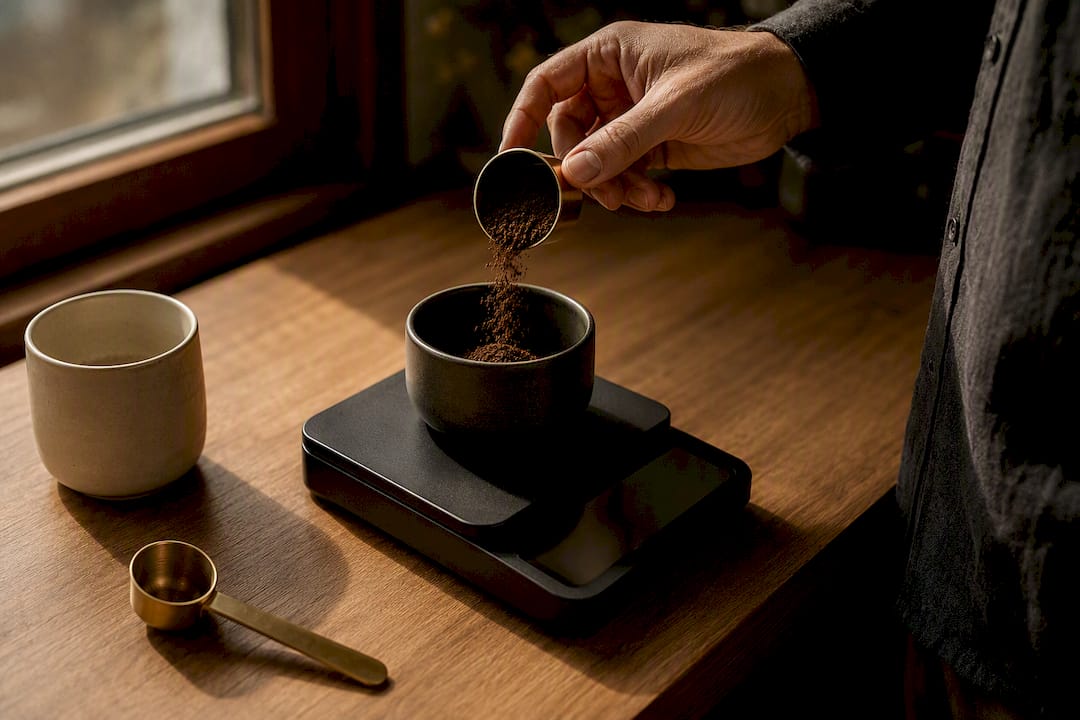
Skip the tablespoon. A tablespoon of finely ground coffee weighs more than the same scoop of coarsely ground coffee, so your “ratio” shifts every time you change grind size without you noticing. A scale removes that variable completely.
What Coffee Ratio Should You Use for Each Brewing Method?
Every brewing method has its own comfort zone, shaped by contact time and how much the water and grounds actually interact.
- Drip or auto-drip: 1:15 to 1:17, with 1:16 as a solid default for most machines.
- Pour-over: 1:15 to 1:16. The shorter, more controlled brew time rewards a slightly tighter ratio for clarity.
- French press: 1:14 to 1:16, starting around 1:15. Full immersion brewing extracts more oils and body, so a little more coffee per gram of water reads as balanced rather than heavy.
- AeroPress: anywhere from 1:12 to 1:17 depending on your press style, though a common standard recipe runs close to 1:15 with a short steep before pressing.
- Espresso: a different game entirely. Espresso uses yield ratio language, meaning dose in versus liquid out, and a typical double shot runs about 1:2, so 18 grams of coffee yields around 36 grams of espresso.
- Cold brew: concentrate brews at 1:5 to 1:8 and gets diluted before drinking, while ready-to-drink versions without dilution often sit closer to 1:8 to 1:12.
- Moka pot: roughly 1:7, reflecting the pressurized, fast extraction that pot design forces on the brew.
- Turkish coffee: around 1:10, with finely powdered grounds simmered directly in the water rather than filtered out.
These are starting points, not laws. Bean density, roast level, and personal taste will nudge every one of these numbers slightly.
How Do You Measure and Calculate the Right Coffee Dose?
Getting the math right takes about ten seconds once you know the formula. Weigh water, divide by your target ratio, and that’s your coffee dose in grams.
- Pick your ratio (start at 16 if you’re unsure).
- Weigh your water in grams on a kitchen scale.
- Divide the water weight by the ratio number to get grams of coffee.
- Example: 240 grams of water divided by 16 equals 15 grams of coffee.
One gram of water equals roughly one milliliter, so you can measure water by volume in a kettle or measuring cup and still convert it cleanly to grams for the math. Ratios also scale linearly. Doubling your batch to 480 grams of water at 1:16 just means doubling the coffee to 30 grams. No new math required, just multiplication.
Pro Tip: Keep a small notebook or notes app entry with your ratio and grind setting for each bag of coffee you buy. Beans change roast to roast, and rebuilding your recipe from memory every time wastes good coffee.
A cheap kitchen scale that measures in grams is the only piece of equipment that actually matters here. Plenty of free online coffee calculators can do the division for you if you’d rather skip the mental math entirely.
Should You Adjust Ratio or Change Grind, Temperature, and Time Instead?
This is where most home brewers get stuck, tweaking the wrong variable and wondering why nothing improves.
Roast level changes solubility. Dark roasts are more porous and give up their soluble compounds faster, so they often taste balanced at a slightly higher ratio number like 1:16 to 1:18. Light roasts are denser and resist extraction more, so they frequently need a tighter ratio, closer to 1:15 to 1:16, to reach the same perceived strength.
Taste is your best diagnostic tool, and most problems map to a clear fix:
- Tastes sour or sharp: usually under-extracted. Grind finer or raise water temperature slightly. Check water temperature guidelines if you’re not sure where to start.
- Tastes bitter or harsh: usually over-extracted or brewed too hot. Grind coarser, lower the temperature, or shorten contact time.
- Tastes weak or watery even after fixing extraction: that’s a ratio problem. Drop the number by one step, say from 1:16 to 1:15.
Consumer testing guidance consistently points to the same discipline: change one variable at a time, in small steps, adjusting ratio by a single gram rather than overhauling grind, temperature, and dose all at once. If you’re still unsure whether your grind is the culprit, a grind size guide by brew method is worth a look before you touch the ratio again.
Practical Rules and a Quick Troubleshooting Checklist
Most brewing frustration comes down to skipped basics, not bad beans.
Buy a scale and use it for both coffee and water, every single time. Start every new bag at 1:16, write down what you brewed, and taste critically before changing anything. If your results are inconsistent day to day even with the same grams, check your dosing and grind consistency before you blame the machine or upgrade equipment you don’t need yet.
- Cup tastes flat or dull: try a fresher bag or a slightly finer grind.
- Cup tastes sour: increase temperature or tighten the grind.
- Cup tastes bitter: coarsen the grind or shorten brew time.
- Cup tastes weak: drop your ratio number by one, from 1:16 to 1:15.
- Cup tastes muddy or over-strong: raise your ratio number by one, from 1:16 to 1:17.
A rundown of common brewing mistakes covers a few more edge cases if your cup still isn’t landing after working through this list.
Where Qahwat Al’ard Fits Into This Guide
Qahwat Al’ard’s coffee journal covers water temperature and cold brew proportions in more depth than this guide allows.
- Cold Brew Coffee fits the 1:5 to 1:8 concentrate range covered above.
- Max Caf Blend works well as a 1:16 starting point for drip or pour-over.
This piece carries editorial perspective from Yasin Sofyian Ayesh.
How Water Quality and Temperature Change Your Effective Ratio
Your ratio math assumes the water itself is neutral, and that assumption breaks down more often than people realize. Hard water, loaded with dissolved minerals, extracts differently than soft water because those minerals bind to certain flavor compounds and change how much soluble material ends up in your cup. The same 15 grams of coffee in 240 grams of hard tap water can taste flatter or chalkier than that exact ratio brewed with filtered water, even though the numbers on paper are identical.
Temperature works the same way, quietly shifting your effective ratio without changing a single gram on the scale. Water that’s too cool under-extracts, leaving your measured ratio tasting weaker and sourer than the math suggests it should. Water that’s too hot over-extracts fast, pulling out bitter compounds and making a properly measured 1:16 taste harsh and overdone. Most filter methods do best in the 195°F to 205°F range, just off a full boil.
This is why two people can weigh out the exact same ratio, follow the exact same recipe, and end up with two different cups. The ratio was never wrong. The water chemistry or the temperature it was poured at compensated for it in the wrong direction. If your cup tastes off despite careful weighing, check your water and your kettle temperature before you second-guess your scale.
How Does Brew Time Interact With Your Coffee Ratio?
Brew time and ratio work together, not independently, and treating them as separate knobs is where a lot of home brewing goes sideways. A longer contact time between water and grounds pulls more solubles out of the coffee regardless of what your ratio says, which means the same 1:16 recipe can taste completely different at a two-minute pour-over versus a five-minute one.
Immersion methods like French press make this obvious. That method’s slightly stronger 1:14 to 1:15 default ratio exists specifically because the four-minute steep time extracts more thoroughly than a quick pour-over ever could. Shorten that steep and the cup tastes thin even at the “correct” ratio. Extend it much past four minutes and the same ratio starts tasting muddy or bitter.
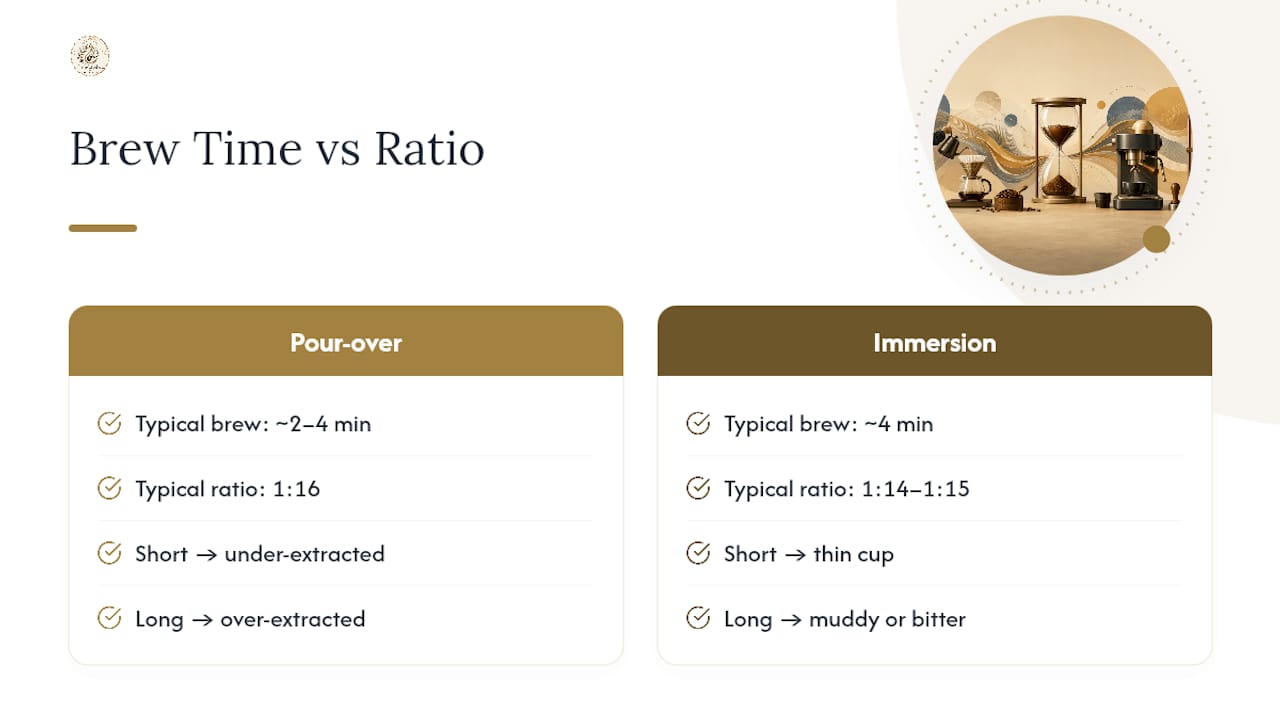
Pour-over methods are more time-sensitive because gravity, not immersion, controls contact. A pour that finishes in under two minutes probably needs a finer grind or a slightly stronger ratio to compensate for lost contact time. A pour that drags past four minutes because the grind was too fine will over-extract even at a textbook 1:16.
The practical takeaway: match your ratio expectations to your method’s typical brew window, and if your timing runs long or short, treat that as the first thing to fix, not the ratio itself.
Why I Tell Every New Brewer to Start With Ratio First
Ratio is the one variable you can control with total precision using nothing but a scale, so it’s the smartest place to start dialing in a cup. Set it at 1:16, taste, and move in single grams from there. Small, systematic changes teach you more about your own preference than any recipe ever will. If you’d rather start from beans built for this kind of experimentation, Consider exploring coffee lineups designed specifically for this kind of experimentation.
— Yasin Sofyian Ayesh
Coffee and Tools That Make Dialing In Easier
Getting the ratio right matters less if the coffee underneath it is inconsistent bag to bag. Qahwat Al’ard’s Cold Brew Coffee is roasted specifically for the concentrate ratios covered above, so a 1:6 or 1:7 steep gives you a clean, repeatable base every time rather than a guess. There’s also a second Cold Brew Coffee option if you want to compare origins side by side at the same ratio.
For drip and pour-over drinkers, the Max Caf Blend is built to perform right at that 1:16 starting point this guide keeps coming back to, so you’re not fighting an unfamiliar bean while you’re still calibrating your scale. Roasted fresh to order, it gives you one less variable to second-guess while you test your way toward the ratio that actually suits your palate. Order a bag, weigh your first cup at 1:16, and adjust from there.
Sources
- Coffee-to-Water Ratio Explained — Coffee Studies
- PMC article on coffee chemistry and extraction
- You don’t need a fancy brewer for great coffee — you need the golden ratio | CNET
- What’s the Ideal Coffee-to-Water Ratio? - Food Network
FAQ
What Is the Best Coffee to Water Ratio to Start With?
Start at 1:16 by weight, meaning 1 gram of coffee per 16 grams of water, and adjust within the 1:15 to 1:18 range based on taste.
How Much Coffee Do I Use for 12 Ounces of Water?
For 355 grams (about 12 ounces) of water at a 1:16 ratio, use roughly 22 grams of coffee.
Is the Coffee Ratio Different for Espresso?
Yes. Espresso uses a dose-to-yield ratio of about 1:2 rather than the 1:15 to 1:18 range used for filter coffee, so 18 grams of coffee yields around 36 grams of espresso.
What Ratio Should I Use for Cold Brew?
Cold brew concentrate typically runs between 1:5 and 1:8, then gets diluted before drinking; ready-to-drink versions without dilution sit closer to 1:8 to 1:12.
Should I Change the Ratio or the Grind Size First?
Diagnose the taste first. Sour or bitter flavors usually point to a grind, temperature, or time problem, while a cup that’s simply too weak or too strong points to the ratio itself.


