


Yes, freezing whole coffee beans is a smart way to preserve aroma for months, but only if you portion them into airtight, single-use pouches before they go in. Never freeze pre-ground coffee, and never refreeze a pouch once it’s opened. Grind straight from frozen or let a sealed pouch come to room temperature before opening. Skip either rule and you’ll trade freshness for a bag of stale, watery-tasting beans.
TL;DR:
- Freezing whole coffee beans preserves their aroma best when portioned into airtight pouches and never refrozen after opening, especially for dark roasts or limited editions.
- Coffee should be frozen around one to two weeks after roasting for filter coffee and two to three weeks for espresso to maintain optimal flavor.
- Proper sealing with vacuum or heavy-duty freezer bags, labeling with roast date, and stacking pouches away from freezer door improve preservation quality.
- Grinding straight from frozen or thawing sealed pouches overnight helps prevent moisture and odor contamination, safeguarding freshness.
- Typically, properly stored frozen beans stay good for three to six months, with dark roasts benefiting most from freezing to retain aromatic oils.
Table of Contents
- Which Coffee Beans Should You Freeze, and When?
- How Do You Freeze Coffee Beans the Right Way?
- What Equipment Actually Keeps Frozen Coffee Fresh?
- How Long Does Frozen Coffee Actually Stay Good?
- Why Do Frozen Coffee Batches Sometimes Taste Off?
- Does Freezing Affect Arabica and Robusta Beans Differently?
- Why Take Freezing Seriously
- Ready-to-Brew Beans That Also Freeze Well
- Sources
- FAQ
Which Coffee Beans Should You Freeze, and When?
Not every bag deserves a spot in your freezer. Dark roasts and rare, limited-lot coffees benefit the most from freezing because they lose aromatic oils faster at room temperature. Light roasts tend to hold their brightness and complexity longer on the counter, so freezing them is more about convenience than rescue.
Timing matters as much as roast level. Coffee is at its best in a fairly narrow window after roasting, and freezing too early or too late wastes the effort.
- For filter or drip coffee, freeze around one to two weeks after the roast date, once initial degassing has settled but before the aromatics fade.
- For espresso, wait closer to two to three weeks post-roast, since espresso profiles often benefit from a slightly longer rest.
- Freeze when you buy in bulk, snag a limited seasonal release, or want to archive a favorite coffee shelf life window before it closes.
If you’re only buying what you’ll drink in the next couple of weeks, the freezer probably isn’t necessary at all.
How Do You Freeze Coffee Beans the Right Way?
Freezing coffee well is less about the freezer and more about what happens before the beans get there. The goal is zero air, zero moisture, and zero unnecessary trips in and out of the cold.
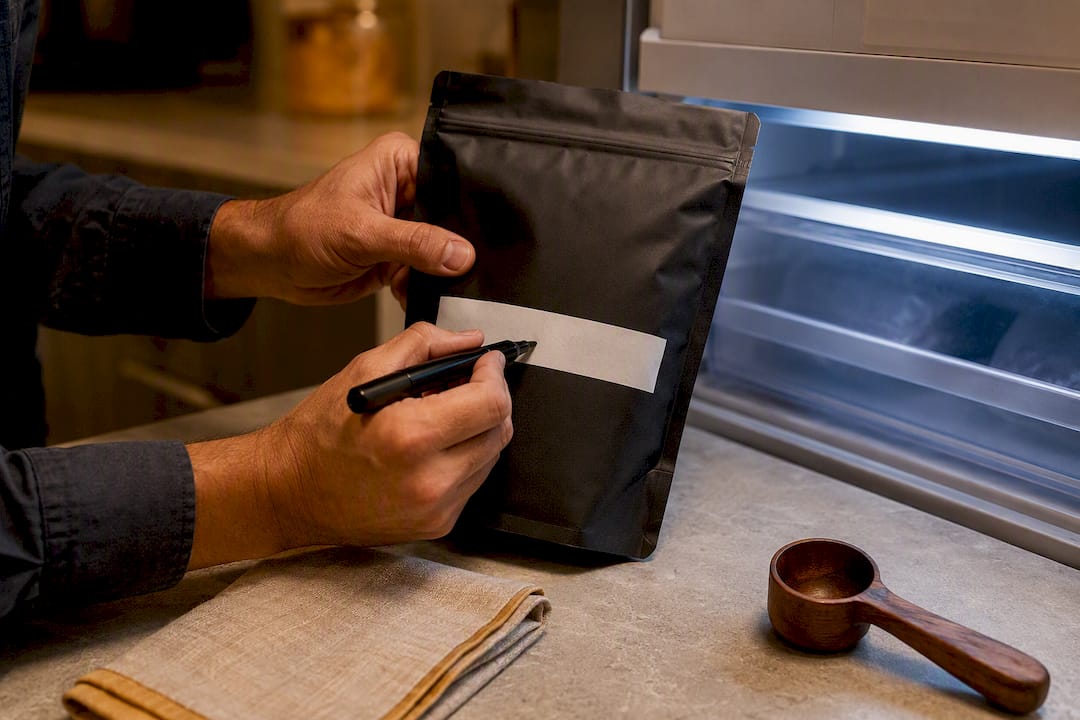
- Portion the beans first. Divide your bag into single-use or short-use doses, roughly one to two weeks’ worth of coffee per pouch, and write the roast date on each one.
- Seal each portion. A vacuum sealer is the gold standard because it removes the air pocket where moisture and odors collect. Without one, use heavy-duty freezer bags with as much air pressed out as possible, or airtight canisters double-bagged for extra insurance.
- Neutralize the valve. If you’re freezing the original roaster bag whole instead of repackaging it, tape over the one-way degassing valve. Practitioner guidance from Serious Eats points out that an untaped valve lets cold, moist air sneak in every time the bag flexes.
- Store it smart. Lay pouches flat and stack them toward the back of the freezer, away from the door where temperature swings are worst every time someone opens it.
- Retrieve using one of two methods. Either pull a sealed pouch and let it thaw overnight at room temperature before opening, or grind straight from frozen if your grinder can handle the colder, more brittle beans.
- Never refreeze. Once a pouch is opened, use what’s inside within a few days and toss whatever’s left rather than putting it back in the freezer.
This two-path retrieval system, thaw sealed or grind frozen, mirrors what specialty practitioners like James Hoffmann and Jonathan Gagné have each championed. Hoffmann’s approach favors the patience of a sealed overnight thaw; Gagné’s leans on grinding directly from frozen, which research on bean brittleness suggests can actually improve grind consistency because colder beans fracture more evenly.
Pro Tip: Keep a permanent marker and a roll of freezer tape next to your coffee station. Labeling each pouch with the roast date takes ten seconds and saves you from grinding a five-month-old mystery bag.
What Equipment Actually Keeps Frozen Coffee Fresh?
The packaging matters more than the appliance. Vacuum sealing works because it eliminates the headspace where condensation forms and where surrounding freezer odors can migrate into the beans, which are notoriously good at absorbing smells according to Epicurious. If you’re shopping for a machine, look for one with an adjustable seal strength and bags rated for freezer use, not just food storage.
You don’t need to spend on a vacuum sealer to do this reasonably well.
- Hand-pump vacuum canisters offer a lighter-duty alternative for short-term single doses.
- Heavy-duty freezer bags with the air pressed out by hand work fine for a few weeks, though they’re more puncture-prone.
- Mason jars can hold a single dose if you fill them close to the top to minimize air space, but they’re a short-term fix, not a long-term solution.
Some roasters and home enthusiasts use small test tubes or mini canisters for single-dose freezing, a trick borrowed from competition barista routines where minimizing repeated exposure to air is everything. Whatever you choose, avoid thin, flimsy bags. A weak odor barrier or a bag that punctures easily undoes all the portioning work you just did.
How Long Does Frozen Coffee Actually Stay Good?
Expect several months of solid quality from a typical home freezer, assuming your beans are portioned and sealed properly. That’s a conservative, realistic window for most kitchens, not a lab-controlled ideal.
Research summarized by Penn State found that storing roasted beans at around negative 25 degrees Celsius significantly slowed degassing and better preserved aromatic compounds compared with room-temperature storage over several weeks. Most home freezers run warmer than that, but the underlying principle still applies at typical freezer temperatures.
That research also lines up with what roasters observe in practice: freezing does more for dark roasts, which lose aroma faster, than for light roasts, which often hold their character at room temperature for a longer stretch anyway. If you’re mostly drinking light, fruity single-origins, freezing is a nice-to-have. If dark roast is your daily driver, it’s closer to essential once you’re past the two-week fresh window.
Why Do Frozen Coffee Batches Sometimes Taste Off?
Almost every disappointing frozen coffee experience traces back to one of a handful of avoidable mistakes.
- Condensation on the bean surface is the biggest risk. It happens when frozen beans meet warm, humid air before you’ve either ground them or let a sealed pouch fully thaw.
- Freezer odors creep in through packaging that isn’t truly airtight. If your coffee tastes like last week’s leftovers, your seal failed somewhere.
- Refreezing opened pouches accelerates staling fast, since each freeze-thaw cycle reintroduces moisture and oxygen exposure.
- Grinding before freezing is one of the most common mistakes home users make. Ground coffee has far more surface area exposed to air, so it stales faster in the freezer than it would even sitting in a cabinet.
If a brew suddenly tastes flat or musty, retrace your steps: check whether the packaging was actually sealed, whether the freezer itself needs a clean, and whether you accidentally froze grounds instead of whole beans.
Pro Tip: If you’re not sure a bag is airtight, submerge it in a bowl of water before freezing. Bubbles escaping mean air is still trapped inside, and that’s air you’ll want to press out first.
Does Freezing Affect Arabica and Robusta Beans Differently?
Arabica and Robusta hold up to freezing in slightly different ways, mostly because of how their chemical makeup interacts with cold storage. Arabica beans, which dominate specialty and single-origin coffee, carry more complex volatile aromatic compounds and roughly twice the sugar content of Robusta. That complexity is exactly what freezing protects. The same low-temperature slowdown in degassing that preserves aroma in any roast has more to preserve when the bean started with a richer aromatic profile to begin with.
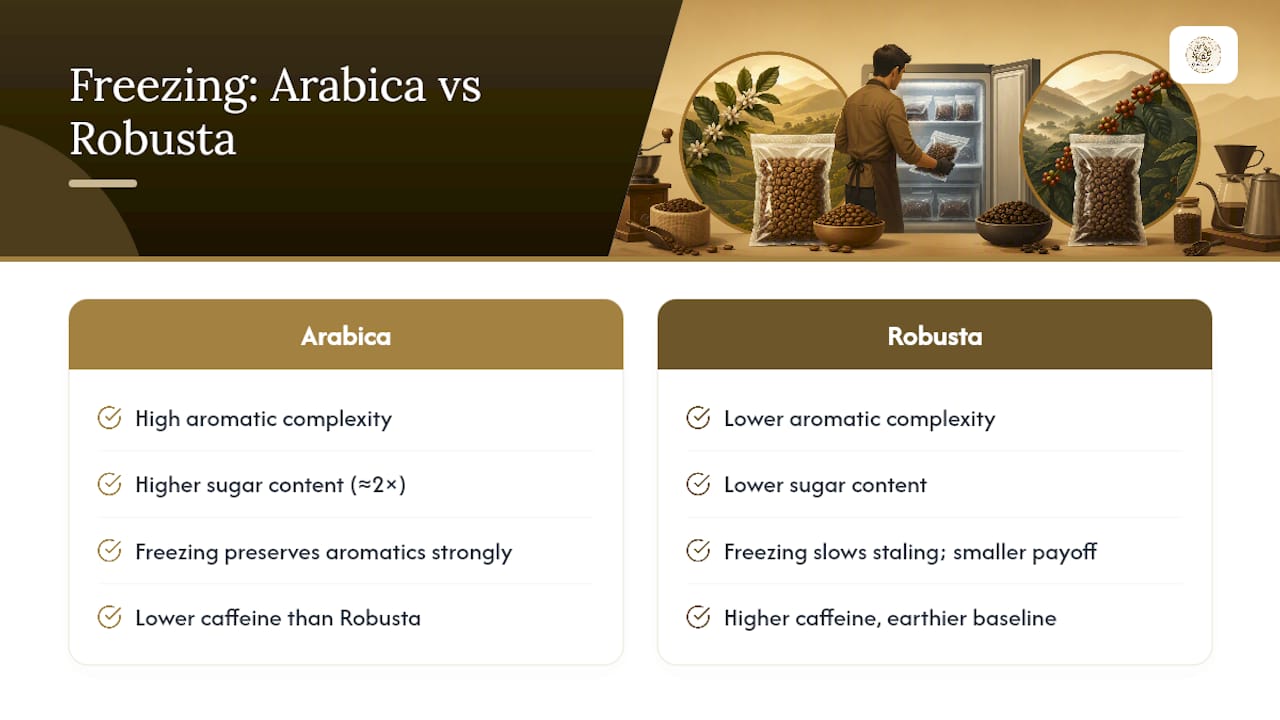
Robusta, by contrast, has a higher caffeine content and a more bitter, earthier flavor baseline that’s naturally more stable over time even without freezing. It’s less prone to the kind of aromatic fade that makes Arabica lovers reach for the freezer in the first place. That doesn’t mean freezing Robusta is pointless. It still slows staling and protects against oxidation, but the sensory payoff is smaller because there’s less delicate complexity at stake.
Bean density plays a role too. Robusta beans tend to be denser and slightly more resistant to the moisture absorption that causes condensation problems, though the difference isn’t large enough to skip your sealing routine. Whichever variety you’re storing, the same rules apply: portion it, seal it, and keep it away from repeated temperature swings. The chemistry differs, but the protocol doesn’t.
Why Take Freezing Seriously
Traceability only matters if the coffee still tastes like where it came from by the time you brew it. It’s important that every roast carries a clear roast date, so you can actually calculate the freezing windows described above instead of guessing. Beans sourced from single origins each carry their own aromatic fingerprint, and freezing at the right moment protects that fingerprint rather than flattening it.
If you want the deeper science behind why timing and temperature matter this much, our breakdown of coffee degassing walks through what’s happening inside the bean in the days after roasting, and how that process shapes everything you do afterward.
— Yasin Sofyian Ayesh
Ready-to-Brew Beans That Also Freeze Well
If portioning and sealing sounds like more prep than you want to deal with, our Cold Brew Coffee is roasted fresh and sized in a way that fits naturally into a freezing routine instead of fighting against it. You buy the bag size that matches how you actually drink, whether that’s a small batch for weekly cold brew or a larger one you’re willing to portion down yourself once it arrives.
Check the roast date listed on each cold brew coffee product page before you buy, and choose a size close to what you’ll use in the next few weeks so you’re freezing at peak freshness rather than freezing to rescue a bag that’s already turned the corner. Visit the product page, confirm the roast date and portion size fit your plan, and order what matches how you actually brew.
Sources
- Wake and smell the coffee: Research shows freezing beans can preserve aroma
- I Asked Coffee Experts How to Keep Beans Fresh—They …
- Storing coffee beans for the freshest tasting brews is easier than you think
- Are we still freezing coffee? - Perfect Daily Grind
FAQ
Is Freezing Coffee Beans a Good Idea?
Yes, for whole beans that are portioned into airtight pouches and not refrozen once opened. It’s especially useful for dark roasts and rare lots that fade faster at room temperature.
What Is the 15-15-15 Coffee Rule?
There’s no single agreed-upon industry definition for a “15-15-15” coffee rule, so treat any version you see with caution. What’s well documented instead is the practical guidance covered here: freeze around one to two weeks post-roast for filter coffee, portion into short-use doses, and avoid refreezing.
Is Coffee Still Good After Being Frozen?
Yes, as long as it was frozen whole and sealed properly. Beans stored this way commonly stay good for three to six months, with dark roasts often benefiting the most from the aroma preservation freezing provides.
Should I Freeze Coffee Beans if I Won’t Use Them for Three Months?
Yes, that’s exactly the scenario freezing is designed for. Portion the beans into vacuum-sealed, single-use pouches before freezing so each dose stays protected until you’re ready to grind or thaw it.


