
If your priority is putting more money directly into farmers’ pockets, Fairtrade is the stronger match. If you care more about how the land is treated and how farms are managed, Rainforest Alliance leads on that front. Plenty of coffee brands, including many single-origin roasters, carry both labels, and neither one solves every problem certification is supposed to fix.
TL;DR:
- Fairtrade offers a guaranteed minimum price and premium benefits aimed directly at supporting farmers’ income, but the premium funds may not always reach individual farmers due to cooperative governance.
- Rainforest Alliance emphasizes environmental management through measurable on-farm standards, with payments dependent on buyer participation and less direct income support for farmers.
- Both certifications allow mass-balance traceability, meaning the exact beans in your bag may not correspond directly to the pay received by the farmer, and independent audits verify overall system integrity.
- Certification labels are not a foolproof indicator of ethical sourcing; specific origin transparency and direct relationships with cooperatives provide much clearer insights into actual practices.
- For a fully traceable and ethically transparent product, prioritize brands that disclose detailed origin information and sourcing practices over relying solely on certification stamps.
Table of Contents
- Rainforest Alliance vs Fair Trade: A Side-By-Side Look
- What the Money and Audit Trails Actually Reveal
- How to Choose Between the Two Labels
- How Qahwat Al’Ard Approaches Certification and Traceability
- The Real Tradeoff Nobody Puts on the Label
- A Traceable Latin American Blend Worth Trying
- Sources
- FAQ
Rainforest Alliance vs Fair Trade: A Side-By-Side Look
The two certifications were built to fix different problems, and that difference shows up in nearly every decision each organization makes. Rainforest Alliance certification is built around environmental conservation and sustainable farm management, with social and economic rules layered on top. Fairtrade certification starts from the opposite direction: economic protection for farmers first, with environmental standards attached to that core.
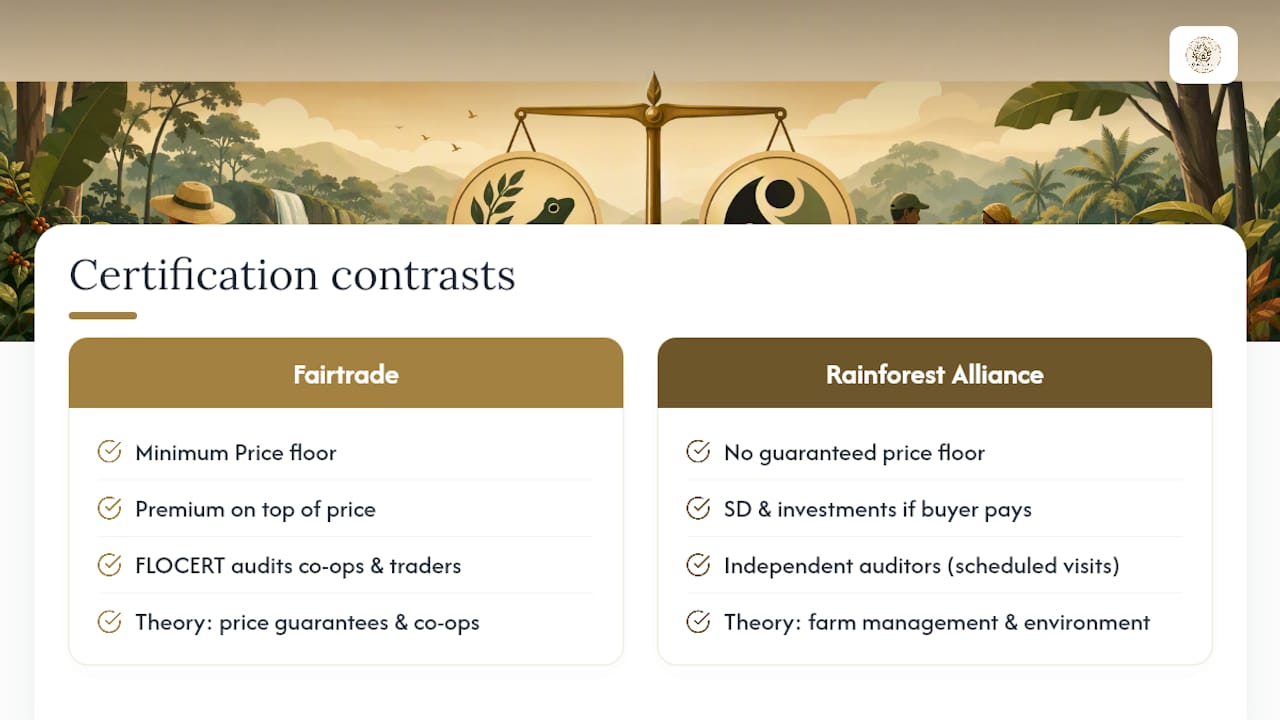
That split shows up clearest in how money moves. Fairtrade guarantees a Minimum Price for the crop plus a separate Fairtrade Premium that cooperatives vote on how to spend, whether that’s a new well, a school building, or farm equipment. Rainforest Alliance takes a different route with its Sustainability Differential (SD) and Sustainability Investments (SI), which put more of the negotiating weight on the buyer and seller agreeing to a shared arrangement rather than a fixed floor price set by the certifier.
Traceability works differently too, and this matters more than most shoppers realize:
- Fairtrade typically allows mass-balance mixing at certain supply chain points, meaning certified and non-certified beans can blend, while still tracking volumes to ensure premiums get paid on what’s certified.
- Rainforest Alliance also permits mass-balance traceability in many supply chains, though identity-preserved options exist for buyers willing to pay for stricter chain-of-custody tracking.
- Neither system guarantees that the exact beans in your bag were the specific beans a farmer got paid a premium for.
- Both operate under similar third-party audit structures, which matters for consistency but doesn’t eliminate the traceability gap.
Rainforest Alliance shows up on more grocery store shelves overall, a byproduct of its broader crop coverage (cocoa, tea, bananas, coffee, and more) and its appeal to large multinational buyers. Fairtrade tends to concentrate more heavily in specialty and direct-trade coffee circles, where the premium mechanism aligns closely with how small roasters already talk about sourcing.
What the Money and Audit Trails Actually Reveal
Fairtrade’s system runs on two concrete numbers: the Minimum Price and the Premium. FLOCERT, Fairtrade’s independent certification body, audits producer organizations and traders to confirm both get paid. The Minimum Price acts as a floor that kicks in when market prices drop below it; the Premium is paid on top of whatever price the coffee sells for, market rate or Minimum Price. Farmer cooperatives, not individual farmers, generally decide how Premium funds get spent, which means the benefit is collective rather than a direct check to one grower.
Academic comparison finds a clear split in intent: Lund University’s analysis describes Fairtrade’s theory of change as centered on price guarantees and producer organization, whereas Rainforest Alliance’s theory of change centers on farm management, productivity, and environmental protection. Neither approach is designed to do the other’s job.
Rainforest Alliance’s Sustainable Agriculture Standard leans on measurable on-farm metrics: soil health, water use, deforestation avoidance, agrochemical reduction, and worker safety protocols. The Sustainability Differential and Sustainability Investments only work if buyers actually agree to pay them. That’s the catch. Uptake and transparency around SD/SI payments vary by buyer and by contract, so the mechanism can be strong in one supply chain and nearly invisible in another.
Both certifiers belong to ISEAL, the umbrella body that sets code standards for credible certification schemes, and both rely on independent auditors rather than self-reporting. That’s a real assurance layer. But auditors typically visit on a schedule, not continuously, and mass-balance traceability means a stamp on your bag reflects system-level compliance more than a guarantee about your specific beans. Critics have also pointed out that Rainforest Alliance lacks a guaranteed price floor comparable to Fairtrade’s Minimum Price, which limits how directly its environmental gains translate into farmer income stability. Fairtrade, meanwhile, has faced its own criticism that Premium spending decisions don’t always reach the farmers who need them most, since cooperative governance quality varies widely from region to region.
How to Choose Between the Two Labels
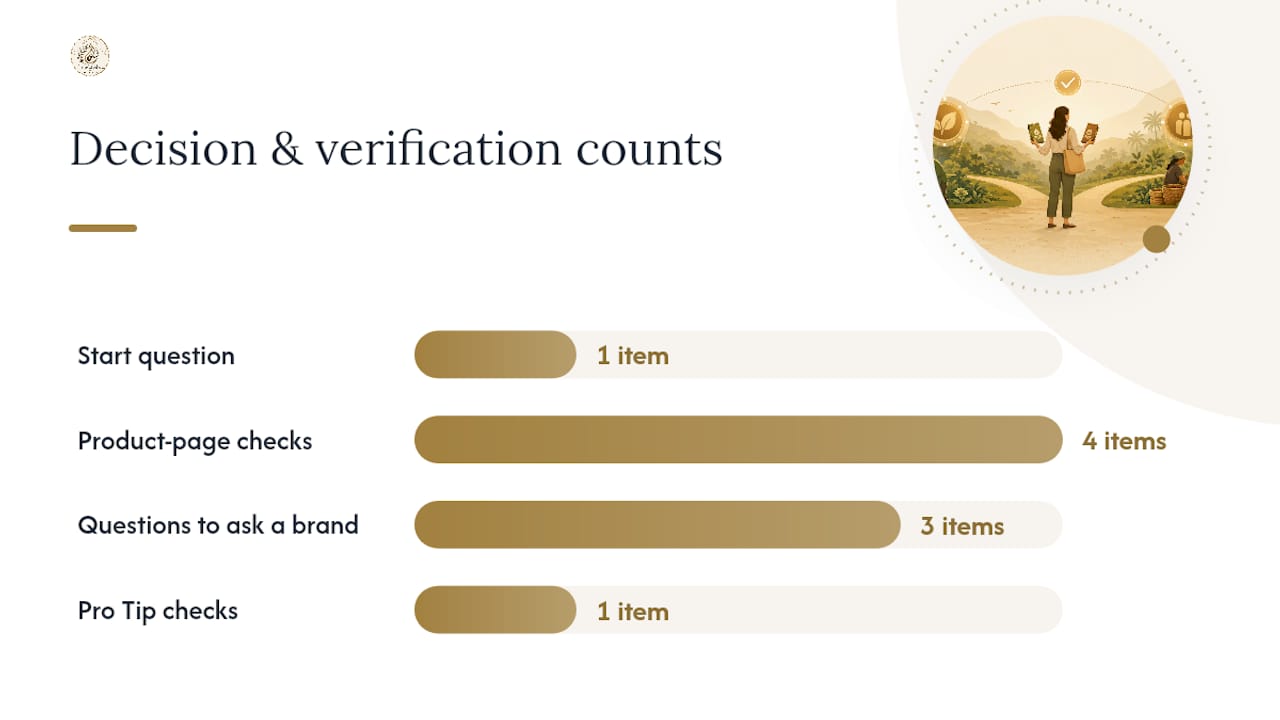
Start with one question: do you care more about farmer income stability, or about how the coffee was grown? That answer should drive everything else.
- If economic support is your priority, look for Fairtrade first. The Minimum Price and Premium are the most direct, verifiable mechanisms for getting money to producers.
- If environmental stewardship matters most, Rainforest Alliance’s farm-management standards, covering water, soil, and biodiversity, are the stronger fit.
- If you want both, look for bags carrying dual certification or check the roaster’s own sourcing page for direct-trade relationships that layer both priorities without relying on either label alone.
- If you’re unsure, treat the label as a starting point, not a finish line. Read the roaster’s origin story before deciding.
Once you know your priority, four checks on the product page tell you whether the label is doing real work: what percentage of the bag is actually certified (blends often mix certified and non-certified beans), whether the traceability model is mass-balance or identity-preserved, who pays the premium or differential and how it’s documented, and whether the origin and cooperative name are specific enough to look up independently.
Three questions worth asking a brand directly: What percentage of this coffee is certified? Do you pay above the certification’s minimum requirements? Can you name the cooperative or farm this batch came from? A roaster that answers all three without hesitation is usually one worth trusting.
Pro Tip: Check the roast date and the country of origin together. A bag with a vague “Blend of Central and South American Origins” label and no roast date is a bigger red flag than the certification itself.
Picture two shoppers. One wants her coffee dollars to reach a farming cooperative as directly as possible. She should scan for Fairtrade first and check the buyer’s guide to sustainability certifications for how the Premium gets used. The other cares more about deforestation and pesticide runoff near the farm. He should look for Rainforest Alliance and read about the sustainable farming practices the standard actually enforces.
How Qahwat Al’Ard Approaches Certification and Traceability
This comparison is written by Yasin Sofyian Ayesh, drawing on Qahwat Al’Ard’s sourcing experience and the certification research above. Coffee retailers see the traceability gap up close: a label tells you a system was audited, not that your specific bag reflects a specific farmer’s premium payment.
Qahwat Al’Ard prioritizes single-origin sourcing with full traceability back to various growing regions, treating certification as one input among several rather than the whole story.
- When a cooperative relationship supports Fairtrade’s Minimum Price structure, that can influence sourcing decisions.
- When farm-level environmental practices are emphasized, Rainforest Alliance criteria may be considered more heavily.
- Many origins we work with qualify under both frameworks, and we say so on the product pages rather than leaning on a badge alone.
Readers who want the specifics, not just the label, can check each product’s origin page for cooperative names, roast dates, and sourcing notes.
The Real Tradeoff Nobody Puts on the Label
Certification schemes get treated like a pass/fail test, and that’s the wrong frame. Fairtrade’s Minimum Price is the closest thing coffee has to an income floor, but cooperative governance varies enough that Premium money doesn’t always land where it should. Rainforest Alliance’s farm-management standards genuinely change how land gets treated, but its Sustainability Differential only works when a buyer actually pays it, and that’s invisible to anyone reading a bag at checkout.
The conventional advice, “just buy the certified bag,” undersells how much variation sits inside each label. A coffee with dual certification and vague origin information can be a weaker choice than a single-certified bag from a named cooperative with a documented direct-trade relationship. Prioritize specificity over stamps: a roaster who can name the farm, the season, and the exact arrangement behind the price paid is usually doing more for the people who grew your coffee than a logo alone can prove.
What should change first? Stop treating certification as the finish line of ethical sourcing. Treat it as the opening question, then read the rest of the product page before you decide.
— Yasin Sofyian Ayesh
A Traceable Latin American Blend Worth Trying
If you’d rather see traceability in practice than read about it in theory, the Latin American Blend is a place to start. It pulls from cooperative relationships across Latin American growing regions, roasted fresh to order rather than sitting on a shelf for months. The product page lists origin details and roasting notes so you can check exactly what you’re buying instead of relying on a badge alone.
Before you add it to your cart, check three things on the page: the roast date, the named origin regions, and any cooperative or farm-level sourcing notes listed. If a blend can’t tell you where its beans came from, that’s worth noticing. This one can. Order a bag and taste the difference traceable sourcing actually makes.
Sources
- What Is the Difference Between Rainforest Alliance and Fairtrade Certification? — Rainforest Alliance
- How Fairtrade certification works — Fairtrade International
- Traceability annex v1.4 — Rainforest Alliance (knowledge base)
- Fairtrade versus Rainforest Alliance — Lund University comparative analysis
- Rainforest Alliance Is Not Fair Trade — Fair World Project
FAQ
What Is the Rainforest Alliance Controversy?
Critics argue Rainforest Alliance lacks a guaranteed price floor like Fairtrade’s Minimum Price, and that its mass-balance traceability can weaken the link between certification and direct farmer benefit.
Is Rainforest Alliance Trustworthy?
It relies on independent third-party audits and ISEAL membership, which are real assurance mechanisms, but its Sustainability Differential payments depend on buyer participation and vary in transparency from one supply chain to the next.
Is Rainforest Alliance Ethical?
It sets meaningful environmental and labor standards, but it doesn’t guarantee farmer income the way Fairtrade’s price floor does, so “ethical” depends on which outcome you’re weighing most.
Are There Any Downsides to Fairtrade?
Yes. Premium spending decisions rest with cooperative leadership, so benefits don’t always reach individual farmers evenly, and Fairtrade’s environmental requirements are generally less detailed than Rainforest Alliance’s farm-management standards.
Should I Look for Both Labels on One Bag?
If both economic support and environmental stewardship matter to you, dual certification is a reasonable shortcut, though checking the roaster’s origin details still tells you more than the labels alone.


