


Living wage coffee farming means paying hired workers enough to afford a decent standard of living, while a related but separate concept, living income, measures whether a farming household’s total earnings cover a similar standard of living. The two get used interchangeably online, and that confusion matters more than it sounds.
-
Benchmark vs. reality: Most coffee-growing regions have a calculated living income or living wage benchmark, and most farming households and hired workers still fall short of it.
-
Who’s protected: Living wage covers hired pickers and estate labor; living income covers the self-employed farming family running the plot.
-
Why buyers matter: The Anker Research Institute methodology underpins most credible benchmarks, and the Global Living Wage Coalition has documented that a large share of coffee farm workers earn below them.
Key Takeaways
Living wage protects hired coffee workers, living income protects farming households, and most benchmarks calculated by the Anker method still exceed what either group actually earns.
| Point | Details |
|---|---|
| Two separate concepts | Living wage applies to hired workers; living income applies to the farming household’s total earnings. |
| Benchmarks use local data | The Anker method prices a real cost-of-living basket for the specific region, not a global average. |
| Gap has multiple causes | Price volatility, small farm size, intermediary margins, and climate shocks compound together. |
| No single fix works alone | Reference prices, long-term contracts, and technical assistance work best combined, not isolated. |
| Traceability is a starting point | Qahwat Al’Ard’s single-origin sourcing gives buyers a verifiable link to a specific farm origin. |
Table of Contents
-
What Is Living Wage Coffee Farming, and How Does It Differ From Living Income?
-
How Are Living Income and Living Wage Benchmarks Calculated?
-
Why Living Wages and Incomes Matter for Coffee Sustainability
-
What Does the Research Say About Living Income Interventions?
-
What Can Coffee Buyers and Consumers Do to Support Living Incomes?
What Is Living Wage Coffee Farming, and How Does It Differ From Living Income?
A living wage is the daily or hourly pay a hired farmworker needs to afford food, housing, health care, and a bit left over, in the place where they actually live. It’s a wage floor tied to a real cost of living, not a legal minimum set by statute. A living wage differs from living income in one key way: living income applies to the self-employed household, not an employee, and it’s measured as total net household earnings from the farm and any side income, not an hourly rate.
Minimum wage is different again. It’s a legal floor set by government, often well below what a living wage calculation would recommend, and it applies only where labor law reaches, which excludes most smallholder households working their own land. A hired picker on an estate might earn the local minimum wage but still fall short of a living wage. A smallholder family might clear a decent living income in a good harvest year and nothing close to it after a frost or a price crash. Brands, certifiers, and living-income programs each lean on these benchmarks differently, which is part of why sourcing claims can look inconsistent from one label to the next.
How Are Living Income and Living Wage Benchmarks Calculated?
Most credible benchmarks trace back to the Anker method, a household-basket approach developed for measuring what a family actually needs to live decently in a specific place, not an abstract global average. The Living Income Community of Practice outlines the process researchers typically follow:
-
Build a local cost-of-living basket covering food, housing, health care, education, and a small savings margin.
-
Define a typical household size and composition for that farming region.
-
Price the basket using local, current market data rather than national averages.
-
Convert the basket into an annual reference value, adjusted for the number of income earners in a household.
That annual figure becomes the living income benchmark, or, when converted to a price coffee needs to fetch for a farm of typical size and yield, a living income reference price. It’s a moving target tied to local prices and household needs, which is why it looks nothing like a flat legal minimum wage or a fixed voluntary premium a buyer might add on top of market price.
Why Living Wages and Incomes Matter for Coffee Sustainability
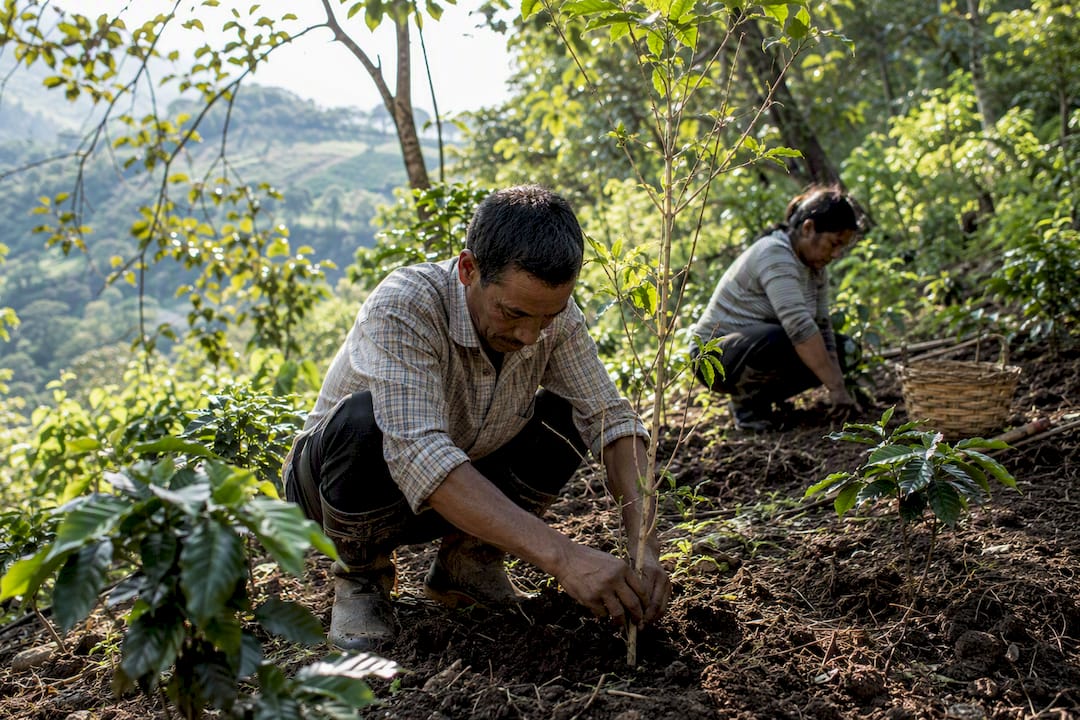
A farming household earning below the living income gap threshold has little room to invest in anything beyond survival. That’s the connection buyers often miss: income stability and farm resilience aren’t separate issues. A household with a reliable income can plant shade trees, diversify crops, and skip the short-term decision to clear more forest or push yields with cheap inputs when prices dip.
Regenerative transitions take real time. Global Coffee Platform guidance notes these shifts can take five years or more and usually require upfront investment before payoff. Households without income security rarely have the runway for that. On the labor side, hired workers earning below a living wage face the same instability, which shows up downstream as high turnover during harvest, the exact moment quality control matters most.
Pro Tip: Ask a coffee brand whether their sourcing model funds anything beyond the harvest season. Year-round investment, not just a good price at pickup, is what actually reduces supply risk for buyers.
What Causes the Coffee Living Income Gap?
The gap between benchmark and reality comes from several forces stacking on top of each other. Price volatility on commodity markets means a farm’s income can swing wildly year to year, even when yields stay flat. Most coffee farms are small, a few hectares at most, so there’s little room to gain from scale. Intermediaries between farmer and roaster often capture a disproportionate share of the final retail price, leaving the farm gate price thin. Add rising costs for fertilizer, labor, and transport, and margins shrink further.
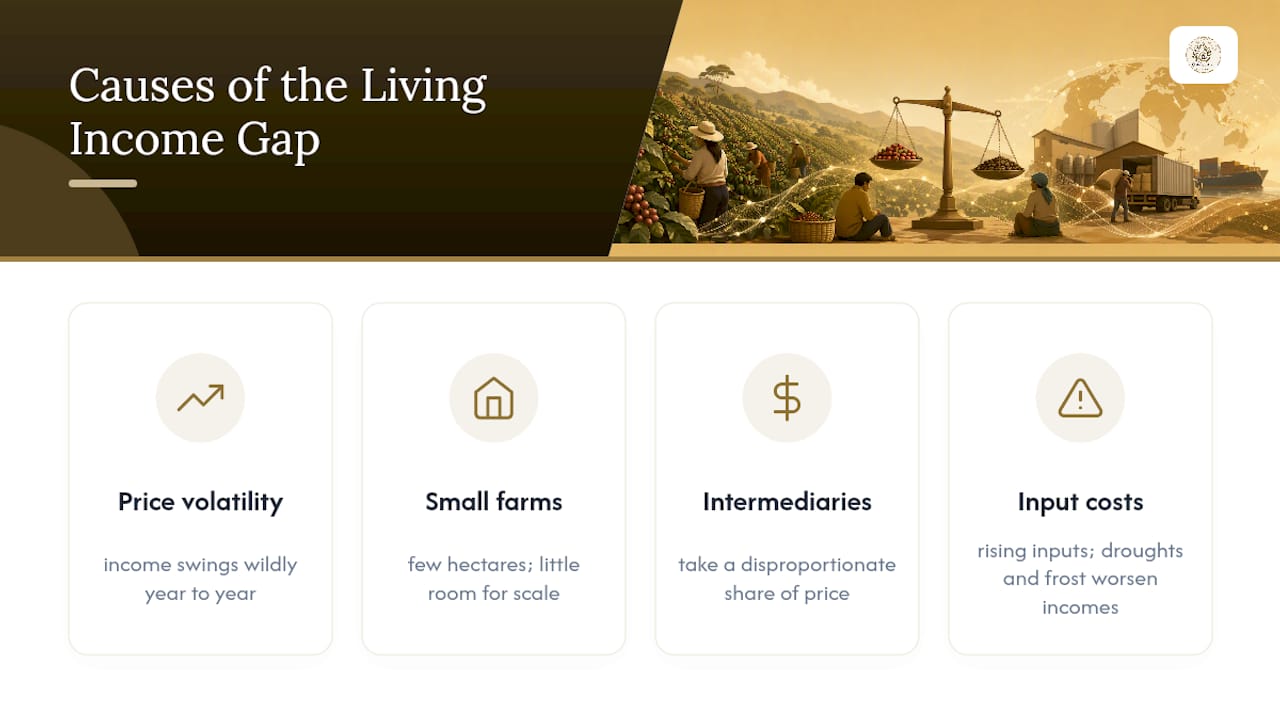
Climate shocks compound all of it. A drought or unexpected frost doesn’t just cut yield for one season, it also drives up input costs the following year and worsens income volatility exactly when a household has the least buffer to absorb it.
How the Coffee Sector Tries to Close the Living Income Gap
No single tool fixes this on its own, and that’s the honest starting point. The instruments in active use each work through a different lever:
-
Living income reference prices set a floor tied to actual local cost-of-living data, but they only work if enough buyers commit to paying them consistently.
-
Premiums add money on top of market price, though a one-time premium doesn’t guarantee it reaches the household reliably or repeats next season.
-
Long-term contracts give farms income predictability, which matters more for planning than a single good price.
-
Cooperatives and direct trade can improve farm-gate share by cutting out layers of intermediaries, though cooperative quality varies widely.
-
Certification and verification create traceability and standards, but a systematic review of sustainability initiatives found the income effect is inconsistent across contexts.
-
Technical assistance and regenerative transitions raise long-term productivity and resilience, at the cost of years before returns show up.
Pro Tip: A single premium rarely moves the needle on its own. Sourcing analysis from the Columbia Center on Sustainable Investment argues buyers get more from structured, repeatable sourcing commitments than from occasional bonus payments.
Coordinated buyer action, several roasters aligning around the same reference price for the same region, tends to outperform isolated premiums because it shifts market norms rather than rewarding one shipment.
What Does the Research Say About Living Income Interventions?
The evidence is genuinely mixed, and it’s worth saying plainly rather than dressing it up. The same systematic review covering certification schemes found that some raised prices and household income in specific cases, while social outcomes, including whether hired workers actually saw better wages, were far less consistently documented. Positive effects tended to show up more at the local, farm level than across an entire certified supply chain.
Most of this literature relies on small case studies with short follow-up windows, particularly for regenerative farming transitions, where the payoff period runs years beyond typical study lengths. That’s a real gap. Anyone citing a certification as proof of higher farmer wages should be pressed on which specific study they mean, and over what time frame.
What Can Coffee Buyers and Consumers Do to Support Living Incomes?
Roasters and retailers have more leverage here than shoppers realize, and the checklist is fairly concrete:
-
Commit to paying living income reference prices for at least your core origins, not just spot-buying at market rate.
-
Favor long-term contracts over one-off purchases so farms can plan investment.
-
Fund farm-level technical assistance rather than treating certification as the finish line.
-
Publish traceability data down to the farm or cooperative level.
-
Join multi-buyer sourcing collaborations instead of acting alone.
Shoppers have a simpler version of the same job. Choose traceable, single-origin coffee over blends with no origin data, and ask a brand directly: What price did the farm receive? Is that price tied to a living income benchmark for that region? How long has this sourcing relationship existed?
A Seller’s View on Sourcing for Living Incomes
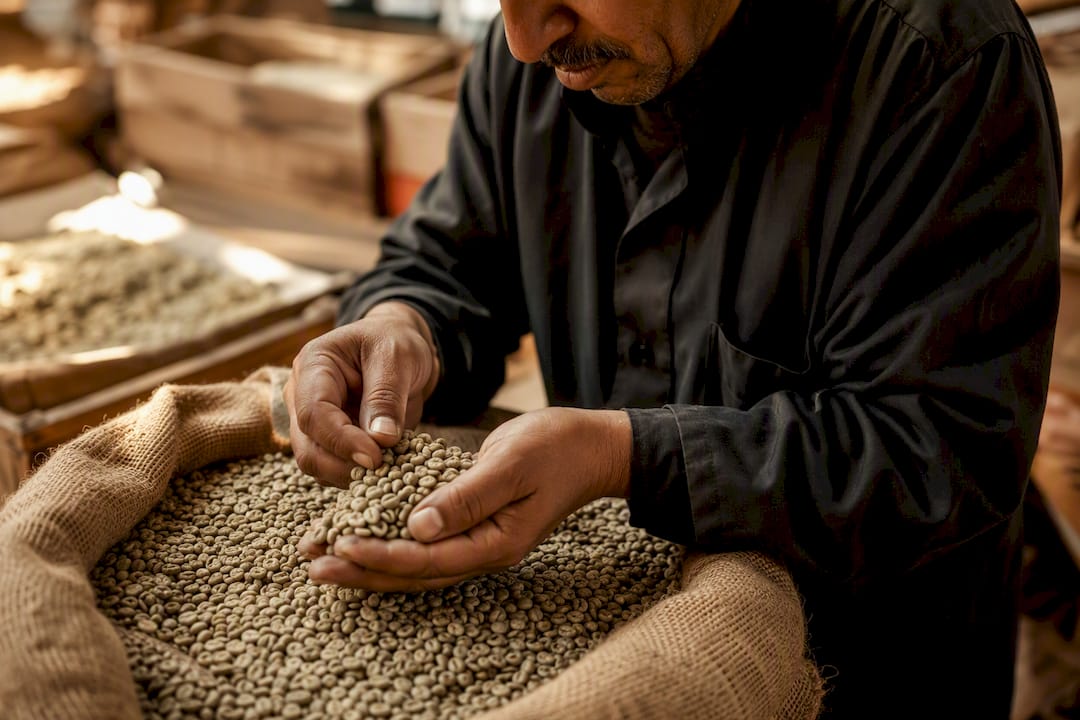
Choosing traceable, single-origin coffee and building long-term relationships with growers isn’t a marketing angle, it’s the mechanism that actually lets farm income stay predictable enough for investment in training and better practices.
Where Traceable Sourcing Fits Into Your Coffee Choice
Choosing a bag of coffee with a clear origin story is one of the few decisions a shopper can actually make with confidence in this space. Qahwat Al’Ard sources single-origin beans with documented farm and regional origin rather than anonymous blends, which gives you a real answer when you ask where your coffee came from and who grew it.
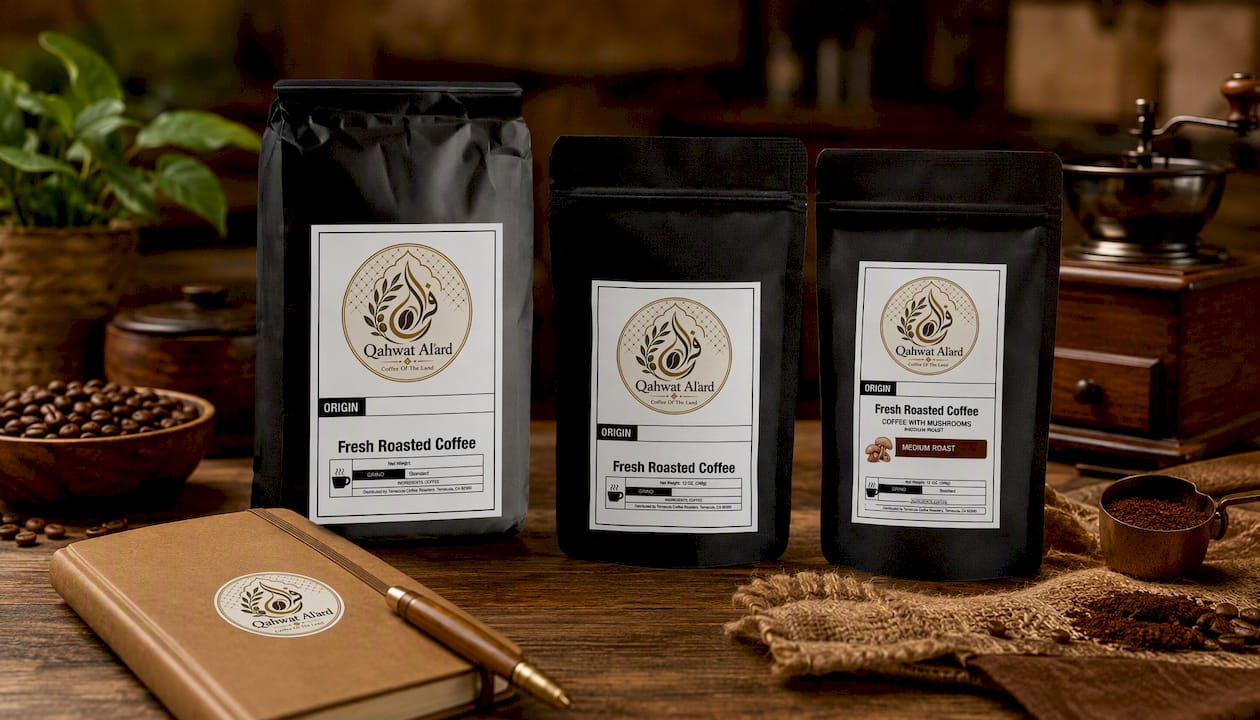
That transparency doesn’t replace the sector-wide work of reference pricing and multi-buyer commitments described above, but it’s a concrete, verifiable starting point for anyone who wants their purchase to actually connect to a named origin. Browse the single-origin collection to see specific growing regions and pick a bag tied to a place, not just a blend name, or explore the coffee collection to compare origins side by side before you order.
Sources
FAQ
How Much Money Do Coffee Farmers Make?
It varies enormously by region, farm size, and harvest year, but the Global Living Wage Coalition has documented that many coffee households and hired workers earn below their local living income or living wage benchmark.
Will There Be a Coffee Shortage in 2026?
Climate shocks and price volatility create real supply risk in specific growing regions, but that’s a separate question from global shortage, and the article’s sourcing data doesn’t support a specific future shortage forecast.
Is It Illegal to Grow Coffee in the United States?
No, coffee is grown legally in the United States, primarily in Hawaii, Puerto Rico, and small operations in California, though the climate limits large-scale production compared to tropical growing regions.
Is Coffee Farming a Good Business?
It can be, but profitability depends heavily on farm size, market access, and whether the household can secure prices near or above the local living income benchmark rather than relying on volatile spot-market pricing.


