
Buy traceable, single-origin coffee with documented sourcing over anything wearing a vague “carbon neutral” sticker with no backup. Some coffee products qualify because each ties back to a named growing region with real traceability, not a purchased offset certificate. The rest of this guide gives you a 90-second checklist to verify any brand’s claims yourself.
TL;DR:
- Brands with named farm or cooperative projects demonstrate more credible insetting efforts compared to vague claims or unverified offsets.
- Choosing lighter roast profiles, like those modeled in recent studies, can lower your coffee’s carbon emissions by about 16 to 33 percent.
- Instant coffee and compostable pods offer lower packaging and shipping footprints, but verify their packaging claims before purchasing in bulk.
- Sample packs allow exposure to multiple origins, helping consumers evaluate taste preferences and traceability claims without large upfront costs.
- Always look for third-party verification and clear origin details on packaging to accurately assess a brand’s actual sustainability commitments.
Table of Contents
- Top Carbon Neutral Coffee Brand Picks for Traceable, Low-Impact Buying
- What Does “Carbon Neutral” Actually Mean for Coffee?
- How Do Brands Actually Achieve Carbon Neutrality?
- How Can You Verify a Brand’s Carbon Neutral Claims?
- How to Match Sustainability to Your Own Coffee Routine
- Why You Can Trust Qahwat Al’Ard’s Sourcing Claims
- Does Carbon Neutral Coffee Taste Different?
- Is Carbon Neutral Coffee Worth the Extra Cost?
- The Checklist Matters More Than the Badge
- Ready to Buy? Start With a Traceable Sample Pack
- Sources
- FAQ
Top Carbon Neutral Coffee Brand Picks for Traceable, Low-Impact Buying
Finding genuinely sustainable coffee brands means looking past marketing badges toward actual sourcing data. Here’s how this core lineup is described for shoppers prioritizing traceability and lower supply-chain impact.
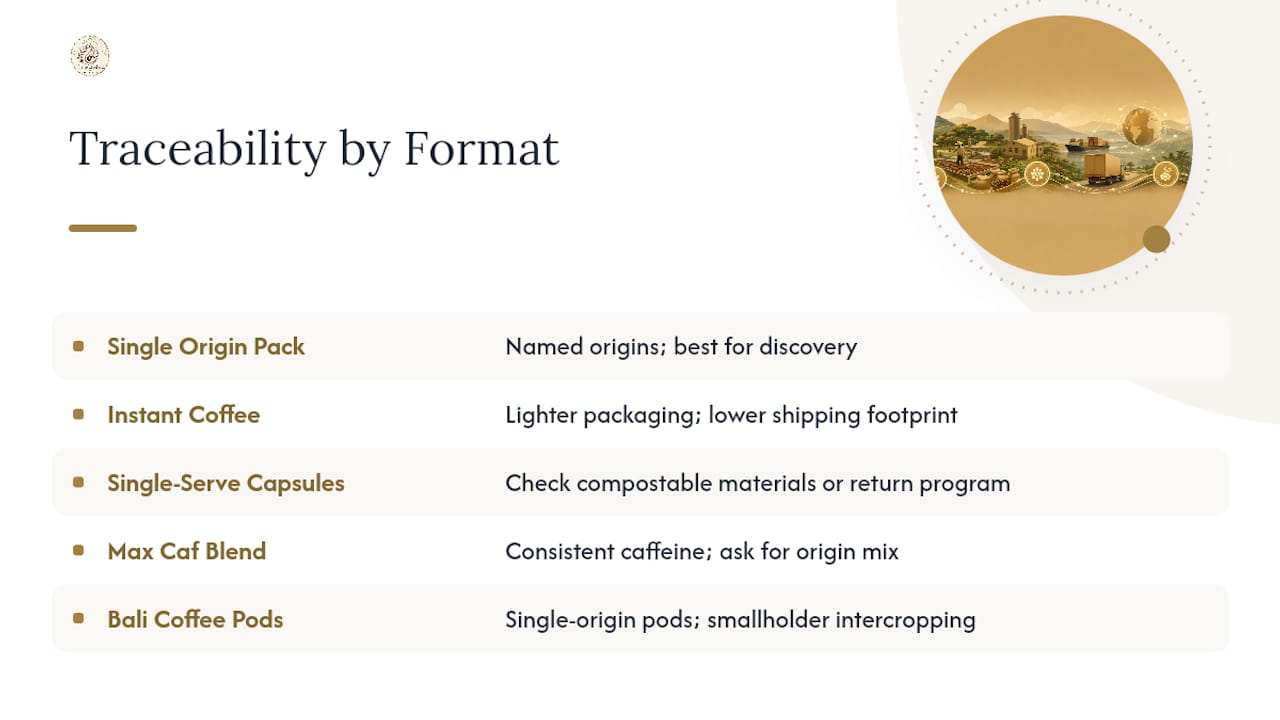
Single Origin Favorites Sample Pack. This is the smart starting point if you’ve never bought traceable coffee before. It bundles several single-origin roasts into one order, so you taste the difference between, say, a Peruvian high-altitude bean and a Balinese volcanic-soil bean without committing to a full bag of either. Format-wise, it’s whole bean, and the traceability story is baked into the product itself: every included origin is named, not blended into an anonymous house roast. For a reader trying to figure out how to choose carbon neutral coffee without guessing, tasting multiple origins side by side is the fastest education you’ll get. Check the Single Origin Favorites Sample Pack if discovery matters more to you than settling on one bag.
Instant Coffee. Skip the assumption that instant means lower quality or higher waste. For travelers, campers, or anyone trying to cut shipping-related emissions on small orders, instant coffee usually means lighter packaging and fewer transport trips over a year of use. It’s not the pick for a slow Sunday pour-over, but it’s the practical choice when convenience and a lighter footprint matter more than ceremony. The Instant Coffee option fits that low-waste travel use case directly.
12 Pack Single Serve Coffee Capsules. Pods get a bad reputation environmentally, and some of it is deserved. What separates a defensible pod purchase from a wasteful one is whether the brand discloses compostable materials or runs a pod-return program. If you’re set on the convenience of capsules, ask whether the 12 Pack Single Serve Coffee Capsules come with disposal guidance before you buy in bulk. Convenience and sustainability aren’t mutually exclusive here, but you have to check the packaging claim rather than assume it.
Max Caf Blend. For the shopper who wants a dependable, higher-caffeine daily driver rather than a rotating single-origin experience, the Max Caf Blend is built for consistency. Blends can still carry traceability if the brand names its component origins, so ask what’s in the mix rather than assuming a blend automatically means anonymous sourcing.
Bali Coffee Pods. This one is worth calling out specifically because Balinese coffee often comes from smallholder farms practicing traditional intercropping, which functions similarly to agroforestry even when it isn’t marketed that way. The Bali Coffee Pods option lets you get single-origin traceability in a convenience format, which is a combination most pod brands don’t offer.
Peach Paradise. A flavored coffee doesn’t have to abandon origin transparency. If you want something more playful than a straight single-origin roast without giving up on knowing where your beans came from, Peach Paradise works as a flavored option built on traceable stock rather than a generic flavored blend.
English Breakfast. Despite the name, this is a coffee roast profile built for people who want a smooth, lower-acid cup to start the day. English Breakfast suits buyers who prioritize a mellow daily cup over bold single-origin intensity.
Peru Coffee Pods. Peru’s coffee regions are frequently tied to shade-grown, smaller-farm production, which tends to support better biodiversity outcomes than large-scale cleared plantations. The Peru Coffee Pods give you that origin story in single-serve form, which matters if you want traceability but your household runs on a pod machine.
If you’re deciding where to start, treat it like this: sample pack for exploration, pods for convenience with a compostability question attached, instant for travel, and named blends like Max Caf when you want daily consistency without sacrificing origin disclosure entirely.
What Does “Carbon Neutral” Actually Mean for Coffee?
Carbon neutral means a company’s net carbon emissions equal zero after subtracting reductions and offsets from total output. Net-zero is a stricter, longer-term standard that usually requires eliminating most emissions before relying on any offset at all. Brands often use these terms interchangeably in marketing, and that’s the first thing to watch for. A coffee bag stamped “carbon neutral” might only account for the roasting facility’s energy use and quietly leave out farming, shipping, and packaging, which is where a large share of a cup’s footprint actually sits.
The emissions hotspots run from farm to cup: fertilizer and pesticide use, land clearing for new plantations, wet or dry processing methods, ocean or air freight to roasting facilities, the roasting process itself, and final packaging. UCL’s analysis of coffee’s lifecycle emissions points to farming and land use as often the largest single contributors, ahead of the roasting step most marketing focuses on.
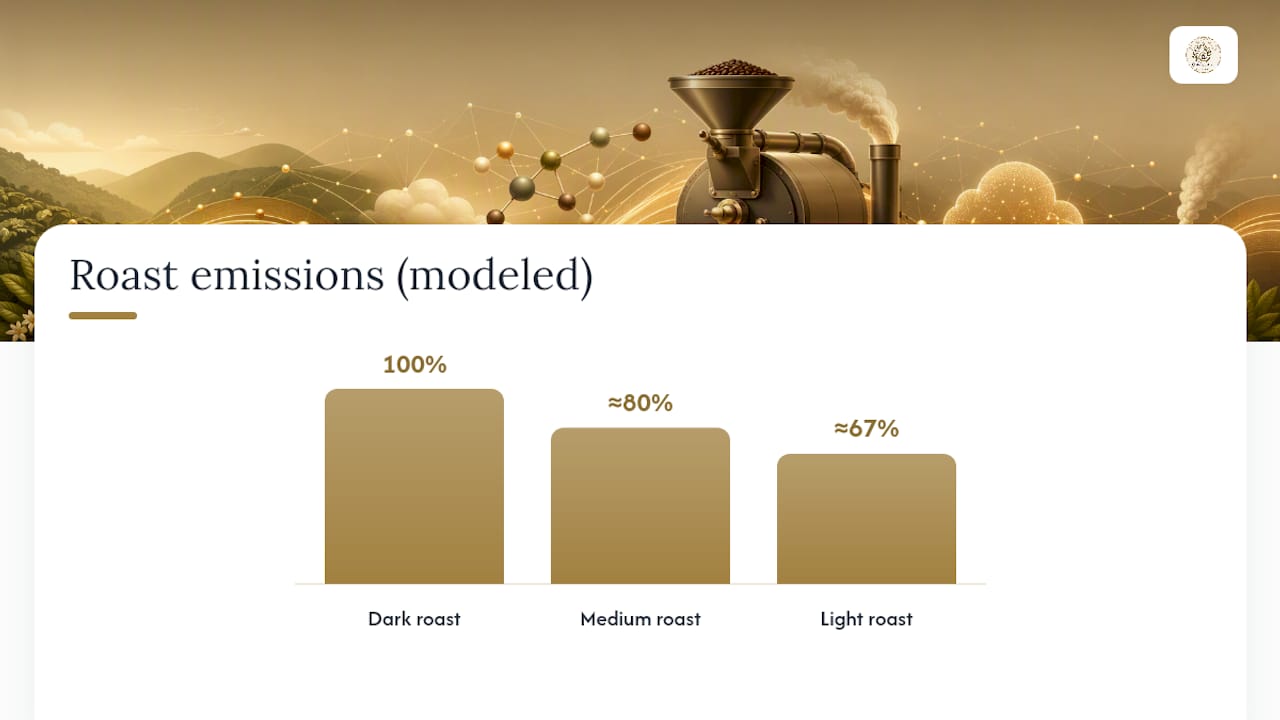
Roasting itself isn’t emissions-neutral, and roast level matters more than most shoppers realize. A 2025 MDPI study modeling roasting energy use found light roasting produced roughly 33.33% lower carbon emissions than dark roasting, and about 16.67% lower than medium roasting, mainly through shorter cook times and better heat recovery opportunities. That’s a real, measurable lever, though it applies to the modeled conditions in that study, not a universal guarantee across every roaster’s equipment.
How Do Brands Actually Achieve Carbon Neutrality?
Three approaches dominate the industry, and they are not interchangeable in terms of credibility. Insetting means investing directly in emissions reductions inside a brand’s own supply chain, such as funding agroforestry or native tree planting on partner farms, often highlighted as an effective strategy. Industry reporting on insetting in coffee supply chains frames it as the stronger option precisely because the ecological and financial benefits stay with the origin community rather than funding an unrelated project somewhere else entirely.
Offsets work differently. A brand calculates its emissions, then pays into a carbon-reduction project anywhere in the world, often a reforestation or renewable-energy scheme with no connection to the brand’s actual coffee farms. The tradeoff: offset projects face real scrutiny over permanence (will that forest still be standing in twenty years?) and additionality (would the reduction have happened anyway?).
Operational reductions cover the changes a company makes to its own facilities: switching roasters to renewable electricity, installing heat recovery systems that capture and reuse roasting heat, shifting toward lighter roast profiles, and moving to compostable or recyclable packaging. Reporting on renewable-powered roasting operations shows these upgrades meaningfully cut a roaster’s direct energy footprint, independent of any offset purchase.
The strongest brands combine all three, but insetting and operational reductions deserve more weight than a standalone offset claim.
- Insetting: tree planting, agroforestry, and farm-level carbon projects tied to named cooperatives
- Offsets: third-party projects purchased to balance remaining emissions, often unrelated to the coffee supply chain
- Operational reductions: renewable energy, heat recovery, lighter roasts, and better packaging at the roasting facility
Pro Tip: Favor brands that name the specific farm or cooperative behind their insetting project. A vague “we plant trees” claim with no location or partner named is a soft signal that the project is more marketing than measurable.
How Can You Verify a Brand’s Carbon Neutral Claims?
You don’t need a sustainability degree to check whether a claim holds up. You need about ninety seconds and a short list of questions.
- Look for a named third-party verifier. Certifications like Carbon Trust, Fair Trade, or Climate Neutral carry more weight than a brand’s own self-issued badge, though scope coverage still varies between certifications, so check what’s actually being measured.
- Check for farm-level traceability. A brand that names its growing regions, and ideally its farm or cooperative partners, is giving you something you can independently research. One that only says “ethically sourced” is giving you nothing to check.
- Read the packaging disclosure. Compostable materials, recyclable pods, or a pod-return program are concrete signals. Ethical Consumer’s shopping guide treats packaging and shade-grown production as core criteria for judging a brand’s real environmental performance, not afterthoughts.
- Watch for the red flags. No traceability, no mention of which emissions scopes are covered, and no public documentation of projects or certificates should all make you skeptical of a “carbon neutral” label.
| Signal | What it tells you |
|---|---|
| Named certifier (Carbon Trust, Fair Trade, Climate Neutral) | Independent verification exists |
| Named farm or cooperative | Traceability is real, not marketing copy |
| Compostable packaging or pod-return program | Brand addresses end-of-life emissions |
| Vague badge, no documentation | Treat the claim with real skepticism |
How to Match Sustainability to Your Own Coffee Routine
Format drives a bigger chunk of your footprint than most people assume. Whole bean has the smallest packaging footprint per cup but demands a grinder. Pods are convenient but only make environmental sense when they’re compostable or part of a return program. Instant coffee minimizes packaging weight and shipping bulk, which matters more than people expect for frequent travelers.
Roast level plays a role too. If the MDPI roasting study holds for your roaster’s equipment, choosing a lighter roast can mean a lower energy footprint per batch, alongside the brighter, more acidic flavor lighter roasts are known for.
- Whole bean: lowest packaging footprint, requires equipment
- Pods: high convenience, only sustainable with compostable materials or return programs
- Instant: lightest shipping footprint, best for travel or minimal-waste kitchens
- Sample packs: lower financial risk while you figure out which origin you actually prefer
Pro Tip: Before buying pods in bulk, confirm whether the packaging is compostable or recyclable through a formal program. A pod that just says “recyclable” without naming the material or the program is often not accepted by curbside recycling.
Why You Can Trust Qahwat Al’Ard’s Sourcing Claims
Coffee brands vary in sourcing; some source from recognized regions and provide clear origin information rather than generic “ethically sourced” labels. That’s the traceability standard this entire guide is built around: name the farm or region, and let shoppers verify it themselves.
Product pages carry sourcing detail alongside roast and flavor notes, and the Qahwat Al’Ard coffee journal covers regenerative farming practices and how to read sustainability certifications in more depth than a single product description can. If you want to understand why a specific origin matters before you buy, that’s where to look.
Does Carbon Neutral Coffee Taste Different?
No inherent tradeoff exists between sustainability and flavor, but the methods brands use to hit carbon neutral targets can shift taste in noticeable ways. Lighter roasting, which the MDPI study links to lower emissions, also produces a brighter, more acidic cup with more of the bean’s original fruit and floral notes intact. Dark roasting, by contrast, adds more smoky, bitter, and caramelized notes while using more energy per batch.
Shade-grown coffee, often associated with agroforestry-based insetting projects, tends to mature more slowly at higher altitudes, which many coffee professionals associate with more complex flavor development compared to fast-grown, sun-exposed crops. That’s not a guarantee. Bean variety, processing method (washed, natural, honey), and freshness at the time of roasting all matter more than the sustainability certification alone.
What sustainability practices don’t do is force a flavor compromise. A well-sourced, freshly roasted single-origin coffee from a farm practicing agroforestry can taste as good as, or better than, a conventionally farmed equivalent, because slower-grown, biodiverse farming often correlates with better bean quality rather than working against it. If a “carbon neutral” coffee tastes flat or stale, the problem is usually roast freshness or storage, not the sustainability claim itself.
Is Carbon Neutral Coffee Worth the Extra Cost?
Sustainably produced coffee often costs more per bag than commodity-grade grocery store coffee, and it’s worth understanding why before deciding it’s not worth it. Farms practicing agroforestry or shade-growing typically produce lower yields per acre than cleared, sun-exposed plantations, and insetting projects like tree planting or cooperative investment cost money that gets built into the price. Third-party certification audits add cost too.
Where the value actually shows up is in what you’re not paying for later: you’re not subsidizing deforestation-driven land degradation, and you’re often supporting farmer incomes directly rather than through a long, opaque supply chain. Sample packs are the smartest way to test whether the price premium is worth it to your own palate and budget before committing to full bags on a subscription. Buying a discovery pack, tasting three or four origins, then settling into a regular order of whichever one hits your flavor preference tends to save money over blind trial and error with full-size bags.
Instant coffee and pod formats generally carry a smaller per-serving premium over conventional versions than whole bean single-origin does, since the sustainability differentiation is more about packaging and sourcing disclosure than farming method alone. If budget is the main constraint, starting with a lower-cost format and a named origin still gets you real traceability without the highest price point in the category.
The Checklist Matters More Than the Badge
The industry has trained shoppers to hunt for a “carbon neutral” label the way they’d hunt for a nutrition fact. That instinct is understandable, but it’s backwards. A label tells you a brand made a claim. It doesn’t tell you whether that claim rests on a tree-planting project tied to an actual farm or on a one-time offset purchase that funded a wind farm nobody in the coffee supply chain will ever benefit from.
The conventional advice to “look for certifications” isn’t wrong, but it stops one step too early. Certifications vary in scope, and a badge alone doesn’t tell you whether farming, shipping, and packaging are all covered or just one narrow slice of the process. What actually separates a credible claim from a marketing exercise is whether you can trace it back to a named farm, a named cooperative, or a specific operational change like a lighter roast profile or a heat-recovery system.
If there’s one thing worth prioritizing first, it’s this: favor brands that make it easy to verify their own claims rather than brands that just make the claims. Traceability is a request you can make of any company. A refusal, or a vague non-answer, tells you more than any badge on the bag.
— Yasin Sofyian Ayesh
Ready to Buy? Start With a Traceable Sample Pack
There are other ways to shop for sustainable coffee, including hunting down small independent roasters one at a time or relying on grocery store shelf labels that rarely explain their sourcing. Some brands put origin and traceability information directly on product pages to aid consumers in verifying claims rather than relying solely on labels.
If you’re new to traceable, sustainably sourced coffee, start with the Single Origin Favorites Sample Pack to taste multiple origins before committing to a full bag. If your household runs on a pod machine, the 12 Pack Single Serve Coffee Capsules or the origin-specific Peru Coffee Pods give you convenience without giving up traceability. Every purchase supports direct sourcing relationships with the farms named on the label, which is the whole point of buying carbon neutral coffee in the first place. Browse the full coffee collection to find your starting point.
Sources
- Energy Efficiency and Carbon Emission Reduction in Coffee Roasting: Approach of Activity-Based Costing (ABC) Methodology
- Can coffee be carbon neutral? - Global Coffee Report
- Ethical Coffee & Coffee Beans — Ethical Consumer
- Analysis: Here’s the carbon cost of your daily coffee and how to make it climate friendly — UCL
FAQ
Which Coffee Brand Is the Most Environmentally Friendly?
No single brand holds an official “most environmentally friendly” title, since evaluations depend on which emissions scopes and certifications you weigh most heavily. The most reliable approach is choosing brands with named farm traceability, documented insetting projects, and operational reductions like renewable roasting energy, rather than searching for one universal winner.
Does Roast Level Affect a Coffee’s Carbon Footprint?
Yes. A 2025 MDPI study found light roasting produced about 33.33% lower emissions than dark roasting and 16.67% lower than medium roasting under the modeled conditions, mainly due to shorter roast times and better heat recovery.
What Coffee Brand Has the Least Chemical Use?
Organic and shade-grown coffee farms generally use fewer synthetic pesticides and fertilizers than conventional plantations, and Ethical Consumer’s guide recommends checking for organic certification alongside shade-grown status to confirm lower chemical input. No brand-wide claim of zero chemical use should be taken at face value without that certification backing it.
What Makes a Coffee Brand High Quality Beyond Sustainability Claims?
Quality comes down to bean freshness, roast date transparency, and single-origin traceability rather than sustainability alone. A brand like Qahwat Al’Ard that roasts to order and names specific growing regions such as Colombia, Peru, and Bali gives buyers both freshness and origin transparency in the same purchase.
Is Insetting Better Than Buying Carbon Offsets?
Insetting is generally considered the stronger approach because it ties emissions reductions directly to the coffee’s origin community, such as funding agroforestry on partner farms, rather than funding an unrelated offset project somewhere else in the world.


