
Some popular small-batch picks for coffee lovers include sample packs for discovery, blends for bold everyday drinking, and specific roasts designed for cold brew methods. Each is roasted in small lots close to order, so the bag in your kitchen was likely roasted within days, not months, of shipping. From there, the right pick depends on how you brew and what flavors you chase.
TL;DR:
- Small-batch roasts are roasted in smaller lots to allow for precise control over heat and timing, resulting in better roast consistency and more distinctive origin profiles.
- Freshness relies on roast date and packaging, with most products roasted within days of shipping and sealed with one-way valves to preserve flavor.
- Choosing between single-origin and blends depends on your preference for clarity of regional character versus consistency, with roast level matching your brewing method for optimal results.
- Sample packs are recommended for first-timers to taste multiple origins and identify personal flavor preferences before committing to larger bags.
- The biggest advantage of small-batch coffee is the ability to roast to order, ensuring fresher beans, more diverse flavors, and a more deliberate cup experience.
Table of Contents
- What Makes These the Top Small Batch Roasted Coffees Right Now
- How Do These Coffees Compare Side by Side?
- How Should You Choose Your Small Batch Coffee?
- How Do You Brew and Taste Small Batch Coffee Properly?
- Why Trust This List of Top Small Batch Roasted Coffees?
- What Does ‘Small Batch’ Actually Mean for Roast Size and Freshness?
- What Ethical Sourcing Looks Like in Small Batch Coffee
- How Do Roasters Preserve Freshness After Roasting?
- Small Batch vs. Mass-Produced: What Actually Changes in the Cup
- What Makes a Small Batch Roaster’s Philosophy Different?
- An Editor’s Honest Take on Small Batch Coffee Right Now
- Where to Buy These Small Batch Roasted Coffees
- Sources
- FAQ
What Makes These the Top Small Batch Roasted Coffees Right Now
Small-batch roasting isn’t a marketing label here so much as a production choice that shows up in the cup. Roasting in small lots gives a roaster tighter control over heat curves and timing, which trade coverage of specialty roasting consistently links to better roast consistency and truer expression of a bean’s origin characteristics. That control matters more than most shoppers realize: a 200 pound batch roasted in a giant drum can’t be adjusted mid-roast the way a 20 pound batch can.
This catalog builds around the principle of small-lot roasting paired with traceable sourcing from various growing regions. What follows is a shortlist of eight coffees and blends that cover the range a typical household actually needs, from a straightforward morning blend to a fruit-forward specialty roast built for something more like a treat than a habit.
- English Breakfast delivers a full-bodied, malty cup built for cream and sugar, and it earns its name honestly.
- Peach Paradise brings stone fruit sweetness to a medium roast, best for drinkers who want dessert in a mug.
- Earl Grey blends citrusy bergamot into a black tea base for readers who want variety alongside coffee.
- Single Origin Favorites Sample Pack bundles several single-origin roasts together for the curious, indecisive, or gift-giving buyer.
- Cowboy Blend is a dark, smoky, no-nonsense roast for people who want their coffee to taste like coffee.
- House Blend is the everyday medium roast built for drip machines and daily routines.
- Cold Brew Coffee is roasted specifically to hold up to long, cold steeps without turning flat or muddy.
- 6 Bean Blend layers six different beans into one complex, well-rounded cup for drinkers who like nuance.
English Breakfast is technically a black tea, not a coffee, and Qahwat Al’Ard lists it that way. It’s worth including here because so many households split mornings between coffee drinkers and tea drinkers, and it’s a natural companion order alongside any of the roasts below. Best for: tea drinkers who want a robust, traditional cup to pair with breakfast. Expect a deep amber color, brisk tannic bite, and enough strength to stand up to milk. It ships in standard bag format, and like the rest of the catalog, it’s positioned around freshness rather than sitting in a warehouse for months.
Peach Paradise takes a different route: a flavored coffee built around real peach character layered over a medium roast base. Best for: readers who find straight black coffee too intense and want something dessert-adjacent without added sugar. The roast level stays light enough that the fruit notes don’t get buried under char, which is a common failure point in mass-market flavored coffee. It’s available as a standard bag and works well as a low-commitment gift for someone outside the specialty coffee crowd.
Earl Grey, like the English Breakfast, sits in the tea side of Qahwat Al’Ard’s catalog. Best for: readers who want bergamot’s citrus lift as a change of pace from roasted coffee, especially in the afternoon when a second cup of coffee feels like too much. The floral, slightly peppery finish makes it a strong pairing with the tea collection for anyone building a rotation instead of committing to one drink.
Single Origin Favorites Sample Pack is the shortlist’s clearest starting point for someone new to the catalog. Best for: first-time buyers, coffee gifts, and anyone who wants to taste the difference between growing regions without buying four full bags. Retailers have leaned into this format because smaller bag sizes and sample packs let buyers compare multiple origins side by side before settling on a favorite, and that logic holds whether you’re comparing Colombian, Peruvian, or Ugandan lots. The standout feature is variety itself. You’re not locked into one roast level or flavor profile while you figure out your preference.
Cowboy Blend is the roast for people who think most specialty coffee is too polite. Best for: dark-roast loyalists and anyone brewing in a percolator, French press, or stovetop pot. Expect heavy body, low acidity, and a smoky finish that holds up under milk, sugar, or nothing at all. It’s built to taste strong at any brew strength, which makes it forgiving for less precise brewing methods.
House Blend plays it straight: a balanced medium roast meant to work in a drip machine every single morning without surprises. Best for: daily drinkers who want consistency more than complexity. It’s the coffee you keep in rotation, not the one you save for weekends, and that’s exactly the point. Available in standard bag format, it pairs naturally with a subscription setup for anyone who doesn’t want to think about reordering.
Cold Brew Coffee is roasted with one job: hold up to several hours of cold water contact without losing character. Coarser, darker roasts tend to extract sweeter and lower in acid over a long steep, which is why cold-brew-formulated roasts taste noticeably smoother than a random bag of coffee thrown into a cold brew maker. Best for: anyone making batch cold brew at home who’s tired of bitter, thin results from beans that weren’t built for the method.
6 Bean Blend closes the shortlist as the complexity pick. Best for: drinkers who’ve moved past basic blends and want layered flavor in every cup. Blending six distinct beans creates a cup with more going on. Notes shift as the coffee cools, which is the kind of thing you notice once you’re paying attention to your coffee instead of just drinking it on autopilot. It works well as a standard bag purchase for someone ready to move beyond a single house blend.
How Do These Coffees Compare Side by Side?
Lining up all eight products against the same criteria makes the decision faster, especially if you’re choosing a gift or trying to fill out a home coffee rotation with more than one option.
- Best for beginners or gifting: Single Origin Favorites Sample Pack, because it removes the guesswork of picking one bag.
- Best for bold, everyday drinking: Cowboy Blend, for dark roast fans who want strength over subtlety.
- Best for a reliable daily driver: House Blend, built for drip machines and routine mornings.
- Best for cold brew specifically: Cold Brew Coffee, roasted and formulated for long, cold extraction.
- Best for flavor variety without coffee: English Breakfast and Earl Grey, both black teas for non-coffee moments.
- Best for a dessert-style treat: Peach Paradise, a flavored medium roast built around real fruit character.
- Best for complexity seekers: 6 Bean Blend, layering six beans into one nuanced cup.
Roast level splits the lineup roughly into three camps: medium roasts (House Blend, Peach Paradise) built for balance and brightness, dark roasts (Cowboy Blend, Cold Brew Coffee) built for body and low acidity, and the single-origin lots inside the sample pack, which vary by region and are roasted to highlight what makes each origin distinct rather than to hit one house style.
Format and pack sizes follow a similar pattern across the catalog. Most items, including English Breakfast, Peach Paradise, Cowboy Blend, House Blend, and 6 Bean Blend, ship as standard bags, while the Single Origin Favorites Sample Pack is built specifically as a multi-origin trial format. Cold Brew Coffee is sold as a standard bag as well, formulated rather than packaged differently, so the difference is in the roast, not the container.
On freshness, The model emphasizes roasting to order rather than roasting to shelf, aiming to roast beans close to the order date rather than storing inventory for long periods. That consistency matters more than any single spec sheet, because a freshness policy that only applies to some products isn’t really a policy at all.
Pricing across the catalog isn’t published as fixed numbers on comparison charts. Instead, current prices live on each product page. That’s worth checking directly rather than relying on secondhand pricing guides, since specialty coffee pricing shifts with origin costs and crop years more than most grocery aisle products do.
How Should You Choose Your Small Batch Coffee?
Picking a small-batch coffee isn’t that different from picking a good bottle of olive oil. The label tells you almost everything you need to know, if you know what to read for. Here’s the order that actually matters when you’re standing in front of a product page trying to decide.
- Check the roast date first, not the roast type. A bag roasted three days ago will usually beat a “premium” bag roasted three months ago, regardless of origin or price. Coffee is generally best within a few weeks of roasting depending on roast level and brew method, according to Specialty Coffee Association research, with lighter filter roasts on the shorter end of that window and darker roasts holding a bit longer.
- Decide between single-origin and a blend based on what you actually want from the cup. Single-origin coffee shows you one region’s character clearly, quirks and all, which is why traceability and origin labeling matter so much to buyers chasing that experience. A blend smooths those quirks into something more consistent and forgiving, which is exactly why blends like House Blend and Cowboy Blend work well for everyday drinking.
- Match roast level to your brewing method before you buy. Light and medium roasts tend to shine in pourover and drip methods where clarity and acidity come through. Dark roasts hold up better at French press, percolators, and cold brew, where a heavier body and lower acidity translate into a smoother result. Buying a light roast for a moka pot, or a dark roast for a delicate pourover, is one of the most common mismatches home brewers make.
- Think about grind format and commitment level. Whole bean gives you the freshest possible grind at brew time, but it requires a grinder. Sample packs let you test three or four coffees before committing to a full bag of any single one, which is especially useful if you’ve never tried a specific origin before.
- Run the price-per-cup math instead of comparing bag prices directly. A $18 bag that makes 20 cups costs less per cup than a $12 bag that only makes 10, so glancing at the sticker price alone can mislead you. Divide the bag price by the expected number of cups (roughly 15 to 18 grams of coffee per cup) to get an honest comparison.
Pro Tip: Buy one sample pack before you buy a full bag of anything new. It costs less than guessing wrong on a $16 bag you end up not finishing, and it teaches your palate faster than any tasting chart ever will.
Roast date deserves one more note, because it’s the single most overlooked factor on this list. Roast level actually affects how quickly coffee degasses after roasting, and very fresh dark roasts sometimes benefit from a short rest of a day or two before brewing, while lighter roasts can often be brewed sooner without losing their brighter notes. If you brew a dark roast the same day it arrives and it tastes a little sharp or uneven, that’s degassing, not a bad batch. Give it 24 to 48 hours and brew again.
How Do You Brew and Taste Small Batch Coffee Properly?
Good beans deserve a brew method that doesn’t waste them. Here’s how to get a fair result depending on what’s in your cabinet, plus what to actually pay attention to once the coffee hits your cup.
- Pourover (best for medium roasts and single-origin lots): Use roughly 15 to 18 grams of coffee per 250 milliliters of water, a ratio backed by standard brewing guidelines from coffee science research, and water just off a boil, around 200°F. Pour in slow circles over 3 to 4 minutes total. This method shows off acidity and origin character better than almost any other brew style.
- Drip machine (best for House Blend and other everyday medium roasts): Same 15 to 18 gram ratio per 250 milliliters, medium grind, and let the machine do the work. Consistency here comes from measuring instead of eyeballing scoops.
- Cold brew (best for Cold Brew Coffee and other dark, low-acid roasts): Use a coarser grind and a stronger ratio, roughly one part coffee to eight parts water by volume, steeped for an extended period in the refrigerator or at room temperature, then strained and diluted to taste.
Once the coffee’s brewed, storage decides whether your next cup tastes as good as the first. Keep the bag sealed between uses, store it somewhere cool and dark rather than near a stove or window, and try to work through an opened bag within two to three weeks for the brightest flavor. Resealable bags with one-way valves, which most small-batch roasters use, let built-up carbon dioxide escape without letting oxygen or moisture in, so keep the seal closed tight after every scoop.
Freshness by the numbers: Home brewing guides often reference a “15-15-15 rule” as a rough shorthand: brew with water around 15 grams per 250 milliliters as a baseline ratio, aim to use beans soon after the roast date for peak brightness, as freshness varies by roast and storage conditions, and grind no more than 15 minutes before brewing to limit flavor loss. Treat it as a memorable starting point rather than a strict law. Actual freshness windows vary by roast level and how the bag was stored.
Tasting is where all that prep pays off, and it only takes four things to check. First, aroma: smell the grounds before you pour water over them, then smell the brewed coffee itself. Second, acidity: does the cup taste bright and lively, or flat and heavy? Third, body: is it thin like tea or thick and syrupy on your tongue? Fourth, finish: does the flavor fade fast, or linger with sweetness or bitterness after you swallow? Running through those four checks on every new bag turns drinking coffee into actually tasting it.
Why Trust This List of Top Small Batch Roasted Coffees?
Recommendations are only useful if they’re grounded in something checkable, so here’s what backs this shortlist beyond opinion.
- Qahwat Al’Ard sources beans with stated traceability from growing regions including Colombia, Peru, Bali, and Uganda, and origin labeling is a trust signal that specialty coffee research consistently ties to buyer confidence in a coffee’s authenticity.
- Every product in this catalog is roasted to order rather than pulled from aging warehouse stock, aligning with the freshness-first practices that trade coverage of specialty roasting associates with better roast consistency.
- The Single Origin Favorites Sample Pack exists specifically because sample formats lower the risk of trying something new, a pattern that holds across the specialty coffee retail space more broadly.
- Product pages lean on the same core fields buyers actually look for: roast date, origin, processing details, and tasting notes, which trade sources point to as the minimum information specialty buyers expect before purchase.
This article is written by Yasin Sofyian Ayesh, who covers specialty coffee sourcing and roasting practices with a focus on separating genuine freshness claims from marketing language. The goal here isn’t to chase every trend in the category. It’s to explain, plainly, which factors on a coffee bag actually predict a better cup, and to point toward products where those factors are stated rather than implied. You can verify most of these claims yourself by comparing roast dates, origin details, and tasting notes across each product page before you buy.
What Does ‘Small Batch’ Actually Mean for Roast Size and Freshness?
“Small batch” gets used loosely across the coffee industry, but it has a fairly concrete meaning when roasters use it honestly. It refers to roasting coffee in small lot sizes, often measured in pounds rather than tons, which lets a roaster monitor and adjust the roast curve for that specific batch instead of running one generic profile across a massive volume.
That control matters because roast-to-order production, where beans are roasted close to the day they ship rather than weeks or months in advance, is only practical at smaller batch sizes. A roaster running huge industrial batches almost has to roast ahead of demand and warehouse the result. A small-batch roaster can wait until an order comes in, roast a fresh lot, and ship within days.
The upside shows up directly in the cup. Small lot roasting is tied to greater consistency and to a roaster’s ability to tailor the profile to bring out what’s distinct about a specific origin, rather than flattening every bean into one uniform flavor. For a shopper, the practical takeaway is simple: when a bag says small batch and also lists a roast date, that’s a real production choice, not just a phrase on the label.
What Ethical Sourcing Looks Like in Small Batch Coffee
Traceability is the backbone of ethical sourcing claims in specialty coffee, and it means being able to trace a bag back to a specific farm, cooperative, or region rather than a vague blend of unnamed origins. Buyers increasingly treat that traceability as a genuine trust signal rather than a nice-to-have, since it’s the clearest evidence that a roaster actually knows, and stands behind, where its beans came from.
For small-batch roasters, ethical sourcing usually shows up in three places: direct or transparent trade relationships with growing regions, honest labeling of origin instead of generic country-of-origin claims, and pricing that reflects what farmers were actually paid rather than commodity-market minimums. Sourcing stories often highlight specific growing regions by name, since traceability requires clear origin identification.
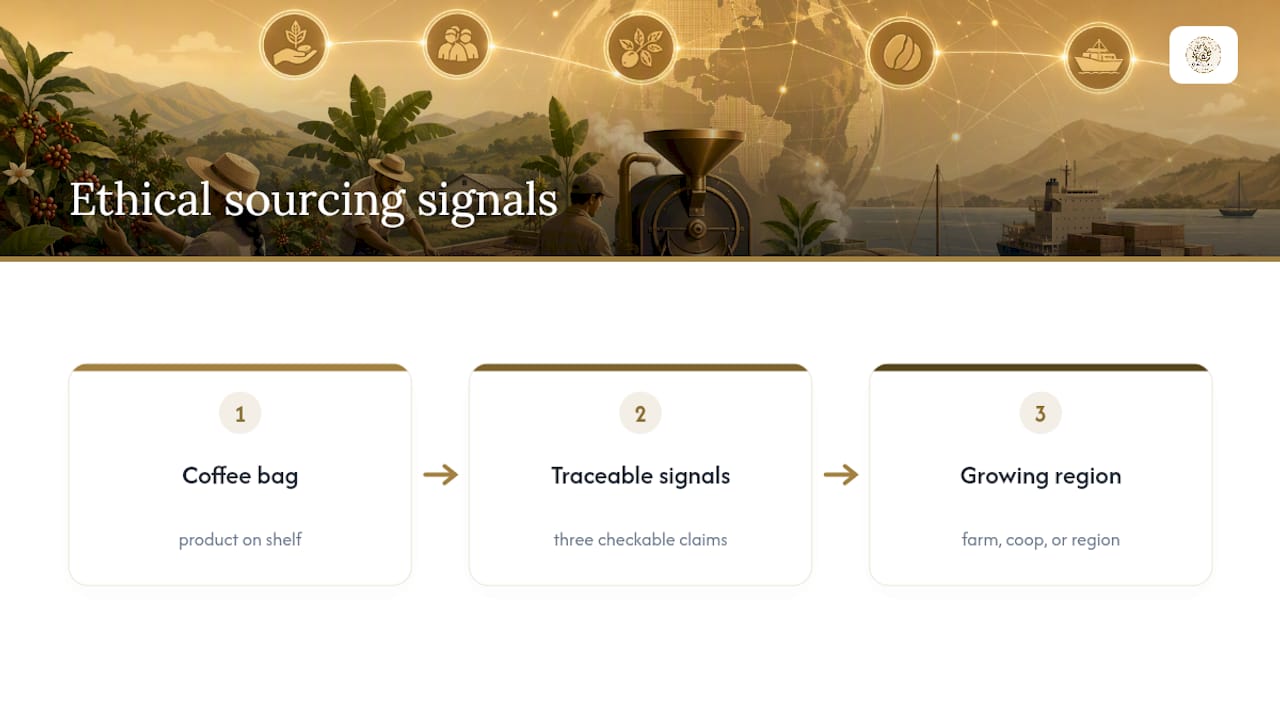
None of this is regulated the way organic or fair trade certifications are, which means the label “ethically sourced” carries only as much weight as the specifics behind it. A roaster that can tell you the region, the farm or cooperative, and the sourcing relationship behind a bag is making a checkable claim. One that just prints the phrase on a bag without any of that detail is making a marketing claim. Learning to spot the difference is worth more than any certification sticker.
How Do Roasters Preserve Freshness After Roasting?
Packaging does more work than most coffee drinkers give it credit for. The single most important feature on a specialty coffee bag is the one-way degassing valve, a small vent that lets carbon dioxide escape after roasting without letting outside air or moisture back in. Freshly roasted beans release CO2 for days after roasting, and without that valve, a sealed bag would either bulge dangerously or need to stay open, exposing the coffee to oxygen the whole time.
Beyond the valve, most small-batch roasters use foil-lined bags rather than plain paper or plastic, since foil blocks light and slows oxygen exchange far better than either alternative. Light and oxygen are the two biggest enemies of roasted coffee, breaking down the oils and aromatics that give a fresh bag its character within just a few weeks of exposure.
Bag size plays a role too, and it connects directly back to the freshness conversation from earlier in this guide. A smaller bag or sample pack gets opened, used, and finished faster, which means less time for the coffee inside to sit exposed to air every time you scoop from it. That’s part of why sample packs work so well as a discovery format: they’re sized to match how quickly a curious drinker will actually work through them, not sized for maximum shelf presence. Resealing carefully after every use, pressing air out before closing the valve area, extends that freshness window even further.
Small Batch vs. Mass-Produced: What Actually Changes in the Cup
The gap between small-batch and mass-produced coffee isn’t really about quality of beans. It’s about control during roasting and how long the coffee sits before it reaches you. Mass-produced coffee is typically roasted in massive batches, often hundreds or thousands of pounds at once, using a single standardized profile that has to work across an enormous volume regardless of subtle variations between lots of green coffee.
Small-batch roasting flips that constraint. Roasting in small lots lets a roaster read each specific batch of green beans and adjust the roast curve accordingly, which trade coverage of specialty roasting practices ties directly to more consistent results and truer expression of origin character. A Peruvian lot and a Ugandan lot don’t behave identically in a roaster, and small-batch production is what allows a roaster to actually account for that difference instead of steamrolling it.
The other major gap is time. Mass-produced coffee often sits in distribution and on shelves for weeks or months before it reaches a shopping cart, while small-batch, roast-to-order coffee is typically roasted within days of shipping. Since coffee’s brightest flavors fade steadily after roasting, that timeline difference alone can be the reason two bags of the “same” coffee taste noticeably different depending on where you bought them.
What Makes a Small Batch Roaster’s Philosophy Different?
Every small-batch roaster operates with some version of the same core belief: that batch size and roast timing are quality variables worth protecting, even at the cost of scale and convenience. Where roasters differ is in how they express that belief through sourcing choices, roast style, and what they choose to put on the label.
Some roasters build their entire identity around single-origin transparency, naming the specific farm or cooperative behind every lot and treating the roast itself as secondary to letting that origin speak clearly in the cup. Others lean toward blend craftsmanship, treating the roaster’s palate as the product, more like a chef building a dish from several ingredients than a single showcase.
Qahwat Al’Ard’s approach sits closer to the first camp, built around origin stories from specific growing regions and a catalog structure that separates single-origin offerings from blends rather than blurring the two together. That’s reflected in how the Single Origin collection is organized separately from blends like Cowboy Blend and 6 Bean Blend. It gives shoppers a clear signal about what they’re actually buying: a showcase of one region, or a deliberately engineered mix of several.
What ties every serious small-batch roaster together, regardless of philosophy, is the roast-to-order commitment. Whether a roaster leans single-origin or blend-focused, roasting in small lots close to ship date is the mechanical choice that makes freshness claims real rather than aspirational.
An Editor’s Honest Take on Small Batch Coffee Right Now
The specialty coffee world talks about “small batch” like it’s a badge of honor, and most of the time that’s fair. But the label has been stretched thin enough that it’s worth staying skeptical of any bag that uses the phrase without backing it up with an actual roast date. That’s the detail I always check first, before origin story, before tasting notes, before anything else printed on the bag.
What strikes me most going through a catalog like this one isn’t any single standout coffee. It’s how differently the same production philosophy plays out across products. A Cowboy Blend and a Peach Paradise couldn’t taste more different, yet both come out of the same commitment to small-lot roasting and traceable sourcing. That’s the real argument for small-batch production: not that every cup tastes the same kind of good, but that the roaster had enough control to make each one deliberately different.
If I had to talk a friend through buying their first bag from this catalog, I’d skip the debate over single-origin versus blend entirely and just point them toward the sample pack. Tasting three origins side by side teaches you more about your own preferences in one week than reading tasting notes ever will. From there, buying with confidence gets a lot easier.
— Yasin Sofyian Ayesh
Where to Buy These Small Batch Roasted Coffees
If you’re ready to try any of the coffees covered in this guide, the fastest place to start is the Single Origin Favorites Sample Pack, which lets you taste several origins before committing to a full bag of any one. Qahwat Al’Ard roasts each order fresh rather than pulling from aged warehouse stock, so what you’re buying reflects the actual roast dates and origin details covered throughout this guide, not marketing language layered on top of commodity coffee.
For everyday drinkers who already know their preferences, the full coffee collection covers everything from the House Blend to Cowboy Blend to Cold Brew Coffee, organized so you can browse by roast style instead of hunting through an undifferentiated catalog. If cold brew is your main method, the Cold Brew Coffee page has the specifics on that particular roast’s formulation.
Qahwat Al’Ard’s catalog is built for readers who’d rather buy one honest bag than three vague ones. Start with a sample pack if you’re undecided, or go straight to a full bag if you already know what you want brewing tomorrow morning.
Sources
- Specialty Coffee Association — Research and resources
- Roast Magazine — trade coverage of specialty roasting practices
FAQ
What Are the Best Small Batch Coffee Companies?
The strongest small-batch roasters share three traits: small-lot roasting for tighter quality control, roast-to-order production instead of warehoused stock, and transparent origin labeling. Qahwat Al’Ard builds its catalog around all three, pairing traceable sourcing from regions like Colombia and Peru with fresh roast dates on every order.
What Is the Best Roasted Coffee?
There’s no single “best” roast since it depends on your brew method and taste preference, but medium roasts like House Blend tend to suit the widest range of drip and pourover setups, while dark roasts like Cowboy Blend work best for French press and stronger, bolder cups.
Which Coffee Roaster Is Considered the Best in the USA?
There’s no single roaster universally ranked as “best” since specialty coffee quality depends heavily on freshness and roast style rather than any national ranking. The more useful question is whether a roaster practices small-lot roasting, discloses roast dates, and sources traceably, all of which specialty coffee research ties to better cup quality.
What Is the 15-15-15 Rule for Coffee?
The 15-15-15 rule is a home-brewing shorthand: use roughly 15 grams of coffee per 250 milliliters of water, try to brew beans within about 15 days of the roast date, and grind no more than 15 minutes before brewing. Treat it as a starting guideline rather than a strict standard, since actual freshness windows vary by roast level.
Does Qahwat Al’Ard Roast Coffee Fresh to Order?
Yes. Qahwat Al’Ard roasts coffee close to the order date rather than pulling from aged warehouse inventory, which is the production model behind every product covered in this guide, from the Single Origin Favorites Sample Pack to the House Blend.


