


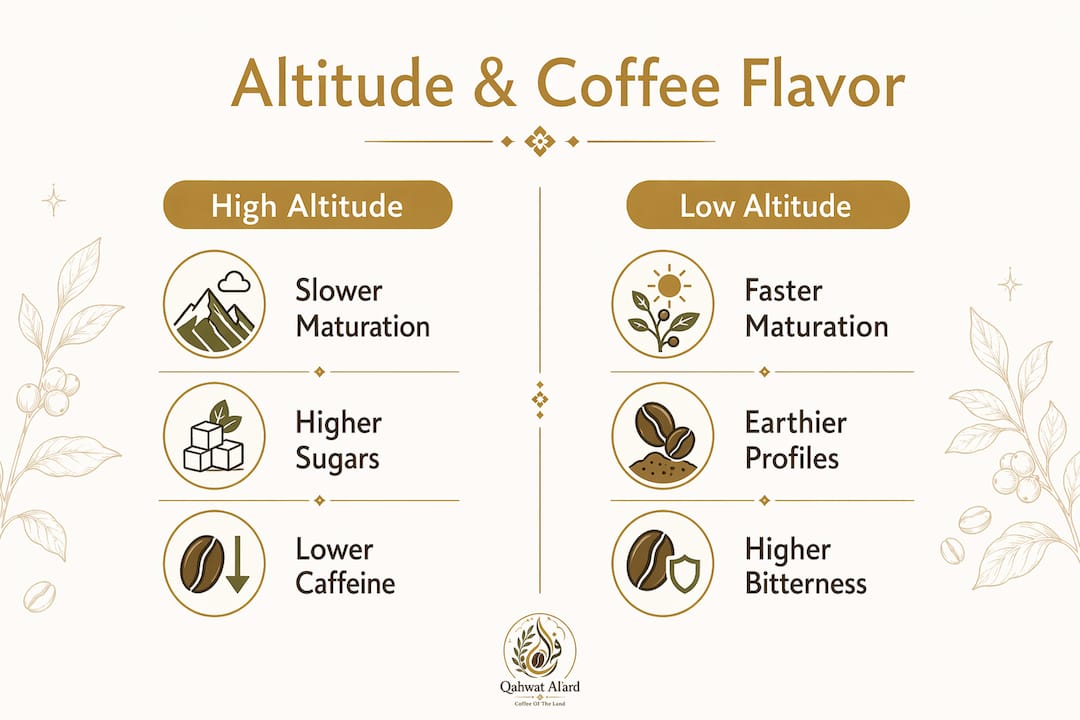
Altitude is the single most discussed variable in specialty coffee, and for good reason. Higher elevation slows the maturation of coffee cherries, forcing the plant to develop sugars and flavor precursors over a longer period. The result is a denser bean with lower caffeine, higher phenolic content, and a flavor profile that shifts from earthy and nutty toward bright, fruity, and caramel-like. Understanding the role of altitude in coffee flavor means understanding why a cup from a 1,800-meter Ethiopian farm tastes nothing like one from a 600-meter Brazilian lowland.
Here is what altitude actually does to your coffee:
- Slows cherry maturation, concentrating sugars and flavor precursors in the bean
- Increases bean density, which changes how the bean responds to heat during roasting
- Reduces caffeine and chlorogenic acid content as elevation rises
- Boosts total phenolic content and antioxidant activity
- Shifts volatile aroma compounds away from pyrazines (nutty, roasted) toward aldehydes (sweet, caramel, fruity)
- Correlates with higher cupping scores, particularly for aroma and flavor
- Raises cultivation challenges, including lower yields and greater labor demands at steep elevations
Table of Contents
- How altitude affects coffee at the biochemical level
- What does altitude-grown coffee actually taste like?
- How altitude connects to coffee quality grading
- Why high-altitude beans behave differently in the roaster
- Micro-terroir: why two farms at the same altitude can taste completely different
- Arabica vs. Robusta: how altitude affects each species differently
- Qahwatalard sources the altitude difference you can taste
- FAQ
- Key Takeaways
How altitude affects coffee at the biochemical level
The chemistry inside a coffee bean changes measurably with every 100 meters of elevation gain. Research on Arabica beans from Ethiopia shows that caffeine and chlorogenic acids decline by approximately 0.12 g/kg and 1.23 g/kg per 100 meters of altitude increase, respectively. That is not a trivial shift. Caffeine contributes bitterness, and chlorogenic acids drive astringency, so lower concentrations of both tend to produce a cleaner, smoother cup.
At the same time, total phenolic content rises with elevation. A positive correlation between altitude and phenolic compounds has been documented across Arabica varieties from Peru, Costa Rica, Guatemala, and Ethiopia. The mechanism is partly stress-driven: cooler temperatures and higher UV exposure at altitude push the plant to produce more protective phenolic compounds. These compounds contribute antioxidant activity and, indirectly, flavor complexity.

Sucrose accumulation follows a more nuanced path. Sucrose content rises with altitude but is modulated by shade cover and whether the beans are processed using wet or dry methods. Fatty acid content also increases with elevation, which matters for mouthfeel and the development of certain aromatic compounds during roasting.
| Compound | Direction with altitude | Flavor implication |
|---|---|---|
| Caffeine | Decreases | Less bitterness |
| Chlorogenic acids | Decreases | Less astringency |
| Total phenolics | Increases | Greater complexity, antioxidant activity |
| Fatty acids | Increases | Fuller mouthfeel, richer roast development |
| Pyrazines (volatile) | Decreases | Less nutty, roasted character |
| Aldehydes (volatile) | Increases | More sweet, caramel, fruity aroma |
What does altitude-grown coffee actually taste like?
The sensory shift that altitude produces is one of the clearest patterns in specialty coffee. Research on Pu’er coffee grown at elevations from 930 meters to 1,530 meters found that aroma and flavor scores increased consistently with elevation, with the highest aroma score of 7.39 and the highest flavor score of 7.75 recorded at 1,530 meters. Body, acidity, and aftertaste showed good ratings across all elevations but changed less dramatically.
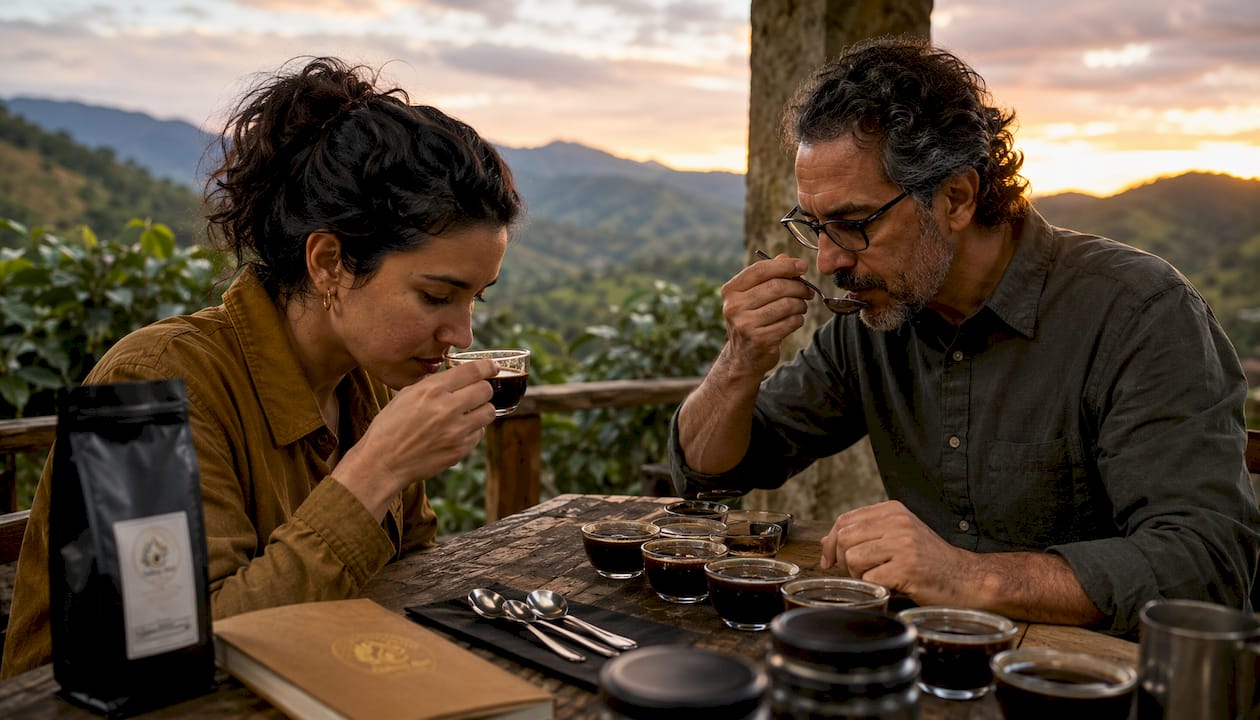
The volatile chemistry behind those scores tells the story. Pyrazines, which give coffee its characteristic nutty and roasted notes, decrease at higher elevations. Aldehydes, particularly furfural and 5-methyl-2-furancarboxaldehyde, increase. Furfural carries sweet, bread-like, caramel, and cinnamon-almond aromas. The net effect is a cup that trades roasted depth for sweetness and aromatic lift.
Low-altitude coffees, grown below roughly 900 meters, tend toward earthier, heavier profiles with more pronounced bitterness. Medium-altitude beans (900–1,200 meters) offer a middle ground: mild acidity, some sweetness, and a rounder body. High-altitude and super-high-altitude coffees (above 1,200 meters, and especially above 1,500 meters) push toward the bright, complex end of the spectrum, where you find the stone fruit, floral, and caramel notes that define top-tier specialty lots.
Regional microclimates add another layer. A 1,400-meter farm in Yemen’s Haraaz district produces a very different cup than a 1,400-meter farm in Colombia’s Huila department, even though both sit at the same elevation. Soil type, rainfall pattern, and diurnal temperature range all interact with altitude to produce the final sensory profile.
Pro Tip: When evaluating an unfamiliar coffee, check the listed elevation before you brew. If it’s above 1,500 meters, expect brighter acidity and look for sweet, caramel, or fruity notes. If it’s below 900 meters, expect a heavier body and earthier tones. Elevation is one of the fastest ways to predict what’s in the cup before you taste it.
- High altitude (above 1,200 meters): bright acidity, floral and fruity notes, caramel sweetness, complex aroma
- Medium altitude (900–1,200 meters): balanced acidity, mild sweetness, rounder body
- Low altitude (below 900 meters): earthy, heavier body, more bitterness, lower aromatic intensity
- Regional microclimates modify these baselines significantly
- Processing method (washed vs. natural) can amplify or dampen altitude-driven flavor traits
How altitude connects to coffee quality grading
Specialty coffee scoring systems and altitude are closely linked, though the relationship is not perfectly linear. Specialty-grade coffees scoring above 80 points on the Specialty Coffee Association (SCA) scale are commonly grown above 1,800 meters, where reduced pest pressure, cooler temperatures, and slower maturation combine to support better sweetness and caramel sensory notes. A study from Peru found that exportable yield and cup quality improved at elevations above 1,800 meters.
The altitude thresholds used in trade reflect this. In Central America, the Strictly Hard Bean (SHB) designation applies to coffees grown above approximately 1,350 meters. In Mexico, the equivalent is Strictly High Grown (SHG). These labels signal density and quality to buyers before a single cupping note is written.
Arabica dominates the high-altitude tier. The species thrives between 1,000 and 2,000 meters, where temperatures stay cool enough to slow maturation without causing frost damage. Robusta, by contrast, grows best at lower elevations, typically below 800 meters, and produces a cup with higher caffeine, more bitterness, and less aromatic complexity. The altitude difference between the two species is one reason Arabica commands a premium in the specialty market.
- Ethiopia (Yirgacheffe, Sidama): 1,700–2,200 meters; known for floral, blueberry, and tea-like notes
- Colombia (Huila, Nariño): 1,500–2,000 meters; bright acidity, red fruit, caramel finish
- Guatemala (Huehuetenango): 1,500–2,000 meters; full body, dark chocolate, stone fruit
- Yemen (Haraaz): 1,500–2,500 meters; wine-like, dried fruit, complex earthiness
- Brazil (Cerrado, Sul de Minas): 800–1,200 meters; lower acidity, nutty, chocolate, and caramel tones
- Vietnam (Robusta regions): 500–800 meters; high caffeine, rubbery, earthy, used primarily in blends
You can explore how elevation and coffee taste interact across these regions in more detail, including how single-origin sourcing decisions are shaped by elevation data.
Why high-altitude beans behave differently in the roaster
Dense beans roast differently, and altitude is the primary driver of density. High-altitude beans roast slower because their physical structure resists heat transfer more than softer, low-altitude beans. Roasters working with beans grown above 4,500 feet (roughly 1,370 meters) consistently note that first crack arrives later and requires more careful heat management.
That slower roast has a direct payoff. Brighter acidity and aromatic compounds are more volatile, meaning they burn off quickly under aggressive heat. A denser bean gives the roaster more time to develop sweetness without scorching those delicate notes. The result is a roasted coffee that preserves the caramel, fruit, and floral character that altitude built into the green bean.
Low-altitude beans, being less dense, respond faster to heat. They suit a more aggressive roast profile and naturally develop the chocolatey, nutty flavors that pyrazines produce. Trying to roast a low-altitude bean the same way as a high-altitude one typically leads to underdevelopment or a flat cup. Understanding bean density and roasting is the practical bridge between elevation data and what ends up in your grinder.
- High-altitude beans need longer development time and lower charge temperatures to avoid tipping or scorching
- First crack arrives later, giving roasters a wider window to develop sweetness
- Post-crack development should be extended slightly to integrate acidity without losing brightness
- Low-altitude beans suit faster, hotter profiles that develop body and chocolate notes
- Altitude-grown coffees generally perform better at light-to-medium roast levels, where their aromatic complexity survives
Micro-terroir: why two farms at the same altitude can taste completely different
Altitude sets the stage, but micro-terroir writes the script. Solar radiation and slope orientation critically mediate how altitude affects coffee flavor, producing measurable variation between farms at identical elevations. A slope facing east catches the morning sun and cools in the afternoon. A west-facing slope does the opposite. Those few hours of temperature difference change moisture retention, maturation rate, and ultimately the volatile compound profile in the bean.
Shade management adds another variable. Shade trees slow photosynthesis and reduce temperature fluctuation, which mimics some of the effects of higher altitude even on lower-elevation farms. When shade is combined with genuine high altitude, the interaction can push phenolic content and sucrose accumulation beyond what either factor produces alone. This is why coffee terroir is best understood as a system, not a single number on a topographic map.
The practical implication for buyers and roasters is that elevation alone is not a guarantee of quality. A 1,600-meter farm with poor shade management, degraded soil, or inconsistent harvesting can underperform a well-managed 1,200-meter farm with ideal microclimate conditions.
- Solar radiation: higher UV at altitude stresses the plant, increasing phenolic production
- Slope orientation: east vs. west facing changes diurnal temperature range and maturation timing
- Shade cover: modifies temperature, humidity, and biochemical stress responses
- Rainfall distribution: uneven rainfall at altitude can cause uneven ripening across a single lot
- Soil composition: volcanic soils common at altitude in Central America and East Africa contribute mineral complexity
Arabica vs. Robusta: how altitude affects each species differently
The altitude preferences of Arabica and Robusta reflect fundamental biological differences between the two species. Arabica (Coffea arabica) evolved in the highland forests of Ethiopia at elevations between 1,500 and 2,000 meters. It carries that preference into cultivation, producing its best cups at high elevations where cooler temperatures slow maturation and build complexity. Robusta (Coffea canephora) is native to lowland equatorial forests and thrives below 800 meters, where higher temperatures and humidity suit its growth pattern.
The biochemical gap between the two is wide. Robusta contains roughly twice the caffeine of Arabica, which contributes to its characteristically harsh, rubbery bitterness. At low altitudes, Robusta’s phenolic profile leans toward compounds that produce astringency rather than the sweet, fruity complexity that altitude-grown Arabica develops. Robusta does have genuine uses, particularly in espresso blends where its crema-producing properties and caffeine punch are valued, but altitude-driven flavor complexity is not its strength.
Some Arabica varieties respond to altitude more dramatically than others. Heirloom Ethiopian varieties like Kurume and Wolisho, grown at very high elevations in Yirgacheffe, produce intensely floral and fruit-forward cups that lower-elevation Arabica cultivars rarely match. Hybrid varieties bred for disease resistance sometimes sacrifice altitude sensitivity in the process, producing more consistent but less expressive cups across elevation ranges.
The takeaway for specialty buyers is straightforward: when altitude is listed on a bag, it is most meaningful for Arabica. For Robusta-dominant blends, elevation data matters less than processing method and roast level.
Qahwatalard sources the altitude difference you can taste
Most coffee sold in the United States comes from supply chains where elevation data is either absent or treated as a marketing footnote. Qahwatalard takes a different approach, sourcing single-origin beans from high-altitude growing regions where traceability is built into the supply chain from farm to bag.
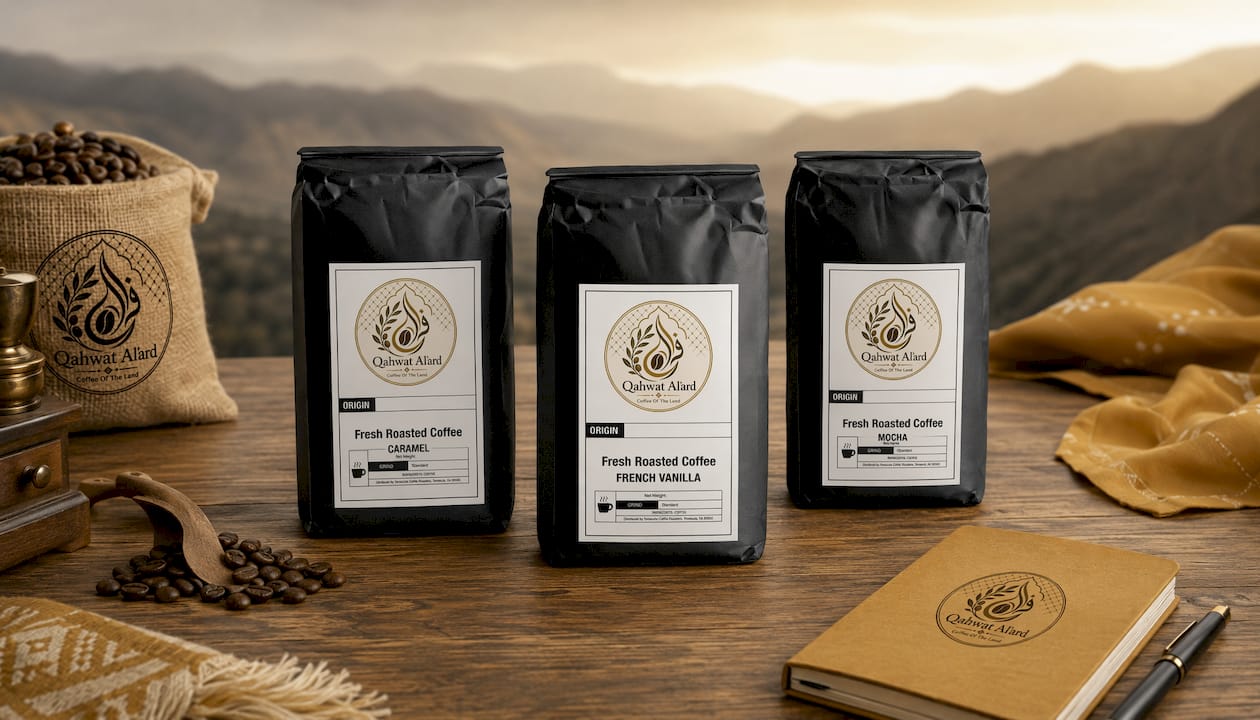
The altitude-driven caramel sweetness that research consistently links to high-elevation Arabica shows up directly in Qahwatalard’s product lineup. The Caramel coffee captures the sweet, aldehyde-rich character that develops in beans grown above 1,200 meters. The French Vanilla blend builds on the floral and sweet aromatic base that slow cherry maturation at altitude produces. And the Mocha offering reflects the chocolate-to-caramel flavor arc that well-roasted high-altitude beans naturally express. Every product is fresh-roasted and sourced with full origin transparency, so you know exactly where the elevation data behind your cup comes from. Browse the full collection at qahwatalard.com and find the altitude profile that matches what you want in the cup.
FAQ
How does altitude affect coffee flavor?
Higher altitude slows cherry maturation, concentrating sugars and flavor precursors while reducing caffeine and chlorogenic acids. The result is a denser bean with brighter acidity, more complex aroma, and flavor notes that shift toward sweet, caramel, and fruity rather than earthy or bitter.
Is high-altitude coffee better than low-altitude coffee?
High-altitude coffee tends to score higher on specialty grading scales, with specialty-grade lots commonly grown above 1,800 meters. That said, “better” depends on preference. Low-altitude coffees offer heavier body and chocolatey, nutty profiles that many drinkers prefer, and micro-terroir factors like shade and soil can close the quality gap significantly.
What elevation produces the best Arabica coffee?
Arabica generally performs best between 1,200 and 2,000 meters, where cooler temperatures slow maturation without risking frost damage. Above 1,500 meters, the shift toward sweeter, more aromatic flavor profiles becomes pronounced, and cupping scores for aroma and flavor tend to peak.
Does altitude affect how coffee should be roasted?
Yes. High-altitude beans are denser and require slower roast profiles with more careful heat management. They respond best to light-to-medium roasts that preserve their brightness and aromatic complexity. Low-altitude beans suit faster, hotter profiles that develop body and roasted character.
How does Arabica differ from Robusta in terms of altitude?
Arabica thrives at 1,000–2,000 meters and develops its best flavor complexity at high elevations. Robusta grows best below 800 meters, contains roughly twice the caffeine of Arabica, and produces a heavier, more bitter cup that altitude does not significantly improve.
Key Takeaways
Altitude shapes coffee flavor primarily by slowing cherry maturation, which concentrates sugars, reduces caffeine and chlorogenic acids, and shifts volatile aroma compounds toward sweet, caramel, and fruity profiles.
| Point | Details |
|---|---|
| Slower maturation builds flavor | Higher elevation extends cherry development, concentrating sugars and flavor precursors in the bean. |
| Caffeine and acids decline with elevation | Caffeine drops approximately 0.12 g/kg and chlorogenic acids approximately 1.23 g/kg per 100 meters of altitude gain. |
| Specialty grade starts above 1,800m | Coffees scoring above 80 SCA points are commonly grown above 1,800 meters, where pest pressure drops and sweetness improves. |
| Dense beans need slower roasting | High-altitude beans resist heat transfer, requiring extended development time to preserve brightness and caramel notes. |
| Qahwatalard sources by origin and elevation | Qahwatalard’s Caramel, French Vanilla, and Mocha offerings are sourced from high-altitude regions with full traceability from farm to cup. |


