
“Bird Friendly” isn’t a marketing phrase. Certified roasters are listed in the Smithsonian’s own directory, and online sellers like Qahwat Al’ard carry traceable, sustainably sourced roasts for buyers who want that same rigor.
TL;DR:
- Bird Friendly certification guarantees both 100% organic and shade-grown coffee with specific habitat and tree diversity standards verified by third-party inspections.
- The certification’s habitat standards provide close to native forest habitat quality, supporting higher bird diversity than other eco labels like Rainforest Alliance.
- Only certified batches carry the Smithsonian Bird Friendly seal, which requires traceability, separation from uncertified coffee, and re-inspection every three years.
- Most Bird Friendly coffee comes from Latin America, especially regions along North American migratory routes, with limited supply and higher prices compared to non-certified options.
- Certification may be costly for small farmers due to organic transition requirements, limiting its global reach despite its strict and transparent standards.
Table of Contents
- What Does the Smithsonian Bird Friendly Certification Require?
- Why Does Bird Friendly Coffee Matter for Birds and Farmers?
- How Does Bird Friendly Handling and Certification Actually Work?
- How Can You Verify and Buy Genuine Bird Friendly Coffee?
- Where Traceable, Sustainable Coffee Fits Into Your Buying Decision
- How Is Bird Friendly Different From “Shade-Grown” or Organic Coffee?
- How Does Bird Friendly Compare to Rainforest Alliance and Fair Trade?
- What Are the Criticisms of Bird Friendly Certification?
- What Does Bird Friendly Coffee Taste Like?
- How Does Certification Affect Farmers Financially?
- Where Is Bird Friendly Coffee Grown Around the World?
- What Should Buyers Actually Prioritize?
- Shop Sustainably Sourced Coffee With Qahwat Al’ard
- Sources
- FAQ
What Does the Smithsonian Bird Friendly Certification Require?
Bird Friendly is the only third-party coffee standard that guarantees both 100% shade-grown and 100% organic production at once. That combination is what separates it from coffee marketed as “shade-grown,” a term with no legal definition and no enforcement behind it.
The on-farm rules are specific, not aspirational. Certified farms need a forest canopy that mimics the layered structure of native woodland — not just a few scattered trees for shade.
- At least 40% canopy cover over the coffee plants
- Multiple tree strata, including an upper layer of tall native species
- A minimum diversity of shade tree species, with limits on how much of the canopy any single species can dominate
- Full organic status as a prerequisite before Bird Friendly criteria even apply
Every certified farm gets inspected by an independent third party, and re-certification happens on a recurring three-year cycle rather than a one-time audit. If you want a plain-language breakdown of how this stacks up against other eco labels, Qahwat Al’ard’s buyer’s guide to coffee sustainability certifications walks through the distinctions in more detail.
Why Does Bird Friendly Coffee Matter for Birds and Farmers?
Smithsonian researchers have measured something most eco labels can’t claim: Bird Friendly farms provide habitat quality second only to undisturbed native forest for migratory songbirds. That’s a big deal in a hemisphere where wintering habitat for species like the wood thrush and Baltimore oriole keeps shrinking to sun-scorched monoculture rows.
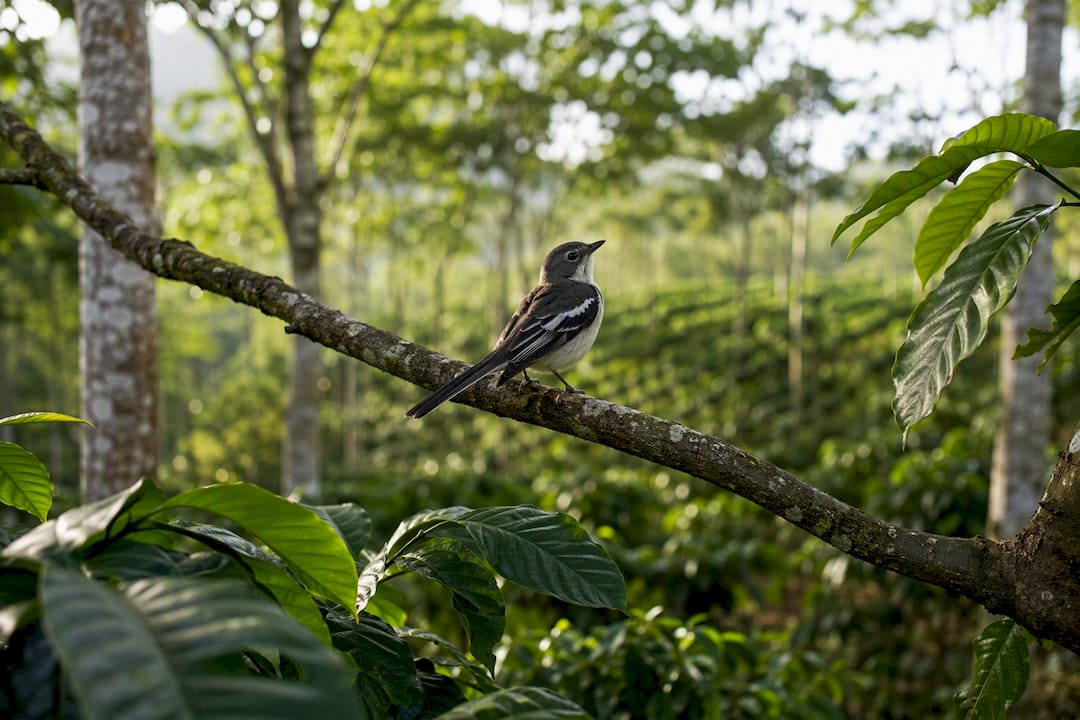
Bird Friendly farms host more birds, at higher diversity, than any other certified coffee production system studied by Smithsonian scientists.
The program now includes more than 4,000 farmers across 14 countries, producing over 36 million pounds of coffee a year under these canopy rules. That scale matters because it turns bird habitat into a working farm, not a nature preserve funded by donations.
Farmers benefit too. Certification opens the door to premium markets and higher per-pound prices, which gives smallholders a financial reason to keep native trees standing instead of clearing them for higher-yield, sun-grown varieties. Conservation and income, in this case, point the same direction.
How Does Bird Friendly Handling and Certification Actually Work?
Growing shade coffee is only half the standard. The other half is a chain-of-custody system designed to stop Bird Friendly beans from ever mixing with uncertified coffee between the farm and your cup.
- Farm certification. An independent inspector verifies canopy cover, tree diversity, and organic compliance before any beans qualify.
- Physical or temporal separation. Mills and processors must keep certified lots physically apart from conventional coffee, or process them at clearly separated times, with documentation at each step.
- Marking and record-keeping. Bags and lot records carry “BF” identifiers so the coffee stays traceable from mill to roaster.
- Licensing agreement. Roasters and importers sign a legal agreement with the Smithsonian and pay a licensing fee to use the trademarked seal, which is why you won’t see it slapped on packaging casually.
- Re-inspection. Farms go through the full certification review again every three years, not just once at enrollment.
Pro Tip: If a bag says “shade-grown” but doesn’t carry the actual Smithsonian Bird Friendly® seal, treat it as a marketing term, not a guarantee. Only the registered trademark comes with inspection and traceability behind it.
How Can You Verify and Buy Genuine Bird Friendly Coffee?
Verification takes less effort than most people assume. You’re looking for one specific mark, not a paragraph of green claims on the back label.
- Check for the actual seal. The Smithsonian Bird Friendly® logo should appear on the packaging, usually alongside explicit “100% organic” language.
- Search the Smithsonian directory. The Bird Friendly Coffee Program, launched in 1996 and now active in countries including Peru, Colombia, Ethiopia, Guatemala, and Mexico, maintains a list of licensed roasters.
- Use the online buying list. Smithsonian’s Buy Bird Friendly Coffee Online page rounds up certified roasters selling direct to consumers, which is the fastest route if there’s nothing certified at your local grocery store.
- Ask before you assume. If you’re shopping in person and don’t see the seal, ask the store manager or roaster directly about provenance. A legitimate certified seller can point to their license.
For a broader look at how traceability claims should hold up under scrutiny, Qahwat Al’ard’s guide to ethical coffee sourcing covers what real supply-chain transparency looks like beyond a single seal.
Where Traceable, Sustainable Coffee Fits Into Your Buying Decision
Bird Friendly certification is a rigorous, verifiable standard, but it isn’t the only signal worth caring about when you’re choosing coffee with a conscience. Traceability, single-origin sourcing, and transparent farmer relationships all matter, even on coffee that isn’t formally certified.
Qahwat Al’ard builds its catalog around that kind of transparency: single-origin beans sourced from regions including Colombia, Peru, Bali, and Uganda, sold with origin details attached rather than a generic “product of multiple countries” label. That’s not the same claim as Bird Friendly certification, and Qahwat Al’ard doesn’t represent its coffee as certified under the Smithsonian program.
- Curated single-origin selections with stated country and region of origin
- Beans roasted fresh to order rather than sitting on a shelf for months
- Educational content covering sourcing, roasting, and sustainability practices for buyers who want context, not just a bag
If you’re building a habit of buying with intention, Qahwat Al’ard’s sustainable coffee farming examples piece is a useful next stop for understanding what responsible agroforestry looks like on the ground, certified or not.
How Is Bird Friendly Different From “Shade-Grown” or Organic Coffee?
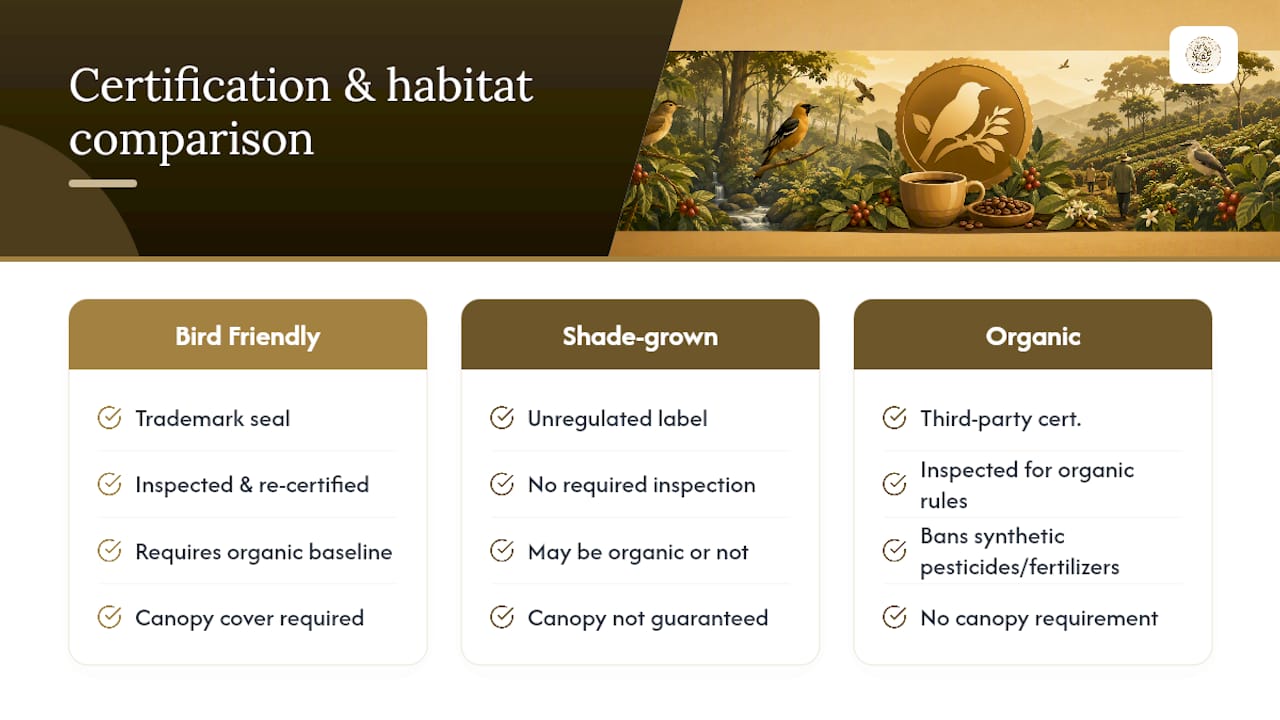
“Shade-grown” sounds like a guarantee. It isn’t. No government agency or certifying body regulates the term, so a company can print it on a bag if the farm has a handful of trees scattered near the edge of a field.
Organic certification is more rigorous, since it requires third-party inspection and bans synthetic pesticides and fertilizers. But organic rules say nothing about tree canopy, bird habitat, or forest structure. A farm can be fully organic and still grow coffee in full sun on cleared land.
Bird Friendly requires organic status as a floor, then adds the habitat criteria on top: canopy cover, tree strata, species diversity. Nothing else in the coffee industry stacks both requirements into a single, inspected and re-certified standard. That’s the practical difference: “shade-grown” is a description anyone can use, while Bird Friendly is a trademarked seal that requires proof, inspection, and renewal.
For a buyer standing in a grocery aisle, that distinction is the whole ballgame. A bag that says “shade-grown, sustainably farmed” might be excellent coffee grown with real care, or it might be sun-grown coffee dressed up with soft language. The Bird Friendly seal removes that guesswork, because it can’t legally appear without the underlying inspection.
How Does Bird Friendly Compare to Rainforest Alliance and Fair Trade?
Rainforest Alliance certification covers a broad set of environmental and social criteria, including some shade requirements, but its canopy and biodiversity standards are less specific than Bird Friendly’s tree-strata and species-diversity rules. It also doesn’t require organic production, which means a Rainforest Alliance farm can still use certain synthetic inputs that Bird Friendly rules out entirely.
Fair Trade certification focuses primarily on labor conditions, farmer cooperatives, and minimum pricing structures rather than habitat or biodiversity. A Fair Trade farm might pay workers fairly and still grow coffee in full sun with no meaningful bird habitat at all. The two certifications solve different problems.
Bird Friendly’s narrower focus is exactly what gives it teeth. It doesn’t try to cover labor standards, pricing structures, or general environmental management the way Rainforest Alliance does. It targets one outcome, forest-quality bird habitat combined with organic farming, and enforces it with inspection and mandatory purity rules that prevent uncertified beans from blending into a certified bag.
Some farms hold multiple certifications at once, stacking Bird Friendly’s habitat rigor with Fair Trade’s labor protections. If you’re choosing between labels rather than assuming they overlap, the honest summary is this: Fair Trade tells you about the people, Rainforest Alliance tells you about general farm management, and Bird Friendly tells you specifically about the trees and the birds living in them.
What Are the Criticisms of Bird Friendly Certification?
The biggest complaint isn’t about the science. It’s about accessibility. Certification requires farms to already meet organic standards before Bird Friendly criteria even apply, and organic transition alone can take years and cost money smallholders don’t always have upfront.
The inspection and licensing process adds friction too. Roasters need a signed agreement with the Smithsonian and a licensing fee to legally use the seal, which means small-batch roasters sometimes source genuinely shade-grown, ecologically sound coffee without ever pursuing formal certification. That coffee might meet the spirit of Bird Friendly standards without carrying the seal, and a shopper scanning for the logo alone would walk right past it.
Availability is a real constraint for consumers, too. Certified Bird Friendly coffee isn’t stocked in most conventional grocery chains, and the total production volume, while meaningful at 36 million pounds annually, is a small fraction of global coffee output. That scarcity can push prices higher and limit variety compared to mainstream sustainability labels with looser requirements.
None of this undermines the standard itself. The criticism is really about scale and reach, not rigor. A certification this strict will always certify fewer farms than a looser one, and that tradeoff is the price of keeping the seal meaningful.
What Does Bird Friendly Coffee Taste Like?
Shade-grown coffee tends to ripen more slowly than sun-grown coffee, since the canopy limits direct sunlight and moderates temperature swings around the coffee cherries. Slower ripening generally gives beans more time to develop sugars and complex flavor compounds before harvest.
That’s not a guarantee every Bird Friendly bag will taste dramatically different from a well-sourced sun-grown coffee. Varietal, processing method, and roast level still drive most of what you taste in the cup. But shade cultivation tends to favor the traditional, complex flavor profiles many specialty drinkers associate with high-altitude, forest-grown arabica: brighter acidity, more pronounced fruit notes, and a cleaner finish than mass-produced sun-grown commodity coffee.
The consumer benefit isn’t just flavor, though. Buying Bird Friendly means you know, with inspection-backed certainty, that your purchase supports a farm maintaining real forest structure rather than a cleared field. For environmentally conscious drinkers, that certainty is often as valuable as the cup itself. You’re not just buying a taste profile. You’re buying a documented outcome.
How Does Certification Affect Farmers Financially?
Bird Friendly certification was built with a dual purpose from the start: protect habitat and create real market advantages for the smallholders who maintain it. That’s not incidental to the program. It’s the mechanism that makes the conservation model work at all.
Access to premium and gourmet markets is the main lever. Certified farmers can sell into a buyer segment willing to pay more for verified, inspected sustainability, rather than competing purely on volume against sun-grown commodity coffee. Price premiums tied to certification give farmers a direct financial incentive to keep native trees standing instead of clearing land for higher-yield varieties.
There’s a cost side to this too, and it’s worth being honest about. Organic transition, the mandatory prerequisite for Bird Friendly status, often means lower yields during the multi-year transition period before soil and pest management stabilize. Farmers absorb that dip before the premium pricing kicks in. For smallholders without savings or credit access, that gap can be the deciding factor in whether certification is realistic at all, which is part of why the program’s reach, while significant, hasn’t scaled to match global coffee production.
Where Is Bird Friendly Coffee Grown Around the World?
Bird Friendly production concentrates in Latin America, where migratory songbirds from North America actually winter. The program is active across countries including Peru, Colombia, Guatemala, Honduras, Nicaragua, Mexico, Ecuador, the Dominican Republic, and Venezuela, along with Ethiopia representing African production.
That geographic pattern isn’t random. The certification exists specifically because so many North American songbird species winter in Latin American shade coffee zones, so the conservation payoff is highest where farm habitat directly connects to bird migration routes. A shade coffee farm in a region outside that migratory corridor delivers real biodiversity value, but not the specific songbird-habitat outcome the Smithsonian program was designed to measure.
For U.S. buyers, this means most certified bags trace back to Central and South American origins rather than African or Southeast Asian growing regions, simply because that’s where the certified farm network is concentrated. If you’re drawn to single-origin coffee from other regions, like East African or Indonesian beans, you’re less likely to find Bird Friendly certification attached, even when the farm practices real agroforestry. That’s a gap in certification reach, not necessarily a gap in sustainable practice on the ground.
What Should Buyers Actually Prioritize?
Most sustainability marketing in coffee is designed to make you feel good without requiring you to check anything. Bird Friendly is the rare exception: it’s built around a seal you can actually verify, backed by inspection records rather than a company’s own claims about its supply chain.
The conventional advice, “look for shade-grown or organic,” undersells how big the gap is between those loose terms and an actual trademarked, inspected standard. Organic tells you about chemical inputs. Shade-grown tells you nothing enforceable at all. Bird Friendly is the only label combining both with habitat science behind it, which is why it deserves more attention than it gets relative to more heavily marketed labels.
Here’s what I’d prioritize: don’t treat the seal as the only signal of a responsible purchase. Certification reach is limited by cost and geography, so plenty of genuinely well-sourced, traceable coffee will never carry the Bird Friendly logo. Look for the seal when it’s there, and when it isn’t, look for a roaster willing to tell you exactly where the beans came from and how they were grown. Traceability without a trademark is still worth something.
— Yasin Sofyian Ayesh
Shop Sustainably Sourced Coffee With Qahwat Al’ard
Buying sustainably shouldn’t mean guessing whether the story on the bag is real. Some roasters source single-origin coffee with full traceability back to the growing region, offering origin transparency Bird Friendly buyers look for, even on roasts that aren’t formally certified.
Some offerings include classic single-origin profiles with clear regional traceability, roasted fresh to order rather than sitting in a warehouse. Other blends combine specialty coffee with functional mushroom ingredients, appealing to drinkers who want more than a standard cup.
None of these are marketed as Bird Friendly certified, and Qahwat Al’ard doesn’t claim otherwise. What they offer is origin transparency and freshness you can actually verify. Start with the Brazil Santos single-origin coffee and see what traceable sourcing tastes like in the cup.
Sources
- Smithsonian resilience: sustainable agriculture — Bird Friendly coffee and cocoa
- Bird Friendly® Coffee Program | Smithsonian Global
- Buy Bird Friendly Coffee Online | Smithsonian’s National Zoo and Conservation Biology Institute
FAQ
Is Starbucks Coffee Bird Friendly Certified?
Starbucks sources some coffee through its own C.A.F.E. Practices program, but that’s a different standard from Smithsonian Bird Friendly® certification. Starbucks coffee is not certified Bird Friendly.
Is It Safe for Birds to Drink Coffee?
Coffee itself isn’t something birds drink or consume, since caffeine is toxic to birds in concentrated amounts. Bird Friendly certification is about protecting bird habitat on coffee farms, not about birds ingesting coffee.
Which Bird Friendly Coffee Brands Are Sold at Whole Foods?
Whole Foods carries a rotating selection of coffee brands, and availability of Smithsonian Bird Friendly® certified roasts varies by store and region. The most reliable way to confirm a specific brand’s certification is to check the Smithsonian’s online directory of certified roasters rather than relying on shelf labels alone.
Is Peet’s Coffee Bird Friendly Certified?
Peet’s Coffee is not listed among Smithsonian’s certified Bird Friendly roasters. Some Peet’s offerings use shade-grown or organic sourcing claims, but those terms don’t carry the same inspection and habitat requirements as the Smithsonian Bird Friendly® seal.
What’s the Difference Between Bird Friendly and Organic Coffee?
Organic certification regulates chemical inputs but says nothing about tree canopy or bird habitat. Bird Friendly requires organic status as a baseline, then adds strict canopy cover, tree diversity, and inspection requirements on top of it.


