


A coffee bag valve is a one-way degassing valve that lets carbon dioxide escape while keeping oxygen and moisture out. It’s essential for most roasted coffee packaged soon after roasting, since fresh beans release gas heavily for days and a sealed bag without one will bloat, seep, or eventually pop its seams. The rule of thumb: skip the valve only on small single-serve packets or coffee rested well before bagging.
TL;DR:
- Bags over 8 ounces that are packaged immediately after roasting require a valve to prevent bloating and preserve freshness.
- Larger or high-pressure bags should use valves with diameters tailored to their size, such as 8mm for retail and 10mm for wholesale, confirmed through testing.
- For accurate sizing, conduct a 24 to 72-hour weight and visual inspection test on sample bags, considering roast profile and storage conditions.
- Pairing a high-quality barrier film with a properly selected valve and optional gas flushing extends shelf life and reduces oxidation.
- Retrofitting unvalved bags is impractical; instead, use pre-valved bags correctly matched to your roast timing and bag size.
Table of Contents
- How a Coffee Bag Valve Works: Mechanism, Internal vs. External, Placement
- When Do You Actually Need a Valve?
- Sizing the Valve: Specs and a Simple Testing Protocol
- Valves, Films, and Gas Flushing: How Freshness Systems Fit Together
- What to Ask Suppliers Before You Order Valved Bags
- Qahwat Al’Ard’s Approach to Packaging Coffee for Freshness
- Where Coffee Bag Valves End Up After You’re Done With Them
- The Valve Isn’t the Hard Part. The Timing Is.
- Ready to Taste the Difference Fresh Packaging Makes?
- Sources
- FAQ
How a Coffee Bag Valve Works: Mechanism, Internal vs. External, Placement
The valve itself is a tiny piece of engineering hiding in plain sight on the back of your coffee bag. Inside a small plastic housing sits an elastomer disc pressed over a set of perforations. When gas pressure inside the bag builds past a set threshold, the disc lifts, gas escapes through the holes, and the disc reseals. Outside air can’t push back through the same path, which is what makes it “one-way.” America’s Test Kitchen confirms this basic mechanism: the valve lets CO2 out while blocking oxygen and moisture from getting in.
Manufacturers build these in two configurations, and each has trade-offs worth knowing before you order bags:
- Internal valves sit inside the bag wall, giving a cleaner exterior look but requiring more precise placement during bag manufacturing.
- External valves mount on the bag’s surface, are easier to apply on existing packaging lines, and show up as the small round patch most consumers recognize.
Placement matters more than most sellers assume. A valve set too close to the fill line risks getting clogged with coffee oils or fines, while one placed too high in the headspace works reliably but needs enough clearance during filling to avoid grounds settling near the aperture.
When Do You Actually Need a Valve?
Not every bag needs one, and slapping a valve on everything wastes money on packaging you don’t need. Three factors decide it:
- Bag size. Packages larger than roughly 8 ounces generally need a valve because they hold enough fresh coffee to build meaningful internal pressure. Smaller single-serve pouches sometimes skip it if the coffee has rested a day or two before packing.
- Roast-to-pack timing. Coffee’s degassing curve peaks in the first 24 to 72 hours after roasting. Bag too soon after roast and you need a valve rated for high initial flow; wait a day or two and a standard valve usually handles it fine.
- Ground vs. whole bean. Ground coffee degasses roughly 50 percent faster than whole beans because grinding exposes far more surface area, so ground SKUs need valves built for a faster initial release.
Roasters chasing the ultra-fast, minimal-packaging route sometimes skip the valve entirely and rely on modified atmosphere packaging (MAP) or nitrogen flushing plus a short rest period instead. That works for high-volume, short-shelf-life products, but it’s a narrower use case than most small roasters realize.
Sizing the Valve: Specs and a Simple Testing Protocol
Getting the diameter right matters as much as having a valve at all. Industry guidance puts 8mm valves on bags in the 8 to 12 ounce range, 10mm valves on 1 to 2 pound bags, and dual valves or larger diameters on bulk formats where gas volume climbs fast.
| Bag fill weight | Typical valve size | Notes |
|---|---|---|
| 8 to 12 oz | 8mm | Standard for retail single-bag SKUs |
| 1 to 2 lb | 10mm | Common for wholesale and gift bags |
| Bulk (5 lb+) | Dual valves or larger diameter | Higher gas volume needs more release capacity |
Six variables actually drive the right spec: roast profile (darker roasts often outgas faster), bean density, fill weight, how soon after roasting you seal, shipping temperature swings, and target shelf life. Instead of guessing, run a three-step test before committing to a full production run. Seal a batch of sample bags the same way you’ll run production, then weigh and visually inspect them at 24, 48, and 72 hours, watching for bloating, leakage around the seal, or valve stress. Finally, run a temperature-cycled sample through a hot car or a cold storage swing to see how the valve holds up outside a climate-controlled room. This lab-free sequence, outlined by PackagingBest, gives you real data instead of a guess borrowed from a supplier’s marketing copy.
Pro Tip: Track mass loss on your sealed test bags over the first 72 hours. A steady, predictable drop in weight tells you how much CO2 your valve is releasing, and you can use that number to decide whether to size up before your next production run.
Valves, Films, and Gas Flushing: How Freshness Systems Fit Together
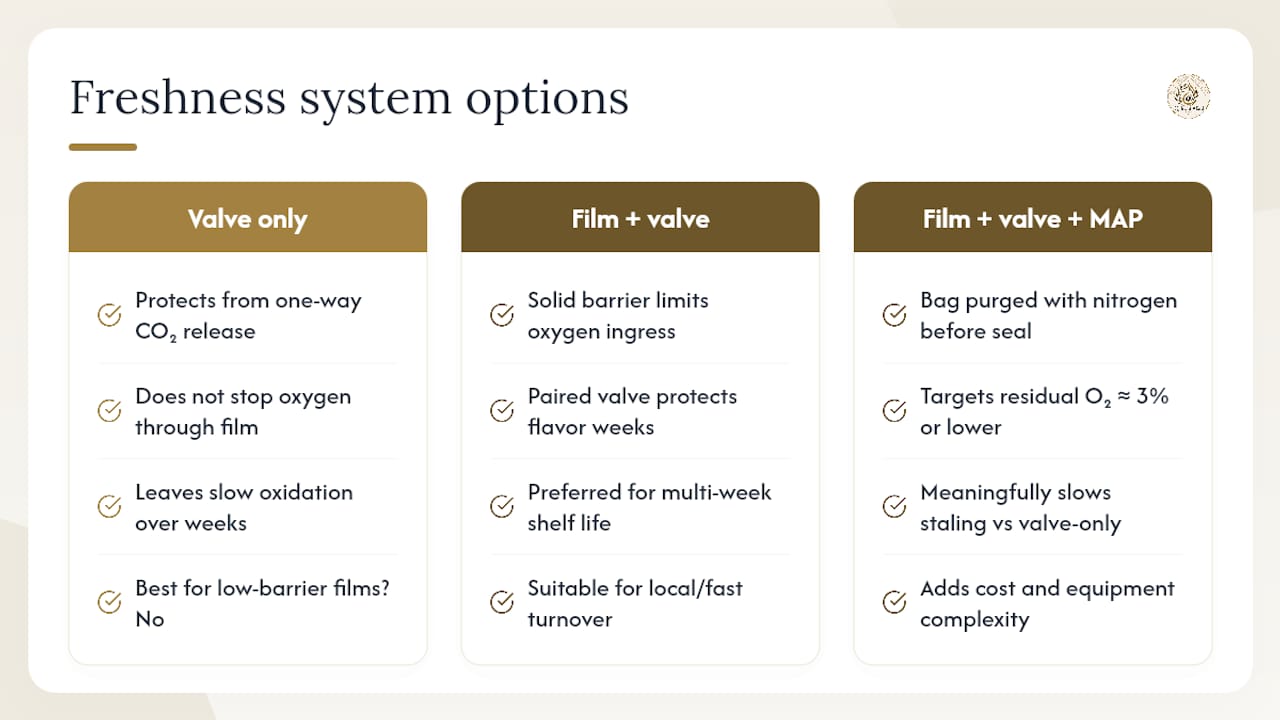
A valve is one piece of a freshness system, not the whole system. The barrier film you choose determines how much oxygen sneaks through the bag material itself over weeks of shelf time, and a valve doing its job on a low-barrier film still leaves coffee exposed to slow oxidation through the plastic. Pairing a solid barrier film with a properly sized valve is what actually protects flavor over a multi-week shelf life, not the valve in isolation.
For export or extended shelf-life runs, many packagers add gas flushing (MAP) alongside the valve, purging the bag with nitrogen to displace oxygen before sealing. Rovema notes that many roasters target residual oxygen levels around 3% or lower when using MAP, which meaningfully slows staling compared to a valve-only bag. That extra step adds cost and equipment complexity, so it tends to make sense for longer supply chains rather than local, fast-turnover sales.
On the eco side, valve materials now include recyclable and compostable options, but material choice only helps if it matches your bag’s own end-of-life pathway, since a compostable valve on a non-compostable film defeats the purpose and can even contaminate recycling streams.
What to Ask Suppliers Before You Order Valved Bags
Ordering the wrong valve and film combination is an expensive mistake to discover after a production run, so work through this checklist before signing off:
- Ask for the barrier film’s oxygen transmission rate (OTR) in writing, not just a general “high barrier” claim.
- Confirm the valve’s opening pressure threshold and the material it’s made from, especially if you need compostable or recyclable options.
- Check that the valve applicator method matches your packaging line. Some valves are pre-applied during bag manufacturing, while others require compatible adhesive or heat-sealing equipment on your end.
- Ask about valve shelf life and storage conditions before use, since valves stored improperly can degrade before they ever touch a bag of coffee.
- Request samples and run the 24/48/72-hour test before committing to a full order.
- Compare minimum order quantities, lead time, and per-unit cost across film and valve combinations, including any eco-friendly upgrades.
Also confirm film-to-valve bonding compatibility with your supplier. PLITEK’s technical guidance points out that mismatched adhesives or incompatible films can cause valves to peel off entirely, which turns a freshness feature into a packaging failure.
Qahwat Al’Ard’s Approach to Packaging Coffee for Freshness
Every batch Qahwat Al’Ard roasts is roasted fresh to order, which means our packaging has to match a real roast-to-pack timeline rather than sitting on a shelf for weeks before it ships. We choose valved bags for our standard retail sizes because our beans travel from origin regions like Colombia, Peru, and Uganda with full traceability, and that promise of authenticity only means something if the coffee still tastes like it did the day it was roasted. We test packaging before launching any new SKU, watching for the same bloating and seal issues covered in the testing protocol above. For customers building out a full home setup, our NNEDSZ 20 Bar Coffee Machine Espresso Cafe Maker pairs naturally with freshly valve-packed beans, giving properly rested, properly sealed coffee somewhere worthwhile to go.
Where Coffee Bag Valves End Up After You’re Done With Them
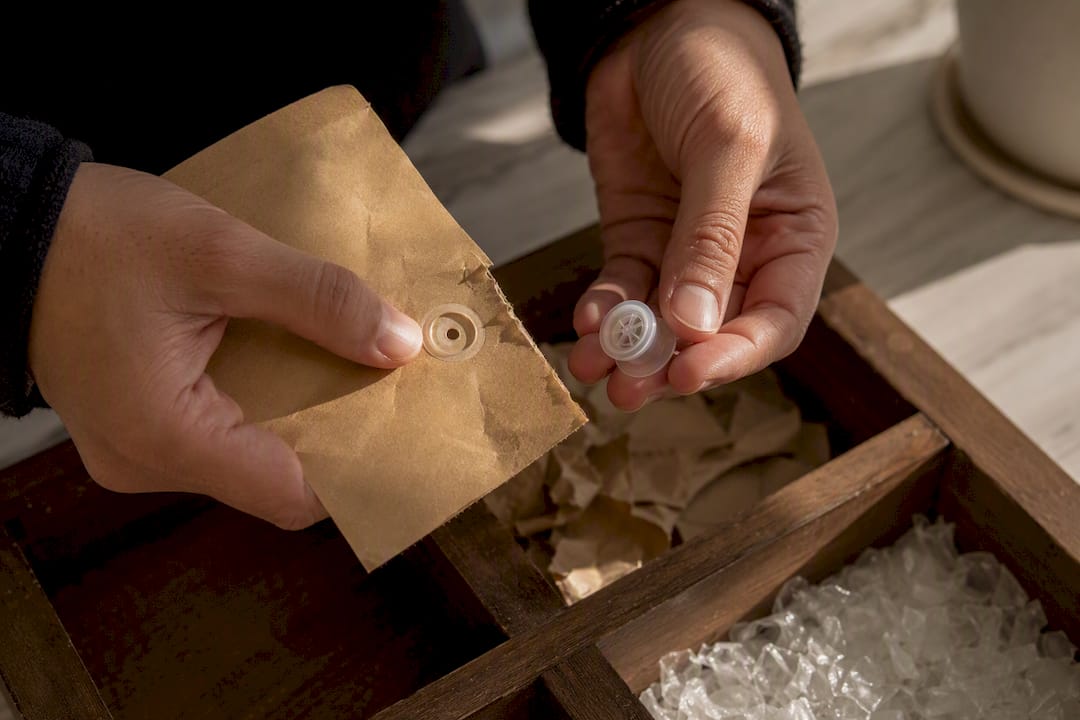
Most coffee bag valves are made from a combination of plastic housing and a thin elastomer disc, materials that don’t break down in a home compost bin and often aren’t accepted in standard curbside recycling because of their small size and mixed-material construction. That creates a real disposal gap: the bag around the valve might be recyclable or even compostable, but the valve itself frequently isn’t, and tossing the whole assembly into a compost stream can contaminate an otherwise good batch.
Compostable valve options exist and are becoming more common, built from bio-based polymers designed to break down alongside compostable films. But a compostable valve only delivers on that promise when it’s paired with a compostable bag and disposed of through a facility equipped to handle both, which usually means industrial composting rather than a backyard pile. Check the film and valve materials together, not separately, before assuming a bag is landfill-free.
For buyers who care about the full lifecycle of their packaging, the practical move is separating the valve from the bag before recycling when the packaging instructions call for it, and choosing suppliers who disclose both film and valve material honestly. Sellers can support this by printing clear disposal instructions on the bag itself rather than leaving customers to guess. A thoughtful approach to sustainable coffee packaging treats the valve as part of the material equation, not an afterthought bolted onto an otherwise green bag.
The Valve Isn’t the Hard Part. The Timing Is.
Most advice on coffee bag valves fixates on which valve to buy, as if the brand or the price point were the decision that matters. It isn’t. The real variable is your roast-to-pack window, and getting that wrong makes even a premium valve underperform. A roaster sealing bags six hours off the roaster needs a fundamentally different valve spec than one resting beans for a full day first, and no amount of valve quality fixes a mismatch there.
The conventional wisdom oversimplifies this into a single checkbox: does the bag have a valve, yes or no. That framing misses ground versus whole bean differences, bag size thresholds, and the fact that a valve without a decent barrier film is only doing half the job. If you sell coffee and haven’t run the 24/48/72-hour weigh test on your own packaging, you’re guessing at a spec that takes an afternoon to verify.
Prioritize the test before the purchase order. A valve that looks right on a spec sheet can still bloat your bags if your actual roast profile or fill weight doesn’t match what the supplier assumed.
— Yasin Sofyian Ayesh
Ready to Taste the Difference Fresh Packaging Makes?
Freshness only survives the trip from roaster to cup if the packaging holds up its end, and that’s exactly what Qahwat Al’Ard builds around: single-origin beans roasted fresh to order, sealed the right way, and shipped without the stale-shelf delay that undercuts most grocery store coffee. If you’re setting up a home brewing station to match that freshness, the NNEDSZ 20 Bar Coffee Machine Espresso Cafe Maker gives properly packaged, properly rested beans a machine worth brewing them on. Have questions about packaging, valve types, or which origin fits your taste? Reach out through the shop for packaging guidance, or browse the current lineup of traceable, sustainably sourced coffee and order a bag that’s been handled with exactly the freshness measures covered above.
Sources
- What Is That Valve on My Coffee Bean Bag? | America’s Test Kitchen
- Why Coffee Bags Have Vents: The Valve Truth Roasters Miss - PackagingBest
- 3 Reasons Degassing Valves Are Important to Coffee Packaging
- Degassing valve technical resources - PLITEK
FAQ
What Is the Valve on a Coffee Bag For?
It releases carbon dioxide that fresh roasted coffee naturally produces, preventing the bag from bloating or bursting while keeping oxygen and moisture from getting in and staling the beans.
Do Coffee Bags Need a Valve?
Most bags larger than about 8 ounces packaged soon after roasting need one, though small single-serve packets or coffee rested a day or two before sealing can sometimes skip it.
Are Coffee Bag Valves One-Way?
Yes. The valve opens under internal gas pressure to let CO2 escape, then reseals, and its design blocks air from flowing back into the bag from outside.
What Is a Coffee Valve in Packaging Terms?
It’s a small mechanical component, usually an elastomer disc over perforations, engineered to manage gas exchange so packaged coffee stays fresh without the bag failing from pressure buildup.
Can You Add a Valve to a Bag That Doesn’t Have One?
Retrofitting an unvalved bag isn’t practical for most sellers since valves need to be bonded to compatible film during bag manufacturing, so the better fix is switching to pre-valved bags for future orders.


