


TL;DR:
- Handpicked coffee beans are better because selective harvesting targets fully ripe cherries that preserve sugars and aromatic oils. It involves multiple passes to ensure cherries are picked at peak ripeness, leading to higher flavor quality and fewer defects. Though more expensive, handpicked coffee supports sustainable farming and offers significant premium prices.
Handpicked coffee beans are better because selective harvesting targets only fully ripe cherries, which preserves natural sugars, protects delicate aromatics, and eliminates the defects that ruin a cup. This method, known in the specialty coffee industry as selective picking, is the standard that separates commodity coffee from specialty grade. Coffee lovers who want to understand why handpicked coffee beans better deliver on flavor need to know what happens at the farm level. The choices made during harvest determine everything that follows, from roast development to your final brew.
Why are handpicked coffee beans better than other harvesting methods?
Selective picking is the practice of harvesting only cherries that have reached peak ripeness, identified by their deep red or yellow color and firm texture. Trained pickers walk each row of coffee trees and choose individual cherries by hand, leaving unripe green ones and overripe soft ones on the branch. This level of attention is what makes handpicked coffee fundamentally different from other harvesting approaches.
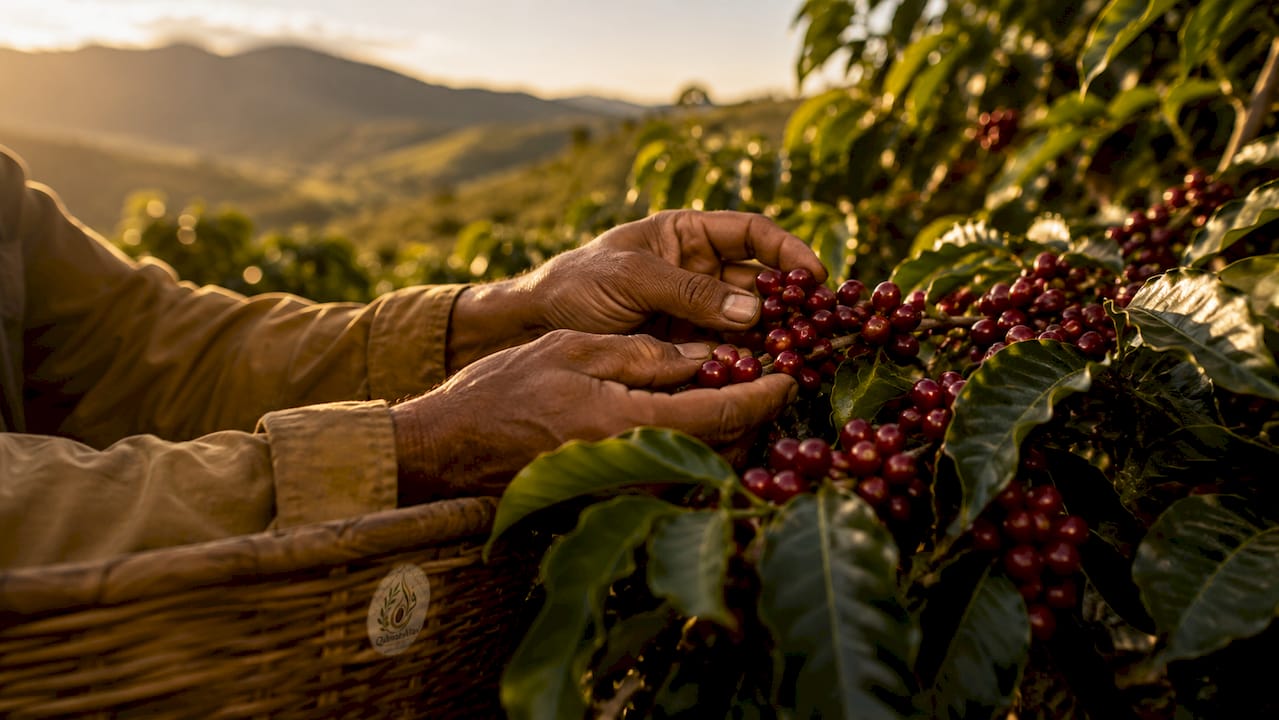
The process requires 3–4 passes per harvest season, spaced 7–14 days apart, so that every cherry is collected at its ideal moment. That spacing matters because coffee cherries on the same tree do not ripen at the same time. A single pass would force pickers to take whatever is available, mixing ripe and unripe fruit in the same batch.
Pickers rely on visual and tactile cues: color uniformity, firmness under light pressure, and the ease with which a cherry detaches from the stem. A ripe cherry releases cleanly. An unripe one resists. These small signals, learned through seasons of practice, are impossible to replicate with a machine.
- First pass: Remove the earliest ripe cherries to prevent overripening on the branch.
- Second pass: Collect the main harvest at peak ripeness across the majority of the tree.
- Third pass: Gather late-ripening cherries that needed more time on the branch.
- Fourth pass (when needed): Final sweep for any remaining ripe fruit before the season closes.
Pro Tip: Multiple passes do more than improve quality. They protect the health of the coffee plant by avoiding the physical stress of strip picking, which supports stronger yields in future seasons.
How does hand-picking affect coffee flavor and quality scores?
The flavor advantage of handpicked coffee comes directly from cherry chemistry. Ripe cherries retain higher natural sugar content and delicate aromatic oils that develop fully during the final weeks on the tree. Those compounds translate into the sweetness, brightness, and complexity that coffee enthusiasts recognize in a well-made specialty cup.
Unripe cherries tell a different story. They contain elevated levels of chlorogenic acid and unconverted starch, which produce harsh, astringent flavors that no roasting technique can fully mask. Overripe cherries introduce fermentation off-notes, often described as sour, vinegary, or musty. Both defect types degrade the cup in ways that are measurable and immediate.
The Specialty Coffee Association (SCA) cupping protocol quantifies this damage precisely. Including 10–15% defective cherries in a lot lowers its SCA cupping score by 2–5 points. That drop is enough to disqualify a coffee from specialty grade, which requires a minimum score of 80 out of 100. A coffee scoring 78 sells at commodity prices. A coffee scoring 83 commands a specialty premium.
“The quality advantage of handpicked coffee lies in preserving the bean’s natural sugar content and avoiding the harsh notes from unripe cherries. Selective harvesting is not a luxury practice. It is the foundation of every high-scoring specialty lot.”
- Clean cup: No fermentation taints, no astringency, no off-flavors from unripe fruit.
- Sweetness: Fully developed sugars create caramel, fruit, and chocolate notes.
- Brightness: Balanced acidity from ripe cherries, not the sharp sourness of underripe ones.
- Consistency: Uniform ripeness means predictable flavor across every batch.
After picking, flotation sorting removes any remaining subpar cherries by separating dense, ripe ones from hollow or fermented ones in water. This step reinforces the quality already established during selective picking. It does not replace it.
What are the economic realities of handpicked coffee?
Selective picking costs 3–5 times more per unit than mechanical harvesting. That gap reflects the labor intensity of multiple passes, the skill required to identify ripe cherries accurately, and the terrain where most specialty coffee grows. Steep hillsides in Ethiopia, Colombia, and Yemen cannot accommodate harvesting machinery, making hand labor the only option regardless of cost.
A skilled picker collects roughly 40–80 kg of cherries per day, depending on tree density and terrain. That output is modest compared to mechanical strip picking, which can process entire rows in a fraction of the time. Selective picking also reduces total yield by 25–35% per tree compared to strip picking, because unripe cherries are intentionally left behind to mature.
The economics work because the market rewards quality. Specialty coffee commands 50–100% price premiums above commodity prices. A farmer who produces a consistent 85-point lot earns significantly more per kilogram than one selling undifferentiated commodity beans. The yield loss from selective picking is offset by the price per unit that specialty buyers pay.
Labor-intensive hand-picking also supports rural farming communities by providing skilled employment with wages tied to cherry quality and weight. In regions where coffee farming is the primary economic activity, selective picking sustains livelihoods in ways that mechanization cannot.
Pro Tip: When you pay a premium for handpicked specialty coffee, you are not just buying better flavor. You are funding the labor model that makes quality coffee economically viable for small farmers.
Handpicked vs. machine-picked coffee: what actually changes?
The core difference between harvesting methods is selectivity. Mechanical strip picking and machine harvesting remove all cherries from a branch in a single pass, regardless of ripeness. The result is a mixed lot containing ripe, unripe, and overripe fruit that must be sorted after the fact.
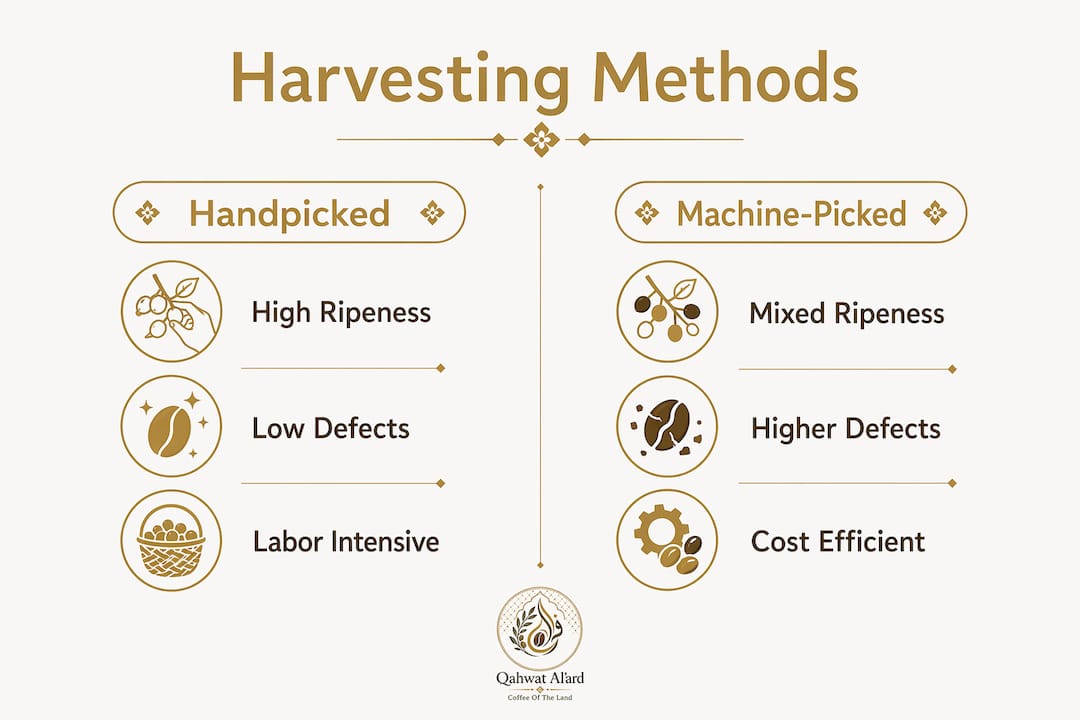
| Harvesting method | Ripeness control | Terrain suitability | Defect rate | Relative cost |
|---|---|---|---|---|
| Selective hand-picking | 85–95% ripe cherries | All terrain types | Very low | Highest |
| Strip picking by hand | Mixed ripeness | All terrain types | Moderate | Low |
| Mechanical harvesting | 60–75% ripe cherries | Flat terrain only | Higher | Lowest |
Machine harvesting collects 60–75% ripe cherries compared to 85–95% for selective hand-picking. That 15–35 percentage point gap in ripeness uniformity directly explains the flavor difference between commodity and specialty lots.
Post-harvest sorting methods, including flotation and density separation, reduce defects in mechanically harvested lots. They improve quality, but they cannot fully compensate for harvesting cherries before their sugars and aromatics have fully developed. A cherry picked too early will never taste like one that ripened completely on the tree.
- Mechanical harvesting works efficiently on flat terrain in Brazil and parts of Vietnam.
- Selective picking is the only viable method on steep slopes in Ethiopia, Yemen, and Central America.
- Strip picking by hand is faster than selective picking but produces lower quality than full selective harvesting.
- Post-harvest flotation helps all methods but adds the most value when combined with selective picking.
The coffee processing methods applied after harvest also interact with picking quality. A washed process amplifies the clean, bright notes that selective picking preserves. A natural process intensifies fruit character, which is most appealing when the cherries were fully ripe at harvest.
How does choosing handpicked coffee support sustainability?
Selective picking supports sustainable farming by preserving plant health and enabling ecological cultivation practices. When pickers take only ripe cherries, the tree continues to direct energy toward maturing the remaining fruit rather than recovering from physical damage. This approach maintains plant vigor across multiple seasons.
The sustainability benefits extend beyond the farm itself.
- Ecological health: Selective harvesting avoids the soil compaction and vegetation damage associated with mechanical equipment on fragile hillside farms.
- Farmer livelihoods: Skilled pickers earn wages based on cherry quality and weight, creating economic incentives aligned with quality production.
- Consumer awareness: Buying handpicked specialty coffee connects enthusiasts directly to the farming practices that produced their cup.
- Specialty coffee culture: The entire specialty coffee movement depends on manual harvesting to deliver the authentic, traceable flavors that distinguish specialty from conventional coffee.
Choosing handpicked specialty coffee supports a move away from commodity farming, benefiting ecological health and farmer livelihoods simultaneously. Every purchase of a traceable, selectively harvested lot reinforces the market signal that quality and ethics matter.
Key Takeaways
Handpicked coffee beans produce superior flavor because selective harvesting ensures only ripe cherries reach the roaster, reducing defects and preserving the natural sugars and aromatics that define specialty-grade coffee.
| Point | Details |
|---|---|
| Selective picking targets ripeness | Trained pickers collect 85–95% ripe cherries, compared to 60–75% from mechanical harvesting. |
| Defects lower SCA scores significantly | Including 10–15% defective cherries drops cupping scores by 2–5 points, risking specialty grade disqualification. |
| Premium pricing offsets higher costs | Handpicked specialty coffee commands 50–100% price premiums above commodity prices, making the labor cost viable. |
| Multiple passes are non-negotiable | Three to four harvest passes spaced 7–14 days apart are required to capture cherries at peak ripeness. |
| Sustainability runs through the supply chain | Selective picking protects plant health, supports rural wages, and reinforces the specialty coffee market. |
The flavor gap is real, and I’ve tasted it firsthand
I’ve cupped hundreds of coffees over the years, and the difference between a selectively handpicked lot and a mechanically harvested one is not subtle. It shows up immediately in the clean cup score. A well-picked Ethiopian natural has a clarity to its fruit notes that a strip-picked lot from the same region simply cannot match, even after flotation sorting.
What surprises most coffee lovers is how much the harvest decision shapes the roaster’s options. A roaster working with a high-quality selectively picked lot has room to develop complexity. A roaster working with a mixed-ripeness lot spends their energy trying to minimize damage. The ceiling on what a roaster can achieve is set at the farm, not the roastery.
The economic argument for handpicked coffee also holds up when you look at it honestly. Paying a premium for a single-origin specialty lot is not indulgence. It is the price of a system that compensates farmers fairly, protects the land, and delivers a cup worth drinking. Commodity coffee is cheap because someone, somewhere, absorbed a cost that the price did not cover.
My honest recommendation: seek out coffees that name the harvest method on the bag. Producers proud of selective picking say so. That transparency is itself a quality signal.
— Anthony-Yasin
Qahwatalard’s handpicked coffee collection
Qahwatalard sources its coffees from farms where selective hand-picking is standard practice, not a marketing claim. Every lot is chosen for traceability, ripeness at harvest, and cup quality.
The single-origin collection includes selectively harvested beans from regions where hand-picking is the only viable method, including high-altitude farms in Peru and Bali. For everyday convenience without sacrificing quality, the Peru Coffee Pods and 60-pack single-serve pods deliver handpicked specialty coffee in a format that fits any morning. Each product reflects Qahwatalard’s commitment to authentic sourcing and the craft behind every cherry.
FAQ
What makes handpicked coffee beans better than machine-picked?
Selective hand-picking collects 85–95% ripe cherries, compared to 60–75% from mechanical harvesting. That higher ripeness uniformity preserves natural sugars and aromatics, producing a cleaner, more complex cup.
How many times do pickers harvest the same coffee tree?
Selective picking requires 3–4 passes per harvest season, spaced 7–14 days apart, to collect cherries only at peak ripeness. Each pass targets the fruit that has matured since the previous visit.
Does handpicked coffee score higher on SCA cupping evaluations?
Yes. Including 10–15% defective or unripe cherries in a lot lowers its SCA cupping score by 2–5 points, which can disqualify it from specialty grade. Selective picking minimizes defects and supports consistently higher scores.
Why does handpicked coffee cost more?
Selective picking costs 3–5 times more per unit than mechanical harvesting due to labor intensity and multiple passes. Specialty price premiums of 50–100% above commodity prices offset those costs for farmers who produce consistently high-quality lots.
Is handpicked coffee better for the environment?
Selective picking preserves plant health by avoiding the physical stress of strip harvesting, supports long-term farm sustainability, and eliminates the soil compaction caused by mechanical equipment on hillside farms.


