


Panama Geisha coffee is a rare coffee variety, genetically traced to the T2722 accession, prized for a floral, jasmine, and bergamot cup unlike almost anything else in specialty coffee. It commands premium prices because true Panamanian Geisha lots are scarce, labor-intensive to grow at altitude, and have set record auction figures that shape the variety’s reputation even though most buyers never pay anywhere close to those numbers. If you’re curious but haven’t tried it, don’t start with a full bag.
Start smaller. Here’s the move:
- Buy a traceable sample (50 to 100 grams) from a roaster who names the farm, lot, and harvest year
- Look specifically for a light roast profile, since heavier roasting tends to bury the floral notes that make Geisha worth the money
- Treat your first cup as a baseline. Everything you learn about brewing it well comes after that first honest taste
Key Takeaways
Panama Geisha coffee earns its price through genetic rarity, high-altitude terroir, and roast-sensitive floral aromatics that most other Arabica varieties simply don’t produce.
| Point | Details |
|---|---|
| Confirm the genetics | Look for T2722 or CATIE accession references before trusting any “Geisha” label. |
| Buy small first | Start with a 50 to 250 gram sample before committing to a full bag of an unfamiliar lot. |
| Roast level changes everything | Lighter, slower roasts preserve floral and bergamot notes; aggressive roasts can push the cup toward medicinal or fermented flavors. |
| Brew gently | Use a 1:16 to 1:17 ratio, water near 195 to 200°F, and a slow pour to protect delicate aromatics. |
| Shop for traceability | Qahwat Al’Ard offers fresh-roasted, farm-traceable small lots and sample sizes suited to trying rare coffees like Geisha. |
Table of Contents
- How to Choose a Panama Geisha Coffee Worth Buying
- Where Panama Geisha Coffee Comes From and What It Tastes Like
- Does Roasting Really Change How Panama Geisha Tastes?
- What’s the Best Way to Brew Panama Geisha Coffee?
- How Much Does Panama Geisha Coffee Cost?
- How Do You Verify a Panama Geisha Claim Before Buying?
- What Makes Qahwat Al’Ard a Reliable Source for Panama Geisha
- Why the Hype Around Panama Geisha Misses the Point
- Ready to Try Panama Geisha for Yourself
- Sources
- FAQ
How to Choose a Panama Geisha Coffee Worth Buying
Not everything labeled “Geisha” delivers the cup people talk about. The variety has spread widely enough that plenty of average lots ride the name without the genetics or growing conditions to back it up. Here’s what actually separates a serious purchase from a marketing label.
- Check for accession or cultivar documentation. A product page or bag that references T2722 or CATIE distribution is telling you something specific: this coffee traces back to the genetic line associated with the classic Panamanian expression. If a listing just says “Geisha” with no lineage detail, treat that as a yellow flag, not a dealbreaker.
- Demand farm and lot-level data. A real micro-lot names the farm, the specific lot number, and the harvest year. Vague sourcing (“Panama origin”) usually means blended or lower-grade material riding the Geisha name.
- Decide what processing style you want. Washed lots tend to show cleaner, more precise florals and citrus. Natural-processed lots push toward riper fruit and heavier body, sometimes at the cost of that signature clarity. Read up on processing methods before you decide which direction fits your taste.
- Look at the cupping score and the price together. Legitimate micro-lot Geisha rarely shows up at bargain prices. If a bag claims an 88+ score at a price that undercuts every other specialty roaster by half, something doesn’t add up.
- Buy small before you buy big. A 50 to 250 gram sample lets you evaluate a specific lot without betting $60 or more on a coffee you’ve never tasted.
Pro Tip: Order two competing Geisha lots at once, same size, and cup them side by side. The differences in aroma and finish will teach you more about what “Geisha character” actually means than any tasting note on a bag ever could.
Roast date matters just as much as origin. A Panama Geisha roasted six weeks ago, no matter how good the lot, will taste flatter and duller than a fresher roast of a slightly less prestigious farm. Always check for a roast date printed on the bag, not just a “best by” window.
Where Panama Geisha Coffee Comes From and What It Tastes Like
Panama Geisha traces its roots to Ethiopia, where the variety grew wild for generations before making its way through Kenya, Costa Rica’s CATIE research station, and eventually into Panama’s Boquete highlands in the 1960s. It stayed largely unnoticed for decades. Then Hacienda La Esmeralda entered a lot in the Best of Panama competition in 2004, and the coffee world took notice almost overnight.
The genetic identifier behind that lineage is accession T2722, distributed through CATIE, and it’s the reason serious buyers now look for that specific code rather than trusting the name “Geisha” alone. Plenty of coffee sold under that name today isn’t genetically identical to what put Boquete on the map.
What should you expect in the cup? The classic profile includes:
- Jasmine and floral top notes, often the first thing you notice on the aroma
- Bergamot and citrus brightness that carries through the cup
- Peach or stone-fruit sweetness in the mid-palate
- A long, clean, tea-like finish rather than the heavier body of a typical washed Arabica
Elevation plays a direct role here. Boquete’s Geisha farms sit around 1,450 to 1,700 meters, and that altitude, combined with cool nights and volcanic soil, slows cherry development enough to concentrate the aromatic compounds that give the variety its signature lift. Lower-altitude Geisha exists, but it rarely reaches the same intensity.
One naming quirk worth knowing: you’ll see the variety spelled both “Geisha” and “Gesha” across different farms and roasters, sometimes on the same shelf. Both refer to the same coffee), and neither spelling tells you anything about quality. The T2722 reference is what actually confirms genetic identity. If a listing skips that detail entirely, the spelling isn’t going to save you.
Does Roasting Really Change How Panama Geisha Tastes?
Yes, dramatically. This isn’t a case where roast level is a matter of preference with no real consequence. Controlled sensory and chemical analysis found that specific roast treatments preserved higher concentrations of linalool and geraniol, the aromatic compounds behind Geisha’s floral and bergamot character, while other roast approaches on the exact same green coffee produced medicinal or fermented flavors instead, according to research published on PubMed.
That’s a striking finding for anyone who assumes a great lot will taste great no matter how it’s handled after purchase. It won’t. The same beans, roasted two different ways, can land in completely different flavor categories.
Roast treatments that ran gentler and preserved more of the bean’s volatile aromatic compounds consistently scored higher for floral and bergamot character in blind sensory panels, while more aggressive roast profiles pushed the same green coffee toward medicinal and fermented notes instead.
A few practical patterns emerge from that research:
- Lighter, slower roast curves tend to protect the floral top notes that define the variety
- Faster, hotter roasts risk scorching away the delicate terpenes before they can develop
- Washed processing generally supports cleaner, more defined florals, while natural processing shifts the profile toward fruit and body, sometimes muting the jasmine notes buyers pay for
If you’re buying from a roaster who publishes their roast approach or offers sample roasts, ask. A roaster willing to talk specifics about their roast target for a Geisha lot is signaling they understand what’s actually at stake in that decision.
What’s the Best Way to Brew Panama Geisha Coffee?
Geisha beans are unusually low-density, which means they extract faster and scorch more easily than a typical Arabica. Brew it like a heavier bean and you’ll pull out bitterness that buries the floral notes you paid for, a point World Coffee Research backs up in describing the variety’s brewing sensitivity.
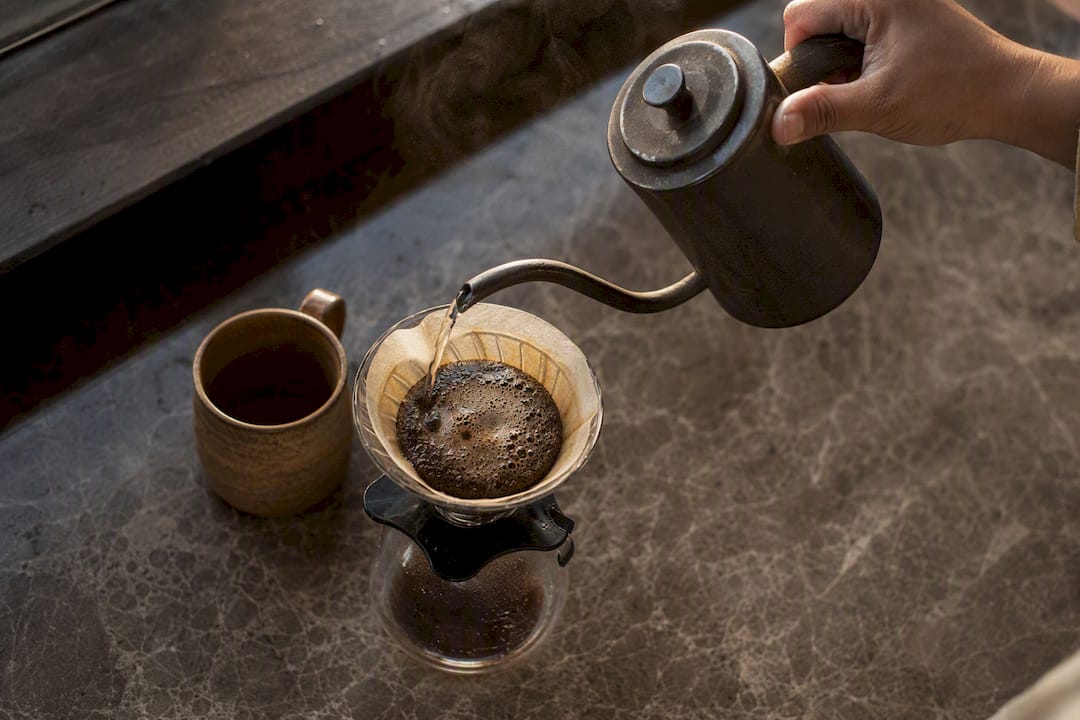
Pour-over is the most reliable method for showing off what makes this coffee worth drinking. A slow, controlled pour gives you even extraction without the turbulence that can push extraction too far. Aeropress works well too, especially with a gentler, lower-pressure recipe rather than a hard full plunge. If you’re set on espresso, dial back the dose slightly and expect a lighter, more tea-like shot rather than a syrupy one; Geisha rarely rewards a traditional ristretto approach.
A few parameters to start from:
- Ratio: 1:16 to 1:17 (coffee to water by weight) for pour-over, leaning toward the lighter side for delicate lots
- Water temperature: aim for 195 to 205°F, and lean toward the cooler end of that range since floral terpenes are volatile and break down faster at higher heat
- Grind size: medium-fine for pour-over, slightly coarser than you’d use for a dense washed Colombian
- Pour technique: slow, steady, center-out spiral pours rather than one aggressive dump
Pro Tip: Grind your Geisha immediately before brewing, not the night before. Those aromatic compounds start dissipating the moment the bean is cracked open, so even a few hours of pre-ground storage costs you real aroma.
For a simple 250 ml pour-over: bring water to 200°F, bloom 15 grams of coffee with 45 grams of water for 30 seconds, then pour the remaining water in two or three slow stages over the next two minutes, aiming for a total brew time around 2:30 to 3:00.
How Much Does Panama Geisha Coffee Cost?
Auction headlines and retail reality are two different markets, and mixing them up leads to disappointment. Recent auction coverage has reported Panamanian Geisha lots selling for multi-thousand-dollar-per-kilogram figures, numbers that make headlines precisely because they’re extraordinary, not typical.
Those record lots are usually competition-grade, sold in tiny quantities to roasters and collectors who then resell in gram-level portions, not retail bags. What you’ll actually encounter as a specialty buyer looks different:
- Retail micro-lot Geisha commonly runs well above standard specialty coffee pricing per bag, reflecting real scarcity without touching auction territory
- Sample sizes (50 to 100 grams) offer a lower-cost way to taste a specific lot before committing to a full bag
- Subscriptions or limited seasonal releases are often the most reliable way to catch Geisha lots when they’re actually in stock, since availability tends to be tight and seasonal
Auction records do matter as a signal, though. They tell you which farms are producing exceptional quality that year, which is useful intelligence even if you never bid on the lot yourself. Qahwat Al’Ard tracks that kind of provenance closely and focuses on offering traceable small lots and sample formats, which is the more realistic entry point for most enthusiasts curious about this variety rather than chasing the auction number itself.
How Do You Verify a Panama Geisha Claim Before Buying?
The word “Geisha” alone guarantees nothing. Here’s a fast checklist to run before you commit money to a listing:
- Farm name and location. A real lot names the specific farm, not just “Panama” or “Boquete region.”
- Lot code or batch identifier. This lets a roaster trace the coffee back to a specific harvest and processing run.
- Harvest year. Coffee is a seasonal product. If a listing doesn’t state the harvest year, ask before buying.
- Roast date. This should be printed on the bag or listed on the product page, not buried in fine print.
- Processing method. Washed, natural, or honey, stated clearly rather than left out.
- Cultivar reference. Mention of T2722 or CATIE distribution is the strongest single signal of genetic authenticity.
Pro Tip: If a product page can’t answer where the coffee was grown, when it was harvested, and how it was processed, walk away regardless of how good the marketing copy sounds.
Common red flags worth knowing: vague country-level sourcing dressed up with flowery language, cupping scores stated without any note of who scored the lot or when, and prices that sit dramatically below every comparable micro-lot on the market. Genuine traceability documentation is the difference between buying a story and buying a coffee.
What Makes Qahwat Al’Ard a Reliable Source for Panama Geisha
Qahwat Al’Ard built its catalog around full traceability, sourcing single-origin coffees from growing regions including Colombia, Peru, Bali, and Uganda with farm-level documentation attached to every listing on Qahwatalard. That same standard applies to rare, high-value lots like Panama Geisha, where provenance is the entire point of the purchase.
Here’s what that looks like in practice:
- Every listing roasts fresh to order, so the beans on your doorstep were never sitting in a warehouse for months before shipping
- Product pages document origin and sourcing details rather than relying on generic marketing language
- Educational resources, including a guide to rare coffee-growing regions, give buyers context on why a specific origin matters before they spend money on it
- Sample and limited-release formats give enthusiasts a lower-risk way to try a rare lot before committing to a full bag
If you’re browsing for Geisha or other limited micro-lots, check the site regularly. Rare lots move fast, and Qahwat Al’Ard rotates limited offerings as new harvests and small batches become available.
Why the Hype Around Panama Geisha Misses the Point
Most coverage of Panama Geisha fixates on auction numbers, and that’s the wrong lesson to take from this coffee. The auction record tells you which farm had an exceptional harvest that year. It tells you nothing about whether the $28 sample bag on a specialty site will taste like jasmine and bergamot or like a flat, generic light roast riding a famous name.
The conventional advice, “just buy Geisha, it’s supposed to be amazing,” skips the two variables that actually determine whether you get that experience: genetic authenticity and roast handling. A coffee genetically identical to the record-setting lot can still taste mediocre if it’s roasted wrong. That’s not a minor caveat. It’s arguably the whole story, and it’s the part nobody puts in the headline.
If you’re new to this variety, prioritize documentation over prestige. A traceable T2722 sample from a careful roaster will teach you more about why people obsess over Geisha than a vague “Panama origin” bag ever will, no matter how the price tag compares.
Ready to Try Panama Geisha for Yourself
Qahwat Al’Ard exists for exactly the reader who just finished this guide: someone who wants a traceable, fresh-roasted specialty coffee without gambling on a vague listing or an unverifiable “Geisha” label. Every product page documents origin and sourcing details rather than leaning on marketing language, and beans roast fresh to order instead of sitting in warehouse stock for months.
While you’re browsing, the Mexico coffee pods offer an easy way to explore a different traceable origin in a lower-commitment format, and coffee-inspired pieces like Pecan Pie and Peach Paradise make solid additions to an order or a gift for the coffee obsessive in your life. Start by browsing current single-origin listings and sample sizes, and check back regularly since rare micro-lots rotate as new harvests come in.
Sources
- World Coffee Research | geisha, panama
- Characterizing Panama Geisha coffee aromas: sensory and chemical analysis across roasting methods - PubMed
- Panama’s Geisha Coffee Sets A Record Price. Its Source Is Worth A Trip - Forbes
FAQ
What is Panamanian Geisha coffee?
Panamanian Geisha is a coffee variety with genetic roots in Ethiopia, distributed under the accession T2722 through CATIE, grown at high altitude in Panama’s Boquete region and known for a floral, jasmine, and bergamot cup profile.
What makes Geisha coffee so distinctive?
Its combination of high-altitude terroir and a genetically distinct lineage produces jasmine, bergamot, and peach-like notes with a long, tea-like finish, a profile that research and sensory analysis confirm depends heavily on both genetics and roast handling.
Why is Geisha coffee so expensive?
Scarcity, labor-intensive high-altitude farming, and standout performances at competitions like Best of Panama have driven demand far past supply, with some competition lots reaching multi-thousand-dollar-per-kilogram auction prices that set the variety’s reputation.
How much does Geisha coffee cost in Panama?
Auction-grade competition lots have sold for record-setting, multi-thousand-dollar-per-kilogram prices, but typical retail micro-lot bags of traceable Panama Geisha cost far less, usually priced well above standard specialty coffee but nowhere near auction extremes.
Where can I buy a traceable Panama Geisha sample?
Look for roasters who publish farm, lot, and harvest data alongside a clear roast date. Qahwat Al’Ard offers fresh-roasted, traceable single-origin coffees with sample formats suited to trying a rare variety before buying a full bag.


