


TL;DR:
- Coffee’s aroma mainly comes from roasting-created compounds, CO2 outgassing, and grinding, with sulfur thiols defining its signature smell. The release of these volatiles peaks shortly after roasting and grinding, but they dissipate quickly, making freshness and timing crucial. Proper storage, fresh roast dates, and immediate grinding maximize the pre-brew aroma’s intensity.
Roasted coffee beans are packed with hundreds of volatile aromatic compounds, and they start escaping the moment roasting ends. The three mechanisms driving that irresistible pre-brew scent are roasting-created volatiles, CO2 outgassing, and the mechanical release triggered by grinding.
- Roasting-created volatiles: The Maillard reaction and caramelization generate over 800 aromatic compounds during roast, many of them highly volatile at room temperature.
- CO2 outgassing: Roasting traps CO2 inside the bean matrix; as it slowly escapes, it carries dissolved aromatic molecules with it into the surrounding air.
- Grinding: Fracturing the bean’s cell walls releases a sudden, concentrated burst of volatiles, which is why freshly ground coffee smells so much more intense than whole beans.
One compound captures this better than any other: 2-furfurylthiol (2-FFT), a sulfur compound with an odor threshold around 0.01 ppb. At concentrations barely detectable by instruments, your nose locks onto it immediately. That is why coffee smells like coffee before a single drop of water touches the grounds. Much of what we perceive as coffee flavor is actually aroma detected by the olfactory system, not taste on the tongue.
Table of Contents
- Why does coffee smell before brewing? The roasting chemistry
- How grinding and degassing release the aroma
- Why dry grounds smell different from a hot cup
- Why does my coffee smell bad when brewing?
- What factors change how strongly your coffee smells before brewing
- How to get the best pre-brew aroma at home
- The science behind sulfur thiols and why they define coffee smell
- Key Takeaways
- The trade-off most coffee drinkers miss
- Where to find beans that actually smell this good
- Useful sources
- FAQ
Why does coffee smell before brewing? The roasting chemistry
Roasting transforms green beans, which have almost no characteristic coffee scent, into the aromatic product you recognize. The roasting process runs through three phases: an initial drying phase, a pyrolytic roasting phase where most aroma compounds form, and a rapid cooling phase. The critical chemistry happens in the middle phase, roughly between 190°C and 220°C.
| Sulfur thiols (e.g., 2-FFT) | Roasty, sulfurous, “coffee” | Character-impact; define the classic scent | | Pyrazines | Nutty, earthy, roasted | Backbone of roasted depth | | Furans / furanones | Caramel, sweet, bready | Sweetness and body notes | | Strecker aldehydes | Malty, chocolate, green | Complexity and depth | | Phenolics | Smoky, spicy, clove-like | Darker roast character |
The Maillard reaction between amino acids and reducing sugars produces most of these classes. Caramelization of sucrose adds the furanones. Sulfur amino acids like cysteine and methionine break down into the thiols that define the roasty top note. After roasting, most of these compounds stay trapped inside the bean’s cell matrix. The bean structure holds them in, which is why a sealed bag of whole beans releases aroma slowly rather than all at once.
How grinding and degassing release the aroma
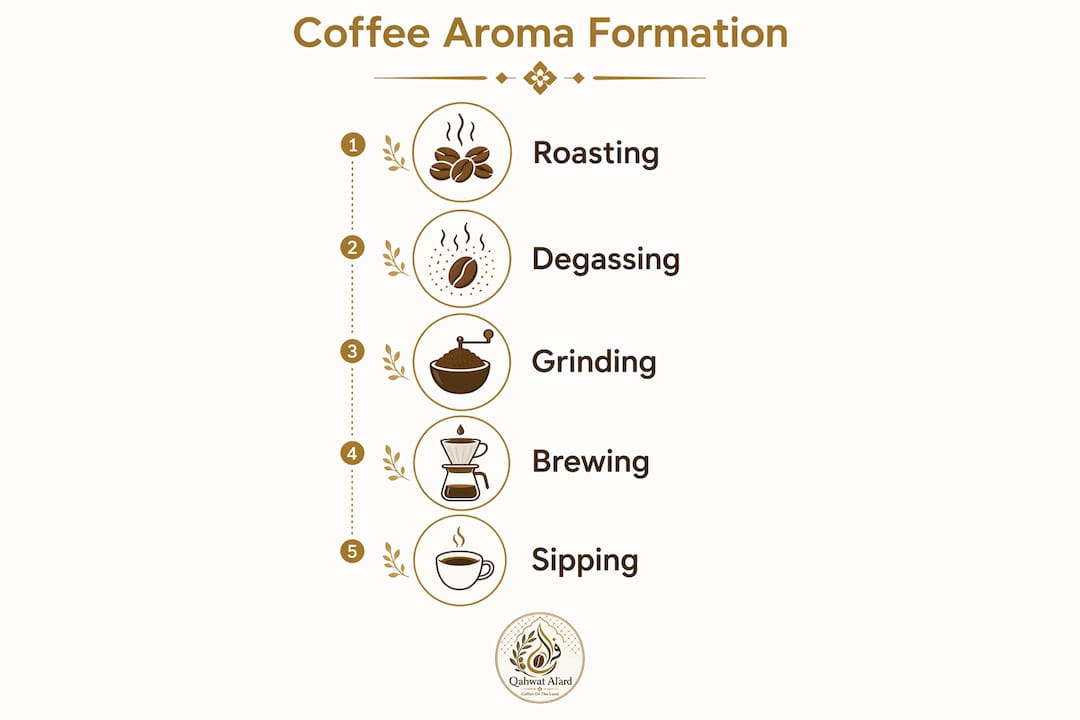
CO2 is the engine behind coffee degassing. During roasting, pyrolysis generates large volumes of CO2 that become trapped in the bean’s porous structure. After the roast ends, that gas begins migrating outward, and it does not travel alone. Dissolved volatile aromatics hitch a ride, which is why a freshly roasted bag smells stronger as days pass and outgassing peaks.
The degassing timeline matters practically:
- Minutes after roast: Rapid initial CO2 release; aroma is intense but somewhat raw.
- Hours to 2–3 days: Outgassing slows; volatile compounds reach peak concentration near the bean surface.
- 4–14 days post-roast: Optimal window for most brewing methods; aroma is fullest and most complex.
- Beyond 3–4 weeks: Volatiles deplete faster than CO2; aroma fades noticeably.
Grinding collapses this timeline dramatically. Fracturing the cell walls releases a concentrated burst of volatiles in seconds, which is why the smell of fresh grounds hits you so hard. It also accelerates staling: once those cells are open, oxidation begins immediately. Grinding just before brewing captures the peak of that burst rather than letting it dissipate into the air.
Pro Tip: Sniff the grounds within 30 seconds of grinding. That window is when sulfur thiols are most concentrated and the aroma is truest to the bean’s character.
Why dry grounds smell different from a hot cup
The same bag of coffee can smell roasty and sulfurous as dry grounds, then shift to caramel and fruit in the cup, then turn flat and papery as it cools. Temperature and volatility explain all three states.
Volatility describes how readily a compound escapes into the air. Compounds with low boiling points and high vapor pressure evaporate at room temperature, which is why you smell coffee grounds without heating them. Sulfur thiols like 2-FFT are among the most volatile and have the lowest odor thresholds, so they dominate the dry-ground aroma. Heavier phenolic and furanone compounds need heat to volatilize fully, which is why a hot cup smells richer and more layered.
Key insight from aroma research: Aroma is dynamic. Different compounds volatilize at different temperatures, so the dominant scent shifts from dry grounds to the bloom stage to a cooling cup. What you smell at each stage is a different chemical snapshot of the same bean.
There is also a perceptual dimension. Orthonasal olfaction is smelling through the front of your nose, what you do when you sniff grounds. Retronasal olfaction is the aroma that travels up the back of your throat while you drink, which is what most people call “flavor.” A hot cup engages both pathways simultaneously, which is why it tastes more complex than it smells from a distance.
Studies tracking thiol loss show that roughly 84% of 2-FFT and 72% of methanethiol disappear within 60 minutes at serving temperature. That is not just evaporation. Melanoidins, the brown polymers formed during roasting, chemically bind and sequester thiols as the brew sits. Reheating does not reverse this, which is why day-old coffee smells flat no matter how hot you make it.
Why does my coffee smell bad when brewing?
An unpleasant smell during brewing is almost always diagnostic. The character of the off-smell points directly to the cause.
- Musty or moldy: Beans stored in humid conditions or processed with defects; check for visible moisture damage on the bag.
- Rancid or greasy: Oxidized oils from stale beans or from dirty equipment with old oil residue; clean your grinder burrs and brew basket.
- Sour or vinegary: Over-fermented processing defects or under-extracted brewing; try a coarser grind or shorter contact time.
- Chemical or plastic: Contamination from equipment, water, or storage containers; run a cleaning cycle and check your water source.
- Flat or papery: Stale beans past their prime; check the roast date.
The fastest fix is to clean your equipment first, then check the roast date on your bag. If the beans are fresh and the gear is clean, the water is the next variable. Chlorinated tap water can suppress and distort aroma compounds noticeably.
What factors change how strongly your coffee smells before brewing
Several variables determine pre-brew aroma intensity, and most of them are within your control.
Roast date is the single biggest factor. Volatile compounds deplete over time; beans roasted within the past two weeks smell dramatically more intense than beans roasted two months ago. Look for a printed roast date, not a “best by” date, on any bag you buy.
Roast level shifts the aromatic profile. Light roasts preserve more of the origin-derived floral and fruit compounds. Dark roasts drive off those delicate notes and replace them with pyrazine-heavy, smoky, and phenolic compounds. Neither is objectively stronger, but they smell distinctly different.
Whole bean vs. pre-ground is straightforward: whole beans retain volatiles until you grind them. Pre-ground coffee begins losing its most volatile compounds the moment the bag is opened, sometimes before.
Origin and processing shape which aromatic families are present. Natural-processed coffees, where the fruit dries on the bean, tend to carry more fruity esters and fermentation-derived compounds. Washed coffees smell cleaner and more floral. Origin and terroir determine the aromatic precursors available before roasting even begins.
Storage and packaging matter more than most people realize. Oxygen, light, heat, and moisture all accelerate volatile loss. Bags with one-way degassing valves protect beans far better than resealable zip-locks because they let CO2 out without letting oxygen in.
Grind size affects surface area. A finer grind exposes more cell surface and releases more volatiles faster, which is why espresso grounds smell intense but stale quickly.
How to get the best pre-brew aroma at home
- Buy beans with a printed roast date and aim to brew them within 2–4 weeks of that date.
- Store whole beans in an airtight container away from heat, light, and strong odors. A ceramic canister with a rubber seal beats a clear glass jar on a sunny counter.
- Grind immediately before brewing. Even 15 minutes between grinding and brewing allows measurable thiol loss.
- Clean your grinder and brewer regularly. Old coffee oils go rancid and contaminate fresh beans.
- Use filtered water. Chlorine and mineral imbalances suppress aroma compounds in the cup.
- For the bloom effect, pour a small amount of hot water over grounds first and wait 30 seconds; the CO2 bloom releases a concentrated aroma burst before full extraction begins.
- Paper vs. metal filter: Paper filters absorb some aromatic oils; metal filters let them through, producing a heavier-bodied, more aromatic cup.
- Cold brew extracts a different volatile profile. GC–MS analysis shows cold brew contains fewer total volatiles than hot-brewed coffee, with a smoother, less sulfurous aroma.
Pro Tip: After opening a fresh bag, press out the air, reseal it, and sniff through the one-way valve 30 seconds later. The concentrated CO2 stream carries the most accurate preview of the bean’s aromatic character.
The science behind sulfur thiols and why they define coffee smell
The reason coffee smells so distinctly like coffee and not like any other roasted food comes down to a handful of sulfur compounds present in concentrations measured in parts per trillion.
2-furfurylthiol forms during the Maillard reaction when furfural, a furan aldehyde, reacts with hydrogen sulfide released from cysteine degradation. Its odor threshold sits around 0.01 ppb, orders of magnitude lower than most other volatiles. Methanethiol, another key thiol, forms from methionine degradation and carries a sharp, sulfurous note that signals freshness at low concentrations and becomes unpleasant at high ones.
From flavor chemistry research: “Aroma freshness of whole roasted coffee is mainly determined by certain low-boiling components, namely low-molecular-weight sulfur compounds, Strecker aldehydes, and α-dicarbonyls. The loss of aroma freshness was due to the loss of certain aroma impact volatiles, mainly methanethiol.” — Coffee Flavour: An Overview (Flavour and Fragrance Journal, 2004)
Flavor chemists use Gas Chromatography–Mass Spectrometry (GC–MS) to identify which compounds are present, then calculate Odor Activity Values (OAVs) by dividing each compound’s concentration by its odor threshold. A compound with an OAV above 1 contributes to perceived aroma; 2-FFT routinely scores among the highest OAVs in roasted coffee despite being present in tiny amounts. This is why human sensitivity to sulfur compounds is so relevant: evolutionary hypersensitivity to sulfur odorants means your nose detects them at concentrations that instruments struggle to measure.
The loss mechanism after brewing is twofold: evaporation at serving temperature removes the most volatile thiols within minutes, and melanoidin conjugation chemically binds the rest. Together, these explain the rapid thiol loss of roughly 84% of 2-FFT within 60 minutes, and why no amount of reheating restores the original aroma.
Key Takeaways
Roasting creates the volatile compounds that give coffee its aroma, CO2 and grinding release them, and sulfur thiols at trace concentrations define the classic scent, but they evaporate fast, making freshness and grind timing the two variables that matter most.
| Point | Details |
|---|---|
| Roasting builds the aroma | Maillard reactions and caramelization generate many volatile compounds; green beans have almost none. |
| CO2 carries the scent | Outgassing CO2 transports dissolved aromatics from inside the bean into the air over hours to days. |
| Sulfur thiols define “coffee smell” | 2-FFT has an odor threshold of ~0.01 ppb; roughly 84% of it disappears within 60 minutes after brewing. |
| Grind timing is critical | Grinding immediately before brewing captures the peak volatile burst before oxidation depletes it. |
| Qahwat Al’Ard for fresh-roasted beans | Qahwat Al’Ard labels roast dates and uses degassing-valve packaging to protect volatile compounds until you brew. |
The trade-off most coffee drinkers miss
There is a persistent idea that darker roasts smell stronger, and therefore must be fresher or better. The chemistry says otherwise. Dark roasts do produce more pyrazines and phenolics, which are assertive and easy to detect. But they also drive off the sulfur thiols and Strecker aldehydes that make a coffee smell alive rather than just roasted. A light-to-medium roast from a high-altitude single-origin, brewed within two weeks of roast, will often smell more complex and more interesting than a dark roast of the same age, even if the dark roast smells louder.
The other thing worth saying plainly: packaging matters as much as the roast itself. A beautifully roasted bean stored in a non-valve bag for three weeks has already lost most of what made it special. Roast date labeling and one-way valve packaging are not marketing details; they are the difference between buying a live product and buying a memory of one.
Where to find beans that actually smell this good
Fresh-roasted, single-origin beans with a printed roast date and proper valve packaging are what deliver the pre-brew aroma this article describes. Qahwat Al’Ard sources traceable beans from renowned growing regions and ships them with roast dates clearly labeled, so you know exactly where you are in the freshness window.
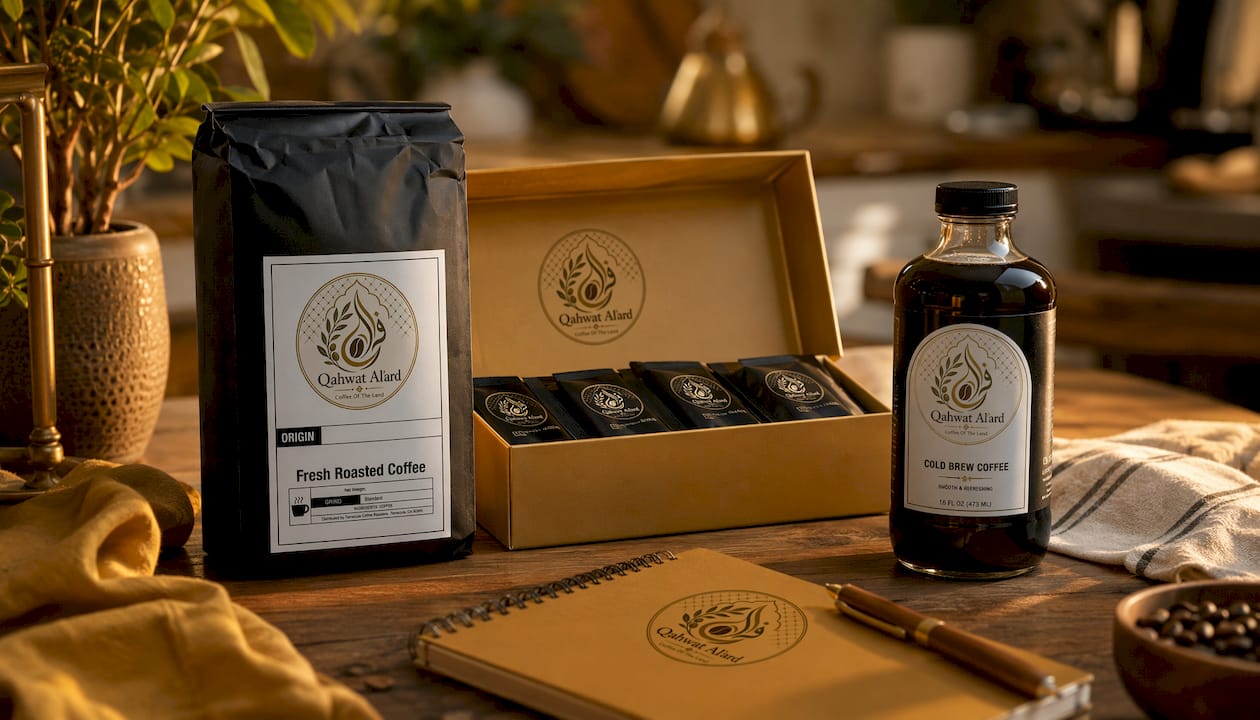
If you want to compare aromatic profiles across roast levels and origins without committing to a full bag, the Flavored Coffees Sample Pack lets you smell and taste multiple profiles side by side. For a different sensory experience, the Cold Brew Coffee option demonstrates how cold extraction produces a smoother, less sulfurous aroma than hot brewing, which is useful context if you have been wondering why your cold brew smells milder. Both products ship with freshness packaging designed to protect volatile compounds in transit. Check the roast date when your order arrives and grind before you brew.
Useful sources
- Coffee Flavour: An Overview — Flavour and Fragrance Journal, 2004. Comprehensive peer-reviewed overview of roasting chemistry, volatile compound classes, and aroma freshness indicators including methanethiol as a freshness marker.
- Frontiers in Nutrition — sulfur compounds and human olfaction — Review article on evolutionary sensitivity to sulfur odorants and their outsized role in food aroma perception.
- JayArr Deep Brew — Flavor Volatiles and OAV Guide — Practical synthesis of GC–MS data, OAV methodology, and thiol loss figures after brewing; useful for understanding which compounds matter most.
- Elsevier — roast outgassing and bean structure — Study on CO2 outgassing mechanics and how bean cell structure controls volatile release timing.
- doi.org — 2-furfurylthiol formation and activity — Primary research on 2-FFT formation pathways via Maillard chemistry and its extraordinarily low odor threshold.
- Elsevier — rapid loss of volatile thiols after brewing — Documents the evaporation and melanoidin-conjugation mechanisms responsible for fast thiol depletion in brewed coffee.
FAQ
Why does coffee smell so strong before you brew it?
Roasted beans contain hundreds of volatile aromatic compounds, including sulfur thiols with odor thresholds as low as 0.01 ppb. CO2 outgassing and grinding both release these compounds into the air before any water is involved.
Why does my coffee smell bad when brewing?
The most common causes are stale beans with oxidized oils, dirty equipment with rancid residue, or water quality issues. Clean your grinder and brewer, check the roast date on your bag, and try filtered water.
Does smelling coffee actually mean anything about freshness?
Yes. A strong, complex pre-brew aroma, particularly the roasty sulfurous note from thiols, indicates that volatile compounds are still present and the beans are relatively fresh. A flat or papery smell usually means significant volatile depletion has already occurred.
Why does cold brew smell milder than hot-brewed coffee?
Cold water extracts fewer total volatile compounds than hot water. GC–MS studies confirm that cold brew contains a narrower volatile profile, with less of the sulfurous thiol character that defines the classic hot-coffee scent.
Does grinding affect how coffee smells before brewing?
Grinding ruptures the bean’s cell walls and releases a concentrated burst of volatiles in seconds. Grinding immediately before brewing captures that peak aroma; pre-ground coffee loses its most volatile compounds quickly once the bag is opened.


