


Aim for 195–205°F (90–96°C) for most hot-brew methods. That range, recommended by the National Coffee Association as the industry standard, gives water enough energy to pull the full spectrum of sugars, acids, and aromatics without scorching them. Here are the quick starting points by method:
- Pour-over: 200–205°F (93–96°C) — start high to offset heat loss during the pour
- Drip machine: 195–205°F (90–96°C) — most quality machines hit this automatically
- French press: 195–200°F (90–93°C)
- AeroPress: 175–205°F (79–96°C) — widest flexibility; experiment freely
- Espresso: 190–196°F (88–91°C) — machine-controlled; consult your machine’s settings
- Cold brew: Room temperature or cold water, 12–24 hours — no heat needed
- Turkish coffee: 160–170°F (71–77°C) — low and slow, never a full boil
Go hotter for light roasts and denser beans. Drop a few degrees for dark roasts or when your tap water has a higher mineral content.
Key Takeaways
The single most reliable rule for coffee water temperature is to start at 200°F, adjust by roast and water chemistry, and change only one variable per brew until the cup is balanced.
| Point | Details |
|---|---|
| Default brewing range | 195–205°F (90–96°C) is the NCA/SCA standard for most hot-brew methods. |
| Roast-based adjustment | Use 200–205°F for light roasts; drop to 195–198°F for dark roasts to avoid bitterness. |
| Water chemistry matters | TDS above 200–300 ppm amplifies bitterness; lower temperature and check alkalinity. |
| Preheat your equipment | Rinsing your dripper or carafe with hot water recovers up to 5°F of effective brew temperature. |
| Qahwat Al’Ard single-origin | Single-origin beans from distinct regions give you a controlled subject for temperature experiments. |
Table of Contents
- How coffee water temperature shapes what you taste
- Recommended temperatures by brewing method
- How to adjust temperature for roast, grind, and water chemistry
- How to hit and hold the right temperature at home
- What the research actually says about how much temperature matters
- If your coffee tastes off, start here
- A practical routine for dialing in your brew temperature
- Qahwat Al’Ard: coffee worth dialing in for
- Sources
- FAQ
How coffee water temperature shapes what you taste
Water temperature is essentially a dial that controls how fast and how deeply compounds dissolve out of ground coffee. Turn it up and extraction accelerates; turn it down and it slows. The practical consequence is that temperature shifts which compounds dominate your cup.
Extraction follows a rough sequence: bright organic acids come out first, then sweetness and body compounds, then the heavier bitter chlorogenic acids and phenols. At lower temperatures, you pull more of the early-stage acids and less of the later-stage bitters. At higher temperatures, you reach further into that sequence. A cup brewed at 185°F often tastes sour and thin because extraction stopped before the sugars arrived in meaningful quantity. Push past 205°F and you risk pulling the bitter compounds that should stay in the grounds.
Heat loss during contact matters just as much as starting temperature. Water cools the moment it hits your grounds, your vessel, and the ambient air. Breville’s brewing guide notes that starting at the higher end of the range often compensates for this drop, particularly in pour-over where water travels through open air before hitting the bed. A cold ceramic dripper can steal 5–10°F before the first drop falls through.
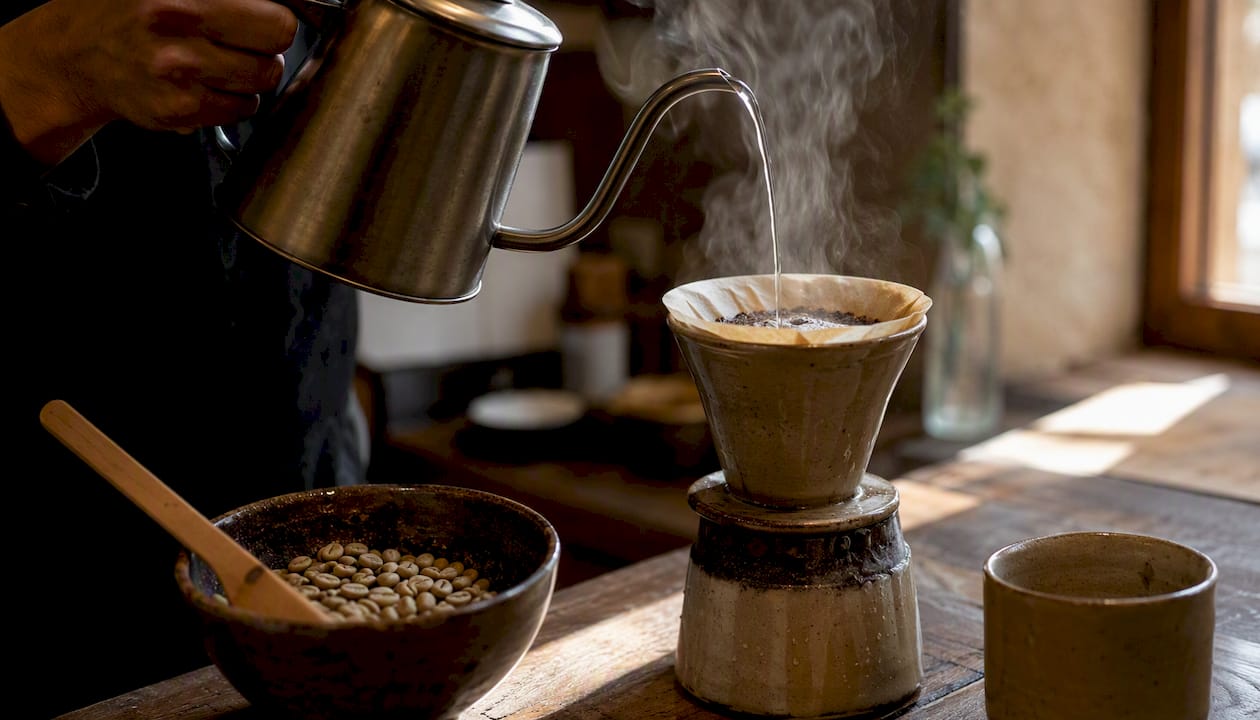
Think of it like cooking a steak: the pan temperature when the meat hits it determines the crust, not the temperature three minutes later. Your brew temperature at first contact sets the extraction trajectory for the whole cup.
Recommended temperatures by brewing method
Specialty coffee brewing methods each have different contact times, agitation levels, and vessel materials, all of which change how temperature behaves in practice.
| Method | Starting Temp (°F) | Starting Temp (°C) | Notes |
|---|---|---|---|
| Pour-over | 200–205°F | 93–96°C | Preheat dripper; high start offsets air-contact heat loss |
| Drip machine | 195–205°F | 90–96°C | Quality machines regulate automatically; check specs |
| French press | 195–200°F | 90–93°C | Preheat carafe; 4-minute steep; temp drops slowly |
| AeroPress | 175–205°F | 79–96°C | Widest range; lower temps work well with fine grind |
| Espresso | 190–196°F | 88–91°C | Machine-controlled; adjust via boiler/group head setting |
| Cold brew | Cold/room temp | Cold/room temp | 12–24 hours; no heat extraction |
| Turkish | 160–170°F | 71–77°C | Slow heat rise; remove from heat before full boil |
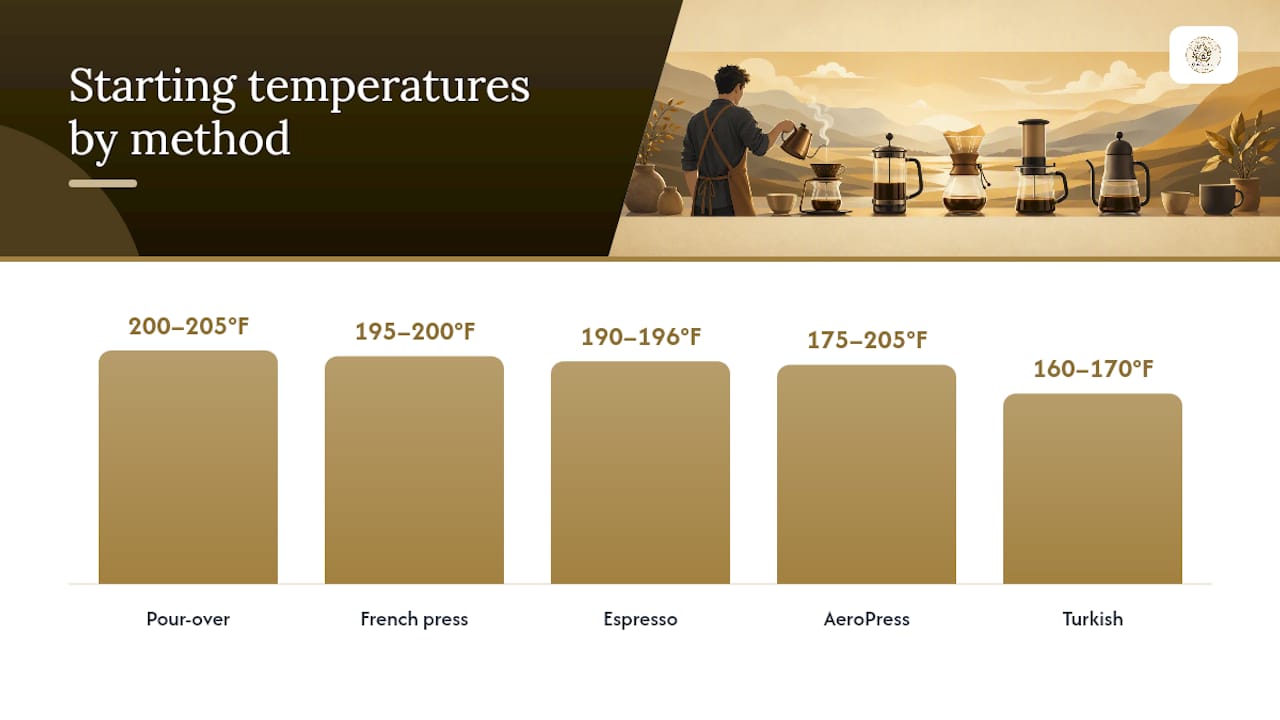
A few method-specific notes worth keeping in mind:
Pour-over: Barista Magazine’s pour-over guide specifically flags heat loss as the primary reason to start at the top of the range. Preheat your dripper and server with hot water before you begin.
AeroPress: The flexibility here is real. Lower temperatures with a finer grind and longer steep can produce a clean, sweet cup that rivals higher-temp brews, making it the best method for experimenting with temperature as a variable.
Espresso: Because the machine controls temperature, your lever is the boiler or group head setting, not a kettle. Small adjustments of 1–2°F at the group head produce noticeable flavor shifts.
How to adjust temperature for roast, grind, and water chemistry
Roast level
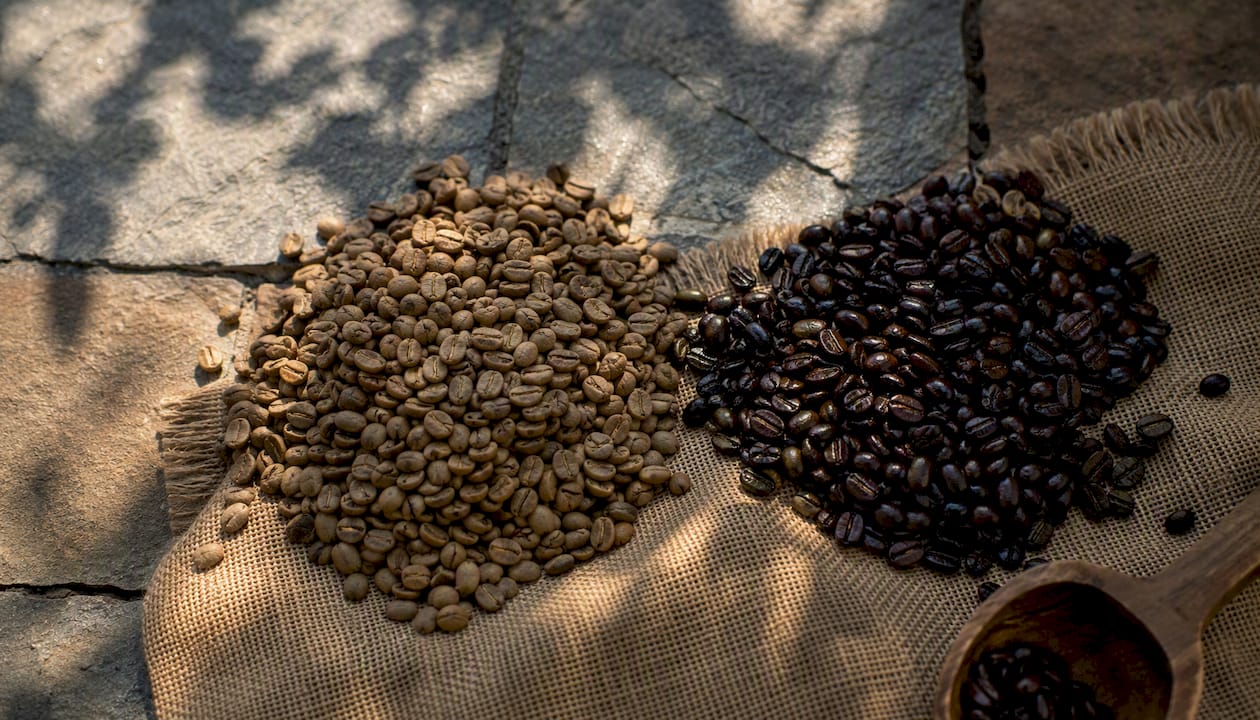
Light roasts are denser and harder to extract. They need higher temperatures, typically 200–205°F, to open up their more complex acids and florals. Dark roasts have already had their cellular structure broken down by the roasting process, so they extract faster and more aggressively. Brewing a dark roast at 205°F often produces an ashy, bitter cup. Drop to 195–198°F and the same beans taste cleaner. Roastopedia’s water temperature guide documents how roast degree directly changes the optimal slurry equilibrium target.
Grind size
Grind and temperature work together. A coarser grind has less surface area, so it extracts more slowly. You can compensate with a slightly higher temperature or a longer contact time. A finer grind extracts quickly, so consider dropping temperature by 2–3°F to avoid over-extraction, especially with dark roasts. BrewFYI’s extraction science guide frames temperature as the second lever after grind and ratio, with a target extraction yield of 18–22% for filter coffee.
Water chemistry: TDS and alkalinity
This is where most home brewers leave improvement on the table. TDS (total dissolved solids) measures the mineral content of your water. Water with a TDS above roughly 200–300 ppm can amplify bitterness and make your coffee taste harsh, and brewing at the lower end of the temperature range helps tame that effect.
Alkalinity is a separate but related variable. Scott Rao points out that alkalinity is often the single most important water-chemistry factor affecting perceived acidity and balance. High alkalinity acts as a buffer that neutralizes the bright acids you worked hard to extract, leaving the cup tasting flat regardless of temperature. If your coffee consistently tastes dull even after dialing in temperature, test alkalinity before making any more temperature changes.
Pro Tip: A cheap TDS meter (under $20 at most hardware stores) tells you in seconds whether your tap water is in the 75–150 ppm sweet spot most specialty brewers target. If it reads above 300 ppm, filter your water or blend with distilled before touching your temperature setting.
Stat to know: CrystalQuest’s water quality guide notes that TDS above roughly 200–300 ppm can amplify bitterness and recommends brewing at the lower end of the temperature range to compensate.
How to hit and hold the right temperature at home
You don’t need a variable-temperature kettle to brew well, though it helps. Here are four practical steps:
- Boil and wait. Boiling water sits at 212°F. A 30–45 second rest after boiling drops it to roughly 200–205°F. Wait 60–90 seconds and you’re near 195°F. Time it once with a thermometer to calibrate your own kettle.
- Use the two-transfer trick. Pour boiling water between two vessels twice. Each transfer drops temperature by approximately 5–8°F and also aerates the water slightly.
- Preheat your equipment. Rinse your dripper, carafe, French press, or AeroPress with hot water before brewing. Cold equipment steals heat from your brew water immediately. This single step can recover 5°F of effective brew temperature.
- Measure at the right spot. Kettle temperature and slurry temperature are not the same. Place your thermometer in the grounds bed or the slurry itself for an accurate reading, not in the kettle spout.
Pro Tip: If you brew pour-over regularly, a variable-temperature kettle with a gooseneck spout pays for itself in consistency within a few weeks. Set it to 202°F, preheat your dripper, and you’ve eliminated two of the biggest variables at once.
For equipment worth considering: a digital instant-read thermometer, a variable-temperature kettle, and an insulated server or carafe. The thermometer is the highest-value purchase if you own only one.
What the research actually says about how much temperature matters
The SCA and NCA consensus puts the standard range at 195–205°F, and that guidance holds up well for most home brewers. But a 2020 study published in Scientific Reports (Nature) adds important nuance: when TDS and percent extraction are controlled, temperature variation within roughly 87–93°C had no appreciable impact on sensory outcome.
That finding doesn’t mean temperature is irrelevant. It means that if your grind, ratio, and water quality are already dialed in, small temperature tweaks within the SCA window produce smaller flavor differences than you might expect. Grind consistency and extraction yield are the bigger levers. Temperature matters most when the other variables are already stable.
Scott Rao reinforces this from a different angle: many brewers obsess over temperature while ignoring alkalinity, which can neutralize acidity far more dramatically than a 5°F temperature shift. The practical takeaway is to treat temperature as one variable in a system, not the master control.
The research suggests that getting grind, ratio, and water chemistry right first makes temperature adjustments more meaningful, not less.
If your coffee tastes off, start here
Taste problems map fairly directly to extraction issues, and temperature is one of the fastest variables to adjust:
- Sour or sharp: Under-extracted. Raise temperature by 3–5°F, or grind finer to increase surface area. Try both separately.
- Bitter or harsh: Over-extracted, or high TDS water. Lower temperature by 3–5°F, or coarsen your grind. Check your water TDS.
- Flat or dull: Often an alkalinity problem. Test your water. Also check that your brew temperature hasn’t dropped too low due to cold equipment.
- Thin body: Usually under-extraction. Raise temperature or increase your coffee-to-water ratio slightly.
- Inconsistent cup to cup: Temperature is fluctuating. Preheat equipment every time and use a thermometer to verify.
Change one variable per brew. If you adjust temperature and grind simultaneously, you won’t know which fix worked. Raise or lower temperature by 2–3°C, brew, taste, then decide whether to move further or try a different lever. Sensory cues for well-extracted coffee include sweetness, clarity, and a finish that doesn’t linger bitterly.
A practical routine for dialing in your brew temperature
Start at 200°F (93°C) — the SCA midpoint — and run three brews with the same grind, ratio, and water before changing anything else.
Brew 1: 200°F, note the flavor profile. Sour? Bitter? Balanced?
Brew 2: Adjust by roast. Light roast tasting sour? Move to 203–205°F. Dark roast tasting harsh? Drop to 196–198°F.
Brew 3: Adjust for water. Test your TDS. Above 200 ppm? Drop 3°F from wherever you landed in Brew 2. Log the result.
Preheat your vessel every time. Test your water TDS once and write it down — it won’t change unless your source changes. After three brews, you’ll have a reliable starting point for that bean. When you switch to a new origin or roast, start the process again. Qahwat Al’Ard’s single-origin collection gives you distinct origin profiles to work through, each of which will respond differently to temperature.
Qahwat Al’Ard: coffee worth dialing in for
Getting temperature right only matters if the coffee underneath it is worth the effort. Qahwat Al’Ard sources single-origin beans and pods from traceable growing regions, roasted fresh so the flavor profile you’re calibrating your kettle for is actually there in the cup. The Peru Coffee Pods offer a clean, medium-roast baseline that responds predictably to temperature changes, making them a reliable subject for the three-brew dialing routine above. For capsule brewers, the 12 Pack Single Serve Coffee Capsules and 60 Pack Single Serve Coffee Pods let you brew consistently without managing grind variables. Browse the full single-origin collection and pick a bean that matches the roast level you’re working with.
Sources
- Scott Rao — Demystifying water for coffee
- National Coffee Association — How to brew coffee
- Breville — A guide to coffee brewing temperature
- BrewFYI — Ratio and temperature science
FAQ
What is the ideal water temperature for brewing coffee?
The National Coffee Association recommends 195–205°F (90–96°C) for most hot-brew methods. Start at 200°F and adjust up for light roasts or down for dark roasts.
Is 90°C (194°F) hot enough for coffee?
It’s just below the standard range but close enough to produce a good cup, especially for medium to dark roasts. Light roasts generally benefit from 93–96°C to extract their more complex compounds fully.
Is 200°F too hot for coffee?
No. 200°F sits at the midpoint of the SCA/NCA recommended range and works well for most methods and roast levels. Only very dark roasts or high-TDS water situations call for dropping below 200°F.
What is the 15-15-15 coffee rule?
The 15-15-15 rule is not a formally defined industry standard with a single canonical definition. Some home-brewing communities use it as a shorthand for bloom time, pour intervals, or ratio guidelines, but definitions vary. For temperature guidance, the NCA’s 195–205°F range is the authoritative reference.
What temperature does McDonald’s serve its coffee at?
McDonald’s has historically served drip coffee at a temperature below the brewing range, which reflects serving temperature after heat loss in transit. Brewing temperature and serving temperature are different measurements.


