


TL;DR:
- Comparing coffee origins for flavor complexity requires understanding terroir, altitude, variety, and processing, which shape distinct taste profiles. Using standardized sensory vocabulary like the SCA Flavor Wheel enables precise, repeatable descriptions and more accurate origin comparisons. Controlling variables such as roast level, processing method, and brewing technique allows for reliable side-by-side tastings that reveal true terroir-driven differences.
You already know that a cup of Ethiopian Yirgacheffe tastes nothing like a Colombian Huila. But when someone asks you why, the answer gets complicated fast. Comparing coffee origins for flavor complexity isn’t just about saying one tastes “fruity” and another tastes “nutty.” It’s about understanding what actually drives those differences and having the vocabulary to describe them with precision. This guide gives you a structured, research-backed approach to origin comparison, so you can move past vague impressions and start tasting with genuine clarity.
Table of Contents
- Key takeaways
- Comparing coffee origins for flavor complexity: the foundation
- How origin variables shape flavor complexity
- A practical method for side-by-side origin tasting
- Common pitfalls when comparing coffee origins
- My take on why this changed how I drink coffee
- Explore single-origin complexity with Qahwatalard
- FAQ
Key takeaways
| Point | Details |
|---|---|
| Use standardized sensory vocabulary | The SCA Flavor Wheel gives you objective language to compare origins without relying on guesswork. |
| Control processing and roast variables | Processing can overshadow terroir, so match these factors across origins before drawing flavor conclusions. |
| Altitude is one factor among many | Elevation shapes bean density and brightness, but variety and processing determine the full picture. |
| Side-by-side cupping reveals the most | Brewing two origins under identical conditions isolates true terroir-driven flavor differences. |
| Species diversity expands the spectrum | Canephora coffees bring savory, umami, and woody notes that arabica simply does not offer. |
Comparing coffee origins for flavor complexity: the foundation
Flavor complexity in coffee refers to how many distinct, layered sensory impressions a coffee delivers across sweetness, acidity, bitterness, body, and aftertaste. A coffee with high complexity doesn’t just taste like one thing. It shifts as it cools, offers a different experience on the finish than on the first sip, and leaves you wanting to identify each note.
The problem most tasters face is that complexity is subjective until you give it a framework. That’s where the SCA Flavor Wheel becomes indispensable. The Specialty Coffee Association’s Flavor Wheel organizes 103 descriptive terms in a three-tier hierarchy, moving from broad outer categories like “fruity” or “roasted” inward toward specific descriptors like “dried cherry” or “dark chocolate.” This structure lets you move from a first impression to a precise description without jumping to conclusions.
The Flavor Wheel’s real power is that it transforms tasting from a personal reaction into a common sensory language. Two tasters using the same wheel will arrive at more similar descriptions than two tasters relying on personal memories or favorite food references. That repeatability is exactly what you need when comparing coffee regions side by side.
- Sweetness: Perceived intensity of sugar-like notes, from caramel to brown sugar to honey
- Acidity: Brightness or liveliness, ranging from citric to malic to phosphoric
- Bitterness: Presence and quality, from clean cocoa to harsh astringency
- Body: Mouthfeel weight, from tea-like to syrupy
- Aftertaste: Length and character of the finish after swallowing
Pro Tip: When you first try the Flavor Wheel, start at the outermost ring and work inward. Resist naming specific notes too early. Your first impression is often one of the broad categories, and specificity comes with reflection.
How origin variables shape flavor complexity
Understanding how origins affect coffee flavor requires looking at four interrelated factors: terroir, altitude, variety, and processing. No single factor tells the whole story.
Terroir refers to the combined effect of soil mineral composition, rainfall patterns, temperature swings, and local microbiology on the growing plant. Volcanic soils in Guatemala impart a distinct earthiness and chocolate depth. The clay-rich soil of Kenyan highlands contributes to that region’s renowned blackcurrant acidity. Terroir is invisible in the bean but unmistakable in the cup.
Altitude is the variable most coffee drinkers hear about first. Higher elevations slow the maturation of the coffee cherry, which allows more complex sugars and acids to develop in the seed. Research shows that altitude explains roughly 25% of extraction yield variation, and it correlates with flavor brightness and aromatics. But altitude alone does not guarantee complexity. A high-grown coffee processed carelessly or roasted too dark can lose everything altitude contributed.
| Origin Region | Altitude Range | Common Flavor Notes | Typical Processing |
|---|---|---|---|
| Ethiopia (Yirgacheffe) | 1,700–2,200m | Bergamot, jasmine, blueberry | Washed or natural |
| Colombia (Huila) | 1,500–2,000m | Red apple, caramel, brown sugar | Washed |
| Kenya | 1,400–2,100m | Blackcurrant, tomato, grapefruit | Washed (double) |
| Brazil (Cerrado) | 900–1,200m | Hazelnut, milk chocolate, low acidity | Natural or pulped natural |
| Guatemala (Antigua) | 1,500–1,700m | Dark chocolate, spice, earthy cedar | Washed |
Coffee variety matters enormously and is often underappreciated. Heirloom Ethiopian varieties like Kurume and Dega carry a genetic diversity that produces florals and fruit notes you simply cannot replicate in a Catimor or Catuai cultivar grown at the same altitude. And canephora (robusta) coffees occupy a completely different flavor dimension. The SCA’s Flavor Wheel for canephora includes descriptors like fermented soy sauce, rum, and animalic tones, notes that many tasters find surprising and genuinely compelling once they stop comparing canephora to arabica standards.
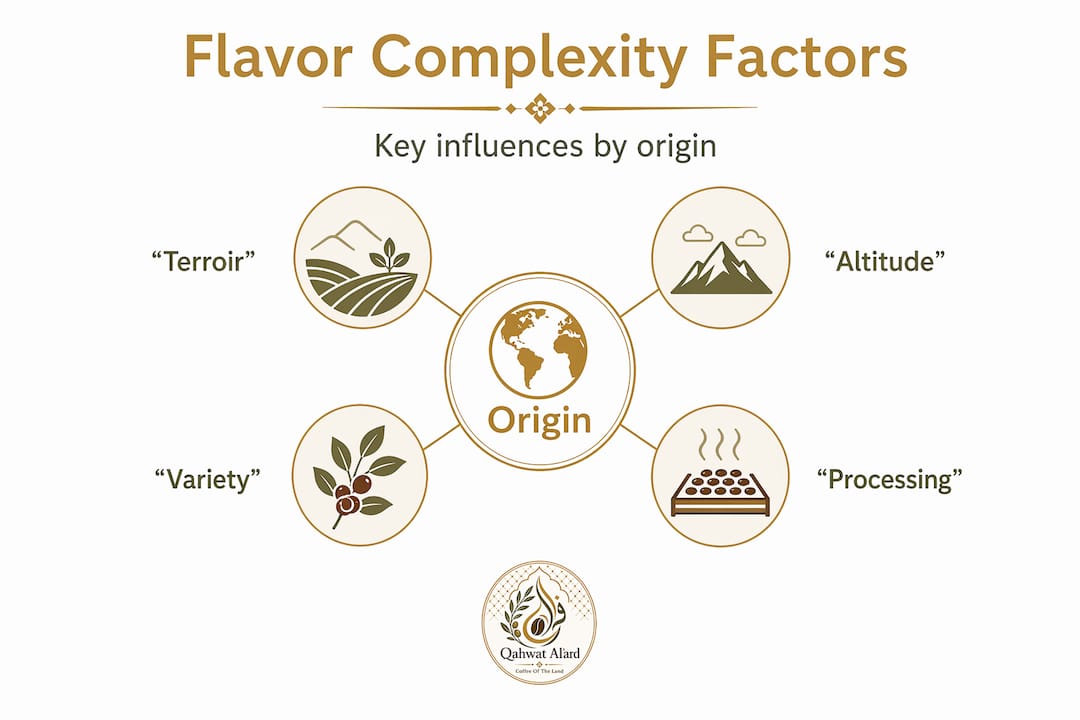
Processing method may be the single most powerful modifier of all. Primary processing methods significantly alter acidity, bitterness, mouthfeel, and overall complexity by changing how sugars, acids, and phenolics develop during the drying or fermentation stage. A natural-processed Ethiopian coffee can taste like a fruit bomb, while the same beans processed using a washed method produce a cleaner, more floral cup. For a deeper look at what each method does at a biochemical level, Qahwatalard’s guide on coffee processing methods is worth reading before you set up any origin comparison.
Pro Tip: When building a comparison tasting, prioritize sourcing the same processing method across your chosen origins. A washed Ethiopian next to a natural Brazilian tells you more about processing than about origin. Match the method, then let the terroir speak.
A practical method for side-by-side origin tasting
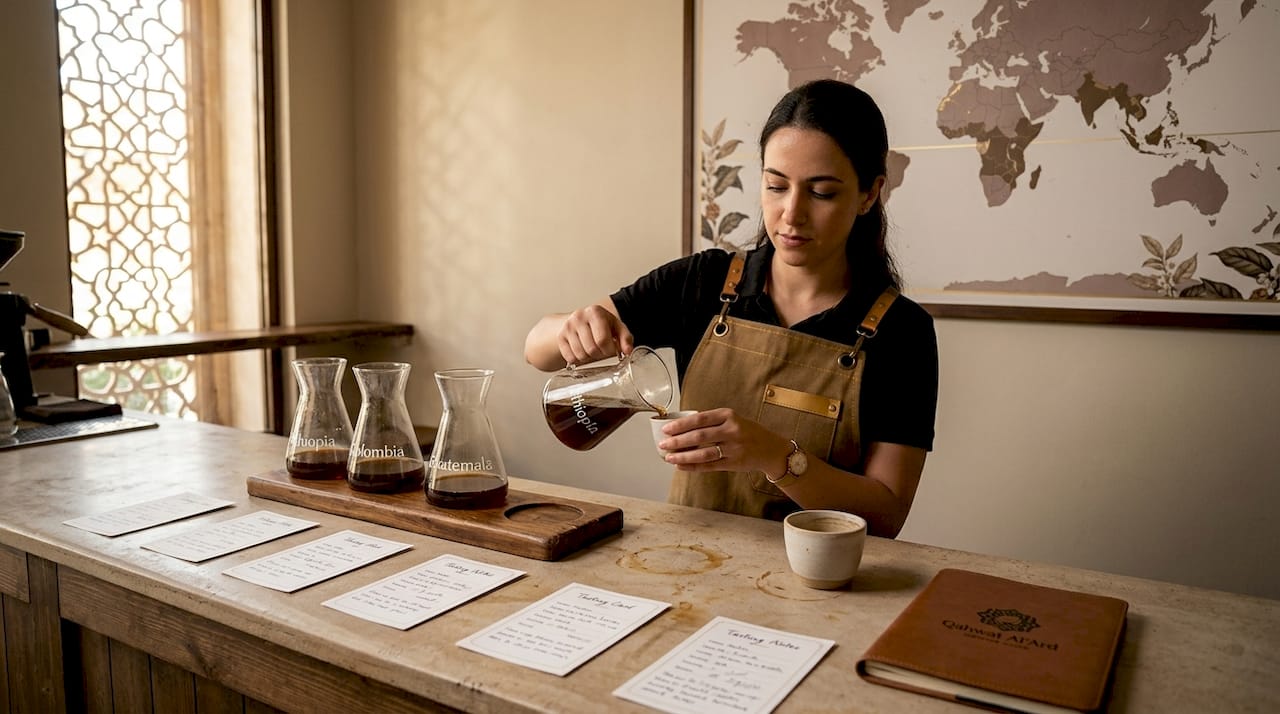
The clearest way to compare flavor complexity across origins is to control everything except the origin itself. Holding roast degree and brewing technique constant while varying origin gives you the clearest attribution of flavor differences to terroir rather than to how the beans were treated after harvest.
Here’s how to set up a reliable side-by-side tasting:
- Select two to three origins with matched processing methods and similar roast levels (aim for medium roast, which preserves origin character better than dark roast).
- Grind to the same coarseness across all samples. Inconsistent grind size changes extraction and skews your taste comparison. Qahwatalard’s resource on coffee grind size covers this in useful detail.
- Use identical dose and water ratio for every sample. A standard cupping protocol uses 8.25 grams per 150ml of water at 200°F (93°C).
- Brew simultaneously using the same method, whether pour-over or the SCA cupping method using immersion and a crust break.
- Taste at the same temperature across all cups. Flavor expression changes significantly as coffee cools, so taste each sample at the same point, twice: once hot (160°F/71°C) and once at room temperature.
- Record your notes using the Flavor Wheel tiers before discussing with anyone else. Sensory calibration improves when tasters record independently first, then compare.
When using the Flavor Wheel during tasting, anchor your observations to specific, consistent attributes. Acidity brightness, sweetness intensity, balance, and aftertaste length are the most repeatable attributes to track across samples. Vague impressions like “tastes good” or “smooth” are not useful for comparison.
- Note whether acidity is citric (sharp, lemon-like) or malic (softer, apple-like)
- Identify whether body is light and tea-like or heavy and coating
- Track the finish: does it fade quickly or linger with a specific note?
Pro Tip: Rinse your palate between samples with room-temperature water and plain crackers, not flavored ones. Residual flavors from previous samples are one of the most common sources of bias in home tasting sessions.
Common pitfalls when comparing coffee origins
Even experienced tasters fall into predictable traps. Here’s what to watch for.
The biggest mistake is comparing coffees roasted to different degrees and attributing the difference to origin. A dark-roasted Colombian and a medium-roasted Ethiopian are being compared at different points on the roast-flavor curve, not at the same one. Dark roast suppresses acidity and origin-specific aromatics in favor of roast-driven notes like carbon, smoke, and dark chocolate. You’re tasting the roaster’s decisions, not the land.
The second trap is assuming altitude automatically equals complexity. As research confirms, altitude explains only part of the flavor equation. A high-grown coffee that undergoes heavy fermentation during processing will display fermentation-driven flavors, not altitude-driven florals. Processing effects can sometimes fully overshadow origin effects, and matching processing history across origins is the only way to isolate what terroir is actually contributing.
Sensory fatigue is a real and underestimated problem. After four or five cups, your ability to detect subtle differences drops sharply. Limit comparison sessions to three origins maximum, and space your tasting over 20 to 30 minutes.
“The palate doesn’t get better by tasting more in one sitting. It gets better by tasting more intentionally over many sessions.”
Finally, watch for confirmation bias. If you already love Ethiopian coffees, you’ll unconsciously score them higher. Recording tasting notes before you look at the origin label, or using coded samples when possible, removes that bias entirely and forces honest, observation-based evaluation.
My take on why this changed how I drink coffee
I’ll be honest: before I started using structured sensory vocabulary, I thought I was tasting coffee. I wasn’t. I was reacting to it. The moment I started working with the SCA Flavor Wheel systematically, something shifted. I stopped saying “I like this one” and started saying “this one has a brighter phosphoric acidity and a longer stone-fruit finish.” Those aren’t just fancier words. They’re data points that let me go back and find more coffees I love.
What surprised me most was discovering how much processing had been driving my preferences without my realizing it. I thought I was drawn to Ethiopian origins. It turned out I was drawn to natural-processed coffees, and Ethiopia happened to produce many of them. Once I ran side-by-side tastings with matched processing, I found washed coffees from Kenya and Colombia I loved just as much.
I’ve also learned to stop overlooking canephora. The savory, umami-driven, almost funky notes in well-sourced robusta are genuinely interesting once you stop grading them against arabica expectations. The SCA’s recent flavor work on canephora proves this complexity deserves serious attention.
My advice: start with three origins, one processing method, one roast level. Take notes. Taste again next week. The differences you thought were subtle will become obvious, and the origins you dismissed will reveal something worth coming back to.
— Anthony-Yasin
Explore single-origin complexity with Qahwatalard
If you are ready to put these tasting principles into practice, the place to start is a curated selection of coffees that actually represent diverse origins at their best.
Qahwatalard’s Single Origin Favorites Sample Pack is built for exactly this kind of structured comparison. It brings together carefully sourced beans from distinct growing regions, all fresh-roasted so origin character is preserved rather than buried. For espresso lovers, the African Espresso showcases the berry-forward intensity that makes African origins so compelling. And if you want to experience how multiple origins interact, the 6 Bean Blend offers a window into complementary origin characteristics in a single cup. Every product comes with transparent sourcing, so you always know exactly what you are tasting.
FAQ
What does “flavor complexity” mean in coffee?
Flavor complexity in coffee refers to the number and layering of distinct sensory impressions across sweetness, acidity, body, and aftertaste in a single cup. High-complexity coffees shift and evolve as they cool, offering different notes at different temperatures.
How do different coffee origins affect flavor?
Origin shapes flavor through terroir (soil, climate, altitude), genetic variety of the plant, and local processing traditions. These factors alter the concentration of sugars, acids, and aromatic compounds in the bean before roasting even begins.
Does a higher altitude always mean a more complex coffee?
Not automatically. Altitude accounts for roughly 25% of extraction yield variation and correlates with brightness, but variety and processing method have an equally significant effect on the final cup complexity.
What is the best method for comparing coffee origins at home?
Use identical roast levels, the same processing method across origins, and a consistent brew ratio. Taste each sample at the same temperature and record notes using the SCA Flavor Wheel before comparing observations between cups.
How does processing method affect origin flavor comparison?
Processing transforms sugars, acids, and phenolics in the green bean, creating such significant sensory divergence that two coffees from the same farm processed differently can taste like entirely different origins. Always match processing methods when isolating terroir-driven flavor differences.


