


What is coffee degassing, and why does it matter?
Coffee degassing is the natural release of CO2 from roasted beans, a process that begins the moment roasting ends and continues for days or weeks. During roasting, chemical reactions including the Maillard reaction and Strecker degradation break down carbohydrates and proteins, generating large volumes of carbon dioxide. That gas gets trapped inside the bean’s microscopic, honeycomb-like cell structure. After roasting, it slowly works its way out.
Why does this matter for your cup? Brew too soon, and excess CO2 physically pushes water away from the grounds, causing uneven extraction and harsh, sour notes. Wait too long, and oxygen takes over, degrading the aromatic compounds that give specialty coffee its character. The window between those two extremes is where great coffee lives.
Key facts about the degassing process:
- CO2 forms primarily through Maillard, Strecker, and pyrolysis reactions during roasting
- Gas remains trapped in the porous cell walls of the roasted bean
- Approximately 40% of total CO2 escapes within the first 24 hours after roasting
- Optimal flavor typically develops after several days of resting, depending on roast level
- Complete degassing signals the start of accelerated oxidative staling
How CO2 forms inside roasted beans and escapes over time
The roasting process transforms green coffee through a cascade of heat-driven reactions. Maillard browning, Strecker degradation, and pyrolysis all generate CO2 as byproducts, and the bean’s porous structure traps much of it under pressure. Research has reported internal bean pressures ranging from 4.4 atm to 25 atm, depending on roast degree and methodology.
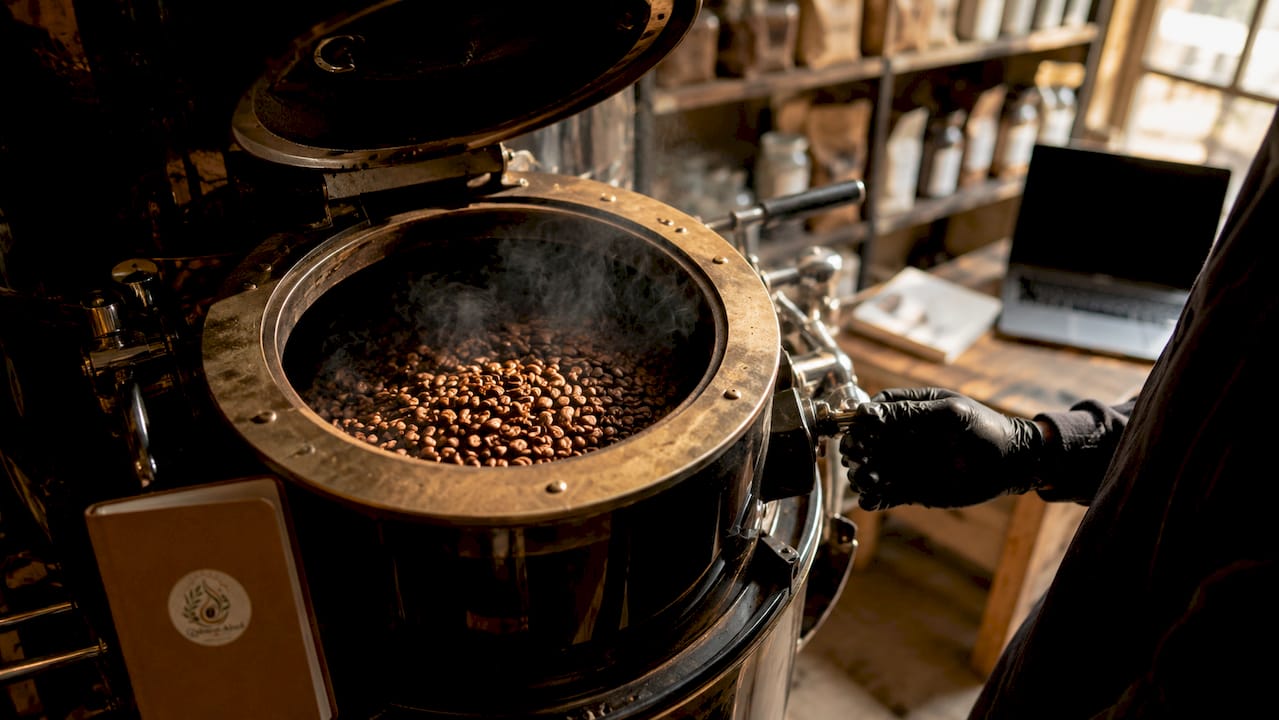
Once roasting stops, CO2 begins diffusing outward through the bean’s cell walls and pores. The rate is not constant. It starts fast, slows through the middle days, and tapers off over weeks. Bean density, roast degree, and roast speed all influence how quickly that gas finds its way out. Understanding how roasters shape flavor through these variables helps explain why two bags roasted to the same color can degas at very different rates.
How long does coffee degas, and when is it ready to brew?
The timeline breaks into three distinct phases, each with different implications for brewing:
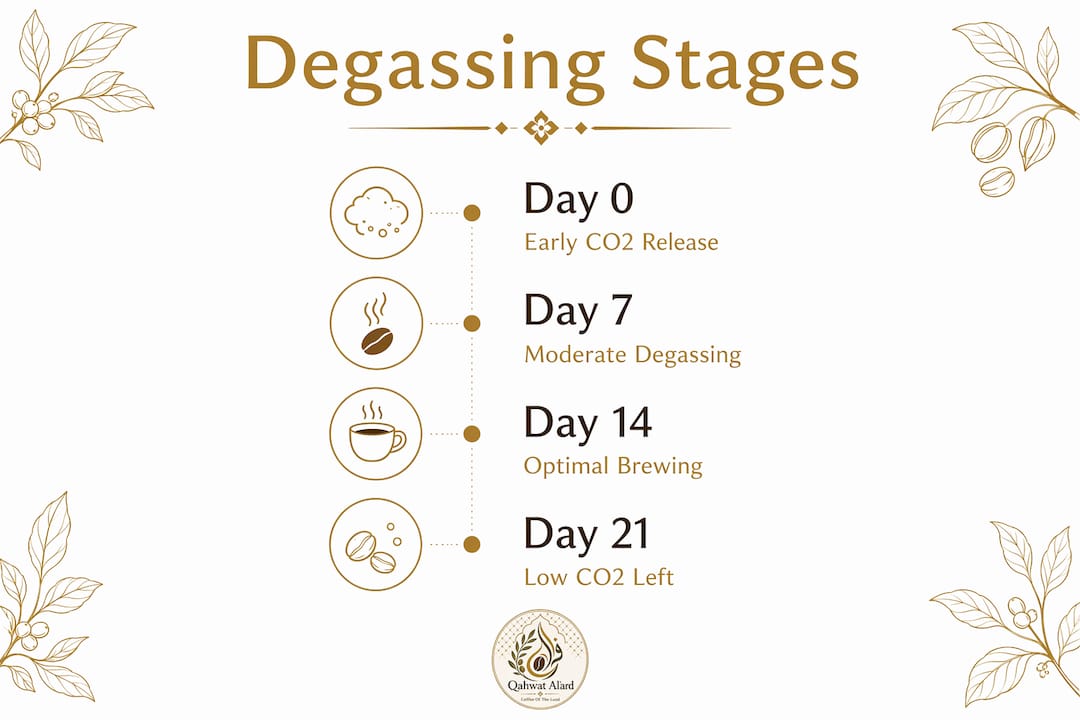
- First 24 hours: The most volatile phase. Around 40% of CO2 escapes during this window. Beans are too unstable for quality brewing; the cup often tastes metallic or dry.
- Days 2–7: Release slows but continues. Aromas begin integrating with the bean’s natural oils. Filter coffees, especially lighter roasts, can start showing desirable clarity and brightness as early as day 3 or 4.
- Days 7 through 3 weeks: The sweet spot for most specialty coffees. Enough CO2 has left that water makes full, even contact with soluble compounds, yet enough residual gas remains to protect against oxidation.
Lighter roasts degas more slowly than darker ones, often needing closer to two or three weeks before fully opening up. Darker roasts typically peak earlier in that window. For espresso specifically, many roasters recommend waiting several days before pulling shots, since excess gas disrupts crema formation and pressure dynamics. For resting coffee after roasting, the roast level is the single most important variable to consider.
Grinding dramatically accelerates the process. Grinding releases most remaining CO2 within 15–30 minutes by shattering cell walls and multiplying the surface area exposed to air.
Why degassing matters for coffee quality and freshness
Excess CO2 creates a physical barrier between water and coffee grounds. The gas pushes outward as hot water tries to penetrate inward, resulting in uneven saturation and a cup that tastes simultaneously too acidic and too bitter. This is a mechanical problem, not just a flavor preference.
Degassing is distinct from staling. Staling involves oxygen reacting with lipids and aromatic compounds, a chemical degradation process. Degassing is the controlled exit of CO2, which actually protects the bean from oxygen during the early post-roast period. The two processes overlap in timing but operate through entirely different chemistry.
For espresso, CO2 directly shapes crema. The right amount of residual gas produces the dense, persistent foam that signals a well-extracted shot. Too much gas and the crema is coarse and dissipates fast; too little and it barely forms.
Pro Tip: Pre-wet your grounds with a small amount of hot water and wait 30–45 seconds before continuing your pour. This “bloom” releases a burst of CO2 so the rest of your water can extract evenly. It works best when the coffee has already rested 3–7 days post-roast.
Key effects of degassing on brewing quality:
- Proper degassing allows full, even water penetration of the grounds
- Residual CO2 contributes to crema texture in espresso
- Insufficient rest leads to channeling, uneven extraction, and off-flavors
- Over-rested coffee loses its CO2 protection and oxidizes faster
What happens after beans degas, and how to preserve freshness
Once CO2 is fully gone, oxygen moves in. The lipids and aromatic compounds that define a coffee’s character begin degrading at an accelerating rate. For whole beans stored at room temperature without protective packaging, complete degassing typically occurs over several weeks post-roast. Pre-ground coffee can reach that point within a day or two after grinding.
One-way valve bags solve the packaging dilemma neatly. They let CO2 escape after roasting, preventing the bag from inflating or rupturing, while blocking oxygen from entering. Without that valve, roasters would have to choose between unsealed bags that let oxygen in or sealed bags that eventually burst.
Storage tips to extend freshness:
- Keep beans in a sealed, one-way valve bag away from heat, light, and moisture
- Avoid the freezer unless you are storing beans for more than a month and can seal them airtight
- Buy in quantities you will use within 2–3 weeks of opening
Pro Tip: Grind immediately before brewing, every time. Once ground, coffee loses most of its remaining CO2 within 15–30 minutes and begins oxidizing rapidly. Pre-grinding the night before costs you more flavor than almost any other variable.
Advanced science behind degassing kinetics
The physics of CO2 release from roasted coffee involves at least three distinct diffusion mechanisms working simultaneously. Molecular diffusion, Knudsen diffusion, and pressure-driven viscous flow each contribute to gas movement through the bean’s porous matrix, and their relative contributions shift depending on grind size, roast degree, and storage conditions.
Gravimetric studies using time-resolved weight-loss methods have allowed researchers to model these release kinetics with precision. CO2 accounts for more than 80% of the volatile fraction in roasted coffee by weight, making it the dominant gas in degassing. Roast speed matters too: high-temperature, short-time roasting produces a higher initial CO2 degassing rate than slow, low-temperature roasting at the same final roast degree. Lighter roasts retain CO2 longer because their denser cell structure provides more sites where gas can remain trapped.
How coffee processing methods affect degassing
The processing method used before roasting influences how a bean degasses afterward. Washed (wet-processed) coffees tend to have cleaner, more uniform cell structures after the mucilage is removed, which can allow for more predictable CO2 release. Natural (dry-processed) coffees, dried with the fruit intact, often develop denser, more complex internal structures that can slow degassing slightly and contribute to longer rest windows before peak flavor.
Honey-processed coffees fall between those two poles. The partial mucilage left on the bean during drying affects cell wall density in ways that vary by producer and climate. Bean density interacts with processing method to determine how much CO2 gets trapped and how quickly it escapes after roasting.
How degassing influences brewing methods and extraction
Different brew methods tolerate CO2 at different levels. Espresso is the most sensitive: the pressurized extraction environment amplifies any gas interference, making rest time before pulling shots more critical than with filter methods. Pour-over and drip brewing are more forgiving, though a proper bloom still improves extraction consistency.
French press and cold brew are the least affected by residual CO2. Cold brew’s long, low-temperature steep gives CO2 plenty of time to dissipate naturally during extraction. The connection between degassing and extraction is direct: water cannot dissolve flavor compounds it cannot reach, and CO2 is what keeps it from reaching them.
How to identify the optimal degassing stage for brewing
The most reliable indicator is the bloom. Pour a small amount of hot water over your grounds and watch what happens. Heavy, rapid bubbling that lasts more than 45 seconds suggests the coffee is still releasing significant CO2 and may need another day or two. A gentle, even bloom that settles within 30 seconds indicates the coffee is in its prime window.
Check the roast date, not the “best by” date. Most specialty roasters print the roast date on the bag. For filter brewing, aim for 4–14 days post-roast. For espresso, 7–21 days is a reasonable target, with lighter roasts sitting toward the longer end of that range.
Other gases involved in coffee degassing beyond CO2
Carbon dioxide dominates the degassing story, but it is not the only gas involved. Carbon monoxide (CO) forms during roasting through similar thermal degradation reactions and also escapes from beans post-roast, though in much smaller quantities. Nitrogen (N2) is present in the bean’s atmosphere and plays a role in packaging: nitrogen flushing is a common technique to displace oxygen in sealed bags before the one-way valve takes over.
Volatile organic compounds (VOCs), including aldehydes, ketones, and furans, also escape during degassing. These are the aromatic molecules responsible for the complex scent of freshly roasted coffee. Their release is intertwined with CO2 degassing, which is part of why the rest period matters so much for aroma development. As CO2 exits, it carries some of these volatiles with it, which is why very fresh coffee can smell intensely gassy rather than aromatically complex.
Qahwatalard sources and roasts its single-origin coffees with degassing timelines in mind, so every bag arrives at the right point in its rest window. If you want a coffee that is ready to brew without the guesswork, explore the full collection.
Key Takeaways
Coffee degassing is the controlled release of CO2 from roasted beans, and timing your brew within the 4–21 day post-roast window is the single most effective way to improve extraction quality.
| Point | Details |
|---|---|
| CO2 forms during roasting | Maillard, Strecker, and pyrolysis reactions trap CO2 inside the bean’s porous cell structure. |
| First 24 hours are the most volatile | Around 40% of total CO2 escapes in the first day; brewing during this phase produces harsh, uneven results. |
| Optimal rest window varies by roast | Light roasts peak at 2–3 weeks post-roast; darker roasts typically reach their best earlier in that range. |
| Grinding accelerates degassing fast | Ground coffee releases most remaining CO2 within 15–30 minutes, so grind immediately before brewing. |
| One-way valve bags protect freshness | They let CO2 escape while blocking oxygen, extending the window before oxidative staling begins. |
FAQ
What is coffee degassing in simple terms?
Coffee degassing is the natural process where roasted coffee beans release trapped carbon dioxide over days to weeks. Brewing before enough CO2 has escaped leads to uneven extraction and off-flavors.
How long should coffee rest before brewing?
Most filter coffees are ready several days after roasting; espresso typically benefits from longer rest periods, with lighter roasts needing more time than darker ones.
Does grinding speed up degassing?
Yes, significantly. Ground coffee releases most of its remaining CO2 within 15–30 minutes of grinding, which is why grinding immediately before brewing preserves the most flavor.
What is the difference between degassing and staling?
Degassing is the controlled exit of CO2, which actually protects beans from oxygen early on. Staling is a separate process driven by oxygen reacting with lipids and aromatic compounds, and it accelerates once degassing is complete.
Why do specialty coffee bags have a small valve?
That one-way valve lets CO2 escape from freshly roasted beans without allowing oxygen in, preventing the bag from inflating while slowing the oxidation that causes staleness.


