


TL;DR:
- Bean density significantly influences roasting and flavor development, with high-density beans requiring longer roast times and careful adjustments. Understanding and measuring density enables roasters and brewers to optimize parameters like charge temperature, grind size, and extraction time for better cup quality. Treat density as a tool for calibration rather than a strict quality indicator, adjusting techniques accordingly for consistent results.
If you’ve ever wondered why two bags of specialty coffee labeled “light roast” can taste completely different, bean density is often the answer no one mentions. The role of bean density in coffee quality is one of the most misunderstood concepts in the enthusiast world, where density gets treated as a simple quality score rather than what it actually is: a structural and thermal variable that shapes how a bean behaves under heat and how flavor develops in your cup. Understanding it changes how you roast, grind, and brew.
Table of Contents
- Key takeaways
- The role of bean density in coffee: what it actually means
- How density affects roasting: heat, timing, and development
- Bean density and flavor: what ends up in your cup
- Practical ways to use density knowledge at home
- My honest take on density after years of chasing better coffee
- Explore coffees that reward this kind of attention
- FAQ
Key takeaways
| Point | Details |
|---|---|
| Density is not a quality score | Bean density influences roasting and extraction behavior but is one of several factors that determine cup quality. |
| Higher density needs more heat | Denser beans absorb heat more slowly and require longer roast development to unlock their full flavor potential. |
| Altitude is a strong density predictor | High-altitude coffees typically exceed 680 g/L, while low-altitude beans often fall below 640 g/L. |
| Density affects your grind and extraction | Compact, dense bean structures require mindful grind size and brew time adjustments to avoid under-extraction. |
| Measure before you roast or brew | A simple weight-to-volume calculation gives you a reliable density reading before you dial in any parameters. |
The role of bean density in coffee: what it actually means
Bean density, known in the industry as green coffee bean density, refers to the mass of a coffee bean relative to its volume. It is typically expressed in grams per liter (g/L) or grams per cubic centimeter (g/cm³), and it describes how tightly packed the cellular structure of a green coffee bean is.
You can think of it this way: a dense bean has more physical material compressed into the same space. That structure comes from where and how the cherry grew. Beans from high-altitude farms mature more slowly because of cooler temperatures, giving them more time to develop tight cell walls, concentrated sugars, and complex aromatic compounds. Higher density beans concentrate sugars and aromatics, which is why they often cup with greater clarity and sweetness.
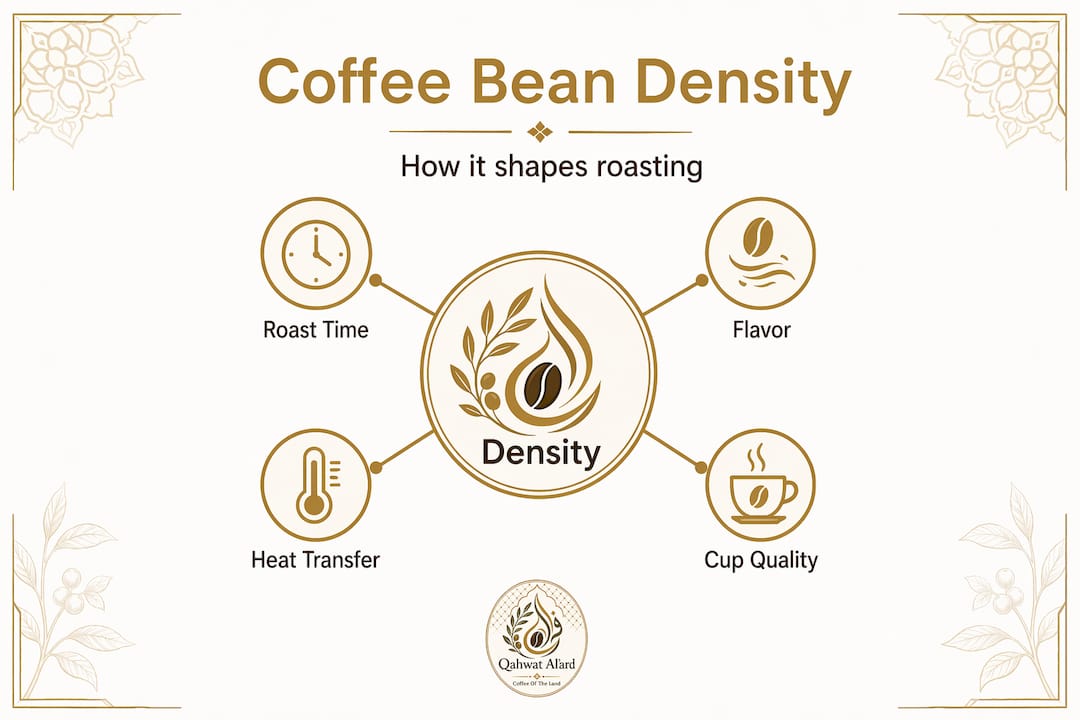
Density is not the same thing as moisture content, though the two are related. Moisture, density, and water activity together form a connected system that determines how a green bean will behave during roasting and storage. A bean can be dense but dry, or less dense but high in moisture. You need both data points to make informed roasting decisions.
How density is measured
The most accessible method at home is the weight-to-volume calculation. Fill a container of known volume with green beans, weigh the contents, and divide. A reading above 700 g/L signals a high-density coffee. Below 640 g/L typically means low-altitude or fast-maturing origin.
Other methods include:
- Floatation tests: Beans that sink in water tend to be denser and more structurally intact than floaters, which are often hollow or defective.
- Sieve grading: While primarily a size-sorting method, sieve results can correlate with density in specific origins.
- Lab measurements: Professional roasters use displacement or pycnometer methods for more precise readings.
Pro Tip: Before your next roast, weigh out 100 grams of green beans and pour them into a measuring cup. That volume reading gives you an immediate ballpark density you can compare batch to batch.
How density affects roasting: heat, timing, and development
This is where coffee density significance becomes genuinely technical, and where most home roasters run into problems without realizing it. Dense beans and less dense beans behave like completely different materials under heat, even when they look identical in the hopper.
Denser beans require longer roasting time because their tighter cell walls slow heat transfer. You’re essentially pushing thermal energy through more resistance. Lower-density beans, by contrast, roast faster and are more prone to uneven extraction if you apply the same heat curve you’d use for a high-altitude lot.

The practical implication comes down to charge temperature and rate of rise. Adjusting charge temperature paired with observing rate of rise is the key to matching your roast energy to the bean in front of you. A concrete benchmark: a difference of roughly 40 to 50 g/L in bean density typically calls for a charge temperature adjustment of 10 to 15°F to maintain your intended development time.
Here is how density ranges typically break down by origin type:
| Density range | Typical origin | Roast behavior |
|---|---|---|
| Above 700 g/L | High-altitude Ethiopia, Kenya, Colombia | Slow heat absorption, longer development needed |
| 640–700 g/L | Mid-altitude Central America, Brazil washed | Moderate roast pace, balanced DTR |
| Below 640 g/L | Low-altitude robusta, natural process | Faster roasting, higher risk of scorching |
First crack timing also shifts with density. Dense beans have longer first crack to drop times because it takes more sustained energy to fully develop sugars and Maillard reactions through their compact structure. Rushing development with a dense bean produces hollow or bitter results. Not because you made a mistake in the obvious sense, but because density-driven timing errors during the development window are subtle and show up in the cup rather than visually on the bean.
Pro Tip: When roasting a new origin for the first time, log the density alongside your charge temperature and first crack time. After three or four batches, you will see clear patterns that make dialing in future roasts much faster.
A few common roasting pitfalls when density is ignored:
- Applying a roast profile designed for a Brazilian natural (low density) to a Kenyan AA (high density) and wondering why the finish tastes thin.
- Dropping a dense bean too early after first crack, leaving sugars underdeveloped and producing a sour, grassy cup.
- Over-roasting a low-density bean because the profile was built for a denser lot, resulting in flat, ashy flavor.
Bean density and flavor: what ends up in your cup
The connection between bean density and flavor is not a simple cause-and-effect relationship, but the correlation is strong enough to use as a practical guide. Higher density beans concentrate sugars and aromatic compounds during slow maturation at altitude, and when roasted correctly, those compounds translate into sweeter, more structured cups with cleaner finishes.
Lower-density beans are not automatically inferior. Natural process coffees, for instance, often have lower green density but produce intensely fruity and complex cups because of how fermentation develops flavor. The density is a structural variable. The flavor depends on the whole picture, including processing, variety, and roast execution.
“Bean density is a heat-transfer and structural variable, not purely a quality score. Roast profiles should be tailored around density, not used as a substitute for understanding it.” Green Coffee Bean Density Roast Profile
Where coffee bean density effects become most visible to home baristas is in extraction. Denser beans with compact structures require grind and brew adjustments to achieve balanced extraction. Because the cells are tightly packed, water takes longer to solubilize the compounds inside. If you grind too coarse or brew too fast, you pull less from each particle and end up with a thin, underdeveloped shot or pour-over.
The specific ways density shapes your brewing:
- Espresso: Dense beans typically extract more evenly at a slightly finer grind. Puck resistance is more consistent because the particles compact predictably.
- Pour-over: You may need to extend total brew time slightly or increase your water temperature by a few degrees to fully develop flavor from high-density lots.
- Cold brew: Dense beans often perform exceptionally well in long, cold extractions because slow-extracted compounds have time to fully dissolve.
Practical ways to use density knowledge at home
You do not need professional roasting equipment or a lab to apply what you know about bean density. The following process works for home roasters and brewers alike.
- Measure before you roast. Use the weight-to-volume method. Write down the g/L reading for every green bean lot you work with. This becomes your reference point for every other decision.
- Adjust your charge temperature. If your usual charge is 380°F for a mid-density Brazilian, push it up 10 to 15°F for a high-altitude Kenyan lot at 700+ g/L. This compensates for the slower heat absorption.
- Monitor your rate of rise. RoR curves vary by density, and denser beans benefit from a lower, steadier RoR to prevent the exterior from developing faster than the core.
- Lengthen development time for dense lots. Give high-density beans at least 20 to 25% development time ratio (DTR) after first crack to fully transform sugars without rushing through the most flavor-critical phase.
- Calibrate your grind at the brewer. After roasting, treat a dense lot as a starting point for a slightly finer grind than usual. Dial in from there based on taste.
- Document everything. Log density, charge temperature, first crack time, DTR, and your tasting notes. After a few batches from the same origin, you will have a dialed-in profile you can repeat reliably.
Pro Tip: If you brew espresso, try adjusting your grind size for dense beans one click finer than your baseline and pulling a 10-second longer shot. The difference in body and sweetness is often immediately noticeable.
Understanding how roasters shape coffee flavor using variables like density, temperature, and timing can also help you reverse-engineer what a roaster did well or where a bag fell short.
My honest take on density after years of chasing better coffee
I’ve spent years adjusting roast profiles and pulling shots, and the single biggest lesson I’ve learned is that density becomes dangerous when you treat it as a proxy for quality rather than a tool for calibration.
I used to assume every high-altitude, high-density bean would automatically produce a stellar cup. It doesn’t work that way. I’ve had stunning cups from low-density naturals that tasted like nothing I’d experienced before, and disappointing results from dense, high-scoring green lots that I simply roasted without accounting for their structure.
What actually changed my results was treating density as a pacing constraint. When I know the density of what’s in my drum, I adjust my entry temperature and watch my RoR accordingly, rather than running the same profile on everything. The cup consistency that follows is not luck. It’s repeatable.
My other hard-won insight: the interaction of moisture content, density, and processing method demands that you consider all three together. A dense washed Ethiopian and a dense natural Ethiopian will roast and brew differently even at the same g/L reading. Density gives you a framework; the rest of the context fills in the picture.
Use density as a guide. Experiment from there. The best coffee you’ll ever make will come from understanding the variables rather than following one rule.
— Anthony-Yasin
Explore coffees that reward this kind of attention
At Qahwatalard, every coffee in the catalog is selected with exactly these principles in mind: traceability, origin integrity, and the kind of quality that density-conscious roasting and brewing actually reveals. If you want to put what you’ve learned to practice, the single origin collection gives you access to coffees from high-altitude growing regions where density, flavor development, and clarity come through in every cup. For those who prefer a thoughtfully layered experience, the 6 Bean Blend brings together origins that complement each other in ways that reflect careful sourcing decisions. And if you want to taste what high-density African origins do in an espresso context, the African Espresso is exactly where to start.
FAQ
What is bean density in coffee?
Bean density refers to the mass of a green coffee bean relative to its volume, typically measured in grams per liter. It reflects the tightness of the bean’s cellular structure, which is shaped by altitude, variety, and growing conditions.
How does density affect coffee roasting?
Denser beans absorb and transfer heat more slowly, requiring longer development times and often higher charge temperatures compared to lower-density lots. Ignoring density during roasting leads to uneven development and flat or bitter flavors in the cup.
Do higher-density beans always taste better?
Not automatically. Higher density often correlates with concentrated sugars and aromatic clarity, but cup quality depends on roast execution, processing method, and origin. A well-roasted low-density natural can outperform a poorly roasted high-density washed lot.
How can I measure bean density at home?
Fill a container of known volume with green beans, weigh the contents, and divide weight by volume to get g/L. Readings above 700 g/L indicate high-density beans; below 640 g/L typically suggests low-altitude or fast-maturing origins.
How should I adjust brewing for dense beans?
Dense beans benefit from a slightly finer grind and longer extraction time because their compact cellular structure slows water penetration. In espresso, try a finer grind and extend your shot time by 5 to 10 seconds compared to your usual baseline.


