


TL;DR:
- The roast date is the most reliable indicator of a coffee’s current freshness and flavor quality. It marks when heat transforms green beans into the aromatic product, which degrades over time due to chemical reactions, oxidation, and degassing. Knowing and tracking the roast date helps ensure optimal brewing timing, especially within the recommended 2 to 6-week window for peak flavor.
The roast date is the single most reliable indicator of your coffee’s current flavor quality, marking the exact moment heat transforms green beans into the aromatic product in your cup. Most coffee drinkers focus on origin, roast level, or price. The roast date is what actually tells you whether those qualities are still intact. Specialty roasters like those supplying Qahwatalard print roast dates as a direct signal of transparency, because best before dates on grocery bags can run 12 to 18 months out and say nothing meaningful about flavor. Understanding why roast date matters for coffee is the difference between drinking coffee at its peak and drinking a shadow of what it could be.
Why does roast date matter for coffee flavor?
Coffee flavor is not static. The moment roasting ends, a cascade of chemical reactions begins that continuously alters what ends up in your cup. Roast date is the timestamp on that process, and without it, you are guessing.
During roasting, heat generates hundreds of volatile aromatic compounds. Pyrazines create nutty and earthy notes. Furans contribute caramel and sweet tones. Thiols, particularly 2-furfurylthiol, are responsible for the characteristic roasted coffee aroma that peaks shortly after roasting and then declines. These compounds do not hold. Oxygen, moisture, and light accelerate their breakdown, and the flavor complexity you paid for begins to flatten within days.
Degassing is the other major post-roast process that roast date tracks. Freshly roasted beans release significant amounts of CO2 in the first days after roasting. This matters practically: too much CO2 during espresso extraction disrupts crema formation and causes uneven flavor extraction in pour-over brewing. CO2 release after roasting directly influences bloom behavior and extraction consistency, which is why knowing the roast date lets you time your brewing for best results.
Roast degree also changes how fast these processes unfold. Darker roasts have more porous cellular structures, which means surface oils oxidize faster and the coffee goes flat sooner in one dimension. Lighter roasts retain brightness longer but lose their delicate aromatic compounds faster because those compounds are more fragile. The roast date is the only way to track where you are in that window.
Pro Tip: If your coffee smells flat or papery before you even brew it, oxidation has already done its work. The roast date on the bag will usually confirm it is past its prime.
Here is what changes post-roast and why it matters:
- Pyrazines and furans degrade within days, stripping nutty, caramel, and sweet notes from the cup
- Thiols like 2-furfurylthiol peak early and fall off quickly, taking the signature roasted aroma with them
- CO2 degassing affects extraction quality and bloom behavior in filter and espresso brewing
- Oxidation accelerates with roast darkness, flattening body and depth faster in dark roasts
- Moisture absorption from ambient air softens bean texture and mutes brightness in lighter roasts
What is the ideal freshness window by roast date?
The Specialty Coffee Association recommends using coffee within 2 to 6 weeks post-roast for best flavor. That range is not arbitrary. It reflects the different rates at which roast levels and brewing methods interact with the chemical changes described above.
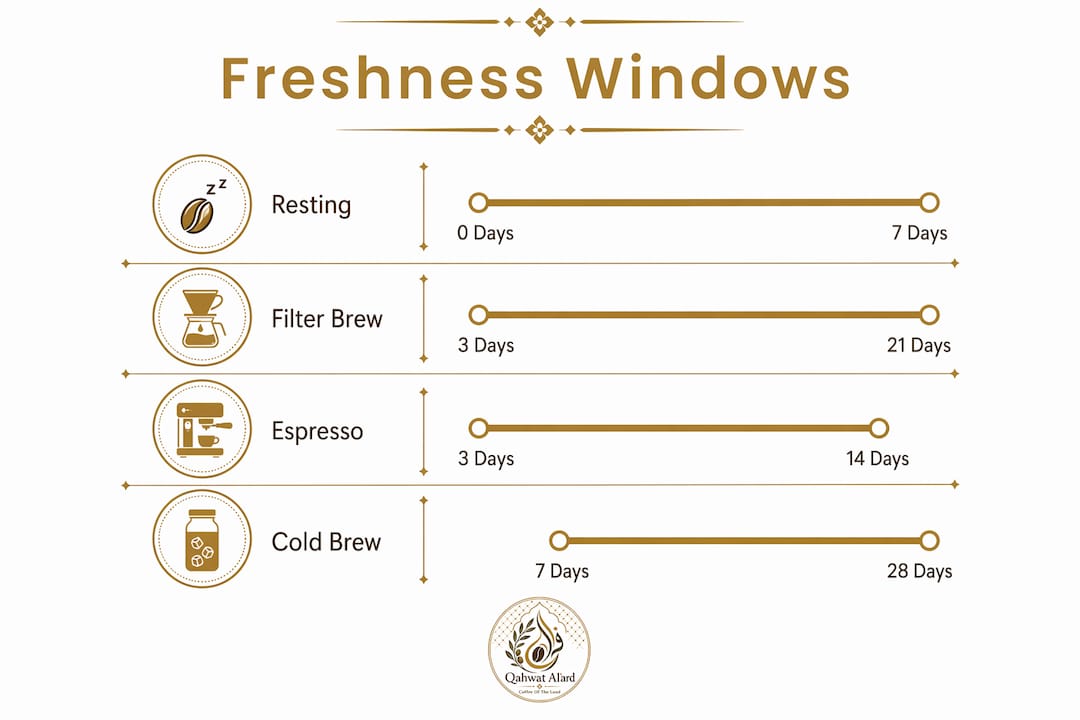
For filter brewing methods like pour-over, Chemex, or AeroPress, the sweet spot is generally 7 to 21 days post-roast. Espresso benefits from a longer rest because the high pressure of extraction amplifies CO2-related turbulence. Most espresso roasters suggest waiting 10 to 30 days after the roast date before pulling shots. This is why a bag labeled “roasted 2 days ago” is not necessarily ready to brew as espresso, even though it sounds maximally fresh.
Resting matters too. The SCA sensory training standards require a minimum rest of 8 to 24 hours after roasting before any cupping or sensory evaluation. This resting floor exists because CO2 is still actively escaping in the first hours, and flavor compounds have not yet stabilized. Home brewers should treat this as the minimum, not the target. Resting and the overall freshness window are two separate considerations, and both depend on roast date.
| Brewing method | Optimal window post-roast | Notes |
|---|---|---|
| Filter (pour-over, drip) | 7 to 21 days | Bright acidity and aroma peak in this range |
| Espresso | 10 to 30 days | Longer rest reduces CO2 interference in extraction |
| Cold brew | 14 to 28 days | Slower extraction tolerates slightly older beans |
| French press | 7 to 21 days | Full immersion benefits from degassed, settled beans |
Pro Tip: Buy in quantities you can finish within two weeks of opening the bag. A 250g bag brewed daily hits the filter sweet spot perfectly. A 1kg bag bought for convenience often means the last third is well past peak.
Lighter roasts degrade their delicate flavor profiles faster than darker roasts, which means the freshness window is narrower and the roast date is even more critical to track. A light Ethiopian natural roasted 25 days ago may already be past its most expressive phase. A medium-dark Brazilian blend at the same age might still be solid. Roast date without roast level context is useful. Roast date with roast level context is precise.
How to read and use roast dates when buying coffee
Knowing why roast date matters is one thing. Using that knowledge at the point of purchase is another. The first step is simple: look for a printed roast date, not a best before date. A best before date tells you when the manufacturer thinks the product becomes unsafe or unacceptable. A roast date tells you when the flavor clock started.
If a bag shows only a best before date, that is a signal worth taking seriously. Roasters who omit roast dates often blend multiple batches or work through older inventory, which makes freshness unpredictable. Some roasters print batch codes instead of roast dates. In that case, contact the roaster directly and ask for the roast date tied to that batch. Specialty roasters who prioritize freshness will answer without hesitation.
Packaging features also signal freshness commitment. One-way valve bags allow CO2 to escape without letting oxygen in, which is the correct design for freshly roasted coffee. A bag without a valve either was packaged after significant degassing had already occurred or is not designed with freshness in mind. Neither is ideal.
Storage after purchase follows straightforward rules:
- Keep beans in an airtight container away from light, heat, and moisture
- Avoid the refrigerator for daily-use coffee. Condensation from temperature cycling degrades beans faster than room temperature storage
- Freeze only for long-term storage, in sealed, portioned bags you open once
- Do not store near the stove or a window. Heat and UV light accelerate oxidation significantly
- Grind only what you brew. Pre-grinding exposes far more surface area to oxygen and collapses the freshness window from weeks to days
Consumers who switched from months-old store-bought coffee to freshly roasted beans reported immediate improvements in aroma, body, and flavor complexity. That difference is not subjective preference. It is chemistry.
Roast date versus origin, processing, and roast level
Coffee marketing leans heavily on origin stories, processing methods, and roast level descriptors. These attributes matter, but they describe the coffee’s potential, not its current state. Roast date describes the current state.
Origin and processing determine the flavor compounds present in the green bean. A washed Yirgacheffe from Ethiopia carries jasmine and citrus notes as a baseline. A natural-processed Sidama carries stone fruit and berry. Those characteristics survive the roast and express themselves in the cup. But they are not permanent. Oxidation and aromatic degradation erode those distinctive notes over time, regardless of how exceptional the origin is.
| Factor | What it tells you | Dynamic or static? |
|---|---|---|
| Origin | Flavor potential from terroir and variety | Static |
| Processing method | Fermentation and drying influence on flavor | Static |
| Roast level | Degree of heat transformation applied | Static |
| Roast date | Current freshness and flavor state | Dynamic |
Roast level modifies how flavor expresses itself. Roast date modifies whether that flavor is still present at all. A beautifully sourced, expertly roasted light Ethiopian coffee purchased six weeks after its roast date will taste duller than a competently sourced medium roast purchased one week post-roast. Freshness does not override quality, but it determines how much of that quality reaches your cup. For coffee enthusiasts who want to explore origin-driven flavor, roast date is the variable that decides whether those origin characteristics are audible or muted.
The volatile biomarkers that define a coffee’s sensory profile are time-sensitive. No amount of exceptional sourcing recovers them once they have degraded. This is why roast date is the one dynamic indicator in a field of static descriptors, and why it deserves more attention than it typically gets on a coffee bag.
Key takeaways
The roast date is the only dynamic quality indicator on a coffee bag, and it determines whether the flavor compounds from origin, processing, and roasting are still present in your cup.
| Point | Details |
|---|---|
| Roast date starts the flavor clock | Aromatic compounds like pyrazines and 2-furfurylthiol begin degrading immediately after roasting. |
| Freshness windows vary by method | Filter coffee peaks at 7 to 21 days post-roast; espresso benefits from 10 to 30 days of rest. |
| Roast level affects degradation speed | Lighter roasts lose delicate aromas faster; darker roasts oxidize surface oils more quickly. |
| No roast date is a red flag | Bags without roast dates often contain blended or aged inventory with unpredictable freshness. |
| Storage extends the window | Airtight containers, cool temperatures, and whole-bean storage preserve freshness after purchase. |
The number on the bag that most people ignore
I have cupped hundreds of coffees over the years, and the single most consistent predictor of a disappointing cup is not a bad origin or a clumsy roast. It is age. Specifically, it is buying coffee without knowing when it was roasted and assuming freshness because the bag looks new.
The uncomfortable reality is that most supermarket coffee is stale before it reaches the shelf. Best before dates of 12 to 18 months out are standard practice in mass-market coffee, and they are designed around food safety, not flavor. When I first started paying attention to roast dates and buying only from roasters who printed them clearly, the difference in cup quality was not subtle. Coffees I had written off as “not my preference” turned out to be excellent when consumed within the right window. I had been blaming origin when I should have been blaming age.
For home brewers, the practical shift is small but significant. Check the roast date before you buy. If it is not printed, ask. If the roaster cannot tell you, buy from one who can. Specialty roasters who roast to order and ship within days are not charging a premium for marketing. They are charging for a product that is actually at its best when it reaches you. That is worth paying for.
Supporting roasters who prioritize roast date transparency is also a vote for a better industry standard. Every time you choose a bag with a clear roast date over one without, you are telling the market that freshness is non-negotiable.
— Anthony-Yasin
Fresh coffee, delivered with full transparency from Qahwatalard
Qahwatalard prints accurate roast dates on every bag, because freshness is not a marketing claim. It is a commitment to the coffee in the cup.
Every coffee in the Qahwatalard lineup is roasted to order and shipped quickly, so the roast date on your bag reflects beans that are genuinely within their peak window when they arrive. The fresh-roasted coffee collection includes single-origin selections and carefully developed blends, all sourced from traceable growing regions and labeled with the transparency that specialty coffee deserves. If you want to taste what a roast date actually protects, this is the place to start. Freshness is not an accident at Qahwatalard. It is the standard.
FAQ
What does roast date mean on a coffee bag?
The roast date is the date the green coffee beans were roasted, marking the start of flavor and freshness changes. It is distinct from a best before date, which reflects shelf stability rather than peak flavor.
How long after the roast date is coffee still good?
The Specialty Coffee Association recommends consuming coffee within 2 to 6 weeks post-roast for best flavor. Filter brewing peaks at 7 to 21 days; espresso benefits from a longer rest of 10 to 30 days.
Why do some coffee bags not have a roast date?
Bags without roast dates often contain coffee blended from multiple batches or sourced from older inventory, making freshness unpredictable. Specialty roasters committed to quality always print the roast date clearly.
Does roast level affect how quickly coffee goes stale?
Yes. Darker roasts have porous structures that accelerate surface oil oxidation, while lighter roasts lose their delicate aromatic compounds faster due to their fragile chemical profiles. Both require attention to roast date, but the degradation pattern differs.
Should I rest coffee after the roast date before brewing?
The SCA recommends a minimum rest of 8 to 24 hours after roasting before tasting or cupping. For home brewing, waiting at least 3 to 5 days post-roast allows CO2 to dissipate and flavor to stabilize, especially for espresso.


