


You pull a shot at home, take a sip, and something feels off. The espresso is bitter, the crema is thin, and it tastes nothing like what your favorite café produces. That frustration is real, and it’s almost never about your technique alone. The gap between home and café coffee usually comes down to the tools in your setup, the quality of your beans, and the small routines that separate a mediocre cup from an exceptional one. This guide walks you through every essential piece of premium gear, how to set it up correctly, what mistakes to avoid, and how to know when your investment is truly paying off.
Table of Contents
- What you’ll need to create a premium home coffee bar
- Step-by-step: Setting up your home barista station
- Common mistakes and how to avoid them
- How to know your premium gear is working for you
- Why most premium coffee setups miss the mark — and how to get it right
- Ready to upgrade? Explore curated coffee gear and beans
- Frequently asked questions
Key Takeaways
| Point | Details |
|---|---|
| Essential gear matters | Investing in the right espresso machine, grinder, and accessories sets the foundation for home barista success. |
| Setup impacts quality | Proper station layout and calibration help achieve café-quality results from your premium gear. |
| Avoid common mistakes | Understanding and correcting frequent errors can dramatically improve your coffee experience. |
| Continuously assess results | Regularly check extraction quality, taste, and gear performance to measure your progress. |
| Beans and gear work together | Pairing premium equipment with specialty, ethically sourced beans maximizes flavor potential. |
What you’ll need to create a premium home coffee bar
Now that you know the potential of great coffee at home, let’s break down exactly what you’ll need to get started.
Premium home coffee starts with the right equipment. Not the flashiest gear, not the most expensive brand, but the right combination of tools that work together to give you control over every variable in your brew. Here’s a quick overview of the core pieces every serious home barista needs.
| Gear | Why it matters | Skill level needed |
|---|---|---|
| Espresso machine | Controls pressure, temperature, and extraction | Beginner to advanced |
| Burr grinder | Produces consistent particle size for even extraction | Beginner |
| Digital scale | Measures dose and yield for repeatability | Beginner |
| Portafilter (58mm) | Holds the puck; size affects accessory compatibility | Intermediate |
| Tamper | Compresses grounds evenly for consistent flow | Beginner |
| WDT tool | Distributes grounds before tamping | Intermediate |
| Milk frother/steam wand | Creates microfoam for lattes and cappuccinos | Intermediate |
Each item on this list plays a specific role. Skip the scale, and you’re guessing at your dose every morning. Use a blade grinder instead of a burr grinder, and you’ll get uneven particle sizes that cause channeling, which is when water finds the path of least resistance through your puck and produces a weak, sour shot.
The machine itself is the centerpiece. The Breville Barista Express Impress is widely regarded as a top premium all-in-one espresso machine for home baristas, featuring a built-in grinder, automated tamping, and precise dosing for consistent shots. It’s an excellent starting point if you want to minimize variables while you learn.

When it comes to beans, quality is non-negotiable. Fresh, specialty-grade coffee from a traceable origin will always outperform stale supermarket blends, regardless of how good your machine is. Filtered water matters too. Tap water with high mineral content can affect extraction and clog your machine over time. Use filtered water with a moderate mineral balance, around 150 ppm total dissolved solids, for the best results.
You can browse espresso machine options designed for home baristas who want café-quality results, or explore cold brew gear if you prefer a chilled, low-acid alternative.
Essential accessories beyond the basics:
- A knock box for spent pucks
- A portafilter stand for workflow organization
- A shot glass with volume markings
- A distribution tool (like a Stockfleth’s move or WDT needle tool)
- A cleaning brush and backflush disc
Pro Tip: If your budget allows only one upgrade beyond the machine, make it the grinder. A quality burr grinder, even a modest one, will improve your espresso more than any other single purchase.
Step-by-step: Setting up your home barista station
With your premium gear in hand, here’s how to put everything together for your own café-level setup.
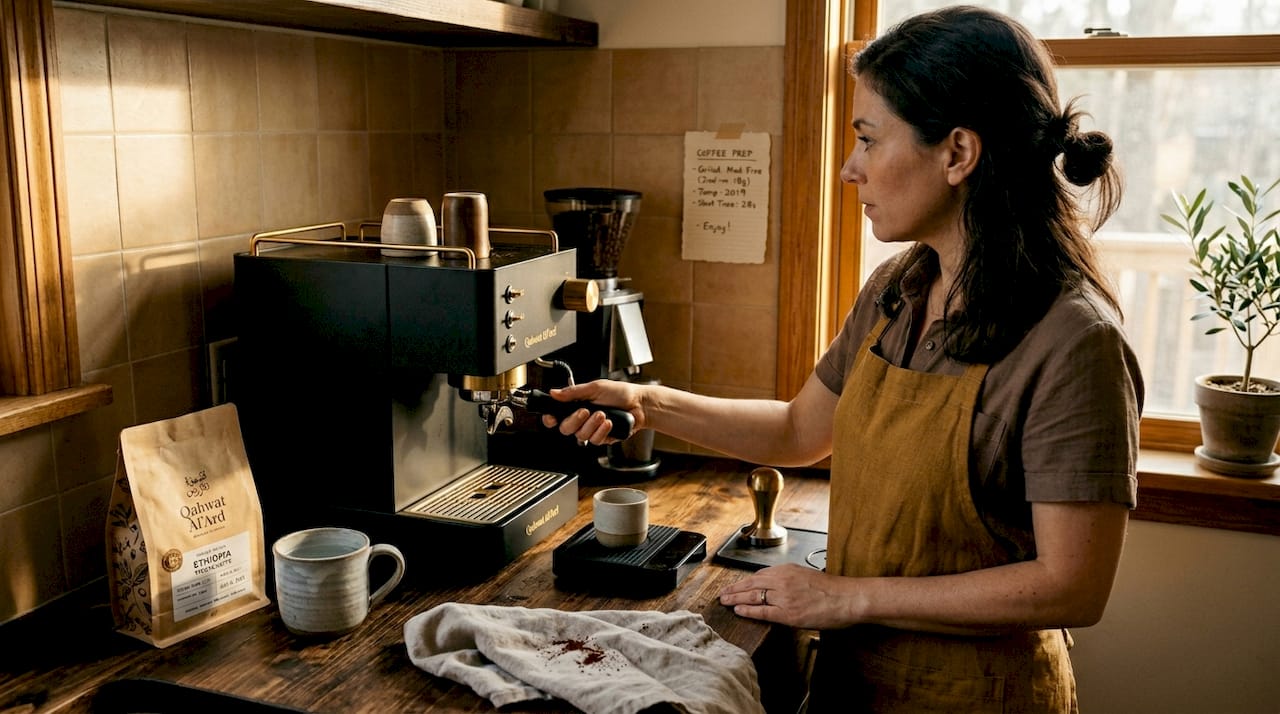
Setting up your station correctly from day one saves you hours of troubleshooting later. The sequence matters. Rushing through calibration or skipping the initial cleaning cycle can lead to inconsistent results that feel impossible to diagnose.
Follow these steps in order:
- Unbox and inspect everything. Check for damage, read the machine manual, and identify all components before powering anything on.
- Run a cleaning cycle. Most new machines ship with machine oil residue. Run two full cycles of plain water through the group head before pulling your first shot.
- Install a water filter. If your machine has a built-in filter, install it now. If not, use filtered water from the start.
- Set up your grinder. Place it directly next to the machine. Dial in the grind size using a medium-fine starting point, then adjust based on your shot time.
- Calibrate your dose. Use your scale to weigh your dry grounds before tamping. A standard double shot uses 18 to 20 grams of ground coffee.
- Pull your first test shot. Aim for a 1:2 ratio, meaning 18 grams in and 36 grams out, in 25 to 30 seconds. Adjust grind size if you’re outside that window.
- Steam your milk. Practice your steaming technique separately before combining it with your espresso pulls.
- Dial in and document. Write down your grind setting, dose, yield, and shot time. This becomes your baseline.
| Setup step | Time required | Skill level |
|---|---|---|
| Initial cleaning cycle | 10 minutes | Beginner |
| Grinder calibration | 15 to 30 minutes | Beginner |
| First dose calibration | 20 minutes | Beginner |
| Shot timing and yield | 30 to 60 minutes | Intermediate |
| Milk steaming practice | 1 to 2 hours | Intermediate |
One detail that gets overlooked is portafilter size. The 58mm portafilter is the industry standard for even extraction and gives you access to precision baskets from brands like VST and IMS. Smaller sizes, like the 54mm found in some popular machines, limit your accessory options and can make it harder to achieve even distribution across the puck.
If you want a faster morning option while you’re still dialing in your espresso skills, quick brew options can fill the gap without sacrificing quality. And if you’re ready to experiment with complex flavor profiles, specialty blends designed for home brewing offer a great way to explore what your setup can do.
Pro Tip: Position your grinder and scale at hand level, ideally on a low shelf or pull-out drawer, so you can weigh, grind, and distribute without lifting your arms above your waist. This small ergonomic change makes your morning routine significantly faster and more consistent.
Common mistakes and how to avoid them
Once set up, it’s easy to miss small errors that can derail your coffee quality. Here are key mistakes to watch for.
Even experienced home baristas fall into habits that quietly undermine their results. Most problems trace back to a handful of recurring errors that are easy to fix once you know what to look for.
The most common mistakes home baristas make:
- Skipping the scale. Eyeballing your dose leads to inconsistent extraction. Even a 1 gram difference in your dose can shift your shot time by several seconds.
- Ignoring grind size adjustments. Humidity, bean age, and roast level all affect how your coffee grinds. What worked last week may not work today if you opened a new bag.
- Tamping unevenly. A tilted tamp creates channels in the puck where water rushes through, producing a weak, sour shot on one side and an over-extracted, bitter shot on the other.
- Not purging the steam wand. Before and after steaming milk, always purge the wand. Milk residue inside the wand burns and ruins the flavor of your next cup.
- Using stale beans. Coffee is best used between 7 and 21 days after roast. Beans older than a month lose their CO2, which is what creates crema and carries aroma compounds.
- Skipping regular cleaning. A dirty machine is one of the most overlooked causes of off-flavors. Oils from coffee grounds go rancid quickly and coat your group head, basket, and portafilter.
The Breville Barista Express Impress addresses some of these issues with its automated tamping system, but no machine eliminates the need for good habits entirely.
Warning: Inconsistent tamping and dosing are the two most common causes of poor shot quality in home espresso setups. Even a premium machine cannot compensate for a poorly prepared puck. Always dose by weight and tamp with even, level pressure before pulling a shot.
For medium roast options that are forgiving during the dialing-in process, look for beans with a roast date clearly printed on the bag. Medium roasts have a wider extraction window than light roasts, making them ideal for home baristas who are still refining their technique.
Pro Tip: Clean your grinder burrs every two weeks if you’re pulling shots daily. Use a grinder cleaning tablet or a dry brush to remove old grounds and oils. Old grounds left in the burr chamber are one of the most common causes of flat, stale-tasting espresso that even fresh beans can’t fix.
How to know your premium gear is working for you
After making adjustments and learning from mistakes, it’s time to check if your gear is paying off.
Knowing whether your setup is actually improving your coffee requires more than just tasting the result. You need a few reliable checkpoints that give you objective feedback, especially when your palate is still developing.
Signs that your premium gear is delivering results:
- Consistent crema. A well-extracted espresso shot produces a thick, hazelnut-colored crema that holds for at least 60 seconds. Thin, pale, or quickly dissipating crema signals under-extraction or stale beans.
- Repeatable shot times. If you’re pulling the same dose with the same grind setting and hitting 25 to 30 seconds consistently, your setup is dialed in.
- Balanced flavor. A properly extracted shot tastes sweet, slightly acidic, and bitter in balance. If it’s overwhelmingly bitter, you’re over-extracting. If it’s sour and thin, you’re under-extracting.
- Smooth, glossy microfoam. Well-steamed milk has a paint-like texture with no visible bubbles. It integrates smoothly with espresso and holds latte art without breaking.
- No channeling marks. When you knock out your spent puck, it should come out in one clean, firm disc. Wet spots, holes, or crumbling indicate channeling or uneven distribution.
To track your progress more precisely, keep a simple taste log. Write down your grind setting, dose, yield, shot time, and a quick flavor note after each session. Over two to three weeks, patterns emerge that tell you exactly where your setup is strong and where it needs work.
For a more technical measurement, a TDS (total dissolved solids) meter measures the concentration of extracted coffee in your cup. Most specialty baristas target a TDS of 8 to 12 percent for espresso. It’s a small investment that gives you hard data instead of guesswork.
The 58mm portafilter standard enables more even water distribution across the puck, which directly translates to better flavor consistency from shot to shot. This is why upgrading to a machine with a standard-size portafilter is one of the most impactful changes you can make.
If you’re curious about alternative brewing methods to benchmark your palate, capsule brewing options offer a consistent reference point that helps you understand what a well-extracted cup should taste like.
Why most premium coffee setups miss the mark — and how to get it right
Here’s a perspective that might challenge how you think about building your home bar.
Most people who invest in premium coffee gear spend the first few months chasing hardware. They read forums, watch comparison videos, and convince themselves that one more upgrade will finally close the gap between their cup and the café down the street. We’ve seen this pattern repeatedly, and the honest truth is that the gear is rarely the bottleneck after a certain baseline.
Once you have a quality burr grinder, a machine with reliable pressure and temperature stability, and a 58mm portafilter, the next 20 percent of improvement comes entirely from your routine. How consistently you dose. How clean your equipment is. Whether you’re using beans within their optimal window. Whether you’re actually adjusting your grind when the shot time drifts.
The home baristas who make the most progress are not the ones with the most expensive machines. They’re the ones who pull shots every morning, keep a log, and treat dialing in as a skill to develop rather than a problem to solve with a purchase. A $600 machine used with discipline and fresh beans will consistently outperform a $2,000 machine used carelessly with old coffee.
Overlooked routines matter more than most people realize. Backflushing your group head twice a week, descaling every two months, and rinsing your portafilter after every shot are habits that preserve the flavor integrity of every cup you make. Neglecting them is like buying a high-performance car and never changing the oil.
Thoughtful upgrades beat collecting gadgets. If you’re going to invest further, put your money into better beans before better hardware. Exploring cold brew insights can also expand your understanding of extraction and flavor, giving you a broader palate to draw from when you return to your espresso setup.
The real premium coffee experience is built on intention, not price tags.
Ready to upgrade? Explore curated coffee gear and beans
To fully experience the elevation of your home bar, pair your gear with exceptional beans crafted for home baristas.
Your equipment is only half the equation. The beans you choose will define the ceiling of what your setup can achieve, no matter how well-dialed your machine is.
At Qahwat Al’Ard, we source and roast with the home barista in mind. Our Max Caf Blend is built for bold, consistent espresso pulls with a rich body and smooth finish that works beautifully through any quality machine. If you want to explore what your grinder and portafilter can do with truly expressive beans, our Single Origin Favorites sample pack lets you taste your way through multiple origins and roast profiles. For those who love the bright, complex notes that shine in milk-based drinks, our African Espresso is a standout choice. Every bag ships fresh, roasted to order, and sourced transparently so you know exactly where your coffee comes from.
Frequently asked questions
What equipment is essential for a premium home coffee setup?
An espresso machine with an integrated or separate burr grinder, a digital scale, a quality portafilter, and fresh specialty beans are the core essentials. The Breville Barista Express Impress is a strong all-in-one starting point that covers most of these bases.
Why does portafilter size matter in home espresso machines?
A 58mm portafilter lets you use precision accessories like VST and IMS baskets and gives more consistent extraction than smaller, proprietary sizes. Smaller portafilters limit your upgrade path as your skills develop.
How often should I clean my home coffee gear?
Clean your portafilter and group head daily, backflush your machine twice a week, and deep clean your grinder burrs every two weeks to maintain optimal flavor and machine performance.
Can premium instant coffee be part of a high-quality home bar?
Yes, modern premium instant blends use specialty-grade beans and deliver excellent flavor when quick convenience is the priority. They also serve as a useful flavor reference while you’re dialing in your espresso machine setup.


