


TL;DR:
- Resting coffee after roasting allows trapped CO2 to escape, improving extraction and flavor balance in your brew. The optimal resting period varies by roast level, with dark roasts needing 3 to 5 days and light roasts up to 14 to 21 days, depending on bean density. Proper storage and paying attention to bloom behavior during brewing help determine when beans are ready for optimal flavor extraction.
Resting coffee after roasting is defined as the deliberate waiting period that allows freshly roasted beans to release trapped carbon dioxide before brewing. This process, known in specialty coffee as degassing, directly controls extraction quality and flavor balance in your cup. Skip it, and you are fighting CO2 the entire time you brew. Understand it, and every variable from bloom to shot timing starts making sense. Whether you pull espresso on a La Marzocco or brew pour-over with a Hario V60, the resting process shapes your results more than most brewers realize.
Why resting coffee after roasting changes what’s in your cup
During roasting, coffee beans generate and trap significant volumes of carbon dioxide inside their cellular structure. The heat of the roast drives chemical reactions, including the Maillard reaction and caramelization, that produce CO2 as a byproduct. That gas stays locked inside the bean until it slowly escapes post-roast. Brew too soon, and you are extracting through a bean still under internal gas pressure.

The timeline of this release is steep at the start. Beans lose roughly 40% of their total CO2 content in the first 24 hours, which means the first day after roasting is the most volatile period for extraction stability. That rapid release creates erratic bloom behavior and uneven saturation in the coffee bed, making consistent brewing nearly impossible.
There is also a direct chemical consequence when CO2 meets brew water. Excess CO2 dissolves into brew water forming carbonic acid, which imparts a sharp, sour taste that masks the sweet and complex flavors the roaster worked to develop. This is not a subtle effect. It is the primary reason freshly roasted coffee often tastes bright to the point of harsh.
Resting is not about letting coffee go stale. It is about letting the bean transition from a thermally stressed state into a chemically stable one where extraction can work with the bean rather than against it.
Beyond CO2, resting also affects volatile aroma compounds. Resting shifts aroma compounds toward balance rather than creating new flavors, stabilizing the profile before oxidation becomes the dominant force. Think of it as the bean settling into itself. The flavors are already there from the roast. Resting just lets them stop competing with escaping gas.
How CO2 affects espresso and filter brewing differently
The effects of resting roasted coffee are not uniform across brewing methods. CO2 behaves very differently under the 9 bars of pressure an espresso machine applies compared to the gravity-fed flow of a pour-over or drip brewer.
For espresso, the consequences of brewing too fresh are immediate and measurable:
- CO2 inflates crema volume far beyond what extraction alone would produce, making the shot appear larger than it actually is.
- A fresh 30 g espresso can yield nearly double in perceived volume due to CO2-inflated crema, which misleads brewers into stopping the shot early.
- Gas creates channels through the puck, causing uneven water flow and underextraction in parts of the bed.
- Brewers compensate by coarsening the grind, which compounds the underextraction problem rather than solving it.
- The result is a sour, thin shot that looks visually correct but tastes wrong.
This is the “fresh bean trap” that catches even experienced home baristas. The visual cues that normally guide espresso dialing in become unreliable when CO2 is still actively escaping under pressure. Visual volume inflation from CO2-inflated crema misleads brewers into coarser grinds and early shot stops, both of which resting corrects by normalizing puck resistance.
Filter brewing is more forgiving, but CO2 still matters. In pour-over methods like the Chemex or Kalita Wave, the bloom phase exists specifically to pre-saturate the coffee bed and allow initial CO2 to escape before the main pour. When beans are too fresh, the bloom becomes violent and uneven, pushing water to the sides of the bed and creating dry spots in the center. The result is channeling without the pressure, just with less dramatic consequences than espresso.
Pro Tip: Watch your bloom. If it bubbles aggressively for more than 45 seconds and the bed rises unevenly, your beans likely need more rest. A calm, even bloom that subsides in 30 to 40 seconds is a sign the beans are in their extraction window.
For filter methods, a shorter rest of 5 to 10 days is generally sufficient. Espresso demands more patience, with optimal resting for espresso at 7 to 21 days to reduce CO2 enough for consistent shot calibration.
How long to rest coffee by roast level and bean type
Resting duration is not one-size-fits-all. Roast level, bean density, altitude of origin, and processing method all influence how fast CO2 escapes and when flavor peaks.
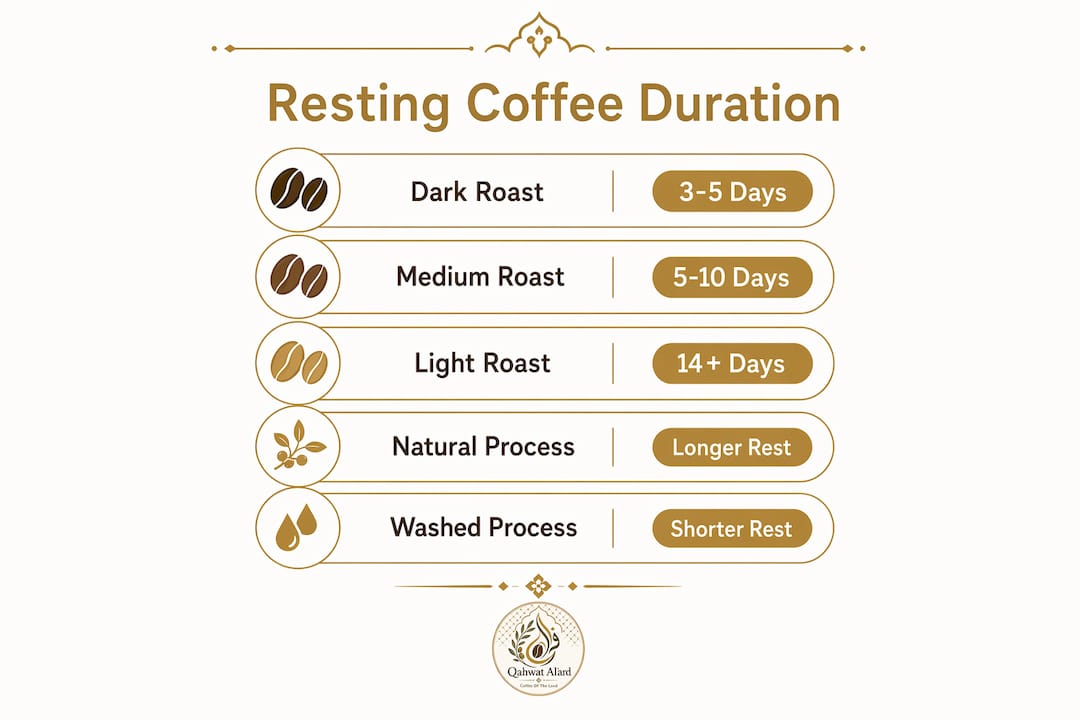
| Roast level | Optimal rest window | Why |
|---|---|---|
| Dark roast | 3 to 5 days | Porous cell structure from extended heat allows faster CO2 escape |
| Medium roast | 5 to 10 days | Moderate density balances degassing speed with flavor stabilization |
| Light roast | 14 to 21+ days | Dense bean structure slows CO2 release significantly |
Dark roasts degas faster due to porous structure, peaking in flavor around 3 to 5 days, while light roasts can need up to 14 to 21 days or more. This is a practical reality that surprises many home brewers who assume lighter roasts are more delicate and therefore need less time. The opposite is true. High-altitude beans like Ethiopian Yirgacheffe or Kenyan AA are naturally denser, and that density slows the entire degassing process.
Processing method also plays a role. Natural-processed coffees, where the fruit dries on the bean, tend to have more complex surface compounds that interact with degassing differently than washed coffees. Naturals often benefit from sitting at the longer end of their roast-level window. Understanding how bean density affects resting time helps you set realistic expectations before you even open the bag.
The risk of waiting too long is real but often overstated. Resting reaches diminishing returns as CO2 levels drop and oxidation becomes the main driver of flavor changes. Past the optimal window, you are no longer waiting for the bean to stabilize. You are watching it degrade. For most home brewers, the practical risk is brewing too soon, not waiting too long.
Pro Tip: Write the roast date on your bag with a marker the moment it arrives. Count forward based on roast level: 5 days for dark, 7 to 10 for medium, 14 to 21 for light. Brew your first cup on day one of the window and again on the last day to taste the difference.
How storage conditions shape the resting process
Getting the rest window right means nothing if storage conditions undermine the process. Temperature, packaging, oxygen exposure, and grind timing all interact with degassing in ways that either protect or destroy flavor.
- One-way valve bags are the most important packaging feature for resting coffee. One-way valve bags allow CO2 to escape while preventing oxygen from entering, which means the bean degasses naturally without being exposed to the oxidation that would otherwise start degrading flavor compounds.
- Storage temperature directly controls the speed of both degassing and oxidation. Cooler temperatures slow both processes. Room temperature storage around 65 to 70°F is appropriate during the active resting window. Moving beans to a cooler environment after the window closes slows the onset of staleness.
- Delaying bag opening preserves the controlled environment the one-way valve creates. Every time you open the bag, you introduce oxygen. Open it only when you are ready to measure and brew.
- Grinding accelerates everything. Ground coffee degasses exponentially faster but at the cost of flavor stability, since the increased surface area also accelerates oxidation. Grinding right before brewing is the standard for a reason. Grinding a day ahead to “speed up” resting trades CO2 for aromatic compounds you cannot get back.
- Freezing after the rest window is a legitimate preservation strategy. Once beans have completed their degassing window and reached peak flavor, freezing in an airtight container halts oxidation and locks the profile in place. Thaw only what you need and never refreeze.
Understanding how grind affects degassing reinforces why whole bean storage is the default recommendation from every serious roaster. The surface area difference between whole bean and ground is not marginal. It is the difference between days of stability and hours.
Key takeaways
Resting coffee after roasting is the single most controllable variable between a roast date and a great cup, and most home brewers skip it entirely.
| Point | Details |
|---|---|
| CO2 causes extraction failure | Brewing too soon creates carbonic acid and uneven saturation, producing sour, flat coffee. |
| Espresso needs the longest rest | Rest espresso beans 7 to 21 days to normalize puck resistance and eliminate crema inflation. |
| Roast level sets the timeline | Dark roasts rest 3 to 5 days; light roasts need 14 to 21+ days due to bean density. |
| Storage protects the rest window | One-way valve bags and whole bean storage preserve degassing without accelerating oxidation. |
| Bloom reveals resting stage | A calm, even bloom in 30 to 40 seconds signals the bean is in its optimal extraction window. |
The part most guides get wrong about resting
I have brewed coffee from dozens of origins and roast profiles, and the most consistent mistake I see home brewers make is conflating “fresh” with “ready.” The specialty coffee world has done a good job communicating that fresh-roasted is better than stale. It has done a poor job explaining that fresh-roasted is not the same as brew-ready.
The roast date on your bag is a starting line, not a finish line. I have tasted Ethiopian light roasts that were genuinely flat and astringent at day 7 and revelatory at day 18. The same beans. The same grinder. The same recipe. The only variable was time.
What I find more useful than any fixed rule is using the bloom as a live diagnostic. Bloom intensity correlates with residual CO2, so a vigorous, rising bloom tells you the bean is still degassing actively. A calm, even bloom tells you extraction conditions are stable. That feedback loop is more reliable than counting days on a calendar, especially when you are working with beans from different origins and processing methods.
My honest recommendation: buy from roasters who print the roast date clearly, not just a “best by” date. Then treat that date as data. Rest accordingly, taste deliberately, and adjust. The window between too fresh and too stale is wider than most people fear. You have time to get it right.
— Anthony-Yasin
Explore coffees worth resting at Qahwatalard
The benefits of coffee resting only show up when the beans are worth waiting for. Qahwatalard sources single-origin coffees from high-altitude growing regions where bean density and processing method directly shape how the rest window performs. Each bag ships with a roast date so you know exactly where you are in the degassing curve. For espresso brewers looking to experience what a properly rested shot actually tastes like, the African Espresso is roasted to a profile that rewards the full 7 to 14 day rest window. If you want to explore how resting affects medium roast complexity, the Coffee with Mushrooms Medium Roast offers a distinct flavor baseline that makes the before-and-after of resting genuinely noticeable.
FAQ
Why does fresh-roasted coffee taste sour?
Excess CO2 reacts with brew water to form carbonic acid, which masks sweetness and produces a sharp, sour taste. Resting allows CO2 to escape before brewing, removing this chemical barrier.
How long should you rest coffee before brewing?
Rest time depends on roast level: dark roasts peak at 3 to 5 days, medium roasts at 5 to 10 days, and light roasts at 14 to 21 days or more due to their denser cellular structure.
Does resting coffee apply to filter brewing too?
Yes, though filter methods are more forgiving than espresso. CO2 still disrupts bloom saturation and extraction evenness in pour-over and drip brewing, so a minimum rest of 5 to 7 days improves results.
Can you rest coffee too long?
Once CO2 levels drop fully, oxidation becomes the dominant process and flavor degrades. Storing beans in an airtight container or freezing them after the optimal rest window preserves peak flavor.
How do you know when coffee has rested enough?
Watch the bloom during brewing. A calm, even bloom that subsides in 30 to 40 seconds indicates the bean has degassed sufficiently and is in its optimal extraction window.


