


TL;DR:
- Flavor complexity in coffee reflects the depth and harmony of multiple, well-integrated flavor and aroma attributes. Experts assess it using tools like the SCA flavor wheel, which maps perceived flavors and tracks progression from aroma to aftertaste, emphasizing balance and evolution. True great coffee demonstrates layered, coherent development rather than just a multitude of disparate notes, making complexity a key indicator of quality.
Most coffee drinkers assume the best cup is simply the boldest, the most distinctive, or the one that hits hardest on the first sip. That instinct makes sense, but it misses what actually separates a truly great coffee from a merely interesting one. Flavor complexity is the real measure of excellence in specialty and single origin coffees. It is not about volume or shock value. It is about layered integration, where aromas, flavor notes, and mouthfeel weave together into a coherent, evolving experience from first sniff to lingering finish. This article will walk you from a clear definition of complexity through expert frameworks, scientific research, and practical tasting strategies you can use right now.
Table of Contents
- What is flavor complexity in coffee?
- How experts assess flavor complexity: The SCA flavor wheel
- The science behind flavor complexity: Beyond sensory panels
- Recognizing and describing complexity in single origin coffees
- Why complexity is the real hallmark of great coffee (and what most enthusiasts miss)
- Explore and elevate your coffee tasting experience
- Frequently asked questions
Key Takeaways
| Point | Details |
|---|---|
| Complexity definition | Flavor complexity means multiple interwoven flavors and aromas with balanced harmony. |
| Assessment frameworks | Professional tasters use the SCA flavor wheel and lexicon to identify and describe complexity. |
| Beyond simple notes | True complexity requires both distinct flavor families and integration—not just a list of flavor notes. |
| Science and tasting | Analytical tools help measure coffee chemistry, but sensory tasting remains the gold standard for evaluating complexity. |
| Recognizing complexity | Enthusiasts can enhance their tasting experience by focusing on aroma, progression, and balance within single origin coffees. |
What is flavor complexity in coffee?
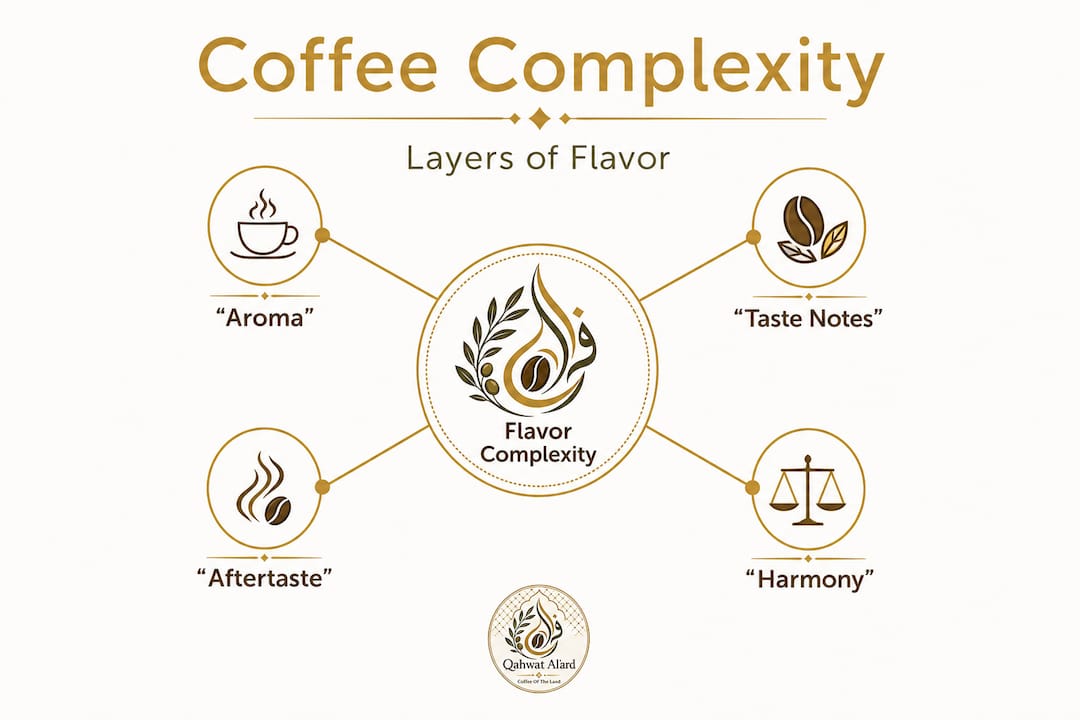
Flavor complexity is one of those terms that gets used loosely but means something precise in specialty coffee evaluation. At its core, flavor complexity is the extent to which a cup expresses multiple, distinguishable flavor and aroma attributes and how well they integrate. That second part matters enormously. A coffee can present ten distinct notes, but if those notes feel scattered or clash, the cup is not truly complex. It is merely busy.
This is where many enthusiasts get tripped up. They chase novelty, scanning for unusual descriptors like red wine, bergamot, or guava, and then call the coffee complex. But genuine complexity requires something more rigorous:
- Multiple flavor families present at once (fruity, floral, chocolatey, nutty, spicy, for example)
- Smooth progression from aroma through flavor to aftertaste
- Harmonious integration, where each note supports the others rather than competing for attention
- Evolving character as the cup cools, revealing new notes that were hidden at higher temperatures
“Flavor complexity is distinct from simple ‘distinctness’ — it can be edge-cased by balance/harmony, where a coffee may have many notes but still taste less ‘complex’ if they don’t integrate well.”
Think of it like a great piece of music. A guitar playing twenty fast notes is not inherently musical. What makes it musical is how those notes relate to each other rhythmically and harmonically. Coffee complexity works exactly the same way.
This principle is especially relevant for roast profiles. A dark roast complexity often focuses on deep, integrated notes like dark chocolate, cedar, and dried fruit, each complementing the others within a narrow but cohesive register. Meanwhile, medium roast flavors tend to show a wider spectrum, bridging bright acidity with sweetness and body. Even a well-designed Max Caf variation can demonstrate how a higher caffeine content does not preclude a layered, balanced flavor experience when the sourcing and roasting are done right.
The misconception that strength equals quality runs deep in coffee culture. Strength is a measure of concentration. Complexity is a measure of dimensionality. They are entirely different things, and treating them as equivalent is the most common mistake casual drinkers make when evaluating premium coffee.
How experts assess flavor complexity: The SCA flavor wheel
Defining complexity is only the beginning. Understanding how experts assess it provides real clarity and actionable guidance you can apply at home.
The most widely used tool is the SCA Coffee Taster’s Flavor Wheel. The SCA Coffee Taster’s Flavor Wheel is a methodology for mapping perceived flavors into standardized descriptors, allowing tasters to communicate with precision rather than vague impressions. The wheel is organized from the center outward: broad flavor families sit at the core, and increasingly specific descriptors branch toward the outer edges. You might start at “fruity” in the center, move outward to “berry,” and arrive at “blackberry” or “raspberry” at the perimeter.
Here is how the number of flavor families a cup expresses directly affects how complexity is perceived:
| Characteristic | Coffee with few flavor families | Coffee with many flavor families |
|---|---|---|
| Flavor range | Narrow, one-dimensional | Wide, multi-layered |
| Aroma | Single dominant note | Multiple evolving notes |
| Aftertaste | Short, fades quickly | Long, changes as it lingers |
| Balance | May be consistent but simple | Requires integration to achieve |
| SCA complexity score | Lower | Higher when well-integrated |
To use the SCA flavor wheel effectively in a real tasting session, follow this sequence:
- Smell the dry grounds before brewing. Note the first broad family that comes to mind, such as floral, fruity, or nutty.
- Brew and smell the bloom, the first release of gases when water hits the grounds.
- Sip at a high temperature and let the liquid coat your whole palate. Do not swallow immediately.
- Identify the first broad impression on the center ring of the wheel, such as “sweet” or “earthy.”
- Move outward on the wheel to narrow down the specific descriptor, such as from “sweet” to “vanilla” or “caramel.”
- Note any flavor shift as the coffee cools by ten to fifteen degrees. New notes often emerge at lower temperatures.
- Assess the aftertaste for length, pleasantness, and whether it introduces any new descriptors.
- Rate integration: do the notes feel cohesive, or do they feel like separate elements that do not belong together?
Using flavor mapping examples across multiple coffees in a single session gives you comparison points that sharpen your ability to identify complexity. It is much easier to recognize a complex coffee when you have just tasted a simpler one.
The science behind flavor complexity: Beyond sensory panels
While structured tasting guides help us describe flavor, science offers new ways to understand complexity at a chemical level.
Coffee flavor is not a single compound. It results from hundreds of volatile and non-volatile molecules interacting simultaneously in the cup. Analytical methods such as electrochemistry and e-tongue technology can quantify flavor profiles and chemical interactions, but complexity is still best understood through sensory frameworks. What science adds is confirmation: measurable chemical variation tends to align with higher perceived complexity scores from trained human panels.
The following table shows how sensory and analytical approaches complement each other in evaluating complexity:
| Indicator | Sensory approach | Analytical approach |
|---|---|---|
| Number of distinct notes | Taster counts flavor families | Gas chromatography identifies volatile compounds |
| Balance and harmony | Taster evaluates integration | Chemical ratio models predict harmonious combinations |
| Flavor progression | Taster tracks aroma to aftertaste | pH and dissolved solids change measured across brew temperature |
| Mouthfeel contribution | Taster assesses body and texture | Viscosity and protein content measured instrumentally |
| Complexity score | Expert panel consensus rating | Composite index from multiple chemical markers |
The e-tongue, a sensor array that mimics taste receptor responses, can detect chemical patterns in coffee that correlate with human ratings of complexity. This is useful for quality control in sourcing and roasting. But it cannot replace your palate. The chemical signal only becomes meaningful when it maps onto a sensory framework that a trained taster can interpret.
Pro Tip: Do not choose between structured tasting and scientific curiosity. The best approach layers both. Use the SCA framework to build your sensory vocabulary, then explore how flavor variation across different origins and roast levels reflects distinct chemical profiles. Over time, you will start to recognize complexity intuitively because you have trained both your palate and your analytical mind together.
Understanding the chemistry also helps you see why processing methods, terroir, and roast development have such a powerful effect on flavor complexity. Natural processed coffees tend to amplify fruity and fermented notes. Washed coffees typically express cleaner, brighter acid structures. The growing altitude, rainfall patterns, and soil composition at origin all contribute layers that no single compound can explain on its own.
Recognizing and describing complexity in single origin coffees
Scientific and structured analysis are important, but your own tasting experience is where recognition really begins.
Single origin coffees are the best classroom for studying complexity because you are tasting one specific place, harvest, and process rather than a blend engineered for consistency. Operational complexity in this context means multiple discernible flavor families plus a coherent progression from aroma through flavor to aftertaste, combined with good balance and overall alignment.
Here are the practical signs to look for in a single origin cup:
- Layered aroma: the dry fragrance, the wet aroma after brewing, and the steam above the cup all tell different stories
- Dynamic flavor progression: the first sip should taste different from the mid-palate experience and different again from the finish
- Length of aftertaste: complexity shows up in a finish that lingers and evolves rather than cutting off abruptly
- Temperature sensitivity: flavors that shift as the cup cools are a strong indicator of a multi-dimensional profile
- Positive texture cues: a clean, pleasant mouthfeel that supports rather than distracts from the flavor experience
When taking tasting notes, avoid the temptation to list every descriptor you can think of. Instead, group your observations into families: fruit, sweetness, acidity type (malic, citric, phosphoric), body, and finish. Then assess whether those families feel unified or fragmented. That assessment is your judgment of complexity.
Understanding how coffee terroir shapes these profiles gives your tasting notes real context. An Ethiopian Yirgacheffe does not taste floral and citrusy by accident. That expression comes from specific elevation, soil, and fermentation practices that interact to create compounds your palate recognizes as complexity. When you know that, the cup means more.
Pro Tip: Always taste at least two coffees side by side during a session. One should be a familiar, simpler baseline, and the other should be the complex coffee you want to evaluate. Contrast sharpens perception faster than any technique. Having the right coffee gear for tastings matters too. A clean grinder, a consistent brewing method, and filtered water remove variables that could mask or distort complexity. Even an instant coffee with mushroom can reveal interesting layered notes when tasted intentionally rather than gulped in a hurry.
Why complexity is the real hallmark of great coffee (and what most enthusiasts miss)
Here is the uncomfortable truth that most specialty coffee education skips over: the obsession with “note collecting” is actually holding a lot of enthusiasts back.
You know the pattern. Someone tastes a coffee and the goal becomes identifying as many descriptors as possible. Passionfruit, blueberry, brown sugar, jasmine, dark chocolate. The longer the list, the more impressed everyone seems. But that behavior trains your palate to catalog rather than evaluate. It turns tasting into a scavenger hunt rather than a holistic judgment about quality.
We see this constantly in how people talk about coffee online and at tastings. The emphasis goes to the most unusual or exotic note rather than to whether the cup actually delivers a satisfying, coherent experience from start to finish. A coffee that mentions thirty notes on its bag but tastes muddled in the cup is not a great coffee. It is a marketing exercise.
True complexity lives in integration and progression. The first sip should invite you in. The mid-palate should reward you with development. The finish should leave you wanting more, not confused about what you just tasted. That is the sequence that separates memorable coffee from merely interesting coffee.
Our view, shaped by years of sourcing and tasting coffees from Ethiopia, Yemen, Kenya, Tanzania, and beyond, is that complexity is not found by chasing the most unusual origin or the most experimental process. It is found by understanding what balance actually feels like in the cup and then selecting coffees that consistently deliver it. That takes patience and repeated exposure.
If you want to develop your palate for real complexity rather than novelty, start by exploring single origin coffees from contrasting regions. Compare an Ethiopian natural with a Kenyan washed. Feel how one leads with fruit and body while the other leads with bright acidity and clean clarity. Then ask yourself which one feels more integrated, not which one lists more notes. A sample pack for tasting built around origins rather than roast levels is one of the most efficient ways to calibrate your sense of balance and integration fast.
Explore and elevate your coffee tasting experience
If reading this has sparked the urge to actually taste these principles in action, that is the right instinct.
At Qahwat Al’Ard, we source and roast single origin coffees specifically to highlight the flavor complexity that makes each region worth knowing. Every coffee in our catalog is selected with balance, progression, and integration in mind, not just bold or unusual flavor profiles. If you are ready to start exploring, try a sample pack that puts contrasting origins side by side, giving your palate the comparison it needs to recognize true complexity. For a wider view of what is available, browse premium coffees across all our roast levels and origins and find the profile that speaks to your palate.
Frequently asked questions
How can I tell if a coffee is complex during a tasting?
Look for several distinct flavor families, a seamless flow from aroma to aftertaste, and overall harmony, as described by structured frameworks like the SCA flavor wheel. Better coffees show more distinct aromas and flavors with a longer, more pleasant finish and harmony among taste, aroma, and mouthfeel.
Does complexity always mean better coffee?
Complexity raises quality potential, but only when flavors are balanced and integrated. Poorly aligned flavors reduce perceived quality even when many individual notes are present.
What tools help recognize and describe coffee complexity?
The SCA flavor wheel and its accompanying sensory lexicon offer structured ways to map and communicate complex profiles. The SCA flavor wheel is based on the World Coffee Research Sensory Lexicon and is used alongside it to clarify attributes at multiple levels of specificity.
Can flavor complexity be measured scientifically?
Yes, analytical methods can quantify chemical interactions related to flavor, but sensory tasting remains essential for full complexity assessment. Electrochemistry and e-tongue techniques can evaluate flavor profiles via chemical interactions, but these findings still require translation into sensory frameworks to be meaningful.


