


TL;DR:
- Bean-to-cup traceability records a coffee lot’s journey from farm to retail with verifiable, linked data at each stage.
- Its effectiveness depends on accurate data entry and consistent lot identification, especially at cooperatives and mills.
- Consumers and buyers should verify lot IDs, harvest dates, and independent audits before trusting traceability claims.
Bean-to-cup traceability is the practice of recording and verifying a coffee lot’s journey from farm through processing, shipping, roasting, and retail so each cup can be traced to specific origin and handling records. As UNIDO defines it, traceability is the inter-linked chain of records across process steps, with cooperatives, traders, and manufacturers each serving as key data providers. In practice, it means a bag of coffee carries a verifiable lot history, not just a country name on the label.
One clarification worth making upfront: “bean-to-cup” means two different things depending on context. In kitchen appliance marketing, it refers to automated espresso machines that grind and brew in one step. In specialty coffee, the phrase describes supply-chain transparency, tracing a lot from a named farm to the consumer’s cup. This guide uses the supply-chain meaning exclusively.
The system only works as well as the data entered at each stage. Blockchain, QR codes, and GPS mapping can all make records tamper-resistant and publicly accessible, but none of them can fix an inaccurate farm-level entry. That dependency on data quality is the central limitation every buyer and roaster should understand before trusting a traceability claim.
Table of Contents
- What does the bean-to-cup supply chain actually look like?
- Why does traceability matter to consumers, roasters, and regulators?
- Which technologies actually enable end-to-end traceability?
- How does the data actually flow from farm to bag?
- What are the real limits of bean-to-cup traceability?
- How can you verify a traceability claim before you buy?
- How Qahwat Al’Ard connects consumers to coffee origins
- Key Takeaways
- Traceable coffee you can order today from Qahwat Al’Ard
- Selected sources and further reading
- FAQ
What does the bean-to-cup supply chain actually look like?
Coffee passes through more hands than most people realize before it reaches a retail shelf. Each stage generates distinct records, and a genuine trace history links all of them with consistent lot identifiers.
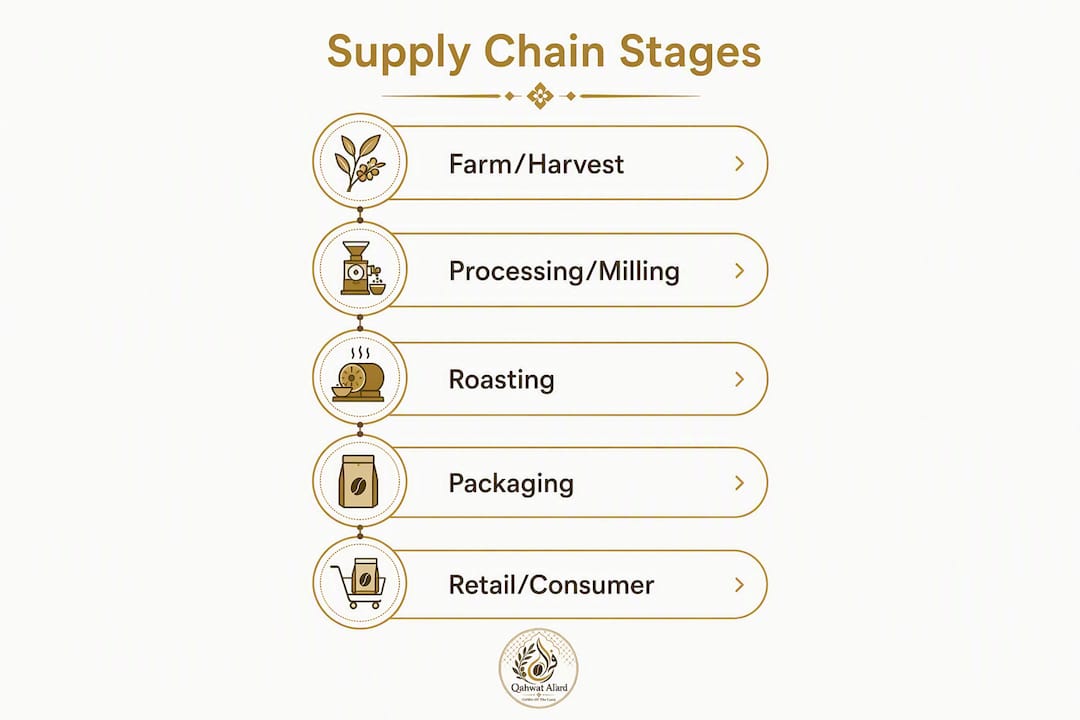
| Supply Chain Stage | Key Data Fields Typically Recorded |
|---|---|
| Farm / Harvest | GPS coordinates, farm name, variety, harvest date, input records (fertilizer, pesticide) |
| Wet/Dry Processing | Processing method (washed, natural, honey), start/end dates, moisture percentage |
| Milling and Grading | Screen size, defect count, moisture at mill, lot ID assigned |
| Export / Import | Bill of lading number, phytosanitary certificate, container ID, country of origin certificate |
| Roasting | Roast date, roast profile, batch/lot ID, weight in/out |
| Packaging / Retail | Bag ID, roast date printed, QR code or barcode linked to lot record |
| Brewing / Food Service | Batch-level trace where available, brew date, grind setting |
The data flow works like a chain of custody. A farmer or cooperative records harvest details and assigns a lot ID. That ID travels with the coffee through the mill, where processing records are appended. The exporter links the lot to shipping documents. When the roaster receives the green coffee, they match the shipment record to their intake log and assign a new roast-lot ID. That roast-lot ID is what ends up encoded in the QR code on the retail bag.
What keeps the chain intact is consistent, unique lot identification at every handoff. When a lot gets blended with another at the mill or cooperative level without a reconciliation record, the trace history breaks. That is the most common failure point in the entire system, and it happens far more often than the marketing around traceability suggests.
For single-origin coffees, the chain is tighter. A named farm, a single processing batch, and a dedicated roast lot can produce a genuinely traceable bag. For blends, including products like the Max Caf Blend, trace detail typically covers the roast lot and sourcing region rather than a single farm record, which is worth knowing when you compare trace claims across product types.
Why does traceability matter to consumers, roasters, and regulators?
The benefits are real, but they land differently depending on where you sit in the supply chain.
For consumers, traceability turns a bag of coffee into a story with evidence behind it. You can verify that the Ethiopia Yirgacheffe on your shelf came from a specific cooperative, harvested in a specific season, processed using a specific method. That matters for flavor expectations, because processing method directly affects cup profile. It also matters for ethical sourcing verification, because a lot history with named farms and cooperative records is harder to fabricate than a vague “sustainably sourced” label.
For roasters and importers, the business case is quality control and risk management. When a defective lot is identified, a trace record lets a roaster pull exactly the affected bags rather than issuing a broad recall. That precision protects both the brand and the customer. Traceability also supports premium pricing: a verifiable single-origin story commands a higher price point than a commodity blend, and buyers increasingly expect the documentation to back it up.
For regulators, the stakes are rising. The EU Deforestation Regulation, which applies to coffee entering the European market, requires operators to demonstrate that products are deforestation-free with documented due diligence. Phytosanitary certificates, certificates of origin, and import documentation all depend on the same underlying traceability infrastructure. Even for U.S. importers, customs documentation and food safety regulations under the FDA’s Food Safety Modernization Act create traceability obligations that a well-maintained lot history satisfies.
A few concrete scenarios show why this matters in practice:
- A consumer scans a QR code on a bag and sees the farmer’s name, the cooperative’s GPS location, and the harvest date. That single scan replaces a marketing claim with a verifiable record.
- A roaster identifies a moisture issue in a specific lot. Because the roast-lot ID links back to a specific mill record, they can notify only the customers who received that batch.
- A specialty importer uses farm-level records to support a Rainforest Alliance or organic certification audit, reducing the documentation burden at audit time.
The importance of coffee traceability extends beyond marketing. It is increasingly a compliance requirement, a quality tool, and a mechanism for distributing value more fairly along the supply chain.
Which technologies actually enable end-to-end traceability?
Several tools are in active use, and they work best in combination rather than isolation.

QR codes and digital passports are the most consumer-visible layer. A QR code on a bag links to a hosted page showing lot history, origin data, and sometimes photos from the farm. They are cheap to generate and easy for consumers to use. The limitation: the page behind the QR is only as trustworthy as the database it pulls from. A QR code is a pointer, not a proof.
Blockchain and distributed ledger technology (DLT) make recorded entries tamper-resistant by distributing copies across multiple nodes. A systematic literature review confirms blockchain can improve traceability and reduce information asymmetries, but benefits depend heavily on infrastructure, governance, and organizational capacity. In practice, blockchain proves that a record was not altered after entry. It does not prove the original entry was accurate.
Pro Tip: When a brand says “blockchain-enabled,” ask one follow-up question: “Can I access the on-chain record directly?” If the answer is no, or if the only view is a company-controlled webpage, the blockchain is providing internal auditability, not public verification. That is still useful, but it is not the same as open traceability.
RFID and barcodes track physical movement of bags and pallets through warehouses and logistics networks. They are reliable for custody tracking but require readers at each checkpoint, which adds cost and infrastructure that many smallholder-facing supply chains cannot support.
GPS and GIS mapping place farms on a map with verified coordinates. This is particularly valuable for deforestation compliance, since satellite imagery can cross-reference a farm’s location against forest-cover data. The ScienceDirect systematic review notes that IoT, AI, and GIS tools can monitor farm and supply-chain conditions, but adoption remains constrained by cost and scale.
Mobile data collection apps are arguably the most practical entry point for smallholder inclusion. A cooperative field agent with a smartphone can capture farm GPS, harvest photos with timestamps, and processing records in one workflow. Integrated mobile frameworks that combine blockchain, RFID, IoT, and mobile capture have modeled impacts including up to 20% lower operational costs and up to 15% productivity gains in pilot studies. The catch is that accuracy still depends on the person entering the data.
Backend data platforms tie everything together, aggregating records from multiple sources into a queryable database that can feed consumer-facing QR pages, certification audits, and roaster dashboards simultaneously. Without a coherent backend, the other tools produce siloed data that cannot be reconciled across the supply chain.
How does the data actually flow from farm to bag?
Understanding who records what, and when, makes the difference between evaluating a traceability claim and just accepting it.
- Farm record created. A farmer or cooperative field agent logs harvest details: farm GPS coordinates, variety, harvest date, and input records. A photo with a timestamp adds a verification layer that is difficult to fabricate retroactively.
- Cooperative verification. The cooperative aggregates individual farm lots, cross-checks records against physical delivery weights, and assigns a cooperative-level lot ID. This is where individual farm identity can be preserved or lost, depending on whether the cooperative maintains lot separation.
- Mill and processing record appended. The mill logs processing method, start and end dates, moisture percentage at intake and output, and screen size after grading. The lot ID from the cooperative travels with the coffee.
- Exporter creates shipment record. The exporter links the lot to a bill of lading, phytosanitary certificate, and certificate of origin. The shipment record connects the physical coffee to its export documentation.
- Roaster receives and assigns roast-lot ID. At intake, the roaster logs the green coffee against the shipment record, records weight and moisture, and assigns an internal roast-lot ID. The roast profile, date, and batch weight are added when the lot is roasted.
- Retail bag links to roast-lot via QR or barcode. The bag’s QR code or barcode encodes the roast-lot ID, which the backend platform uses to surface the full lot history when scanned.
| Actor | Records Generated | Example Fields |
|---|---|---|
| Farmer / Cooperative | Farm record, harvest log | GPS coordinates, variety, harvest date, input records |
| Mill | Processing record | Method, dates, moisture %, screen size, lot ID |
| Exporter | Shipment record | Bill of lading, phytosanitary certificate, container ID |
| Roaster | Intake log, roast record | Green weight, roast date, roast profile, roast-lot ID |
| Retailer / Brand | Bag record | Bag ID, roast date, QR code linked to roast-lot |
Common failure points cluster at the cooperative and mill stages. Non-unique lot IDs, aggregation of multiple farms into one lot without reconciliation records, and siloed systems that cannot exchange data with the roaster’s platform are the three most frequent causes of trace gaps. Independent audits and photographic evidence with timestamps are the most effective verification checkpoints, because they create records that are costly to falsify.
What are the real limits of bean-to-cup traceability?
Honest traceability advocates acknowledge the gaps. The technology is not the hard part. The hard part is the human and economic context around it.
Technical limits include the absence of universal data standards, which means a record created in one platform often cannot be read by another. Many coffee-growing regions have limited internet connectivity, making real-time data capture impractical. Offline mobile apps that sync when connectivity is available help, but they introduce reconciliation risks.
Economic and social limits are more stubborn. Smallholder farmers bear the cost of data collection without always sharing in the premium it generates. A Frontiers review found that blockchain pilots risk increasing the burden on small producers and reinforcing existing power asymmetries rather than correcting them. Who controls the data, who can access it, and who profits from the traceability premium are questions that technology alone cannot answer.
Operational errors are the most common source of inaccuracy. A field agent who enters the wrong harvest date, a mill that reuses a lot ID across two batches, or an exporter who consolidates lots without documentation all introduce errors that propagate through the entire chain. Once an inaccurate record is anchored to a blockchain, it is immutably wrong.
Fraud risk exists at every stage where physical coffee changes hands without independent verification. A shipment labeled as single-origin Ethiopia can be blended with lower-grade coffee after the trace record is created. Without physical verification at key handoffs, the record and the product can diverge.
Mitigation approaches that actually work: cooperative-level training and aggregation support, role-based access controls so records cannot be altered after verification, third-party audits at the farm and mill stages, and financial incentives that reward accurate data entry rather than just participation. Sustainable farming practices that build cooperative capacity also strengthen the human infrastructure that traceability depends on.
How can you verify a traceability claim before you buy?
Most consumers never look past the label. Here is what to actually check.
When you scan a QR code, look for:
- Farmer or cooperative name (not just a country or region)
- Harvest date or crop season
- Lot ID or batch number
- Processing method (washed, natural, honey, anaerobic)
- Roast date and roast-lot ID
- Independent verification, certification, or audit reference
What a credible digital passport contains versus marketing copy:
A genuine trace page shows timestamped records, specific lot IDs, and ideally photos from the farm or processing station. A marketing page shows a map of the origin country, a paragraph about “our commitment to farmers,” and no verifiable data. The difference is usually obvious within 30 seconds of reading.
Questions worth asking a roaster or seller:
- “Can I see the lot history for this specific bag?”
- “Who verified the farm-level entries, and when?”
- “Is there an audit, certification, or cooperative record I can reference?”
- “What lot ID is on this bag, and where does it trace back to?”
Red flags that suggest weak or performative traceability:
- No roast date on the bag
- Origin listed only as a country or broad region with no farm, cooperative, or lot ID
- “Blockchain-enabled” language with no accessible on-chain record or audit trail
- QR code that leads to a general brand page rather than lot-specific data
- Certification logos without a verifiable certificate number
Reading origin labels carefully is a skill worth developing. A bag that names a specific cooperative, processing station, and harvest season is telling you something verifiable. A bag that says “sourced from the highlands of Ethiopia” is telling you almost nothing.
How Qahwat Al’Ard connects consumers to coffee origins
Qahwat Al’Ard builds its product selection around the principle that origin information should travel with the coffee, not get stripped out at the roasting or retail stage. For single-origin offerings, the brand publishes provenance details on product pages, including sourcing region, processing method, and roast profile, so buyers can connect flavor expectations to specific handling decisions made at origin.
The operational logic follows the supply-chain stages described above. Green coffee is sourced from named growing regions, roasted in tracked batches, and packaged with roast dates and lot references that link back to the sourcing record. That chain of information supports both the flavor storytelling on the product page and the ethical sourcing claims the brand makes about its supply relationships.
Product-level trace detail varies by SKU type, which is worth understanding. The Instant Coffee and 12 Pack Single Serve Coffee Capsules offer convenience-format options where roast-lot and sourcing information is available, though the trace depth for a capsule format differs from a whole-bean single-origin listing. Blends like the Max Caf Blend carry roast-lot traceability and sourcing region data, but by nature of blending, they do not trace to a single farm the way a single-origin lot does. That distinction is not a flaw; it is just an honest description of what traceability looks like across different product formats.
Key Takeaways
Bean-to-cup traceability is only as reliable as the data entered at each supply-chain stage, which means verification tools and independent audits matter as much as the technology itself.
| Point | Details |
|---|---|
| Definition | Traceability records a coffee lot’s journey from farm through roasting and retail with verifiable, linked data at each stage. |
| Technology limits | QR codes, blockchain, and RFID prove records exist; they cannot guarantee the original farm-level entry was accurate. |
| Key verification steps | Scan QR codes for lot ID, harvest date, processing method, roast date, and an independent audit or certification reference. |
| Common failure points | Lost lot reconciliation at the cooperative or mill stage is the most frequent cause of trace gaps in real supply chains. |
| Qahwat Al’Ard | Publishes sourcing region, processing method, and roast-lot data on product pages, with single-origin listings offering the deepest trace detail. |
Why traceability is worth more than the marketing around it
The conversation about bean-to-cup traceability tends to get captured by technology vendors and marketing teams, which means the actual substance, what a lot history proves and what it cannot, gets buried under enthusiasm for blockchain pilots and QR code campaigns.
What I find genuinely worth paying attention to is the human layer underneath the technology. A timestamp on a blockchain entry is only as honest as the person who created it. The cooperatives and field agents who do the actual data entry are often the least resourced actors in the supply chain, and the systems built around them frequently extract data without returning value. When traceability is designed to serve compliance and marketing rather than farmer income, it tends to produce records that look good on a product page and mean very little to the people who grew the coffee.
The specialty coffee sector is at its best when traceability serves both ends: a consumer who can verify what they are buying and a producer who gets a better price because that verification exists. That connection, between transparency and fair value distribution, is what separates genuine supply-chain accountability from a QR code pointing to a pretty map. Buyers who ask harder questions, specifically about lot IDs, cooperative records, and audit trails, are the ones who actually move the market toward something better.
Traceable coffee you can order today from Qahwat Al’Ard
Knowing what to look for in a traceable coffee is one thing. Finding it without spending an afternoon cross-referencing product pages is another.
Qahwat Al’Ard’s single-origin collection is the most direct starting point for buyers who want sourcing region, processing method, and roast-lot information in one place. Each listing is built around the origin story of the coffee, not just its flavor profile, so you get the context that makes traceability meaningful rather than decorative. For convenience formats, the 12 Pack Single Serve Coffee Capsules and Instant Coffee both carry roast-lot and sourcing information on their product pages. Browse the full coffee collection to find the format and origin that fits what you are looking for, and check the product page for the trace details that matter to you before you add to cart.
Selected sources and further reading
These are the primary research and practitioner sources used in this article. Industry professionals looking for implementation detail should consult the methods sections of the academic papers directly.
- Traceability in the Green Coffee Supply Chain (UNIDO) — Authoritative definition of traceability and the multi-stakeholder collaboration required; covers cooperative and trader roles in data generation.
- Optimizing coffee supply chain transparency and traceability through mobile application (Emerald / EJIM) — Covers integrated mobile, blockchain, RFID, and IoT frameworks; includes modeled cost and productivity impacts from pilot studies.
- Blockchain and Coffee Supply Chain: Implications for Traceability, Efficiency, and Sustainability (MDPI) — Systematic literature review on blockchain’s context-dependent benefits and governance constraints.
- The promised potential of blockchain technology for transparency and fairness in agri-food chains: insights from the coffee sector (Frontiers) — Critical review of blockchain pilots; addresses power asymmetries and smallholder burden.
- Transparency and Traceability in the Supply Chains of Coffee and Cocoa (Maastricht University / FSD) — Covers siloed systems, fragmentation, and the role of cooperatives in maintaining trace integrity.
- Digital technologies and sustainability transformations in coffee supply chains (ScienceDirect) — Systematic review of IoT, AI, and GIS roles; addresses adoption barriers and research gaps.
- Coffee Intelligence business brief (Cropster) — Practitioner-facing clarification of the two meanings of “bean-to-cup” and their implications for supply-chain communication.
FAQ
What is traceability in coffee?
Coffee traceability is the practice of recording and linking a lot’s movement and handling data from farm through processing, export, roasting, and retail, so the origin and custody history of any bag can be verified. As UNIDO defines it, it is an inter-linked chain of records across process steps, maintained by cooperatives, traders, and manufacturers.
What does “bean to cup” mean in a supply-chain context?
In specialty coffee, “bean to cup” refers to supply-chain transparency, tracing a coffee lot from a named farm or cooperative to the consumer’s cup with verifiable records at each stage. It is distinct from the appliance industry’s use of the term for automated espresso machines that grind and brew in one step.
Which coffees tend to have the least pesticide exposure?
Certified organic coffees carry the strongest documented controls on pesticide use, since organic certification requires third-party audits of farm inputs. Single-origin coffees from traceable supply chains also tend to have better-documented input records than commodity blends, though “low pesticide” claims without a certification or lot-level audit trail are difficult to verify independently.
What is the 15-15-15 coffee rule?
The 15-15-15 rule is a brewing guideline sometimes cited in specialty coffee: 15 grams of coffee, 15 bars of pressure, and a 15-second extraction time as a starting point for espresso. Definitions vary across sources, and it is a practitioner heuristic rather than a formal industry standard.
How do I know if a traceability claim on a coffee bag is genuine?
Look for a specific lot ID, harvest date, processing method, and roast date, ideally linked to a QR code that opens a page with timestamped records rather than a general brand story. Independent certification references or cooperative audit records are the strongest verification signals; a vague region name with no lot ID is the clearest red flag.


