


TL;DR:
- Gourmet (specialty) coffee uses high-scoring Arabica beans from traceable origins with careful processing methods, resulting in a broader flavor spectrum. Regular coffee blends lower-grade beans with less emphasis on freshness and origin, leading to a narrower, more uniform taste. Choosing high-quality coffee involves examining roast date, origin details, and transparency, offering better flavor and potential health benefits at a modest premium.
Gourmet coffee is defined as premium, carefully sourced coffee made from high-scoring Arabica beans that deliver complex, origin-driven flavors. Regular coffee, by contrast, is mass-produced for cost efficiency and consistency, often blending Robusta and lower-grade Arabica beans to hit a price point. The difference between gourmet and regular coffee is not just marketing. It runs from the farm through the roaster and into your cup. Understanding these distinctions helps you spend smarter, taste better, and support the practices that actually matter in the coffee supply chain.
What makes gourmet coffee beans different from regular coffee beans?
The foundation of every quality difference starts with the bean itself. Specialty coffee uses 100% Arabica beans from single origins, while regular commercial coffee typically blends Arabica with Robusta or lower-grade lots sourced in bulk. Robusta carries roughly twice the caffeine of Arabica but delivers a harsher, more bitter flavor with a rubbery aftertaste. That bitterness is not a flaw in Robusta. It is simply a different plant with a different purpose: volume and cost reduction.
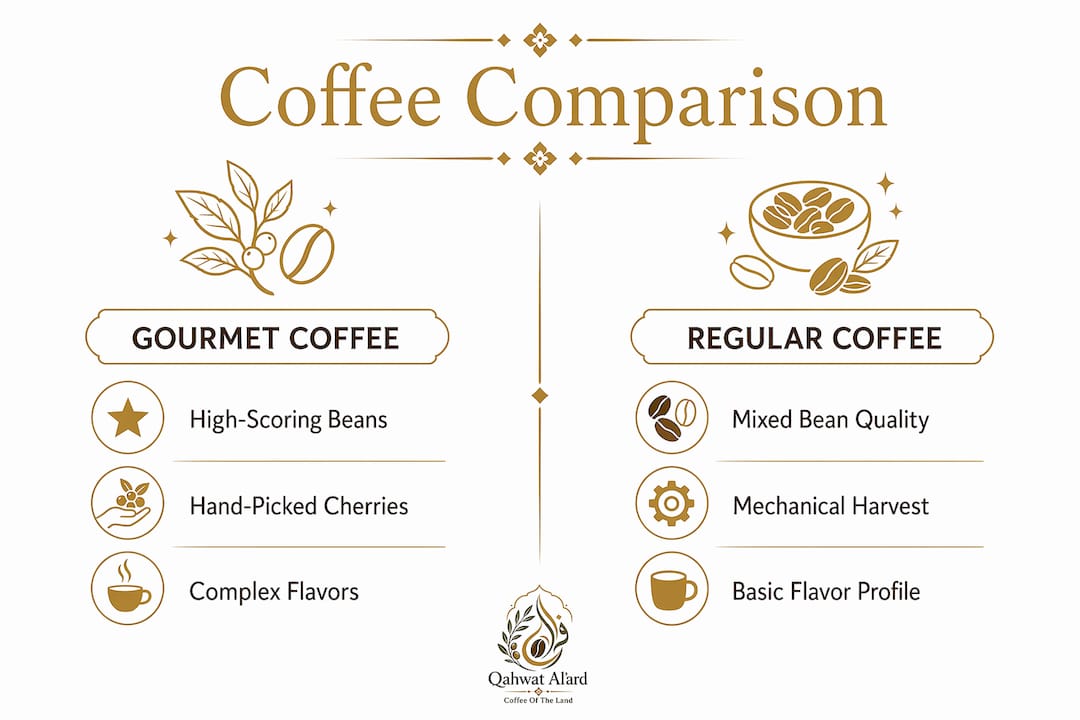
The Specialty Coffee Association (SCA) scores beans on a 100-point scale. Specialty coffee scores 80 or above, while regular commercial coffee typically lands between 60 and 75. That gap reflects defect tolerance. A 350-gram sample of specialty coffee must contain zero category-one defects (like full black beans or full sours) and fewer than five category-two defects. Commercial lots allow far more. Those defects carry off-flavors directly into your cup.
Harvesting method also separates the two categories. Specialty producers hand-pick only ripe, red cherries at peak sugar development. Commercial operations use mechanical strip harvesting, which pulls every cherry off the branch regardless of ripeness. Unripe and overripe cherries mixed together produce inconsistent fermentation and muddled flavor. The role of terroir and origin compounds this further. A well-farmed Ethiopian Yirgacheffe grown at 1,800 meters carries jasmine and bergamot notes that no amount of roasting skill can create from a low-altitude, mechanically harvested lot.
| Feature | Gourmet (Specialty) Coffee | Regular Commercial Coffee |
|---|---|---|
| Bean variety | 100% Arabica, single origin | Arabica/Robusta blend or mixed lots |
| SCA score | 80 to 100 | 60 to 75 |
| Harvesting method | Hand-picked, selective | Mechanical strip harvest |
| Defect tolerance | Near zero | High tolerance |
| Flavor potential | Complex, origin-driven | Consistent, narrow spectrum |
Pro Tip: When buying whole beans, look for a roast date on the bag, not just a “best by” date. A roast date tells you the roaster is confident in their product’s freshness.
How do roasting and processing methods influence gourmet vs regular coffee taste?
Roasting is where potential becomes flavor, and the two categories treat it very differently. Commercial roasters prefer dark roasts to mask defects and unify inconsistent lots under a single smoky, bitter profile. Specialty roasters use light to medium roasts specifically to preserve the origin character that careful farming produced. A dark roast applied to a high-quality Ethiopian bean destroys the floral and fruit notes that made it worth sourcing in the first place.
Processing method is the step between harvesting and roasting, and it shapes flavor just as dramatically. Three methods dominate the specialty world:
- Washed (wet) processing removes the fruit before drying, producing clean, bright, acidic coffees where the bean’s intrinsic character shines. Ethiopian Gedeo washed coffees are a textbook example of clarity and floral complexity.
- Natural (dry) processing dries the whole cherry intact, letting the fruit ferment around the bean. The result is a heavier body with intense berry and wine-like notes. Ethiopian Harrar naturals and Brazilian naturals are widely recognized examples.
- Honey processing sits between the two. Some fruit mucilage is left on the bean during drying, producing sweetness and body without the full fermentation intensity of naturals. Costa Rican yellow honey and red honey lots are popular among specialty buyers.
You can explore how each of these processing techniques affect flavor in detail to understand why two coffees from the same country can taste completely different. Regular commercial coffee rarely specifies processing method because the goal is uniformity, not distinction.
Freshness is the final roasting variable most consumers overlook. Specialty coffee is best consumed within two to six weeks of the roast date. CO2 off-gassing peaks in the first few days and tapers off, taking volatile aromatic compounds with it. Commercial coffee sits in warehouses and on retail shelves for months, which is why roast date transparency is a reliable signal of a roaster’s commitment to quality.
Pro Tip: If you brew cold brew regularly, know that the method mutes acidity and origin character significantly. Cold brew narrows the flavor gap between gourmet and regular coffee, making it a reasonable use case for lower-cost beans.
What flavor and sensory differences can you expect?
The flavor gap between premium and commercial coffee is measurable, not just subjective. Untrained consumers identify specialty coffee correctly in 80 to 85% of blind taste tests, and accuracy approaches 100% when the regular coffee is stale or pre-ground. That is a striking result. It means the difference is not reserved for trained palates.
Gourmet coffee delivers a wide sensory spectrum. Depending on origin and processing, you might taste stone fruit, citrus, dark chocolate, caramel, jasmine, or brown sugar. Acidity in specialty coffee is not sourness. It is brightness, the same quality that makes a ripe peach more interesting than a flat one. Body ranges from tea-like and delicate in a light-roasted Kenyan to syrupy and full in a natural-processed Sumatran.
Regular coffee operates in a narrower band: roasty, bitter, smoky, and flat. Those qualities are not inherently bad. They are predictable, which is exactly what mass-market brands need to deliver. The issue is that dark roasting and stale beans eliminate the possibility of complexity. You cannot taste what was never preserved.
| Sensory Attribute | Gourmet Coffee | Regular Coffee |
|---|---|---|
| Flavor range | Fruity, floral, chocolatey, caramel | Roasty, bitter, smoky |
| Acidity | Bright and structured | Low or harsh |
| Body | Variable (light to full) | Medium to heavy, uniform |
| Aroma | Complex, origin-specific | Generic roast aroma |
| Aftertaste | Clean, lingering sweetness | Bitter, short |
Brewing method and coffee grind consistency amplify these differences. A specialty bean brewed on a quality pour-over with a freshly calibrated grind will express its full range. The same bean run through a blade grinder and a cheap drip machine will taste closer to regular coffee. The bean sets the ceiling. Brewing determines how close you get to it.
Are there any health benefits linked to gourmet versus regular coffee?
Coffee’s health benefits are real, but they are tied to quality and consumption habits. High-quality coffee contains polyphenols and antioxidants that reduce inflammation and oxidative stress, supporting cardiovascular health. These compounds are more concentrated in well-processed, high-quality beans than in defect-heavy commercial lots where degraded beans contribute fewer bioactive compounds.
The evidence on moderate consumption is compelling. Here is what the research shows:
- Cardiovascular protection: Drinking 3 to 4 cups per day is linked to a 19% decrease in cardiovascular mortality, particularly when consumed without excess sugar or cream.
- Mental clarity and metabolism: High-quality coffee’s bioactive compounds support mental clarity and metabolic function beyond the caffeine effect alone.
- Additive impact: Sugar, flavored syrups, and heavy cream modify the health profile significantly. A black specialty coffee and a sweetened commercial latte are nutritionally unrecognizable as the same beverage. If you want to experiment with a homemade coffee creamer that avoids processed additives, the difference in your daily intake adds up quickly.
- Brewing method and antioxidant bioavailability: Filtered brewing methods like pour-over remove cafestol, a diterpene that raises LDL cholesterol. Unfiltered methods like French press and espresso retain it. Neither is universally better, but knowing the difference lets you make an informed choice.
The practical takeaway is that gourmet coffee’s health advantage comes from fewer defects, better processing, and the habit of drinking it black or with minimal additions. Regular coffee consumed in moderation still delivers meaningful benefits, but the quality ceiling is lower.
How can coffee lovers choose the right coffee based on quality and budget?
Price is the most common barrier people cite when considering premium coffee, and the math is often misunderstood. A quality specialty bag costs $18 to $25 for 12 ounces. At roughly 28 grams per 12-ounce brewed cup, that yields about 15 cups per bag, or $1.20 to $1.65 per cup at home. A commercial bag costs $8 to $12 for the same weight but delivers a fundamentally different experience. The per-cup gap is roughly 50 to 75 cents. For daily drinkers, that is a meaningful number. For occasional or weekend brewing, it is negligible.
Here is how to make smarter decisions at every budget level:
- Read the bag like a label. A quality roaster lists origin country, region or farm, processing method, and roast date. Bags that list only “medium roast” or “premium blend” with no sourcing detail are commercial products regardless of price.
- Seek sourcing transparency as a quality signal. Roasters who publish farm relationships, harvest years, and processing details are accountable for what is in the bag. Opacity is not modesty. It is a sign that the details would not impress you.
- Use regular coffee strategically. Cold brew concentrate, large-batch office brewing, and baking applications are all situations where a commercial blend performs adequately. Reserve specialty beans for methods that showcase their character: pour-over, AeroPress, or a well-dialed espresso.
- Try a sample pack before committing. Side-by-side tasting is the fastest way to calibrate your own palate. Brewing a specialty single-origin next to your usual commercial bag on the same morning removes all variables except the coffee itself.
The term “gourmet” carries no regulatory definition. Any brand can print it on a bag. The SCA score, roast date, and origin transparency are the only reliable proxies for actual quality.
Key takeaways
Gourmet coffee outperforms regular coffee in flavor, quality, and health potential because it starts with better beans, preserves them through careful processing, and delivers them fresh.
| Point | Details |
|---|---|
| Bean quality is the foundation | Specialty coffee uses SCA-scored Arabica beans (80+); commercial coffee allows far more defects. |
| Roast level reveals intent | Light and medium roasts preserve origin character; dark roasts mask defects in lower-quality lots. |
| Freshness is non-negotiable | Specialty coffee consumed within six weeks of roast date delivers its full flavor potential. |
| “Gourmet” is not regulated | Rely on roast date, origin transparency, and SCA scores, not marketing language, to identify quality. |
| Health benefits favor quality | Higher polyphenol content and fewer defects give well-processed specialty coffee a measurable health edge. |
Why the “gourmet” label is the least useful thing on the bag
I have tasted coffees labeled “gourmet” that scored below 75 on any honest cupping, and I have had unlabeled house blends from small roasters that were genuinely exceptional. The word means nothing without the evidence behind it. After years of working with specialty coffee, the single most reliable habit I have developed is ignoring the front of the bag entirely and reading the back.
What I look for: a roast date within the last three weeks, a named origin (not just “South America”), and a processing method. If those three things are present, the roaster is at least trying to be accountable. If they are absent, the price and the label are irrelevant.
The other misconception worth addressing is that gourmet coffee is inherently precious or difficult. It is not. A well-sourced Ethiopian natural brewed in a simple AeroPress takes four minutes and costs less per cup than a gas station coffee. The barrier is knowledge, not money or equipment. Once you taste the difference, the choice becomes obvious. I also think there is something worth honoring in supporting ethical sourcing practices in coffee. The farmers producing the best lots are often in the most economically vulnerable positions. Paying a fair premium for traceable coffee is one of the few consumer choices that directly improves conditions at origin.
— Anthony-Yasin
Explore premium coffee at Qahwatalard
If this article has made you want to taste the difference rather than just read about it, Qahwatalard is a strong starting point. The platform sources single-origin beans from renowned growing regions worldwide, with full traceability and fresh-roasting as standard practice, not marketing claims.
For first-time buyers, the Single Origin Favorites Sample Pack lets you taste multiple origins side by side without committing to a full bag of each. If you want something with a distinctive profile, the African Espresso delivers the bright acidity and fruit-forward character that makes African-origin beans so widely respected. Qahwatalard also carries the full single-origin collection for those ready to explore beyond the basics.
FAQ
What is the main difference between gourmet and regular coffee?
Gourmet (specialty) coffee uses high-scoring Arabica beans (SCA 80+) with traceable origins and careful processing, while regular coffee prioritizes volume and consistency using mixed or lower-grade beans. The result is a measurably wider flavor range and fewer off-flavors in specialty coffee.
Is gourmet coffee actually worth the higher price?
At roughly $1.20 to $1.65 per home-brewed cup versus $0.50 to $0.80 for commercial coffee, the per-cup premium is modest. For daily drinkers who brew at home, the flavor and quality difference justifies the cost, particularly when using brewing methods that showcase origin character.
How can I tell if a coffee is genuinely high quality?
Look for a roast date within three weeks, a named origin with region or farm detail, and a stated processing method. The term “gourmet” carries no regulatory definition, so transparency from the roaster is the only reliable quality signal.
Does gourmet coffee have more health benefits than regular coffee?
High-quality beans contain higher concentrations of polyphenols and antioxidants that reduce inflammation and support cardiovascular health. Moderate consumption of 3 to 4 cups per day is linked to a 19% reduction in cardiovascular mortality, with benefits strongest when coffee is consumed without excess sugar or cream.
What brewing method works best for specialty coffee?
Pour-over, AeroPress, and well-calibrated espresso are the methods that best express origin character and flavor complexity in specialty beans. These methods give you control over water temperature, contact time, and grind size, all of which directly affect how much of the bean’s potential reaches your cup.


