


TL;DR:
- Kenyan coffee is distinguished by its bright acidity and berry-forward sweetness, resulting from high-altitude cultivation, unique varietals, and double-wash processing. Regional differences and careful brewing techniques reveal a complex flavor profile that evolves as the coffee cools, demanding patience from tasters. Bean size grades do not predict quality; instead, processing and origin are the key indicators of a Kenya’s cup character.
Kenyan coffee is defined by bright, structured acidity and berry-forward sweetness, with signature tasting notes of blackcurrant, grapefruit, and florals that set it apart from virtually every other origin on the planet. The Kenyan coffee tasting profile is not accidental. It is the product of high-altitude growing conditions, two exclusive varietals, and a processing method found nowhere else at scale. For coffee enthusiasts and professionals who want to move beyond generic tasting descriptors, understanding the specific mechanics behind these flavor notes transforms how you source, brew, and evaluate a Kenyan cup.
What creates the unique kenyan coffee flavor characteristics?
Kenyan coffee’s flavor complexity is the result of three converging forces: geography, genetics, and processing. No single factor explains the profile. The integrated effect of cultivar, altitude, and double-washed processing produces the cup clarity and fruit intensity that make Kenya one of the most recognizable origins in specialty coffee.
Geography and altitude
Kenya’s coffee grows at 1,400 to 2,000 meters above sea level, primarily on the slopes of Mount Kenya and the Aberdare Range. At these elevations, cooler temperatures slow the maturation of coffee cherries significantly. Slower ripening allows more sugars and organic acids to accumulate in the fruit, which translates directly into the pronounced sweetness and acidity you taste in the cup. The volcanic soils in these regions are rich in phosphorus and potassium, minerals that further support the development of complex fruit flavors.
The SL28 and SL34 varietals
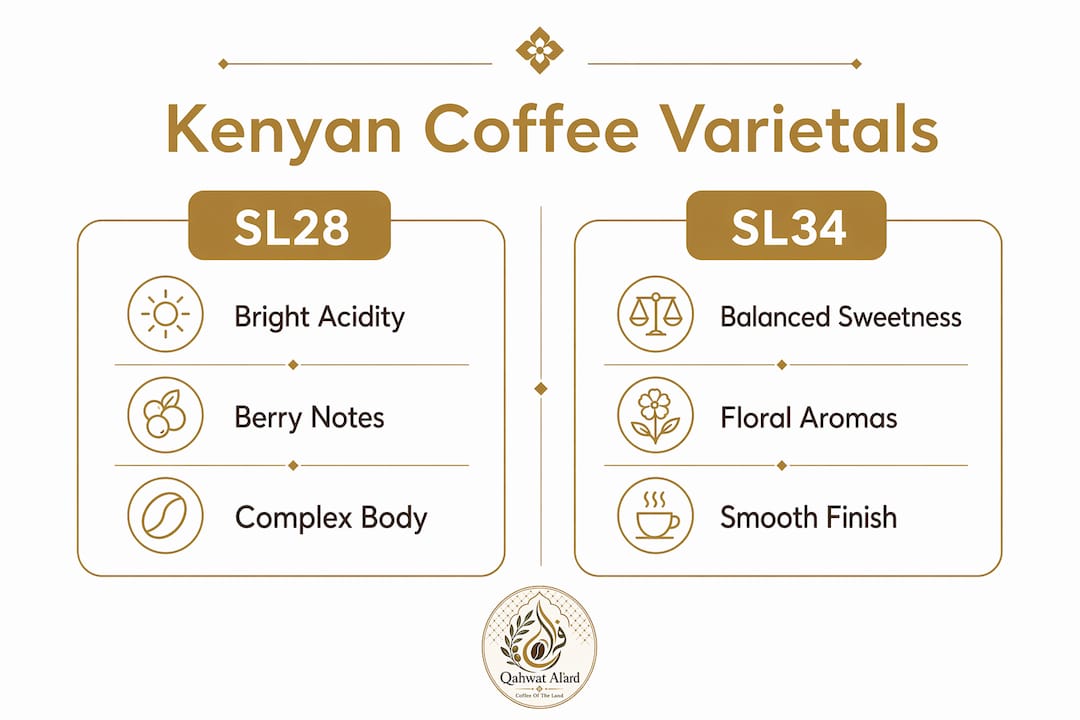
Two varietals dominate Kenyan production and define its flavor identity. SL28 and SL34 were selected by Scott Laboratories in the 1930s for yield and drought resistance, but their flavor contribution turned out to be their most significant legacy. SL28 thrives above 1,600 meters and produces intense blackcurrant character with a sharp phosphoric acidity. SL34 is slightly more productive, with a brighter but less concentrated blackcurrant note and a more pronounced floral quality. Many Kenyan lots blend both varietals alongside newer disease-resistant types like Ruiru 11 and Batian, which adds variability that makes lot-by-lot evaluation necessary.
The double-wash processing method
Kenya’s processing method is the clearest technical explanation for its cup clarity. After pulping, beans ferment submerged in water for 12 to 24 hours, then are washed and soaked again in clean water for another 12 to 24 hours. This double-wash removes mucilage more thoroughly than a standard washed process, producing a cleaner, brighter cup. Some micro-lots go further with a double fermentation protocol lasting 12 hours followed by a second fermentation of 12 to 36 hours, which intensifies blackcurrant character and cup clarity even further. Understanding this process is foundational to understanding the flavor. For a broader look at how processing shapes taste, the coffee processing methods guide from Qahwatalard covers the full spectrum.
Pro Tip: When sourcing Kenyan green coffee, ask your importer whether the lot used standard double-wash or extended double-fermentation. The flavor difference between the two is significant enough to affect your roast development targets.
- High altitude slows cherry maturation, building sugar and acid complexity.
- Volcanic soils supply phosphorus and potassium that support fruit flavor development.
- SL28 delivers intense blackcurrant and phosphoric acidity; SL34 adds florals.
- Double-wash processing removes mucilage in two stages, producing exceptional cup clarity.
- Extended double-fermentation lots push blackcurrant intensity and clarity even further.
How do flavor notes vary by Kenyan region and cultivar?
Kenya is not a monolithic origin. Regional flavor distinctions are real and consistent enough that experienced cuppers can often identify the growing area from the cup alone. Microclimates, soil composition, and the specific cultivar mix at each washing station all contribute to these differences.
Nyeri, located on the southern slopes of Mount Kenya, produces the most intensely fruit-forward cups in the country. The combination of rich red volcanic soil and reliable rainfall creates a profile that leans heavily toward ripe blackcurrant and dark berry. Kirinyaga, directly to the east of Nyeri, produces cups with juicy, bright acidity and more pronounced floral notes, often described as jasmine or hibiscus alongside citrus. Embu and Murang’a, further east and at slightly lower elevations, tend toward a softer berry and citrus expression with less aggressive acidity, making them more approachable for drinkers who find Nyeri lots intense.
The varietal split within each region amplifies these differences. SL28-dominant lots from Nyeri read as almost savory-sweet, with a tomato-like complexity underneath the blackcurrant. SL34-dominant lots from Kirinyaga lean floral and bright without the same depth of fruit. Blended lots that include Ruiru 11 or Batian often show a cleaner but less complex profile, since these newer varietals were bred for disease resistance rather than flavor complexity.
| Region | Primary flavor notes | Acidity character |
|---|---|---|
| Nyeri | Blackcurrant, dark berry, sweet tomato | Intense, structured |
| Kirinyaga | Florals, juicy citrus, red berry | Bright, vibrant |
| Embu and Murang’a | Berry, citrus peel, light florals | Softer, approachable |
The terroir factors behind these regional differences are worth studying in depth if you source Kenyan coffee professionally. Microclimate variation within a single county can shift the cup profile more than the varietal difference between SL28 and SL34.
What does Kenya’s grading system tell you about flavor?
Kenya’s AA/AB grading system is one of the most recognized in the coffee world, and one of the most misunderstood. The AA grade indicates bean screen size 17 to 18, meaning the beans are physically large and uniform. AB grade covers screens 15 and 16. Peaberry is a separate category for the small, round beans that form when only one seed develops inside the cherry instead of two.
The critical point for professionals is that bean size does not predict flavor quality. A well-processed AB lot from a high-altitude Nyeri washing station will consistently outperform a poorly processed AA from a lower-elevation farm. The grade tells you about physical uniformity, which matters for roasting consistency, but it says nothing about the cup.
- AA (screen 17-18): Largest beans, most uniform. Useful for even roasting, not a flavor guarantee.
- AB (screen 15-16): Slightly smaller, often more affordable. Cup quality depends entirely on processing and origin.
- Peaberry: Dense, round, single-seed beans. Some roasters prize them for even heat absorption; flavor is lot-dependent.
- C grade and below: Smaller, less uniform. Rarely found in specialty channels.
Roasters must adjust roast curves for AA versus AB grades primarily due to density and bean size differences, not because one grade inherently tastes better. An AB lot may actually require less development time to achieve the same brightness as an AA from the same farm. For professionals building a sourcing program, the practical advice is to cup before you commit, regardless of grade.
How to brew and taste Kenyan coffee for maximum flavor clarity
Brewing method and temperature management are the two variables that most affect how accurately you perceive Kenyan coffee flavor characteristics. Get these right and the blackcurrant, grapefruit, and floral notes come through cleanly. Get them wrong and you taste a flat, acidic cup with no sweetness.
- Choose pour-over or V60 as your primary brewing method. These methods produce the clarity and brightness that define the Kenyan tasting profile. Immersion methods like French press tend to mute the acidity and obscure the fruit notes under heavier body.
- Use a light roast profile. Light roasts preserve the phosphoric acidity and fruit complexity that make Kenyan coffee distinctive. Darker roasts suppress brightness and shift the profile toward generic chocolate and caramel notes, which erases the origin character entirely. The impact of roast development on Kenyan brightness is significant enough to change the cup from exceptional to ordinary.
- Brew at 93 to 96 degrees Celsius. Higher temperatures extract the bright acids more efficiently. Lower temperatures can under-extract and produce a thin, sour cup.
- Taste at multiple temperature stages. Kenyan coffee shifts flavor profile as it cools, moving from bright citrus and grapefruit at higher temperatures to sweeter blackcurrant and subtle chocolate nuances as it approaches room temperature. Evaluating only at drinking temperature means you miss half the profile.
- Dial in your grind size carefully. A medium-fine grind on a V60 is the standard starting point. Too coarse and you lose acidity and sweetness; too fine and you introduce bitterness that masks the fruit. The grind size guide from Qahwatalard is a practical reference for calibrating this.
Pro Tip: At a professional cupping, evaluate Kenyan lots at three stages: just off boil (around 85°C), at 70°C, and at 55°C. The flavor transitions between these stages reveal the full complexity of the lot and are essential for accurate scoring.
The most common brewing mistake with Kenyan coffee is using water that is too cool or a roast that is too dark. Both decisions push the profile toward flat sourness rather than the vivid, structured brightness that defines the origin.
Key takeaways
Kenyan coffee’s signature flavor profile is the direct result of high-altitude cultivation, SL28 and SL34 varietals, and double-wash processing working together, not any single factor in isolation.
| Point | Details |
|---|---|
| Flavor is multi-factorial | Altitude, SL28/SL34 genetics, and double-wash processing all contribute equally to the Kenyan cup profile. |
| Regional variation is significant | Nyeri, Kirinyaga, Embu, and Murang’a each produce distinct flavor expressions worth evaluating separately. |
| AA grade signals size, not quality | Processing and roast profile determine cup quality more reliably than bean screen size. |
| Temperature reveals complexity | Tasting Kenyan coffee at multiple cooling stages exposes the full range from citrus to blackcurrant to chocolate. |
| Light roast is non-negotiable | Darker roasts erase the brightness and fruit complexity that define authentic Kenyan flavor. |
Why Kenyan coffee rewards patience more than any other origin
I have cupped coffees from Ethiopia, Colombia, Yemen, and Panama, and no origin tests your patience as a taster quite like Kenya. The first sip at near-boiling temperature can read as aggressively acidic, almost sharp, and I have watched experienced professionals dismiss a lot in that first moment. That is a mistake I made myself early on, and it cost me some genuinely exceptional cups.
What Kenyan coffee demands is time in the cup. The flavor dynamics as the coffee cools are unlike any other origin. The grapefruit and citrus peel that dominate at 80°C give way to a deep, almost jammy blackcurrant sweetness at 60°C, and by the time the cup reaches 50°C, you sometimes find a savory tomato-like complexity underneath that sweetness that is genuinely surprising. Ethiopian coffees are floral and delicate. Tanzanian coffees offer a softer berry profile. But Kenya is the origin that keeps revealing itself.
The variability between micro-lots also means that generalizations about Kenyan coffee are always provisional. A Nyeri AA from one washing station can taste completely different from a Nyeri AA from a station two kilometers away. This is not a flaw. It is the reason Kenya remains one of the most exciting origins for professionals who pay attention to provenance. My advice: never buy a Kenyan lot based on grade or region alone. Cup it, cool it, and cup it again.
— Anthony-Yasin
Explore authentic Kenyan coffee at Qahwatalard
Qahwatalard sources single-origin Kenyan coffees with full traceability back to the washing station, so you know exactly which region, varietal, and processing method produced the cup in your hand. The single-origin collection includes carefully selected Kenyan lots chosen for the brightness, berry complexity, and cup clarity that define the best of this origin. For those who want to experience Kenyan flavor notes within a broader African profile, the African Espresso showcases the fruit-forward brightness that East African coffees do better than anywhere else. Every lot is fresh-roasted and sourced with the processing transparency that serious coffee professionals expect.
FAQ
What are the primary flavor notes of Kenyan coffee?
Kenyan coffee is characterized by blackcurrant, grapefruit, citrus peel, and florals, with some lots showing a sweet tomato-like savory complexity. The profile is defined by bright, structured acidity and high cup clarity.
How does Kenyan coffee differ from Ethiopian coffee flavor profiles?
Ethiopian coffees tend toward delicate florals and stone fruit, particularly jasmine and peach in washed lots, while Kenyan coffees deliver more intense berry acidity and a sharper, more structured cup. Both origins produce fruit-forward profiles, but Kenya’s double-wash processing creates a clarity and brightness that reads as distinctly different from Ethiopia’s lighter, more tea-like character.
Does Kenyan AA grade mean better flavor?
No. The AA grade reflects bean screen size, not flavor quality. A well-processed AB lot from a high-altitude farm will consistently outperform a poorly processed AA in the cup.
What brewing method best highlights Kenyan coffee’s flavor?
Pour-over methods, particularly the V60, best highlight the brightness and fruit clarity of Kenyan coffee. Immersion methods like French press tend to suppress the acidity and obscure the berry notes that define the origin.
Why does Kenyan coffee taste different as it cools?
Kenyan coffee shifts from bright citrus to sweeter blackcurrant and subtle chocolate notes as it cools, because different aromatic compounds become more perceptible at lower temperatures. Tasting at multiple stages is the most accurate way to evaluate the full profile.


