


Extra-coarse grinds work for cold brew, coarse suits French press, medium fits drip machines, medium-fine covers pour-over and AeroPress, fine is for espresso, and extra-fine is reserved for Turkish coffee. That’s the whole map. Every specialty coffee grind size exists to control one thing: how fast water pulls flavor out of the coffee bed. The finer the grind, the more surface area is exposed, and the faster extraction happens.
If your cup tastes sour, sharp, or thin, your grind is usually too coarse for that brew time. If it tastes bitter, ashy, or harsh, it’s usually too fine. That single rule, adjusted in small steps, solves more brewing problems than any new gadget will. Fresh beans matter too. A stale bag of coffee, no matter how well it’s ground, will never taste as bright as beans from a roaster that lists a roast date, which is one reason Qahwat Al’Ard ties its whole catalog to traceable sourcing.
| Grind Type | Texture Feels Like | Best For |
|---|---|---|
| Extra-coarse | Peppercorns | Cold brew |
| Coarse | Sea salt | French press |
| Medium | Sand | Drip machines |
| Medium-fine | Table salt | Pour-over, AeroPress |
| Fine | Granulated sugar | Espresso, Moka pot |
| Extra-fine | Flour | Turkish coffee |
- Cold brew tolerates the loosest grind because it steeps for an extended period instead of minutes.
- Espresso needs the tightest grind because water passes through in under 30 seconds under pressure.
- Everything between those extremes is a tradeoff between contact time and particle size.
Key Takeaways
Matching grind size to brew method and adjusting by taste, sour means finer, bitter means coarser, solves most home brewing problems without new equipment.
| Point | Details |
|---|---|
| Match grind to brewer | Use extra-coarse for cold brew, coarse for French press, medium-fine for pour-over, fine for espresso. |
| Start coarser than expected | A too-fine grind clogs brewers; it’s easier to step finer gradually than to fix a stalled shot. |
| Taste is your compass | Sour means under-extracted (grind finer); bitter means over-extracted (grind coarser). |
| Burr grinders beat blade | A tighter particle distribution lets you actually dial in a repeatable recipe. |
| Start with fresh, consistent beans | Qahwat Al’Ard’s dated-roast blends like the Breakfast Blend give a stable baseline for calibration. |
Table of Contents
- Why Does Grind Size Change How Coffee Tastes?
- What Are the Grind Sizes for Every Brew Method?
- How Do You Dial In Your Grind by Taste?
- Does Grinder Type Actually Matter That Much?
- How Do You Fix a Bad Cup by Brew Method?
- What I’ve Learned Watching Home Baristas Chase the Perfect Cup
- Ready to Practice? Start With Beans You Can Trust
- Sources
- FAQ
Why Does Grind Size Change How Coffee Tastes?
Grind size determines how much surface area of the bean touches water, and that controls extraction speed. A whole bean has almost no exposed surface. Crush it into flour, and nearly every cell wall is exposed at once, so water strips out flavor almost instantly. That’s why espresso, with barely 25 to 30 seconds of contact time, needs a fine grind, while cold brew, steeping for a full day, needs a coarse one to avoid turning into bitter sludge.
Particle size for pour-over sits in a fairly specific band. For cone drippers, aim for roughly 400 to 600 microns, landing you in a 2:45 to 3:30 brew window. That’s genuinely fine, close to table salt. A flat-bottom Chemex wants a coarser bed, around 600 to 900 microns, stretching the brew to 3:30 to 4:30.
Median grind size only tells half the story. What actually wrecks a cup more often is particle-size distribution, the spread between the smallest fines and the largest chunks in the same batch. A grind full of both dust and boulders can taste sour and bitter in the same sip, because the fines over-extract while the boulders under-extract at the same time. Narrowing that spread often fixes flavor problems faster than nudging the median setting.
- Finer grind = more surface area = faster extraction.
- Coarser grind = less surface area = slower extraction.
- Wide particle spread = simultaneous sour and bitter notes, even at the “right” average size.
Pro Tip: Before blaming your recipe, check your grinder. A cheap or worn burr set can produce a wide particle spread no matter how carefully you dial in the setting, and no amount of recipe tweaking will fix that.
What Are the Grind Sizes for Every Brew Method?
Different coffee grind sizes line up with brew methods because each method gives water a different amount of contact time and pressure. Extra-coarse works for cold brew, coarse for French press, medium for drip and flat-bottom pour-over, medium-fine for cone pour-over and AeroPress, fine for espresso, and extra-fine for Turkish.
A few brewers don’t fit neatly into that chart. The Moka pot sits between drip and espresso, finer than table salt but coarser than true espresso grind, because it uses steam pressure but not nearly as much as a machine. AeroPress is famously flexible: standard recipes call for medium-fine, but immersion-style AeroPress recipes with longer steep times can push toward medium, closer to drip grind. If you want a printable reference for your own kitchen, Qahwat Al’Ard’s grind guide breaks these categories down by brew method in more detail.
How Do You Dial In Your Grind by Taste?
Pick the grind family for your brewer from the chart above, then treat that as a starting point, not a fixed answer. Every burr grinder, every bean, and every water source behaves slightly differently, so the real skill is adjusting from that baseline using taste and brew time as your two signals.
- Measure your dose on a scale. Consistency starts here, not at the grinder.
- Set your grinder to the starting point for your brew method (medium-fine for pour-over, fine for espresso, and so on).
- Time the brew from first water contact to final drip or plunge.
- Taste the result. Sour or weak means under-extracted. Bitter or harsh means over-extracted.
- Adjust one small increment: finer if sour, coarser if bitter.
- Repeat with the same bean and dose until the brew time lands in the target range and the flavor is balanced.
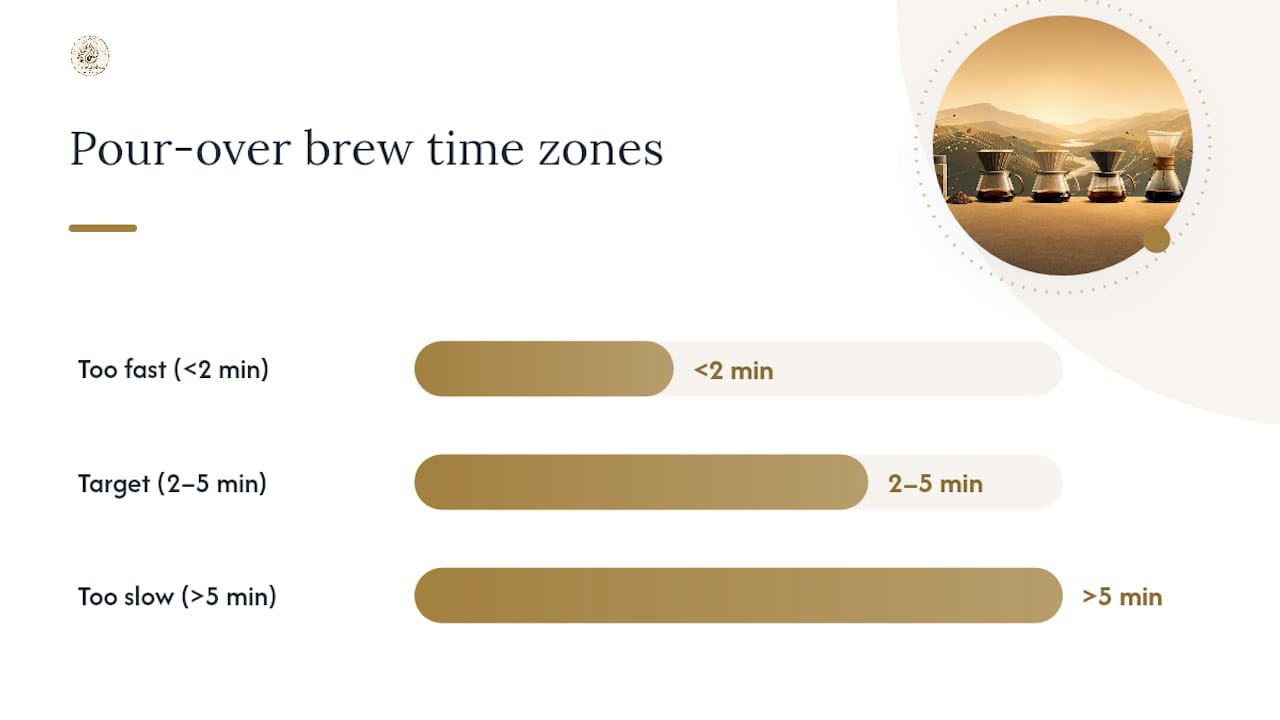
Brew time is your objective check on taste. If your pour-over finishes in under two minutes, it’s probably running too fast regardless of how it tastes, and the fix is a finer grind, not more coffee. If it drags past five minutes, it’s too fine or your bed is too deep. Bed depth and burr alignment change what “optimal” even means for a given grinder, so don’t assume your setting will match a friend’s machine.
Pro Tip: Start coarser than you think you need. A grind that’s too fine can clog a pour-over or choke an espresso machine, turning a simple adjustment into a mess. It’s much easier to step finer in small increments than to un-clog a stalled shot.
To check for uneven particle spread at home, pour a small sample onto a white plate under good light. If you see a visible mix of dust and large chunks side by side, especially with a blade grinder, that spread is likely working against you no matter what the average setting reads.
Does Grinder Type Actually Matter That Much?
Yes. Burr grinders produce a far tighter particle distribution than blade grinders, and that consistency is what actually lets you dial in a recipe instead of guessing. A blade grinder chops coffee unevenly, leaving a chaotic mix of fine dust and large chunks in every batch, which is exactly the sour-and-bitter-at-once problem described earlier.
- Electric flat burr: Fast, consistent, and generally the most precise option for espresso; higher price point and larger footprint.
- Electric conical burr: Slightly less uniform than flat burrs but quieter and often cheaper; a solid all-around choice for drip and pour-over.
- Manual hand grinder: Portable, quiet, and often surprisingly consistent for the price; requires physical effort and more time per cup.
- Blade grinder: Cheap and widely available, but produces wide particle spread and should be considered a last resort for anyone serious about specialty coffee.
Prioritize low retention (how much old grounds get stuck inside), stable burr alignment, and genuine consistency over flashy digital displays. A $60 manual burr grinder that grinds evenly will outperform a $150 blade grinder every time.
Pro Tip: If your grinder has numbered settings, don’t trust the numbers printed on the dial from reviews or forums. Treat those numbers as your own private language. Write down your own clicks or settings for each brew method and bean, because burr wear and calibration vary from unit to unit.
How Do You Fix a Bad Cup by Brew Method?
Espresso: Shot chokes or drips too slowly (over 35 seconds for a standard double) → grind coarser or lower your dose slightly. Shot runs too fast and watery under 20 seconds → grind finer.
French press: Muddy, gritty cup with sediment → grind coarser; you’re getting too many fines through the mesh filter.
Pour-over: Water pools on top and drains slowly, brew exceeds five minutes → grind coarser. Water rushes through in under two minutes and tastes thin → grind finer.
AeroPress: Bitter, harsh finish → grind coarser or shorten steep time. Weak or sour → grind finer or extend steep time slightly.
Cold brew: Weak or watery after 12 to 24 hours → grind slightly finer, but stay well above pour-over range to avoid excessive sediment.
Moka pot: Burnt, bitter taste → grind coarser, closer to standard drip grind. Watery, underwhelming result → grind slightly finer.
Turkish: Gritty sediment overwhelms the cup → confirm you’re using a true extra-fine, flour-like grind, since anything coarser won’t suspend properly in the brew.
- Identify the symptom (too fast, too slow, sour, bitter).
- Make one grind adjustment, one step at a time.
- Re-brew with the same dose and bean.
- If unchanged, check dose and water temperature before blaming the grind again.
Pro Tip: Roast level changes the math. Darker roasts are more brittle and tend to produce more fines at the same setting, so you may need to grind slightly coarser than you would for a light roast to hit the same brew time. Light roasts are denser and often need a touch finer than a medium roast to extract fully.
What I’ve Learned Watching Home Baristas Chase the Perfect Cup
The biggest mistake I see home baristas make isn’t choosing the wrong grind category. It’s chasing a new grinder setting every single day instead of holding everything else steady long enough to learn what their equipment is actually telling them. Grind size is one variable in a system that includes water temperature, dose, bean freshness, and technique, and changing more than one thing at a time makes it impossible to know what actually fixed or broke your cup.
The habit that separates people who dial in quickly from people who stay frustrated for months is boring: use the same bean, the same dose, and the same brew method for a stretch of sessions, and change only the grind. Write down the setting, the brew time, and how it tasted. That log becomes more valuable than any chart, because it’s specific to your grinder and your water, not a generic number from a review site.
Consistency in your process matters more than chasing the “correct” grind size on paper. A burr grinder helps because it removes one source of noise. But even a great grinder can’t save you if you’re changing your dose, your water temperature, and your grind setting all in the same week.
Ready to Practice? Start With Beans You Can Trust
Dialing in grind size only works if the variable you’re not changing, the coffee itself, stays consistent and fresh. That’s the one ingredient a chart can’t fix for you, and it’s where Qahwat Al’Ard fits into this whole process: single-origin and blend coffee with a listed roast date, so your calibration sessions aren’t fighting stale beans on top of grind settings.
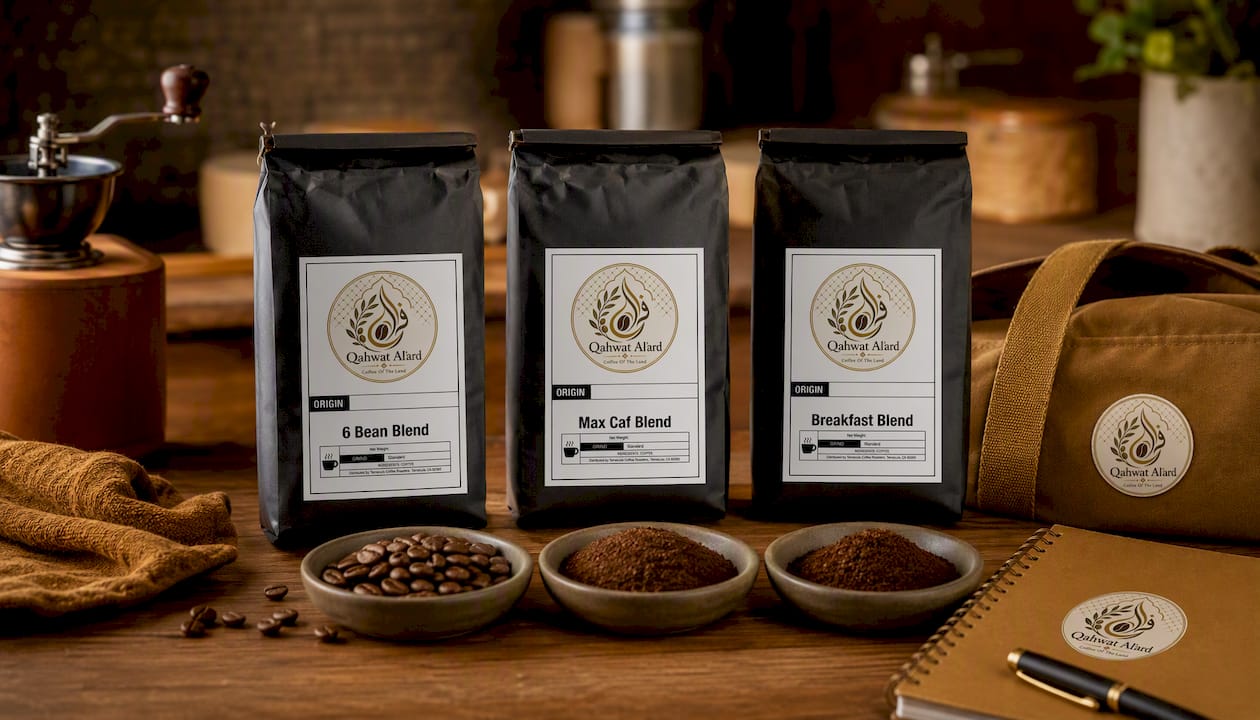
For general practice across drip, pour-over, and French press, the 6 Bean Blend gives you a stable, balanced profile that won’t punish small grind mistakes while you’re still learning. If you’re calibrating espresso or a Moka pot, where extraction sensitivity is highest, the Max Caf Blend has the bold, robust profile that shows grind errors clearly, which actually makes it easier to taste the difference between too fine and too coarse. And if you’re just establishing a baseline for drip or pour-over, the Breakfast Blend is the approachable, forgiving option to start with before you branch out.
Every bag lists its roast date, because grind size means nothing on a bean that’s already gone flat. Pick one blend, run the dial-in checklist above for a week, and see how much a fresh, single-variable calibration session changes your results.
Sources
For a deeper walk-through of grind categories and how they map to brew methods, Qahwat Al’Ard’s grind guide covers the same territory with additional visuals. If your cups keep tasting off no matter what you adjust, common coffee brewing mistakes covers errors beyond grind size, like water temperature and dose ratios.
- How to choose a grind setting — Scott Rao
- Pour Over Grind Size in 5 Easy Steps | HomeCoffeeBeans
- Coffee grind size chart | MasterClass
- Coffee grind sizes explained | The Manual
- It’s not the grind size, it’s the spread | Bean Leaf
FAQ
What grind size is best for pour-over coffee?
Medium-fine, roughly 400 to 600 microns for cone drippers, is the standard starting point for pour-over, targeting a brew time of about 2:45 to 3:30.
Why does my coffee taste sour even at the right grind setting?
A wide particle-size spread, meaning a mix of fine dust and large chunks in the same batch, can cause sour and bitter notes at once regardless of the average setting; this is often a grinder quality issue rather than a setting issue.
Is a burr grinder really necessary for specialty coffee?
Not strictly necessary, but burr grinders produce a much more consistent particle size than blade grinders, which makes dialing in a repeatable recipe far easier and is why nearly every specialty coffee guide recommends one.
How coarse should coffee be for cold brew?
Extra-coarse, similar in texture to peppercorns, works best for cold brew because the long steep time (12 to 24 hours) would over-extract and turn bitter at a finer setting.
Should I adjust grind size based on roast level?
Yes. Darker roasts are more brittle and tend to produce more fines at the same setting, so they often need a slightly coarser grind than a light roast to hit the same brew time and balance.


