


Anaerobic coffee processing is fermentation carried out in a sealed, oxygen-deprived environment, where CO2 buildup or active flushing displaces oxygen and fundamentally changes the bean’s chemistry before it ever reaches a roaster. The result: cups that lean winey, tropical, or intensely fruity in ways that open-air fermentation rarely produces. Producers use it to push flavor into territory that washed or natural processing alone can’t reach, and to do so with more control than a traditional open fermentation tank allows.
A few things to understand from the start:
- “Anaerobic” describes the fermentation environment, not a standalone processing category. It is an added step layered onto washed, natural, or honey processing.
- The anaerobic step does not replace the overarching classification; a coffee labeled “anaerobic washed” still goes through a full washed finish after the sealed fermentation phase.
- Flavor outcomes range from bright tropical esters to heavier, savory, or wine-like notes depending on fermentation time, temperature, and whether the fruit is intact or pulped.
Key Takeaways
Anaerobic coffee processing produces its most distinctive flavors through sealed fermentation that shifts microbial metabolism toward ester-rich, fruit-forward compounds, with fermentation time (24–72+ hours) as the primary lever producers use to shape the final cup.
| Point | Details |
|---|---|
| Core definition | Coffee fermented in a sealed, oxygen-deprived vessel; CO2 displaces oxygen and shifts microbial activity. |
| Flavor hallmarks | Winey, tropical, estery, or stone-fruit notes; intensity increases with fermentation duration (24–72+ hours). |
| Key buying signals | Look for exact method, fermentation time, whole-fruit vs. pulped, and temperature control on the label or product page. |
| Producer trade-offs | Higher equipment cost and monitoring demands; mismanaged batches risk off-flavors; lots typically sold as pricier microlots. |
| Qahwat Al’Ard | The single-origin collection offers traceable coffees with processing details, including Peru Coffee Pods as an accessible starting point. |
Table of Contents
- What is anaerobic coffee processing, exactly?
- Common anaerobic processing methods and the labels you’ll see on bags
- What producers actually do from harvest to drying
- How anaerobic processing shapes flavor
- Which microbes and metabolites drive the flavor changes?
- Producer benefits and trade-offs: what you gain and what it costs
- Quality control and food-safety practices producers should follow
- How to read labels and what to ask when buying anaerobic coffees
- What peer-reviewed research shows about SIAF timing and flavor
- A curator’s perspective on sourcing and tasting anaerobic lots
- Taste anaerobic coffees from Qahwat Al’Ard’s single-origin selection
- Sources
- FAQ
What is anaerobic coffee processing, exactly?
At its core, anaerobic fermentation in coffee works the same way carbonic maceration does in winemaking: coffee cherries or depulped beans are placed in a sealed container, and the CO2 produced by microbial activity gradually displaces whatever oxygen remains. Once oxygen drops below a critical threshold, the microbial community shifts. Microbes that thrive without oxygen take over, producing a different set of metabolites than they would in open-air conditions.
Two broad approaches exist. In self-induced anaerobic fermentation (SIAF), producers simply seal the vessel and let the coffee’s own microbial activity generate CO2 naturally. In actively flushed systems, producers inject CO2 directly at the start to accelerate oxygen displacement. SIAF is more accessible and lower-cost; CO2-flushed systems give faster, more predictable control over the transition to anaerobic conditions.
Inside a sealed tank, the oxygen depletion favors facultative anaerobes, microbes that can switch metabolic pathways depending on available oxygen. As conditions become more reducing, these organisms produce higher concentrations of esters, organic acids, and alcohols that diffuse into the bean. The longer the fermentation runs, the more those compounds accumulate.
Pro Tip: Temperature inside the tank matters as much as time. Cooler fermentations (around 8–10°C) tend to preserve acidity and clarity, while warmer tanks push bolder, brown-sugar or spice-forward notes. If a roaster can’t tell you what temperature the fermentation ran at, that’s a gap in traceability worth noting.
Common anaerobic processing methods and the labels you’ll see on bags
The term “anaerobic” covers a wide range of actual techniques, and no industry-wide standard governs how it’s labeled. Two bags both marked “anaerobic” may have been processed in sealed plastic sacks, stainless steel tanks with airlocks, or CO2-flushed vessels at controlled temperatures. Here’s what the most common labels actually mean:
- Anaerobic natural: Whole cherries ferment in a sealed vessel, then dry on raised beds with the fruit intact. Expect the most intense fruit expression, often tropical or winey.
- Anaerobic washed: Cherries are depulped before sealing. The sealed fermentation phase replaces or supplements the traditional water-tank soak, then the coffee is washed clean. Flavor tends to be brighter and cleaner than anaerobic natural.
- Anaerobic honey: Cherries are depulped but some mucilage is left on the bean before sealing. Sits between the two above in body and fruit intensity.
- Carbonic maceration: Borrowed directly from winemaking. Whole cherries ferment in CO2-saturated tanks. Produces notably clean, juicy, and often floral cups.
- SIAF (self-induced anaerobic fermentation): The vessel is sealed and the coffee’s own fermentation generates CO2 without external injection. Lower equipment cost, but requires careful monitoring.
For a broader look at how these coffee processing methods compare to washed, natural, and honey, the distinctions become clearer when you see them side by side.
When you see “sealed-tank” or “CO2-flushed” on a bag, those are descriptions of equipment and method. “SIAF” signals the self-induced approach. Neither tells you fermentation time or temperature, which are the variables that most directly shape what ends up in your cup.
What producers actually do from harvest to drying
The sequence varies by method, but a typical anaerobic lot follows this path:
Ripe cherries are harvested and sorted for defects. For anaerobic natural, they go into the sealed vessel whole. For anaerobic washed or honey, they’re depulped first, removing the outer skin before sealing. The vessel, whether a polyethylene bag, a food-grade barrel, or a stainless steel tank fitted with a one-way airlock valve, is then sealed.
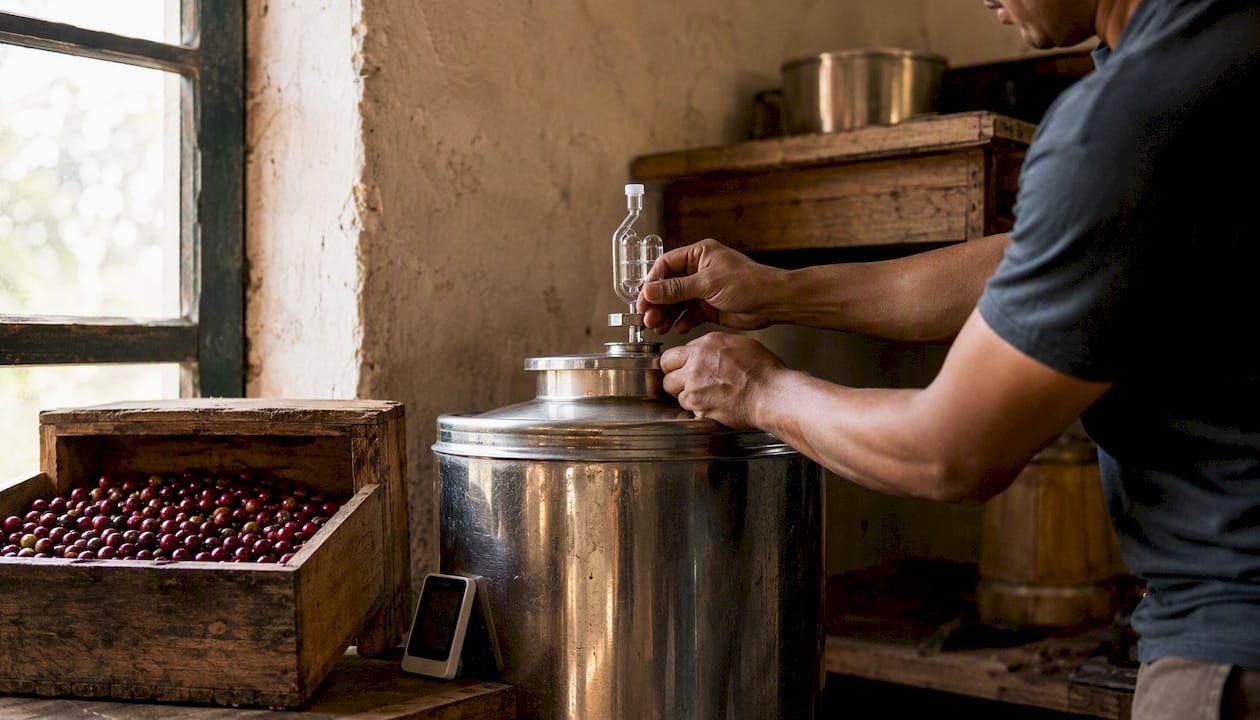
Fermentation runs for anywhere from 24 to 72+ hours. Shorter runs (24 hours) produce lighter ester-driven notes; extended runs (48–72 hours) push toward heavier fermentation byproducts and more complex, sometimes savory profiles. Producers monitor temperature, pH, and off-odors throughout. A pH drop below roughly 3.5 or the presence of sharp, unpleasant odors signals over-fermentation.
After fermentation, washed-finish lots go through a rinse to remove mucilage. Natural-finish lots move directly to raised drying beds. Some producers use mechanical dryers for consistency; others rely on sun drying with regular turning.
Essential equipment includes sealed tanks or bags, one-way airlock valves (to let CO2 escape without letting oxygen in), a thermometer, a pH meter, and ideally a refractometer for tracking sugar depletion. More advanced setups use stirred-tank reactors and starter cultures to raise repeatability, an approach that research has linked to measurable consistency gains.
After drying, the parchment-covered beans rest before milling. Understanding coffee degassing after roasting is the next relevant step for anyone tracking how post-processing handling affects the final cup.
How anaerobic processing shapes flavor
The sensory range of anaerobic coffees is wider than almost any other processing category. Common tasting notes include:
- Tropical fruit: mango, pineapple, passion fruit (especially from anaerobic naturals with extended fermentation)
- Stone fruit: peach, apricot, plum (more common in shorter anaerobic runs or pulped approaches)
- Winey / fermented brightness: red grape, port, kombucha-like acidity
- Estery / candy-like: bubblegum, strawberry, lychee (driven by ethyl acetate and amyl acetate accumulation)
- Savory or funky: umami, soy, or earthy notes when fermentation runs long and warm
Time and temperature are the two biggest levers. Short anaerobic fermentations (around 24 hours) tend to produce cleaner, brighter cups with fruit-forward ester notes. Extended runs (48–72 hours) shift the profile toward heavier fermentation byproducts and more complex, sometimes polarizing flavors. Whole-cherry fermentations amplify fruit intensity compared to pulped approaches, because the intact skin and pulp contribute additional sugars and microbial inoculants throughout the process.
Origin interacts with processing too. A Yirgacheffe variety’s natural floral character can be amplified by a short anaerobic step, while a dense Peruvian bean might need a longer run to express similar complexity. How origin shapes flavor complexity is worth understanding before attributing everything you taste to the processing method alone.
Which microbes and metabolites drive the flavor changes?
The microbial picture inside a SIAF tank looks different from an open fermentation vessel. Studies on SIAF have identified higher relative counts of Enterobacteriaceae and filamentous fungi compared to open tanks, alongside variable populations of lactic acid bacteria (LAB) and yeasts depending on fermentation duration and tank layer. The bottom of a sealed tank tends to show different microbial activity than the top, which is one reason agitation matters for consistency.
The metabolites these microbes produce are what end up in your cup. Key compounds include:
- Ethyl acetate and amyl acetate: fruity, estery notes; increase with extended fermentation time
- Lactic acid: clean, bright acidity; produced by LAB activity
- Acetic acid: vinegar-like sharpness; can be desirable in small amounts, off-putting in excess
- Pyrazines: earthy, nutty, roasted notes that develop during roasting from fermentation precursors
- 3-octanol: mushroom-like, earthy; identified in extended SIAF runs
These compounds diffuse into the bean during fermentation and survive into the roasted cup. The research on SIAF metabolites also identified acetic acid, pyrazine, and methyl 2-propanone accumulating in roasted beans after extended anaerobic fermentation, linking those changes directly to sensory diversification.
Why does oxygen deprivation change the metabolic output so dramatically? In open fermentation, aerobic pathways dominate early, producing CO2 and water. Once oxygen is gone, microbes switch to fermentative pathways that generate ethanol, organic acids, and esters instead. Those compounds are the flavor precursors that make anaerobic lots taste so different from their conventionally processed counterparts. For a deeper look at how fermentation shapes coffee flavor at the chemical level, the science behind metabolite diffusion is worth exploring.
Producer benefits and trade-offs: what you gain and what it costs
Anaerobic processing gives producers a genuine tool for differentiation. The benefits are real:
- Precision control: sealed environments let producers manage temperature, pH, and fermentation time more tightly than open tanks.
- Repeatability: with proper monitoring, the same profile can be reproduced across harvests, which matters for building a recognizable microlot identity.
- Premium pricing: anaerobic lots consistently command higher prices at auction and through direct trade, reflecting both the labor involved and the market’s appetite for distinctive cups.
- Expanded flavor range: producers can create profiles that simply aren’t achievable through washed or natural processing alone.
The trade-offs are equally real. Anaerobic processing requires higher capital investment in equipment (tanks, valves, monitoring tools) and more intensive labor for monitoring. The learning curve is steep: a mismanaged batch can produce off-flavors that render an entire lot unsellable. Tank space is limited, which is why anaerobic lots are almost always sold as microlots rather than large commercial volumes.
Smaller farms face a harder calculation. The equipment cost and technical expertise required can be prohibitive without access to credit or cooperative infrastructure. This is why anaerobic processing has spread faster among well-capitalized farms and processing stations than among smallholder farmers working with traditional equipment.
Quality control and food-safety practices producers should follow
Anaerobic fermentation creates conditions where things can go wrong faster than in open-air processing. The sealed environment amplifies both desirable and undesirable microbial activity, so monitoring is non-negotiable.
Key controls producers use:
- Sanitation: tanks and bags must be thoroughly cleaned and sanitized between batches. Residual organic matter from previous fermentations can introduce unwanted microbial populations.
- Temperature monitoring: fermentation temperature should be checked at regular intervals. Runaway heat accelerates microbial activity and can push the batch toward over-fermentation within hours.
- pH tracking: a steady pH drop is expected and healthy. A drop below roughly 3.5, or a sudden stall, signals a problem.
- Sensory checks: producers open the vessel periodically to check for off-odors. Sharp ammonia or putrid smells indicate spoilage, not fermentation.
- Controlled drying: after fermentation, drying to a safe moisture level (around 11%) prevents mold growth during storage and transport.
Extended fruit fermentation also reduces embryo viability in the seed, which matters for producers who save seeds for replanting. This is a less-discussed but real consequence of very long anaerobic runs.
Pro Tip: Sample the fermentation liquid at 24-hour intervals and track pH alongside sensory notes. A simple log of temperature, pH, and smell at each interval gives you the data to replicate a successful batch or diagnose what went wrong in a failed one.
How to read labels and what to ask when buying anaerobic coffees
Most specialty roasters who sell anaerobic lots include some process detail on the bag or product page, but the depth varies considerably. Here’s what to look for:
- Exact method name: “anaerobic natural,” “anaerobic washed,” “carbonic maceration,” or “SIAF” tells you more than just “anaerobic.”
- Fermentation time: 24 hours versus 72 hours produces meaningfully different cups. If it’s not listed, ask.
- Whole-fruit vs. pulped: whole-cherry fermentation amplifies fruit intensity; pulped approaches tend toward cleaner, brighter profiles.
- CO2-flushed vs. SIAF vs. sealed-bag: these signal different equipment and control levels.
- Drying protocol: raised beds, mechanical drying, or a combination affects the final moisture and any post-fermentation flavor development.
Questions worth asking your roaster: Did they use starter cultures? What temperature did fermentation run at? How did they verify the batch was on track? A roaster who can answer those questions has a real relationship with the producer.
For brewing, anaerobic coffees reward methods that highlight clarity and aromatics. Pour-over at 93–94°C with a 1:15 ratio lets the ester-driven fruit notes open up without muddying them. If the profile is very intense (heavy tropical or winey), a slightly coarser grind and shorter contact time can tame it. Specialty brewing methods matched to the roast level make a real difference with these lots.
What peer-reviewed research shows about SIAF timing and flavor
The most directly relevant research on anaerobic coffee fermentation comes from controlled SIAF studies that sampled fermentation at 24, 48, and 72 hours and tracked both microbial communities and metabolite production across those intervals.
The findings are consistent: extended SIAF runs (48–72 hours) produced higher levels of metabolites including 3-octanol, ethyl acetate, and amyl acetate compared to 24-hour runs, and sensory panels found greater profile diversification in the longer fermentations. Microbial community composition also shifted with time, with different dominant groups observed at each interval. Tank layer mattered too: bottom, middle, and top samples showed different metabolite concentrations, which is why agitation is recommended for homogeneity.
| Fermentation Duration | Key Metabolites Elevated | Sensory Tendency |
|---|---|---|
| 24 hours | Lower ester accumulation | Cleaner, brighter, lighter fruit |
| 48 hours | Ethyl acetate, amyl acetate rising | More pronounced tropical/fruity notes |
| 72+ hours | 3-octanol, acetic acid, pyrazines | Complex, winey, sometimes savory or earthy |
For producers, time functions as a direct flavor lever. For consumers, a bag labeled with a 72-hour anaerobic fermentation will almost always taste more intense and complex than one labeled 24 hours, all else being equal. The practical implication: if you’re new to anaerobic coffees, start with a shorter fermentation lot before moving to extended runs.
A curator’s perspective on sourcing and tasting anaerobic lots
When cupping anaerobic lots for selection, the first thing to look past is novelty. The category has attracted a lot of attention precisely because the flavors are so distinctive, but intensity alone doesn’t equal quality. A well-executed 48-hour anaerobic washed from a high-altitude farm should show fruit clarity and structural acidity underneath the ester notes. If the fermentation character overwhelms everything else and the cup tastes flat once the initial aroma fades, that’s a sign of process over substance.
Before listing an anaerobic microlot, the traceability details that matter most are fermentation time, temperature log, and drying protocol. A producer who can supply those three data points has the process under control. One who can only say “sealed tank, about three days” is working more by feel than by design, and that shows up in cup consistency across the harvest.
The most memorable anaerobic lots tend to come from producers who treat the fermentation as one variable in a larger system, not as the whole story. Variety, altitude, and harvest timing still set the ceiling. The anaerobic step shapes what you do with that ceiling.
Taste anaerobic coffees from Qahwat Al’Ard’s single-origin selection
Qahwat Al’Ard sources traceable, single-origin coffees from renowned growing regions, and the single-origin collection is the most direct place to find lots where processing details and origin story are front and center. For readers who want an accessible entry point into single-origin flavor, the Peru Coffee Pods offer a clean, traceable cup in a convenient format, and the 12 Pack Single Serve Coffee Capsules make it easy to sample across origins without committing to a full bag.
For brewing anaerobic lots at their best, try a pour-over at 93°C with a 1:15 coffee-to-water ratio. That temperature and ratio let the ester-driven fruit notes come through without amplifying any harsh fermentation edges. Browse the full collection and check each product page for processing details and tasting notes to find the profile that fits what you’re looking for.
Sources
- Understanding the Effects of Self‑Induced Anaerobic Fermentation on Coffee Beans Quality: Microbiological, Metabolic, and Sensory Studies - PMC
- What Does Anaerobic Fermentation Mean For Coffee? | Sprudge Coffee
- Anaerobic fermentation | Cafe Imports
- Understanding the process: Anaerobic processing | Barista Magazine
- A Quick Guide to Anaerobic Coffee - Imbibe Magazine
FAQ
Is anaerobic coffee better than washed or natural?
Not inherently. Anaerobic processing offers greater flavor control and can produce distinctive profiles, but quality depends on producer execution, variety, and whether the fermentation was well-managed. A poorly run anaerobic batch will taste worse than a clean, well-processed washed lot.
What are the main disadvantages of anaerobic fermentation?
Higher equipment and monitoring costs, a steep learning curve, and the risk of off-flavors if temperature or fermentation time goes unchecked. Mismanaged batches can be unsellable, which raises the financial stakes compared to conventional processing.
How do you brew anaerobic coffee to highlight its flavors?
Pour-over at 93–94°C with a 1:15 coffee-to-water ratio works well. That approach preserves the ester-driven fruit notes without amplifying harsh fermentation edges. A slightly coarser grind helps if the profile is very intense.
Is anaerobic coffee the same as washed coffee?
No. Anaerobic processing is an added fermentation step that can precede a washed, natural, or honey finish. A coffee labeled “anaerobic washed” had a sealed low-oxygen fermentation phase before being washed clean, so it carries both process characteristics.


