


Coffee scoring systems are standardized protocols that translate sensory and physical measurements into a practical signal of cup quality and green-bean value. Understanding coffee scoring systems means knowing two distinct axes: the SCA 100-point cupping scale and the physical green-bean grading conventions that run alongside it.
Here is what the SCA thresholds look like at a glance:
- 90–100: Outstanding — rare, auction-level lots
- 85–89.99: Excellent — high-end specialty, single-origin showcase
- 80–84.99: Specialty — the minimum threshold for specialty classification
- 70–79.99: Premium/commodity — above commodity floor but below specialty
- Below 70: Below standard or off-grade
Green-bean grading (screen size, defect counts, density) is a separate axis. A coffee can carry a Kenya AA label and still score anywhere from 78 to 92 on the cup, because size and cup quality do not move in lockstep. The SCA’s Coffee Value Assessment (CVA) goes further still, replacing the single number with four complementary assessments: physical, descriptive, affective, and extrinsic.
Key Takeaways
The SCA 80-point threshold is the minimum for specialty classification, but a score only tells the full story when it comes with disclosed methodology, a named grader, and descriptive data alongside the number.
| Point | Details |
|---|---|
| Specialty starts at 80 | SCA scores below 80 do not qualify as specialty; 85+ signals premium single-origin quality. |
| Combine score with green grading | Defect counts and screen sizes reveal processing quality that a cup score alone cannot show. |
| Require descriptive data for high-value lots | A total score without attribute breakdown or flavor notes is insufficient for serious buying decisions. |
| CVA replaces single-number limits | The SCA’s Coffee Value Assessment separates physical, descriptive, affective, and extrinsic data for richer evaluation. |
| Qahwat Al’Ard sources transparently | Every product is selected with traceable scoring and origin documentation — sample packs let you taste the difference. |
Table of Contents
- How does the SCA 100-point scale actually work?
- How is a cupping score built from individual attributes?
- What is the cupping protocol, and what is the 15-15-15 rule?
- What does Q-grader certification actually guarantee?
- How does green-bean grading differ from a cupping score?
- What are the real limits of a single-number coffee score?
- How should you use scores when buying or roasting?
- Quick glossary of key coffee scoring terms
- Why transparent scoring matters for sourcing and customers
- Qahwat Al’Ard: scored, sourced, and ready to taste
- Sources
- FAQ
How does the SCA 100-point scale actually work?
The SCA 100-point scale divides coffees into classification bands that carry real commercial weight. A score is not a grade on a curve — it is a composite of ten sensory attributes, each scored on a 6.00–10.00 scale, minus any defect penalties. The cup score explained by Qahwat Al’Ard breaks down how those numbers translate to what lands in your cup.

| SCA Band | Industry Label | What Buyers Expect |
|---|---|---|
| 90–100 | Outstanding | Exceptional complexity; auction lots, micro-lots |
| 85–89.99 | Excellent | Distinct origin character; premium single-origin |
| 80–84.99 | Specialty | Clean, traceable, above commodity floor |
| 70–79.99 | Premium/commodity | Acceptable quality; blending grade |
| Below 70 | Below standard | Defect-heavy; not suitable for specialty trade |
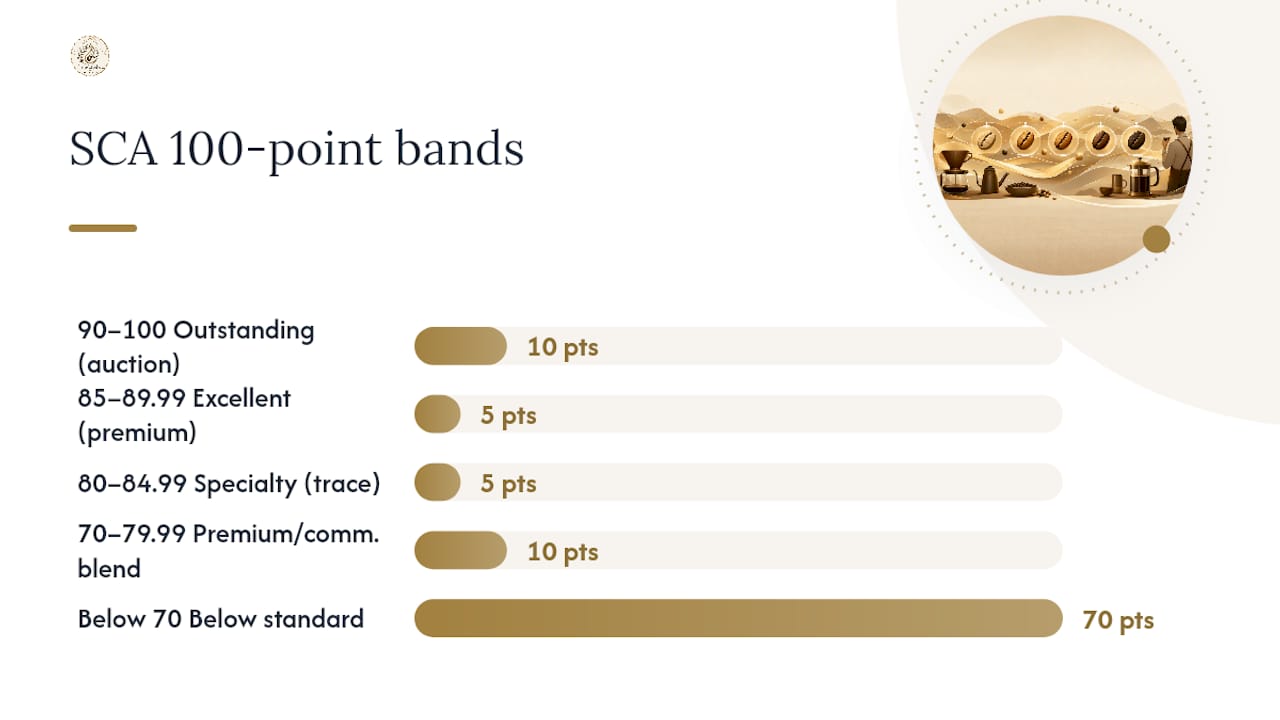
Scores at 80–84 are the workhorse of the specialty market. They are clean, traceable, and priced above commodity, but they rarely carry the dramatic complexity that justifies a premium retail price on their own. The 85–89 band is where single-origin programs live. At 90+, you are in genuinely rare territory — lots that typically move through direct trade or competitive auction.
Pro Tip: A score printed on a retail bag usually reflects a green-bean evaluation under a light sample roast at origin. Your roaster’s actual roast profile will shift the cup profile, sometimes significantly. Treat the printed number as a sourcing signal, not a finished-cup guarantee.
How is a cupping score built from individual attributes?
The SCA/CQI cupping protocol scores ten sensory attributes, each on a 6.00–10.00 scale in 0.25-point increments. Here is what each attribute captures:
- Fragrance/Aroma: Dry fragrance of ground coffee plus wet aroma after brewing
- Flavor: The full mid-palate impression — range, complexity, and accuracy to origin
- Aftertaste: Length and quality of the finish after swallowing
- Acidity: Brightness, vibrancy, and whether the acidity is pleasant or harsh
- Body: Tactile weight and texture on the palate
- Balance: How well the attributes integrate without one dominating
- Sweetness: Scored across five cups; each cup scores 2 points (10 points maximum)
- Uniformity: Consistency across five cups; same 2-points-per-cup structure
- Clean Cup: Absence of off-flavors across five cups; same structure as uniformity
- Overall Impression: The grader’s holistic judgment, separate from the attribute sum
Sweetness, uniformity, and clean cup each use a five-cup structure worth up to 10 points total. That means a single off-flavor in one cup costs 2 points on clean cup alone, before any defect penalty is applied.
Defect penalties work on top of that. Taints (minor off-flavors) subtract 2 points per cup; faults (major off-flavors) subtract 4 points per cup. A single consistent fault across all five cups subtracts 20 points from the total. That is why a coffee that smells beautiful but carries a fermentation fault can drop from a theoretical 87 to a 67 in one scoring session.
A realistic example: eight attributes averaging 7.75 each (62 points) plus 10 points for sweetness, 10 for uniformity, 10 for clean cup, and an 8.00 overall impression gives a raw total of 100. Subtract a taint in two cups (4 points) and the final score lands at 86. That math is why graders on a panel often produce scores within a point or two of each other — the structure is tight enough to anchor judgment, even if it cannot eliminate it entirely. Panels of three or more graders typically average their scores to reduce individual variance.
What is the cupping protocol, and what is the 15-15-15 rule?
A standardized cupping session follows a specific sequence. The home cupping guide from Qahwat Al’Ard walks through the full procedure for enthusiasts who want to practice at home.
- Sample preparation: Weigh 8.25 g of coffee per 150 mL of water. Grind immediately before brewing to a medium-coarse setting.
- Fragrance evaluation: Assess dry fragrance within 15 minutes of grinding, before adding water.
- Water addition: Pour water at 200°F (93°C) directly onto the grounds. Start your timer.
- Crust break: At 3–5 minutes, break the crust with three gentle stirs and evaluate the wet aroma.
- Skim and wait: Remove foam and floating grounds. Let the cups cool to approximately 160°F (71°C) before tasting.
- Tasting sequence: Begin slurping at around 8–10 minutes. Score flavor, aftertaste, acidity, body, and balance during this window.
- Sweetness, uniformity, clean cup: Evaluate across all five cups as they cool further (around 140°F / 60°C).
- Overall impression: Score last, after all attributes are assessed.
- Defect check and cleanup: Note any taints or faults, apply penalties, and calculate the final score.
The “15-15-15” shorthand refers to a ratio-based approach some roasters use: 15 g of coffee per 250 mL of water, with a 15-minute total session window. It is a practical adaptation for quick calibration sessions rather than formal SCA protocol, and it is acceptable for internal roastery work. For any score that will be reported publicly or used in a commercial transaction, the full SCA procedure applies.
Pro Tip: SCA water specifications call for total dissolved solids between 75–250 ppm, with 150 ppm as the target. Using filtered water at that range removes one variable that quietly skews acidity and body scores more than most graders expect.
What does Q-grader certification actually guarantee?
Q-grader certification, administered by the Coffee Quality Institute (CQI) under SCA governance, is the closest thing the industry has to a standardized credential for professional coffee evaluation. Earning it requires passing a battery of blind sensory exams — including triangulation tests, olfactory identification, and grading calibration — not just completing a course.
Key trust signals to look for when evaluating a reported score:
- Q-grader involvement: Scores produced by a certified Q-grader carry more weight than those from uncredentialed tasters, because the grader has demonstrated calibration against a known standard.
- Standardized SCA cupping forms: A score reported with a completed SCA form (showing individual attribute scores, defect notes, and sample information) is verifiable. A single number with no breakdown is not.
- Panel-based scoring: Three or more graders averaging their scores reduces individual bias. Single-grader scores should be treated as indicative.
- Recalibration: Q-graders must recertify periodically. A credential that has lapsed is a weaker signal than a current one.
The weakest signal in retail coffee is a score printed on a bag with no methodology attached. “Scored 92 points” means almost nothing without knowing who scored it, when, at what roast level, and whether a standardized protocol was followed. Treat those numbers as marketing unless the methodology is disclosed.
How does green-bean grading differ from a cupping score?
Physical green-bean grading and cupping scores measure different things, and conflating them is one of the most common misreads in specialty coffee buying. National grading systems combine altitude, variety, screen size, defect counts, and sometimes cup quality — but the weighting varies by country.
Screen sizes are measured in 1/64-inch increments. A screen 18 bean is 18/64" in diameter. Common national labels map to screen-size bands like this:
| Label | Country | Typical Screen Size | Notes |
|---|---|---|---|
| AA | Kenya | Screen 18+ | Top export grade by size |
| AB | Kenya | Screen 15 | Second tier by size |
| Supremo | Colombia | Screen 18+ | Largest Colombian export grade |
| Excelso | Colombia | Screen 14–15 | Standard Colombian export grade |
| Type 2 | Brazil | Multiple screens | Defect-count based, not size-only |
As Perfect Daily Grind notes, AA or Supremo labels indicate screen-size bands and export conventions — they do not map to a specific SCA cupping score. A Kenya AA can score 84 or 94 depending on the farm, processing method, and harvest year.
Defect counting uses a 300 g sample. The FAO green-bean classification methodology applies penalty coefficients to different defect types (black beans, sour beans, stones, husks, insect damage) and sums them into a full-defect count. Grade thresholds then assign the lot to Specialty, Premium, Exchange, Below Standard, or Off Grade categories. A Specialty-grade green lot typically allows zero Category 1 defects (black, sour, fungus-damaged) and a limited number of Category 2 defects in the 300 g sample.
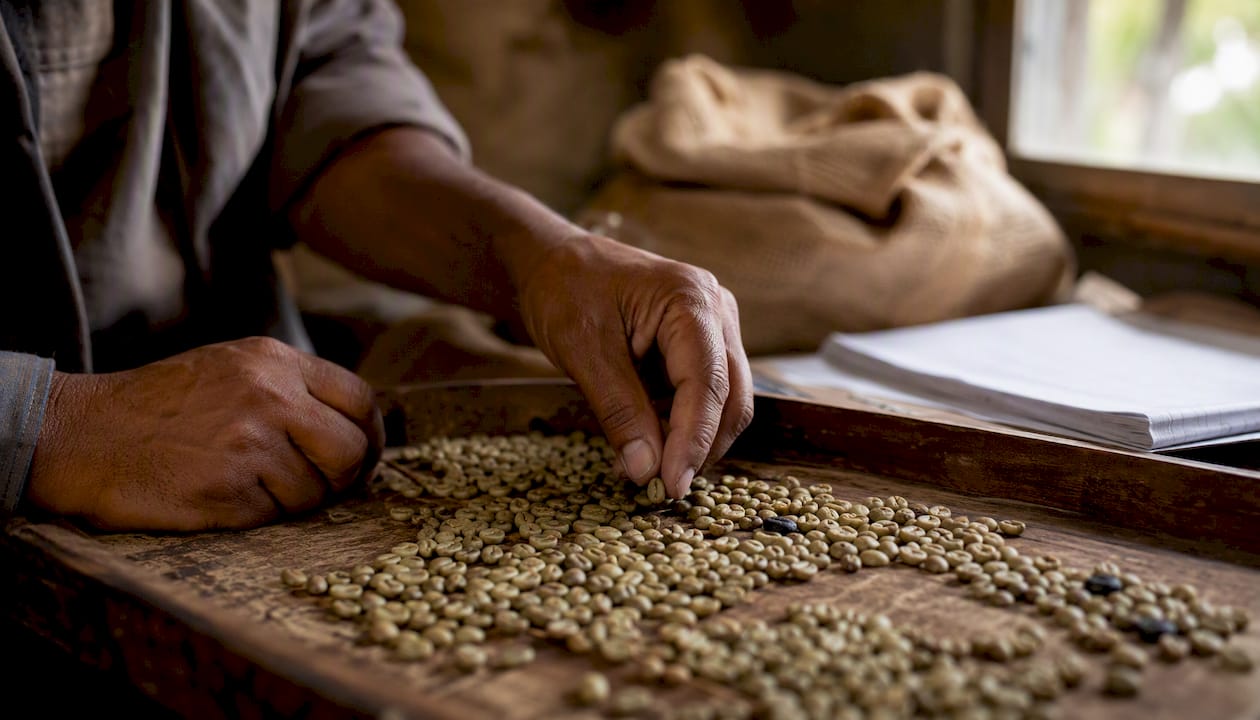
Exporters and buyers use both axes together. A lot with a strong cup score but a high defect count signals inconsistent processing. A clean, defect-free lot with a modest cup score is a reliable blending component. The combination tells a more complete story than either number alone. For a deeper look at how defect classification works in practice, Qahwat Al’Ard’s defect classification guide covers the methodology in detail.
What are the real limits of a single-number coffee score?
The 100-point score is a useful shorthand, but it carries structural problems that the industry has been wrestling with for years.
Known limitations:
- Subjectivity: Even with calibration, graders bring cultural flavor preferences. A grader trained on washed East African coffees may systematically undervalue the fruit-forward naturals from Brazil or Ethiopia.
- Score inflation: As specialty coffee has grown, average reported scores have crept upward. Scores in the 82–84 range that once represented solid specialty now sometimes appear on lots that would have scored lower under stricter calibration.
- Single-number reductiveness: A 86-point score tells you nothing about whether the coffee is floral or chocolatey, bright or mellow, suited to espresso or filter. Two coffees with identical scores can taste nothing alike.
- Pricing distortion: Because buyers use scores as pricing anchors, a one-point difference near the 80 or 85 threshold can mean a significant price jump, even when the sensory difference is marginal.
The SCA’s Coffee Value Assessment addresses these problems directly. CVA separates four distinct assessments: physical (green quality), descriptive (what flavors and attributes are present), affective (how much a specific taster or market segment likes it), and extrinsic (origin, certifications, story). Separating descriptive from affective is the key move — it lets a buyer know what is in the cup without conflating that with whether their customers will like it.
Pro Tip: Use the 100-point score to filter lots quickly — it is a reliable signal for minimum quality thresholds. But before committing to a high-value lot, ask for descriptive and affective data. A coffee your customers find “too bright” is a problem no score can warn you about.
How should you use scores when buying or roasting?
Score literacy turns into purchasing and roasting decisions through a short set of practical questions.
Buyer checklist:
- Who performed the score, and are they Q-grader certified?
- What roast level was used for the cupping (light sample roast is standard; darker roasts suppress acidity and can inflate body scores)?
- Are individual attribute scores available, or just a total?
- Are descriptive notes included? Does the flavor profile match your customer base?
- What is the defect count on the green lot?
For roasters, higher-scored coffees — particularly those in the 87+ range with strong acidity and floral notes — tend to respond well to lighter roast development. Pushing them into a medium-dark profile will suppress the attributes that earned the score. Coffees in the 82–85 range with strong body and balance often perform better in fuller roast curves and blend well without losing their character. Grind size and roast decisions interact directly with how those cup attributes express in the final brew.
A practical score-to-use framework:
- 82–85: Reliable daily drinker, excellent for blends, consistent quality. The 6 Bean Blend is built around this principle — consistent, clean, and approachable.
- 85–88: Single-origin filter or espresso, origin-forward menus, subscription programs.
- 88+: Showcase lots, pour-over bars, competition prep, or the Max Caf Blend profile where roast development and intensity are dialed to the score’s strengths.
When ordering specialty coffee online, look for sellers who publish the scoring methodology alongside the number. A transparent sourcing chain is a stronger quality signal than the score itself.
Quick glossary of key coffee scoring terms
- Cupping: A standardized tasting procedure used to evaluate coffee quality by assessing sensory attributes under controlled conditions.
- Q-grader: A coffee professional certified by the Coffee Quality Institute (CQI) to evaluate coffee using the SCA 100-point protocol after passing blind sensory exams.
- Full defect: A unit of measurement in green-bean grading; different physical defects (black beans, stones, husks) carry different penalty coefficients that convert to full-defect equivalents.
- Taint vs. fault: A taint is a minor off-flavor that does not dominate the cup (2-point penalty per affected cup); a fault is a major off-flavor that does (4-point penalty per affected cup).
- Screen size: Bean diameter measured in 1/64-inch increments; used in physical grading to sort beans by size for roasting uniformity and export classification.
- AA / Supremo: Screen-size labels used in Kenya and Colombia respectively. AA does not imply a specific cupping score — it indicates bean size only.
- CVA (Coffee Value Assessment): The SCA’s multi-dimensional evaluation framework with four assessments (physical, descriptive, affective, extrinsic) designed to replace a single numerical score.
- Descriptive assessment: The CVA component that identifies what flavors, aromas, and attributes are present in the cup, without judging preference.
- Affective assessment: The CVA component that measures how much a taster or target market actually likes the coffee — separate from what is objectively present.
- Extrinsic assessment: The CVA component covering origin, certifications, sustainability claims, and supply-chain story.
Why transparent scoring matters for sourcing and customers
At Qahwat Al’Ard, transparent evaluation is not a marketing claim — it is the mechanism that makes traceability meaningful. A score without methodology is a number. A score with a disclosed protocol, a named grader, and a green-bean defect report is a sourcing decision. That distinction shapes every lot we select and every product description we publish.
Customers who understand coffee scoring systems can read our product pages differently. They know that a stated score reflects a specific evaluation context, that the roast profile we apply will shift the cup, and that the origin story behind a lot is part of its value — not a substitute for quality data. That is why we pair scoring transparency with sample packs: tasting is the final calibration.
Qahwat Al’Ard: scored, sourced, and ready to taste
Every lot Qahwat Al’Ard carries is selected with scoring transparency at the center. You get the origin, the evaluation context, and a roast profile matched to what the score’s attributes actually call for — not a number printed on a bag with nothing behind it.
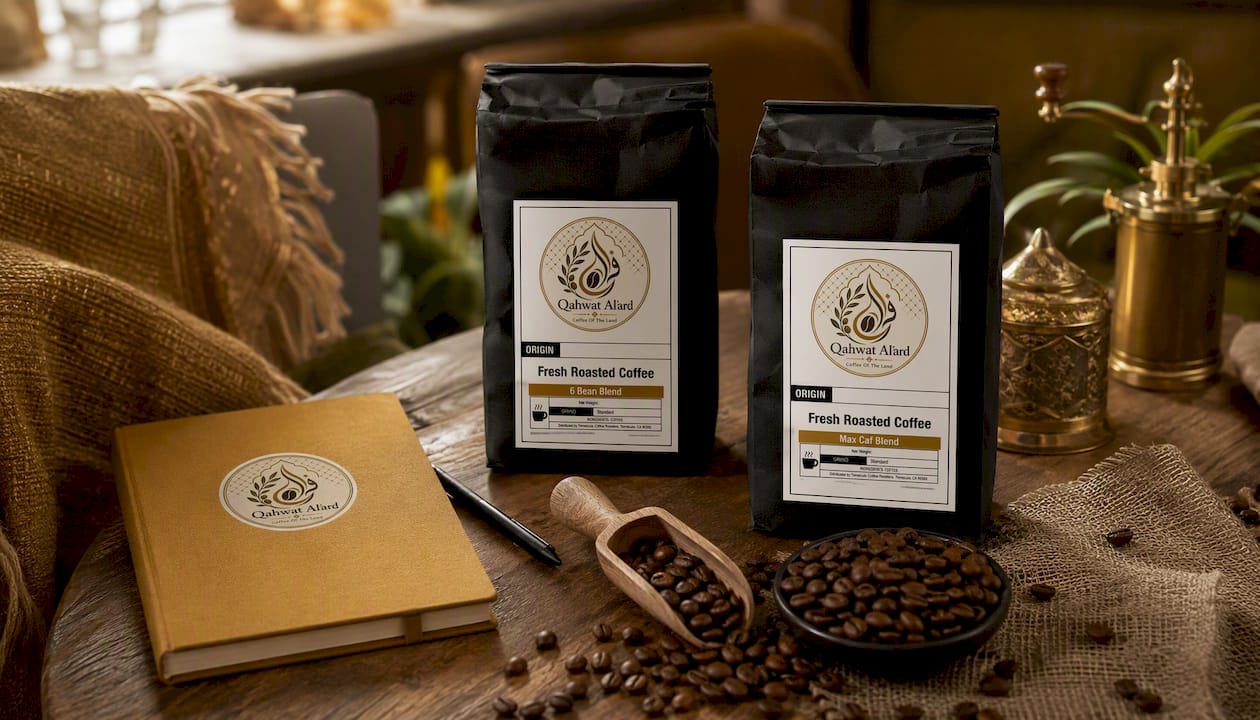
The 6 Bean Blend is the place to start if you want consistent, clean specialty-grade coffee that performs across brew methods. For a higher-intensity profile with a roast development dialed to the lot’s strengths, the Max Caf Blend delivers exactly that. Both are sourced with the same commitment to traceable, documented quality that this guide describes. Browse the full selection at Qahwatalard and order the sample pack that matches where your palate is right now.
Sources
Authoritative resources for each need:
- Coffee Value Assessment — Specialty Coffee Association
- Annex 7: Green Coffee Classification and Grading
- Kenya AA, Colombia Supremo: Understanding Coffee Grading - Perfect Daily Grind
- How the Coffee Scoring System Actually Works (And Why It’s Being Replaced) | JayArr Coffee
- The Coffee Exporter’s Guide — national quality standards summary (ICO/ITC)
FAQ
How does coffee scoring work?
A trained grader evaluates ten sensory attributes (fragrance, flavor, aftertaste, acidity, body, balance, sweetness, uniformity, clean cup, and overall impression) on a 6.00–10.00 scale, then subtracts defect penalties across five cups to reach a final score out of 100.
What is the 15-15-15 coffee rule?
It is a roaster shorthand for a quick cupping ratio: 15 g of coffee per 250 mL of water, evaluated within a 15-minute session window. It is a practical calibration tool, not the formal SCA protocol used for commercially reported scores.
What is a good coffee score?
Any score at 80 or above qualifies as specialty under SCA standards. Scores in the 85–89.99 range indicate excellent, premium-quality coffee; 90 and above is outstanding and genuinely rare in the market.
What is grade 4 coffee?
Grade 4 refers to a physical green-bean classification used in some national systems (notably Ethiopia), based on defect counts in a 300 g sample. It sits below the specialty and premium tiers and is generally considered a lower commercial grade, not suitable for specialty trade.


